+92 318 3068833 Get Free Audit

Google Workspace B2B SaaS Features A Complete Guide 2026

Explore the Google Workspace B2B SaaS features that matter most for growing software companies including security, AI tools and plan tiers.
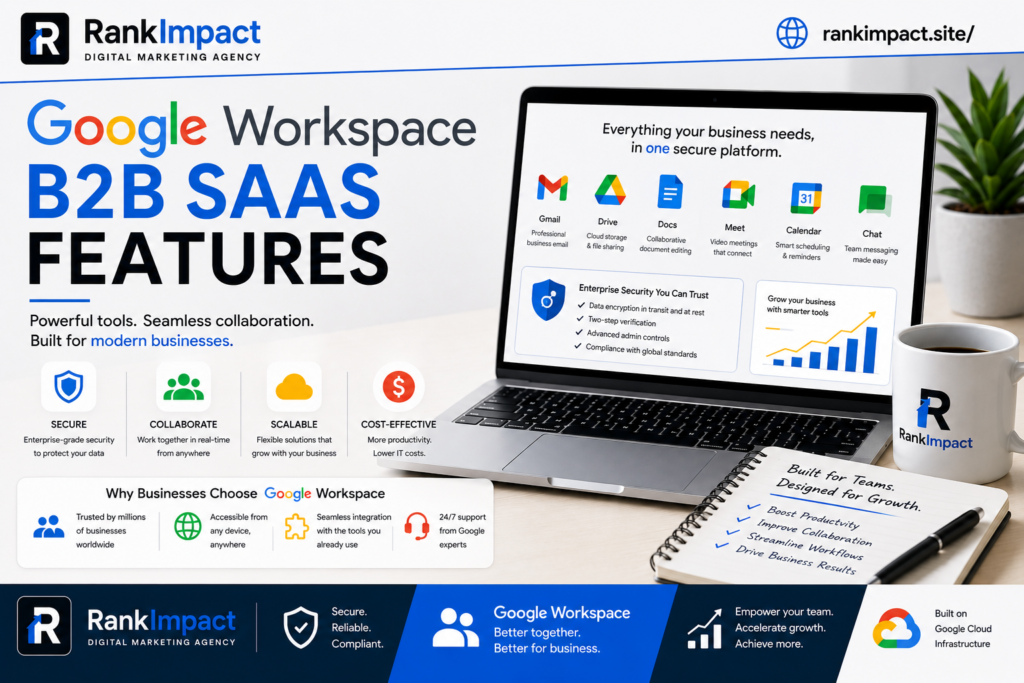
google workspace b2b saas features

Google Workspace B2B SaaS Features A Complete Guide for Growing Teams

B2B SaaS companies run on collaboration, and few decisions shape daily operations as quietly but significantly as which productivity suite a growing team standardizes on. Google Workspace B2B SaaS features have become a central part of that conversation because so many software companies, from early stage startups to companies preparing for enterprise sales, rely on the suite for everything from internal communication to client facing documentation and security compliance. Understanding exactly which features matter for a B2B SaaS context, rather than treating Workspace as a generic office tool, helps founders and operations leaders make a more informed decision and get significantly more value out of the platform once adopted.

This guide is written for founders, operations leaders, and IT decision makers at B2B SaaS companies evaluating or already using Google Workspace. Readers researching this topic typically fall into a few groups. Some are early stage founders comparing Workspace against alternatives before committing to a company wide tool. Others are operations or IT leads at a scaling SaaS company trying to understand which plan tier and features actually matter as headcount grows and enterprise customers start asking security questions. And some are simply trying to understand how Workspace’s collaboration and security capabilities map onto the specific needs of a subscription software business. This article addresses all three by covering the platform’s core capabilities, plan structure, and practical considerations in depth.

Why Google Workspace Matters Specifically for B2B SaaS Companies

Unlike many industries, B2B SaaS companies operate with a particular set of demands around collaboration, security, and scale. Product, engineering, sales, and customer success teams need to share documents and coordinate constantly, often across distributed or fully remote teams. At the same time, B2B SaaS companies frequently sell into enterprise customers who scrutinize vendor security practices closely, which means the internal tools a SaaS company uses can directly affect how credible it appears during a buyer’s own due diligence process.

Google Workspace is positioned as a cloud based productivity and communication suite that combines email, document creation, video meetings, and file storage into a single connected ecosystem, and its collaborative editing and flexible video meeting capabilities have made it a common default for companies operating in hybrid or fully remote structures where teams need real-time collaborative editing of documents and flexible video meetings to stay productive across distance. For a B2B SaaS company specifically, this means engineering documentation, sales proposals, customer onboarding materials, and internal knowledge bases can all live within one connected environment rather than fragmented across disconnected tools. Substack

Core Collaboration Features B2B SaaS Teams Actually Use

Real time collaborative editing across Docs, Sheets, and Slides remains one of the most heavily used capabilities for SaaS teams, allowing product managers, engineers, and customer facing teams to work on the same specification document, roadmap, or client presentation simultaneously without the version control chaos that plagues teams relying on emailed file attachments. Sheets in particular tends to become a lightweight operational tool for SaaS companies well beyond basic spreadsheets, often used for tracking sales pipelines, customer health scores, and lightweight reporting before a company invests in dedicated tools for those functions.

Google Chat and Spaces have grown into a genuine internal collaboration hub for many companies, functioning as lightweight project coordination spaces where project-based Spaces act like lightweight project management boards while AI-suggested tasks automatically create to-do lists from conversations. For a SaaS company juggling multiple concurrent projects across engineering sprints, customer escalations, and marketing campaigns, this kind of lightweight built in coordination reduces the need to immediately purchase a separate project management tool during early growth stages. Evolve Web Hosting

Google Meet handles video communication for internal standups, customer calls, and sales demonstrations, and increasingly includes AI supported capabilities such as live speech translation, which empowers seamless global collaboration in real time and is particularly relevant for B2B SaaS companies selling into international markets with distributed customer bases and support teams. Devoteam

Security and Compliance Features That Matter for B2B Sales

Security capability within Google Workspace becomes especially important for B2B SaaS companies because internal tool security directly intersects with the trust a company must build with its own enterprise customers. Higher tier plans include capabilities such as eDiscovery, data retention and archiving through Vault, secure LDAP, and advanced endpoint management, features specifically designed for companies that need added security and control features as they scale and begin handling more sensitive customer data internally. North Carolina Bar Association

For a SaaS company preparing for its first enterprise deals or pursuing a SOC 2 audit, having demonstrable data retention policies and endpoint management in place across its own internal tools strengthens its position significantly during a prospective customer’s own vendor security review. Enterprise plan tiers extend these controls further, offering the kind of granular administrative oversight that larger prospective customers often specifically ask about during procurement conversations.

Two step verification and built in spam and phishing protection within Gmail further reduce the risk of the kind of credential compromise that remains one of the most common entry points for security incidents at growing companies, an especially important consideration for SaaS companies handling customer data as part of their core product.

AI Features Reshaping How SaaS Teams Work

Artificial intelligence capability has expanded rapidly across Google Workspace and increasingly shapes how SaaS teams draft documentation, prepare customer materials, and manage information across scattered internal sources. A capability that generates a complete first draft from a prompt, synthesizing context directly from a company’s own Drive, Gmail, and Chat history, allows teams to produce polished internal reports or customer facing materials significantly faster than starting from a blank page, since Gemini pulls from your Drive, Gmail, and Chat to generate a fully formatted first draft based on a simple natural language description of what is needed. Data Pilot

A related capability addresses a common pain point in collaborative SaaS environments where multiple contributors write in noticeably different tones within the same document, since a feature that lets a user select a reference document allows Gemini to rewrite new content to match its style and register, which matters considerably for customer facing documentation like proposals or onboarding guides where a consistent voice affects how professional the material appears. Data Pilot

NotebookLM has also become genuinely useful for SaaS teams synthesizing large volumes of internal knowledge, whether product documentation, customer research, or competitive analysis, into more digestible formats. Higher tier AI access adds capabilities such as generating high-value outputs with infographics, audio overviews and mind maps, which SaaS teams increasingly use to turn dense internal research into material that is easier for other teams to actually absorb and act on. Devoteam

Choosing the Right Plan Tier as a B2B SaaS Company

Google Workspace offers several plan tiers, and choosing correctly matters considerably for a B2B SaaS company balancing cost against genuine operational need. The entry level Business Starter plan is the most limited in terms of applications, storage, and video meeting capacity, making it generally suitable only for very early stage teams with minimal storage and collaboration demands rather than a company preparing to scale.

Business Standard extends storage significantly and adds capabilities including NotebookLM, e-signatures, and appointment booking pages, which tend to matter more once a SaaS company has active sales and customer success motions requiring signed agreements and scheduled customer calls. This tier represents a reasonable middle ground for companies past the earliest founding stage but not yet large enough to require the most advanced security and compliance controls. North Carolina Bar Association

Business Plus becomes relevant once a company needs the security and compliance depth described earlier, including eDiscovery, Vault for data retention and archiving, secure LDAP, and advanced endpoint management alongside significantly expanded storage per user. Most B2B SaaS companies approaching their first serious enterprise sales conversations or beginning formal compliance work should evaluate whether Business Plus, or the Enterprise tier for companies with more advanced control requirements, better matches their actual operational and sales stage rather than defaulting to whichever plan was chosen at initial signup. North Carolina Bar Association

Common Mistakes B2B SaaS Companies Make With Workspace

One frequent mistake is selecting a plan tier during initial company setup and never revisiting that decision as the company scales, resulting in either paying for capability the team does not use or, more commonly, operating without security controls that become genuinely necessary once the company starts handling more sensitive customer data or pursuing enterprise deals. Revisiting plan tier alongside company milestones, such as the first enterprise customer or the beginning of a formal compliance audit, prevents this mismatch from persisting unnoticed.

Underutilizing the built in collaboration and lightweight project tools represents another common gap, where teams purchase additional dedicated tools for functions that Chat, Spaces, and Sheets could reasonably handle during earlier growth stages, adding unnecessary tool sprawl and cost before it becomes genuinely necessary. Conducting a periodic audit of which paid tools genuinely earn their cost against what Workspace already provides often reveals opportunities for consolidation.

Many companies also fail to configure administrative and security settings deliberately, instead relying entirely on default configurations that may not reflect the specific risk profile of a company handling customer data as part of its core product. Taking time to review admin console settings, particularly around data sharing defaults and third party app access, closes a gap that many growing SaaS companies overlook until a customer security questionnaire forces the issue.

Finally, companies frequently underinvest in training their own team on newer AI capabilities as they roll out, missing genuine productivity gains simply because staff continue using the platform the same way they did years earlier. A brief internal walkthrough whenever significant new capability becomes available meaningfully increases actual adoption compared to assuming staff will discover new features independently.

Integrating Google Workspace Into a Broader SaaS Tool Stack

Google Workspace rarely operates as a company’s only tool and instead functions as connective tissue between more specialized platforms a B2B SaaS company relies on, including its CRM, support desk, and engineering tools. Evaluating how well a prospective or existing integration connects with Workspace, particularly around calendar, Drive, and Gmail, meaningfully affects daily workflow efficiency for sales and customer success teams especially, since context switching between disconnected tools quietly consumes significant time across a growing team.

Single sign on integration connecting Workspace with other core company tools reduces both password fatigue and security risk simultaneously, and should be treated as a priority configuration step for any SaaS company running multiple connected platforms across its team rather than an optional convenience.

Frequently Asked Questions

What are the most important Google Workspace B2B SaaS features for a growing team?

The most important Google Workspace B2B SaaS features typically include real time document collaboration, Vault for data retention, advanced endpoint management, and AI capabilities like Gemini for drafting and NotebookLM for synthesizing internal knowledge.

Which Google Workspace plan is best for an early stage B2B SaaS startup?

Business Standard generally offers the best balance for early stage SaaS startups, providing expanded storage and features like e-signatures and appointment booking without the higher cost of enterprise level security controls not yet needed at that stage.

Does Google Workspace support the security requirements enterprise SaaS buyers expect?

Higher tier Workspace plans include eDiscovery, Vault data retention, secure LDAP, and advanced endpoint management, which can support the kind of internal security posture enterprise buyers often expect vendors to demonstrate during procurement review.

How does Google Workspace AI help B2B SaaS teams specifically?

Google Workspace AI features help B2B SaaS teams draft documentation faster by generating content directly from prompts using existing Drive and Gmail context, maintain consistent tone across collaborative documents, and synthesize large volumes of internal research into more digestible formats.

Can Google Workspace replace a dedicated project management tool for a SaaS company?

For early stage teams, Chat and Spaces can reasonably handle lightweight project coordination, though most SaaS companies eventually adopt a dedicated project management tool once team size and workflow complexity grow beyond what built in features comfortably support.

How often should a SaaS company review its Google Workspace plan tier?

A SaaS company should revisit its Workspace plan tier at major company milestones, such as landing its first enterprise customer or beginning a formal compliance audit, rather than leaving the original plan selection unreviewed indefinitely.

Is Google Workspace suitable for B2B SaaS companies with international teams?

Yes, features including live speech translation in Google Meet and broadly available cloud based access make Workspace particularly suitable for B2B SaaS companies with distributed international teams and customer bases.

What is the difference between Business Plus and Enterprise Workspace plans?

Business Plus provides substantial security and storage capability suitable for most scaling SaaS companies, while Enterprise plans extend administrative control and security depth further for larger organizations with more advanced compliance and governance requirements.

Conclusion

Google Workspace B2B SaaS features extend well beyond generic office productivity once a company understands which specific capabilities matter at each stage of growth. Collaboration tools support the fast moving coordination SaaS teams depend on daily, security and compliance features directly strengthen a company’s credibility during enterprise sales conversations, and rapidly expanding AI capability increasingly changes how quickly teams can produce polished internal and customer facing material. Companies that deliberately match their plan tier and configuration to their actual operational stage, rather than leaving early decisions unreviewed, consistently get significantly more value from the platform as they scale.
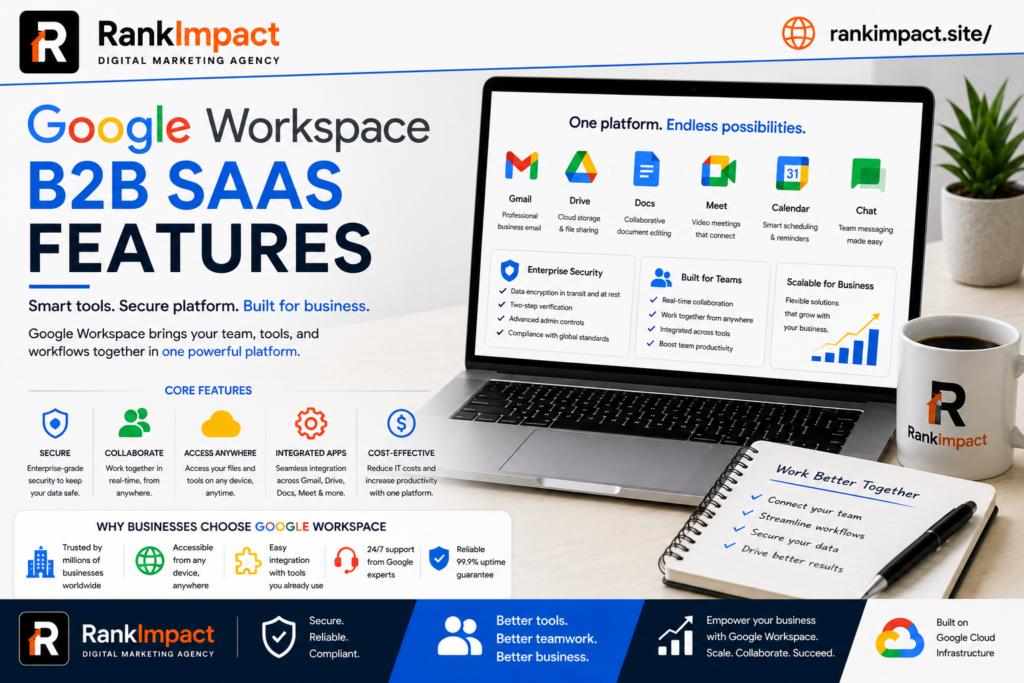
Key Takeaways

Google Workspace B2B SaaS features span collaboration, security, and increasingly sophisticated AI capability that directly supports how growing software companies operate daily. Security features like Vault, secure LDAP, and advanced endpoint management become particularly important once a SaaS company begins pursuing enterprise customers who scrutinize vendor security practices closely. AI capabilities including prompt based document generation and cross tool knowledge synthesis increasingly change how efficiently SaaS teams produce internal and customer facing material. Common mistakes include never revisiting plan tier as the company scales and relying on default security configurations without deliberate review. Treating Workspace as connective tissue across a broader SaaS tool stack, with attention to integrations and single sign on, improves daily efficiency significantly as a team grows.
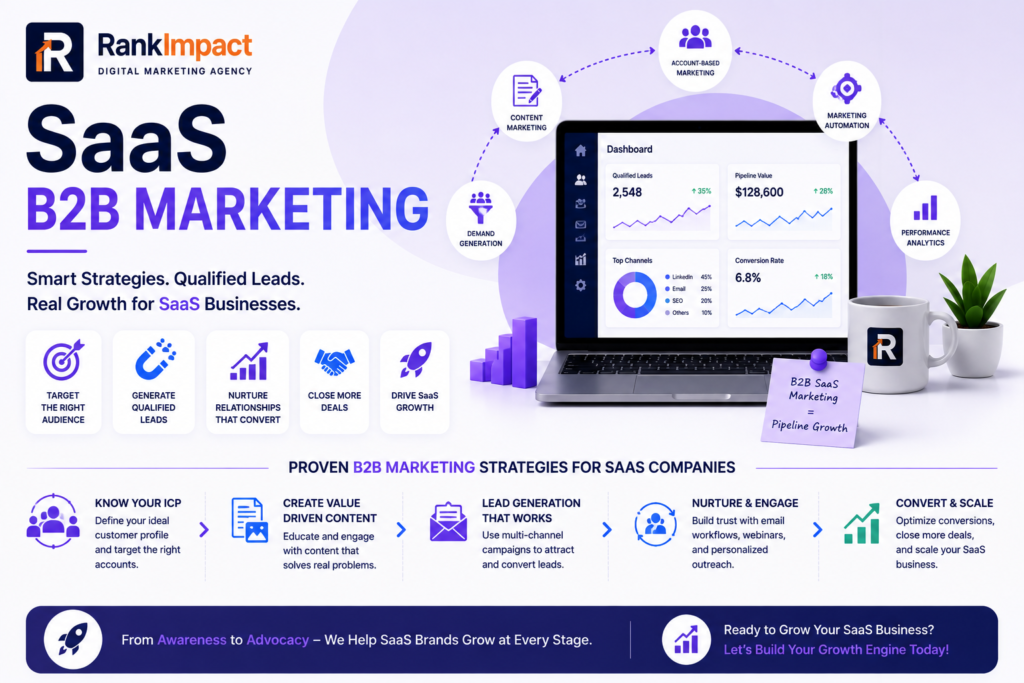
SaaS B2B Marketing The Complete Growth Framework

Learn how SaaS B2B marketing really works channels, funnel strategy, metrics that matter, and mistakes that quietly stall growth. Read the full guide.

SaaS B2B marketing

What Is SaaS B2B Marketing?

SaaS B2B marketing runs on a completely different set of rules than marketing a physical product or a one time service. When a business buys software, the decision is rarely made by one person in one meeting. It typically involves a champion, budget holder, end-user team, and sometimes IT or procurement before a contract gets signed.

How SaaS B2B Marketing Drives LongTerm Growth

The work doesn’t stop after the contract is signed. Customers need to renew, expand their usage, and eventually become advocates for the product, or the recurring revenue model can suffer. Effective SaaS B2B marketing focuses on channels and tactics that generate qualified pipeline rather than vanity metrics, while aligning marketing with the realities of customer acquisition, retention, expansion, and long term growth.

What Makes SaaS B2B Marketing Different From Traditional B2B Marketing

Traditional B2B marketing often optimizes for a single closed won moment get the lead, get the demo, get the signature. Marketing a subscription product has to optimize for that same moment and then keep optimizing for months or years afterward, because monthly or annual recurring revenue depends on customers staying, upgrading, and expanding their usage over time. This shifts the job description considerably. Instead of just generating leads, teams working in this space are increasingly responsible for product adoption content, customer marketing, and expansion campaigns that sit much closer to the customer success function than a traditional demand generation team ever needed to be.

The buying committee is also larger and more distributed than in most traditional B2B categories. A mid market software deal might involve a department head who feels the pain point daily, a VP who controls budget, an IT security reviewer who needs to approve the vendor, and sometimes a procurement team focused purely on contract terms. Content has to speak to all of these audiences with different messaging, not a single generic value proposition repeated across every touchpoint. This complexity is exactly what separates SaaS B2B marketing from simpler transactional selling, and it’s why frameworks borrowed directly from consumer marketing rarely translate cleanly into this world.

Core Channels That Drive Results

Content Marketing and SEO

Organic search remains one of the highest-leverage channels available because buyers actively research solutions before ever speaking to a salesperson. The most effective content strategies map directly to the buyer journey top of funnel educational content that builds awareness, middle-of-funnel comparison and alternatives pages that capture people actively evaluating options, and bottom of funnel pages like pricing, integrations, and use case pages that support the final decision. Companies that treat content as a series of disconnected blog posts rather than a structured system rarely see it compound into meaningful pipeline over time.

Product-Led Growth and Free Trials

Product led growth has fundamentally reshaped how software companies approach acquisition over the last several years by shifting part of the sales process into the product itself. Instead of gating every interaction behind a sales call, PLG companies let prospects experience real value through a free trial or freemium tier before any conversation with a sales rep happens. This approach works exceptionally well for lower complexity products with fast time-to-value, though it tends to work less well for genuinely complex enterprise software where a guided evaluation and multiple stakeholders are simply unavoidable.

Paid channels search ads, LinkedIn ads, and retargeting still play an important role, particularly for capturing high-intent searchers and re engaging visitors who didn’t convert on their first visit. The mistake many teams make is treating paid acquisition as a standalone growth lever rather than an amplifier for content and product-led motions that are already working organically. Paid spend tends to perform best when it’s pointed at proven, high converting pages rather than propping up weak messaging that hasn’t been validated any other way.

Email and Lifecycle Marketing

Because recurring revenue depends on retention as much as acquisition, lifecycle email deserves far more strategic attention than it typically receives. Onboarding sequences, usage based trigger emails, and renewal or expansion campaigns directly influence churn and net revenue retention two of the most important numbers in any subscription business. A well built lifecycle program can often move the needle on revenue more costeffectively than a comparable investment in new customer acquisition.

Customer Marketing and Advocacy

Case studies, customer testimonials, and communitydriven advocacy carry disproportionate weight in software buying decisions, since prospects trust peer validation far more than vendor claims. Building a structured customer marketing motion actively identifying happy customers, capturing their results, and turning them into referenceable stories is one of the most underinvested channels across this space, despite consistently strong returns.

Building a Funnel That Actually Converts

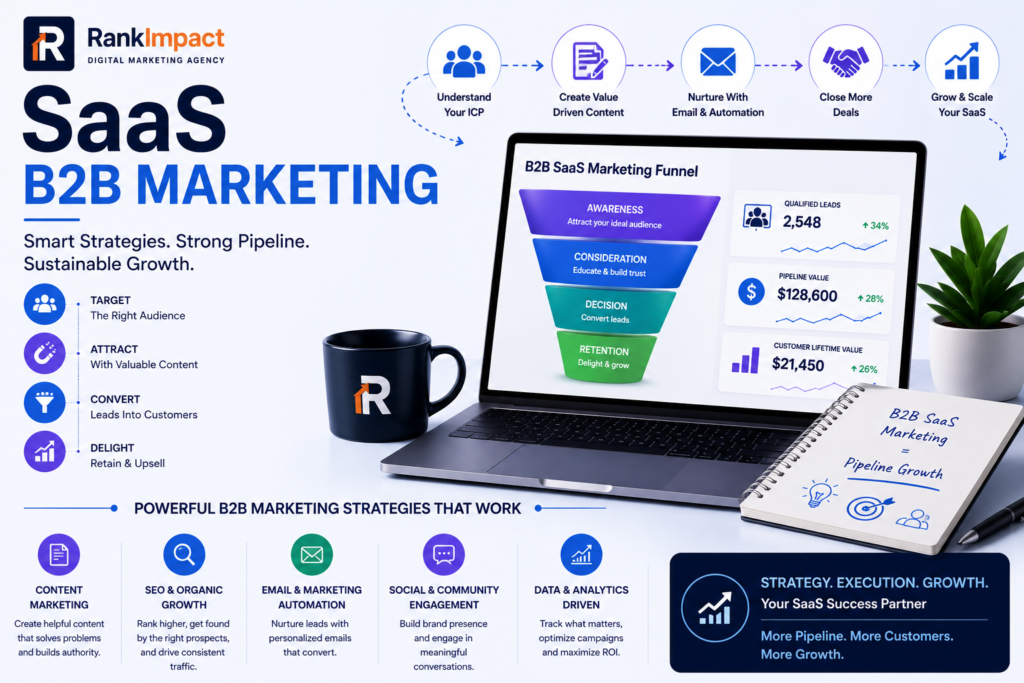
A funnel built around this kind of buying process needs to account for the fact that conversion isn’t a single event it’s a sequence of smaller commitments that build toward a signed contract and, eventually, a renewed one. Top of funnel content should focus on genuinely useful education rather than thinly veiled product pitches, since buyers can spot a sales pitch dressed up as an article within seconds and will simply leave. Middle of funnel content needs to directly address comparison and evaluation questions, because this is exactly where competitors are fighting hardest for the same searcher’s attention.

Bottom of funnel pages pricing, demo requests, and free trial signups deserve disproportionate optimization effort relative to their traffic volume, because even small improvements in conversion rate on these pages have an outsized impact on pipeline. Many companies invest heavily in top of funnel content while leaving their pricing page cluttered, vague, or missing the specific objections that stop a buyer from signing up. Auditing and improving these lower funnel pages is often the highest ROI project available at any given time, yet it’s frequently overlooked in favor of chasing new content volume.

Common Mistakes in SaaS B2B Marketing

One of the most persistent mistakes is chasing traffic instead of pipeline. A blog post that ranks well and drives thousands of visits but attracts the wrong audience contributes nothing to revenue, yet it’s easy to celebrate because the traffic graph looks impressive. Every piece of content and every campaign should be evaluated against whether it’s reaching people who could realistically become customers, not just people who are curious about the topic.

Another common error is neglecting the post-signup experience. Teams often pour resources into acquisition while treating onboarding, activation, and retention as someone else’s job. In a subscription business, a customer who churns after two months erases most of the value that acquisition work went into creating, which means marketing has a direct stake in making sure new customers actually succeed with the product.

Misaligned messaging across the buying committee is another frequent issue. Content written entirely from the perspective of the end user will fail to address the budget-holder’s concerns about ROI, and content that only speaks to ROI will fail to convince the day to day user that the product is actually pleasant and effective to work with. A well run SaaS B2B marketing strategy deliberately builds messaging tracks for each stakeholder rather than assuming one message fits everyone in the room.

Finally, many teams under invest in customer marketing and case studies relative to how much buying decisions actually depend on peer proof. It’s common to see a marketing team with a robust blog and a strong paid program but only two or three outdated customer stories, even though prospects consistently cite peer validation as one of the strongest factors in their final decision.

A subtler mistake worth naming separately is treating every stage of the funnel with equal urgency. Early stage teams especially tend to spread themselves thin across every possible channel at once, rather than getting one or two motions working well before expanding further. A content engine that’s actually driving qualified pipeline is worth far more than five half built channels that never individually reach critical mass.

Metrics That Actually Matter

Vanity metrics like total website traffic or social media followers rarely correlate with revenue outcomes in a subscription business. The metrics that genuinely matter include marketing qualified leads that convert into sales qualified opportunities, trial to-paid conversion rate, customer acquisition cost relative to lifetime value, and critically how marketing sourced customers perform on retention compared to customers acquired through other channels. A channel that generates cheap signups but poor retention is often more expensive in the long run than a slower, higher quality channel that costs more upfront.

Net revenue retention deserves particular attention because it reflects how well the entire customer lifecycle is being managed, not just the initial sale. Teams that track and influence this number, rather than treating it purely as a customer success metric, tend to build far stronger cases for their budget and their strategic value inside the business. When marketing leadership can point to a direct line between specific campaigns and improved retention, budget conversations become dramatically easier to win.

Attribution is another area worth getting right early, even if it stays imperfect. Multi touch attribution models are notoriously difficult to build accurately, especially in longer sales cycles involving several stakeholders and touchpoints spread across months. Rather than chasing a perfect model, most growing teams get more value from a simpler approach: tracking which content and channels show up most often in the journeys of customers who both closed and retained well, then doubling down on those patterns even without perfect certainty about causation. Directionally correct data used consistently tends to outperform a theoretically perfect model that takes a year to build and constantly needs recalibrating.

How to Structure a Marketing Team for This Kind of Business

Early-stage companies typically need generalists who can move across content, paid, and lifecycle marketing simultaneously, since there isn’t yet enough volume in any single channel to justify a dedicated specialist. As a company grows past product market fit and into a scaling phase, specialization becomes more valuable a dedicated content or SEO lead, a paid acquisition specialist, and a lifecycle or customer marketing owner each start to justify their own headcount because the volume and complexity in each channel increases significantly.

Regardless of team size, close alignment with sales and customer success is non negotiable. Marketing needs direct visibility into which content and campaigns are actually influencing closed deals, and customer success needs to feed real usage and satisfaction data back into marketing’s understanding of what a good fit customer actually looks like. Companies that keep these functions siloed consistently struggle to improve their funnel, because each team is optimizing against an incomplete picture of what’s really happening across the full customer lifecycle.

External expertise can also play a useful role at specific inflection points, even for teams that are otherwise building in-house. Bringing in a specialist for a defined project — auditing a stalled content program, restructuring a pricing page, or setting up lifecycle email infrastructure — can move faster than hiring a full-time employee for a problem that may only need concentrated attention for a few months. The key is treating outside help as a way to accelerate a clear internal strategy, not as a substitute for having one in the first place.

FA1. What is SaaS B2B marketing exactly?

Q: SaaS B2B Marketing

SaaS B2B marketing is the practice of promoting subscription based software to business buyers, with strategies built around a longer, multi stakeholder buying process and a revenue model that depends on ongoing retention and expansion rather than a single transaction.

2. How is SaaS B2B marketing different from B2C SaaS marketing?

It typically involves longer sales cycles, multiple decision makers, and higher price points, which means content and campaigns need to address several distinct audiences rather than a single individual consumer making a fast purchase decision.

3. What channels work best for this type of marketing?

Content marketing and SEO, product led growth motions like free trials, targeted paid acquisition, lifecycle email marketing, and customer advocacy programs consistently produce the strongest results, though the ideal mix depends heavily on deal size and product complexity.

4. How important is SEO in a subscription software strategy?

SEO is one of the highest-leverage long-term channels because it captures buyers who are actively researching solutions, and a well structured content strategy compounds in value over time rather than requiring continuous spend like paid channels.

5. What is product led growth and how does it relate to this discipline?

Product-led growth is a go to market strategy where the product itself, often through a free trial or freemium plan, drives acquisition and conversion, shifting part of the traditional sales process into hands on product usage.

6. How do you measure success in SaaS B2B marketing?

Success is best measured through pipeline driving metrics like marketing qualified to sales qualified conversion rates, trial to paid conversion, customer acquisition cost versus lifetime value, and how marketing sourced customers retain over time, rather than surface level traffic or engagement numbers.

7. Why does customer marketing matter in this strategy?

Case studies, testimonials, and peer validation carry significant weight in software buying decisions because prospects trust the experiences of similar companies far more than direct vendor claims, making customer marketing a high return but often underinvested channel.

8. How big should a marketing team be for a growing SaaS company?

Team size depends on company stage early stage companies usually rely on generalists covering multiple channels, while companies past product market fit benefit from specialized roles in content, paid acquisition, and lifecycle or customer marketing as channel complexity grows.

9. What’s the biggest mistake companies make in SaaS B2B marketing?

The most common mistake is optimizing for traffic and lead volume instead of pipeline and retention, which leads to marketing programs that look successful on paper but fail to contribute meaningfully to actual revenue growth.

10. How does marketing influence retention in a subscription business?

Marketing influences retention through onboarding content, lifecycle email sequences, and ensuring the customers being acquired are genuinely a good fit for the product, since poor fit customers acquired for a quick sale tend to churn faster and damage long term revenue.

Conclusion

SaaS B2B marketing succeeds or fails based on how well a team understands that a subscription business isn’t won at the moment of signature it’s won and re-won continuously through onboarding, retention, and expansion. The companies that consistently outperform their competitors treat content, product led growth, paid acquisition, lifecycle marketing, and customer advocacy as connected parts of a single system rather than isolated tactics, and they measure themselves against pipeline and retention rather than surface-level traffic. Building this kind of marketing function takes time and discipline, but it’s the difference between a growth engine that compounds and one that quietly stalls the moment a single channel underperforms.

Key Takeaways

  • SaaS B2B marketing has to account for a multi stakeholder buying committee and a revenue model built on retention, not just a single closed won moment.
  • Content, product led growth, paid acquisition, lifecycle email, and customer advocacy work best as a connected system rather than isolated tactics.
  • Bottom of funnel pages like pricing and trial signups deserve disproportionate optimization attention relative to their traffic volume.
  • Vanity metrics like traffic and followers should be replaced with pipeline and retention focused metrics.
  • Marketing has a direct stake in onboarding and retention, not just acquisition, in a subscription business.
  • Team structure should evolve from generalists to specialists as the company scales past product market fit.
  • Close alignment between marketing, sales, and customer success is essential for improving the full customer lifecycle.

Get Your FREE SEO Audit

Enter your details below. Our team will review your website and email you a comprehensive SEO and speed report within 24 hours.