+92 318 3068833 Get Free Audit

Google Workspace B2B SaaS Features A Complete Guide 2026

Explore the Google Workspace B2B SaaS features that matter most for growing software companies including security, AI tools and plan tiers.
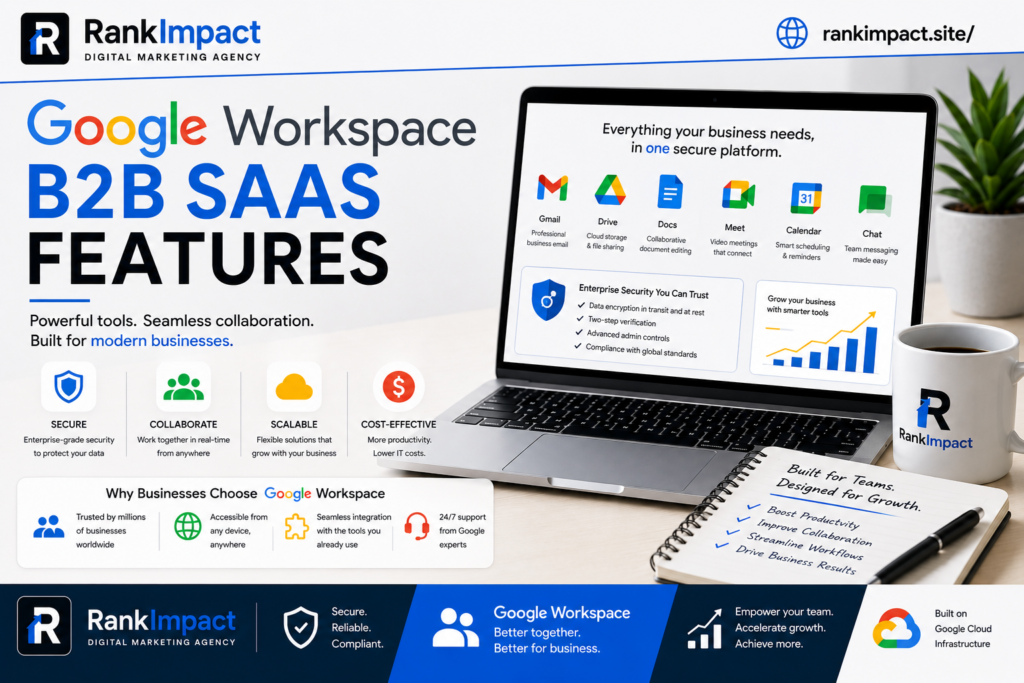
google workspace b2b saas features

Google Workspace B2B SaaS Features A Complete Guide for Growing Teams

B2B SaaS companies run on collaboration, and few decisions shape daily operations as quietly but significantly as which productivity suite a growing team standardizes on. Google Workspace B2B SaaS features have become a central part of that conversation because so many software companies, from early stage startups to companies preparing for enterprise sales, rely on the suite for everything from internal communication to client facing documentation and security compliance. Understanding exactly which features matter for a B2B SaaS context, rather than treating Workspace as a generic office tool, helps founders and operations leaders make a more informed decision and get significantly more value out of the platform once adopted.

This guide is written for founders, operations leaders, and IT decision makers at B2B SaaS companies evaluating or already using Google Workspace. Readers researching this topic typically fall into a few groups. Some are early stage founders comparing Workspace against alternatives before committing to a company wide tool. Others are operations or IT leads at a scaling SaaS company trying to understand which plan tier and features actually matter as headcount grows and enterprise customers start asking security questions. And some are simply trying to understand how Workspace’s collaboration and security capabilities map onto the specific needs of a subscription software business. This article addresses all three by covering the platform’s core capabilities, plan structure, and practical considerations in depth.

Why Google Workspace Matters Specifically for B2B SaaS Companies

Unlike many industries, B2B SaaS companies operate with a particular set of demands around collaboration, security, and scale. Product, engineering, sales, and customer success teams need to share documents and coordinate constantly, often across distributed or fully remote teams. At the same time, B2B SaaS companies frequently sell into enterprise customers who scrutinize vendor security practices closely, which means the internal tools a SaaS company uses can directly affect how credible it appears during a buyer’s own due diligence process.

Google Workspace is positioned as a cloud based productivity and communication suite that combines email, document creation, video meetings, and file storage into a single connected ecosystem, and its collaborative editing and flexible video meeting capabilities have made it a common default for companies operating in hybrid or fully remote structures where teams need real-time collaborative editing of documents and flexible video meetings to stay productive across distance. For a B2B SaaS company specifically, this means engineering documentation, sales proposals, customer onboarding materials, and internal knowledge bases can all live within one connected environment rather than fragmented across disconnected tools. Substack

Core Collaboration Features B2B SaaS Teams Actually Use

Real time collaborative editing across Docs, Sheets, and Slides remains one of the most heavily used capabilities for SaaS teams, allowing product managers, engineers, and customer facing teams to work on the same specification document, roadmap, or client presentation simultaneously without the version control chaos that plagues teams relying on emailed file attachments. Sheets in particular tends to become a lightweight operational tool for SaaS companies well beyond basic spreadsheets, often used for tracking sales pipelines, customer health scores, and lightweight reporting before a company invests in dedicated tools for those functions.

Google Chat and Spaces have grown into a genuine internal collaboration hub for many companies, functioning as lightweight project coordination spaces where project-based Spaces act like lightweight project management boards while AI-suggested tasks automatically create to-do lists from conversations. For a SaaS company juggling multiple concurrent projects across engineering sprints, customer escalations, and marketing campaigns, this kind of lightweight built in coordination reduces the need to immediately purchase a separate project management tool during early growth stages. Evolve Web Hosting

Google Meet handles video communication for internal standups, customer calls, and sales demonstrations, and increasingly includes AI supported capabilities such as live speech translation, which empowers seamless global collaboration in real time and is particularly relevant for B2B SaaS companies selling into international markets with distributed customer bases and support teams. Devoteam

Security and Compliance Features That Matter for B2B Sales

Security capability within Google Workspace becomes especially important for B2B SaaS companies because internal tool security directly intersects with the trust a company must build with its own enterprise customers. Higher tier plans include capabilities such as eDiscovery, data retention and archiving through Vault, secure LDAP, and advanced endpoint management, features specifically designed for companies that need added security and control features as they scale and begin handling more sensitive customer data internally. North Carolina Bar Association

For a SaaS company preparing for its first enterprise deals or pursuing a SOC 2 audit, having demonstrable data retention policies and endpoint management in place across its own internal tools strengthens its position significantly during a prospective customer’s own vendor security review. Enterprise plan tiers extend these controls further, offering the kind of granular administrative oversight that larger prospective customers often specifically ask about during procurement conversations.

Two step verification and built in spam and phishing protection within Gmail further reduce the risk of the kind of credential compromise that remains one of the most common entry points for security incidents at growing companies, an especially important consideration for SaaS companies handling customer data as part of their core product.

AI Features Reshaping How SaaS Teams Work

Artificial intelligence capability has expanded rapidly across Google Workspace and increasingly shapes how SaaS teams draft documentation, prepare customer materials, and manage information across scattered internal sources. A capability that generates a complete first draft from a prompt, synthesizing context directly from a company’s own Drive, Gmail, and Chat history, allows teams to produce polished internal reports or customer facing materials significantly faster than starting from a blank page, since Gemini pulls from your Drive, Gmail, and Chat to generate a fully formatted first draft based on a simple natural language description of what is needed. Data Pilot

A related capability addresses a common pain point in collaborative SaaS environments where multiple contributors write in noticeably different tones within the same document, since a feature that lets a user select a reference document allows Gemini to rewrite new content to match its style and register, which matters considerably for customer facing documentation like proposals or onboarding guides where a consistent voice affects how professional the material appears. Data Pilot

NotebookLM has also become genuinely useful for SaaS teams synthesizing large volumes of internal knowledge, whether product documentation, customer research, or competitive analysis, into more digestible formats. Higher tier AI access adds capabilities such as generating high-value outputs with infographics, audio overviews and mind maps, which SaaS teams increasingly use to turn dense internal research into material that is easier for other teams to actually absorb and act on. Devoteam

Choosing the Right Plan Tier as a B2B SaaS Company

Google Workspace offers several plan tiers, and choosing correctly matters considerably for a B2B SaaS company balancing cost against genuine operational need. The entry level Business Starter plan is the most limited in terms of applications, storage, and video meeting capacity, making it generally suitable only for very early stage teams with minimal storage and collaboration demands rather than a company preparing to scale.

Business Standard extends storage significantly and adds capabilities including NotebookLM, e-signatures, and appointment booking pages, which tend to matter more once a SaaS company has active sales and customer success motions requiring signed agreements and scheduled customer calls. This tier represents a reasonable middle ground for companies past the earliest founding stage but not yet large enough to require the most advanced security and compliance controls. North Carolina Bar Association

Business Plus becomes relevant once a company needs the security and compliance depth described earlier, including eDiscovery, Vault for data retention and archiving, secure LDAP, and advanced endpoint management alongside significantly expanded storage per user. Most B2B SaaS companies approaching their first serious enterprise sales conversations or beginning formal compliance work should evaluate whether Business Plus, or the Enterprise tier for companies with more advanced control requirements, better matches their actual operational and sales stage rather than defaulting to whichever plan was chosen at initial signup. North Carolina Bar Association

Common Mistakes B2B SaaS Companies Make With Workspace

One frequent mistake is selecting a plan tier during initial company setup and never revisiting that decision as the company scales, resulting in either paying for capability the team does not use or, more commonly, operating without security controls that become genuinely necessary once the company starts handling more sensitive customer data or pursuing enterprise deals. Revisiting plan tier alongside company milestones, such as the first enterprise customer or the beginning of a formal compliance audit, prevents this mismatch from persisting unnoticed.

Underutilizing the built in collaboration and lightweight project tools represents another common gap, where teams purchase additional dedicated tools for functions that Chat, Spaces, and Sheets could reasonably handle during earlier growth stages, adding unnecessary tool sprawl and cost before it becomes genuinely necessary. Conducting a periodic audit of which paid tools genuinely earn their cost against what Workspace already provides often reveals opportunities for consolidation.

Many companies also fail to configure administrative and security settings deliberately, instead relying entirely on default configurations that may not reflect the specific risk profile of a company handling customer data as part of its core product. Taking time to review admin console settings, particularly around data sharing defaults and third party app access, closes a gap that many growing SaaS companies overlook until a customer security questionnaire forces the issue.

Finally, companies frequently underinvest in training their own team on newer AI capabilities as they roll out, missing genuine productivity gains simply because staff continue using the platform the same way they did years earlier. A brief internal walkthrough whenever significant new capability becomes available meaningfully increases actual adoption compared to assuming staff will discover new features independently.

Integrating Google Workspace Into a Broader SaaS Tool Stack

Google Workspace rarely operates as a company’s only tool and instead functions as connective tissue between more specialized platforms a B2B SaaS company relies on, including its CRM, support desk, and engineering tools. Evaluating how well a prospective or existing integration connects with Workspace, particularly around calendar, Drive, and Gmail, meaningfully affects daily workflow efficiency for sales and customer success teams especially, since context switching between disconnected tools quietly consumes significant time across a growing team.

Single sign on integration connecting Workspace with other core company tools reduces both password fatigue and security risk simultaneously, and should be treated as a priority configuration step for any SaaS company running multiple connected platforms across its team rather than an optional convenience.

Frequently Asked Questions

What are the most important Google Workspace B2B SaaS features for a growing team?

The most important Google Workspace B2B SaaS features typically include real time document collaboration, Vault for data retention, advanced endpoint management, and AI capabilities like Gemini for drafting and NotebookLM for synthesizing internal knowledge.

Which Google Workspace plan is best for an early stage B2B SaaS startup?

Business Standard generally offers the best balance for early stage SaaS startups, providing expanded storage and features like e-signatures and appointment booking without the higher cost of enterprise level security controls not yet needed at that stage.

Does Google Workspace support the security requirements enterprise SaaS buyers expect?

Higher tier Workspace plans include eDiscovery, Vault data retention, secure LDAP, and advanced endpoint management, which can support the kind of internal security posture enterprise buyers often expect vendors to demonstrate during procurement review.

How does Google Workspace AI help B2B SaaS teams specifically?

Google Workspace AI features help B2B SaaS teams draft documentation faster by generating content directly from prompts using existing Drive and Gmail context, maintain consistent tone across collaborative documents, and synthesize large volumes of internal research into more digestible formats.

Can Google Workspace replace a dedicated project management tool for a SaaS company?

For early stage teams, Chat and Spaces can reasonably handle lightweight project coordination, though most SaaS companies eventually adopt a dedicated project management tool once team size and workflow complexity grow beyond what built in features comfortably support.

How often should a SaaS company review its Google Workspace plan tier?

A SaaS company should revisit its Workspace plan tier at major company milestones, such as landing its first enterprise customer or beginning a formal compliance audit, rather than leaving the original plan selection unreviewed indefinitely.

Is Google Workspace suitable for B2B SaaS companies with international teams?

Yes, features including live speech translation in Google Meet and broadly available cloud based access make Workspace particularly suitable for B2B SaaS companies with distributed international teams and customer bases.

What is the difference between Business Plus and Enterprise Workspace plans?

Business Plus provides substantial security and storage capability suitable for most scaling SaaS companies, while Enterprise plans extend administrative control and security depth further for larger organizations with more advanced compliance and governance requirements.

Conclusion

Google Workspace B2B SaaS features extend well beyond generic office productivity once a company understands which specific capabilities matter at each stage of growth. Collaboration tools support the fast moving coordination SaaS teams depend on daily, security and compliance features directly strengthen a company’s credibility during enterprise sales conversations, and rapidly expanding AI capability increasingly changes how quickly teams can produce polished internal and customer facing material. Companies that deliberately match their plan tier and configuration to their actual operational stage, rather than leaving early decisions unreviewed, consistently get significantly more value from the platform as they scale.
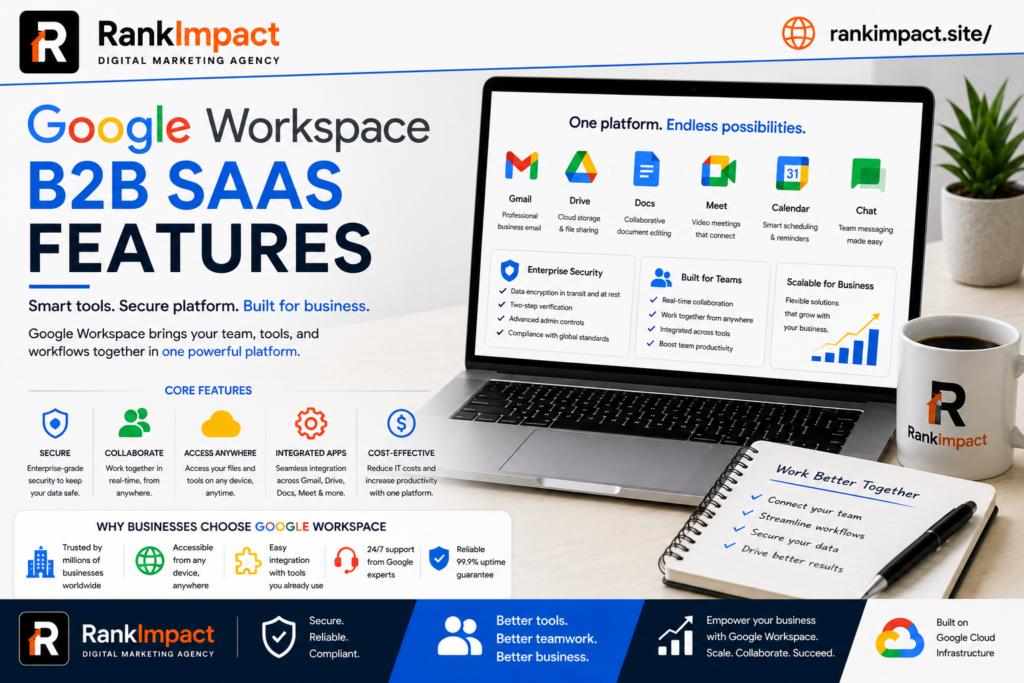
Key Takeaways

Google Workspace B2B SaaS features span collaboration, security, and increasingly sophisticated AI capability that directly supports how growing software companies operate daily. Security features like Vault, secure LDAP, and advanced endpoint management become particularly important once a SaaS company begins pursuing enterprise customers who scrutinize vendor security practices closely. AI capabilities including prompt based document generation and cross tool knowledge synthesis increasingly change how efficiently SaaS teams produce internal and customer facing material. Common mistakes include never revisiting plan tier as the company scales and relying on default security configurations without deliberate review. Treating Workspace as connective tissue across a broader SaaS tool stack, with attention to integrations and single sign on, improves daily efficiency significantly as a team grows.
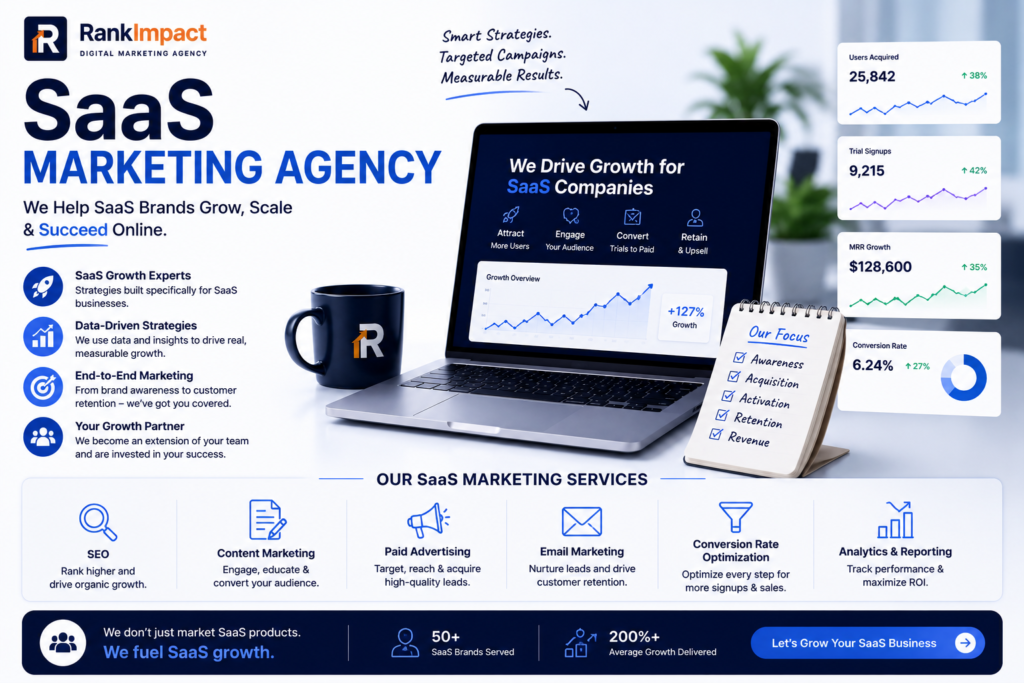
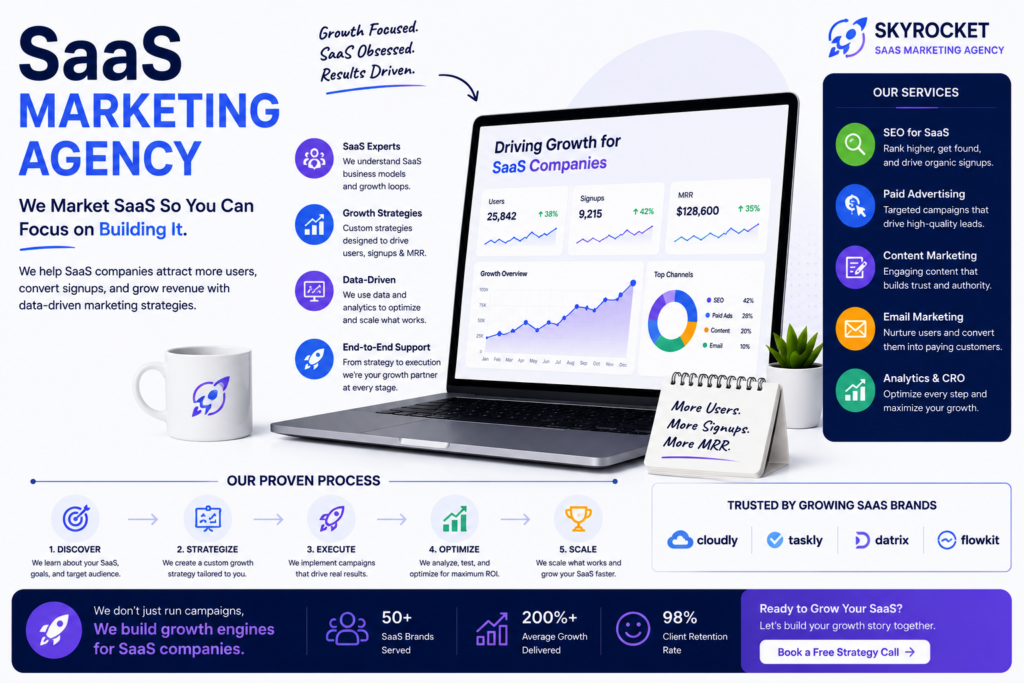
Top 7 Tips to Choose a SaaS Marketing Agency in 2026

Thinking about hiring a SaaS marketing agency. Learn what they do, how pricing works, and how to choose the right growth partner for your software company.

SaaS marketing agency

Why SaaS Companies Turn to Specialized Marketing

Software companies live and die by predictable customer acquisition. A brilliant product with no pipeline is a hobby, not a business, and this is exactly why so many SaaS founders eventually search for a SaaS marketing agency instead of continuing to guess their way through growth.

Building an internal marketing function from scratch is expensive, slow, and risky, especially for companies still trying to find product-market fit or scale past their first few million in annual recurring revenue. A specialized agency brings something an internal hire rarely can on day one: pattern recognition across dozens of software businesses, proven playbooks for demand generation, and a bench of specialists who already know how SaaS buyers behave.

This guide breaks down everything a founder, CMO, or marketing manager needs to know before hiring one. You will learn what these agencies actually do, how their pricing structures work, the difference between a generalist and a SaaS specialist, how to vet candidates properly, and the mistakes that quietly waste budget. The goal is not to sell you on outsourcing, but to give you the clarity to make a decision that fits your stage, budget, and growth goals, whether that means hiring an agency, building in-house, or blending both approaches.

What a SaaS Marketing Agency Actually Does

A SaaS marketing agency is a specialized firm that manages some or all of the marketing function for software companies, typically on a retainer basis. Unlike a broad digital marketing agency that might work with restaurants, ecommerce brands, and law firms in the same month, a SaaS focused agency lives inside the subscription business model. That distinction matters more than most buyers realize. Metrics like monthly recurring revenue, churn, customer acquisition cost, and lifetime value are not side considerations for these agencies, they are the entire framework the strategy is built around.

Day to day work typically spans several disciplines. Content marketing and SEO form the backbone for many SaaS companies because organic search remains one of the most cost efficient channels for reaching buyers who are actively researching a solution. Paid acquisition through search and social platforms fills the top of funnel faster but at a higher cost, and a good agency knows how to blend both. Product led growth support, including onboarding flows and in app messaging, has become increasingly common as more agencies expand beyond traditional marketing into activation and retention. Conversion rate optimization, marketing automation, email lifecycle campaigns, and analytics reporting round out the core service list.

What separates a strong agency from a mediocre one is not the list of services offered but the depth of SaaS specific expertise behind each one. A generalist writer can produce a blog post about your product, but a SaaS content strategist understands how to structure that post around buyer intent at each stage of a complex, often multi stakeholder sales cycle. That is the real value proposition.

Why SaaS Companies Choose Agencies Over In House Teams

The decision between building an internal team and hiring an agency usually comes down to speed, cost, and risk tolerance. Hiring a full internal marketing team, including a content strategist, paid media specialist, SEO expert, designer, and marketing operations manager, can easily run into six figures annually before accounting for tools, benefits, and management overhead. An agency lets a company access that same range of expertise for a fraction of the cost of five or six full time salaries, because the agency spreads its specialists across multiple client accounts.

Speed is another major factor. Recruiting, interviewing, and onboarding a single senior marketer can take two to three months, and building a full team can take the better part of a year. A capable agency can often start executing within a few weeks because the processes, tools, and templates already exist. For an early or mid stage SaaS company racing to hit growth targets before the next funding round or before runway runs out, that time savings is not a nice to have, it is often the entire point.

There is also the benefit of objectivity. Internal teams sometimes fall in love with a channel or tactic that used to work but has stopped delivering results, simply because changing course feels uncomfortable. Agencies that work across many SaaS clients can see patterns faster. They know when a tactic that worked well in 2023 has become saturated, and they can pivot budget toward what is actually converting today rather than what used to convert.

None of this means agencies are automatically the right choice. Companies with a clear, well tested growth model and the budget to hire strong in house talent may get more long term value from building internally, since institutional knowledge stays inside the company rather than walking out the door if the agency relationship ends. The right answer depends heavily on stage, budget, and how quickly the business needs to move.

Core Services Offered by a SaaS Marketing Agency

Most SaaS agencies structure their offerings around a handful of core pillars, even though the exact packaging varies from firm to firm.

Search engine optimization remains one of the most requested services because organic traffic compounds over time and tends to deliver a lower long term cost per lead than paid channels. A strong SEO program for a SaaS business goes well beyond keyword research. It includes building topical authority around the problems the product solves, optimizing product and comparison pages that influence bottom of funnel decisions, and creating content clusters that answer every stage of the buyer journey from early awareness to final evaluation.

Paid advertising, including search ads, LinkedIn campaigns, and increasingly short form video ads, gives companies a faster path to pipeline while organic efforts mature. A good agency treats paid spend as a controlled experiment rather than a blank check, constantly testing messaging, audiences, and landing pages to bring down acquisition costs.

Content marketing sits at the center of most SaaS growth strategies because software purchases are considered, research heavy decisions. Buyers read comparison articles, case studies, and technical guides before ever speaking to sales. Agencies that specialize in SaaS understand how to write content that educates without sounding like a sales pitch, which builds the trust needed to move a prospect down the funnel.

Marketing automation and lifecycle email round out the picture by nurturing leads who are not ready to buy today. For product led SaaS companies, this often extends into behavioral email triggers tied to in app activity, encouraging trial users to reach activation milestones before their trial expires.

Finally, many agencies now offer conversion rate optimization and analytics as standalone services, recognizing that driving traffic means little if the website and product experience do not convert visitors into paying customers.

How Pricing Works for SaaS Marketing Agencies

Pricing structures vary widely, and understanding the common models helps buyers avoid sticker shock or unrealistic expectations. Monthly retainers are the most common arrangement, typically ranging from a few thousand dollars a month for a narrow, single channel engagement to well over twenty thousand dollars a month for a full funnel program spanning SEO, paid media, and content. Retainers usually reflect the scope of work and the seniority of the team assigned to the account, so the cheapest option on paper is not always the best value if it comes with junior staff and limited strategic input.

Project based pricing suits companies that need a specific deliverable, such as a website redesign, a rebrand, or a one time content audit, rather than ongoing management. This model gives clear cost certainty but does not include the continuous optimization that ongoing growth work usually requires.

Performance based pricing, where fees are tied to results such as leads generated or revenue influenced, sounds appealing but is rarer than most buyers expect, largely because marketing results depend on factors outside the agency’s control, including sales follow up, product quality, and pricing. When agencies do offer performance components, they usually combine a smaller base retainer with a bonus structure rather than pure commission.

Buyers should be cautious of unusually low retainers, since they often signal outsourced or junior labor, limited strategic oversight, or a business model that depends on managing far more accounts than a team can realistically serve well. A fair price reflects the complexity of SaaS marketing, the experience level of the people doing the work, and the number of hours genuinely required to move the needle.

How to Choose the Right SaaS Marketing Agency

Selecting an agency is one of the highest leverage decisions a growth focused SaaS company will make, so it deserves a structured evaluation rather than a gut call after one sales conversation.

Start by reviewing case studies and asking for client references in your specific segment, whether that is B2B, product led growth, vertical SaaS, or enterprise software. Results in one segment do not always transfer to another, since the buyer psychology, sales cycle length, and channels that work can differ dramatically between, say, a self serve productivity tool and an enterprise security platform.

Ask direct questions about who will actually be working on your account. Many agencies sell the engagement using their most senior, most impressive team members, then hand day to day execution to junior staff once the contract is signed. Clarify staffing before signing anything, and ask how often you will interact with senior strategists versus account coordinators.

Look closely at how the agency talks about measurement. A trustworthy partner will be upfront about what is and is not attributable to their work, and will set realistic timelines, since SEO in particular often takes three to six months before meaningful results appear. Agencies that promise overnight results or guaranteed rankings are usually cutting corners in ways that create long term risk, including manipulative link building tactics that can trigger search engine penalties.

Finally, evaluate cultural fit and communication style during the sales process itself. If an agency is slow to respond, vague in its answers, or pushy about closing the deal quickly, that behavior tends to continue after the contract is signed. The best partnerships feel collaborative from the very first call, with the agency asking thoughtful questions about your business rather than immediately pitching a standard package.

Common Mistakes Companies Make When Hiring an Agency

One of the most frequent mistakes is hiring an agency without a clear internal owner. Even the best agency needs a point person on the client side who can provide product knowledge, approve content quickly, and make decisions about messaging and positioning. Without that internal champion, projects stall in review cycles and the agency ends up guessing at details only the client truly understands.

Another common error is expecting instant results from channels that are inherently slow to compound, particularly organic search and content marketing. Companies that judge an SEO focused engagement after sixty days are almost always setting themselves up for disappointment, since search engines need time to trust new or expanded content, and rankings typically build gradually rather than overnight.

Scope creep is a quieter but equally damaging problem. Clients often ask for additional deliverables outside the original agreement without adjusting the retainer, which spreads the agency’s time thin across too many priorities and dilutes the quality of everything being produced. Clear scope documents and regular check ins prevent this from happening gradually and invisibly.

Some companies also make the mistake of switching agencies too frequently, chasing the next shiny pitch deck instead of giving a strategy enough time to mature. Marketing programs, especially organic ones, often show their best results in months four through twelve. Constantly restarting with a new partner resets that clock every time.

Metrics That Actually Matter in a SaaS Agency Partnership

Vanity metrics like raw traffic or social media impressions feel good to report but rarely tell the full story of whether a marketing partnership is working. For SaaS businesses specifically, the metrics that matter most tie directly back to revenue and retention.

Pipeline generated and cost per qualified lead reveal whether marketing activity is translating into real sales opportunities, not just website visitors. Trial to paid conversion rate matters enormously for product led companies, since driving more signups means little if those signups never convert into paying customers. Customer acquisition cost relative to customer lifetime value is the ultimate test of whether the marketing spend is sustainable, because even a channel that generates plenty of leads can quietly destroy unit economics if the cost to acquire each customer exceeds what that customer will ever be worth.

A capable agency will proactively report on these numbers rather than waiting to be asked, and will connect marketing activity to business outcomes in a way that a founder or CFO can actually use in board meetings. If an agency’s reporting stops at traffic and rankings without ever tying back to pipeline or revenue, that is a signal worth raising directly with the account team.

In House, Agency, or a Hybrid Model

Many growing SaaS companies eventually land on a hybrid approach rather than choosing purely between building internally or outsourcing entirely. A common pattern is keeping strategic direction, product marketing, and brand voice in house, where deep product knowledge matters most, while outsourcing execution heavy work like SEO content production, paid media management, and design to a specialized agency.

This hybrid model tends to work well because it keeps institutional knowledge inside the company while still accessing specialist skill sets that would be expensive to hire full time. A single in house marketing lead who manages an agency relationship can often produce results comparable to a five person internal team, particularly at the growth stage where budgets are still tight but the need for sophisticated execution is already high.

The right structure ultimately depends on company stage. Early stage startups with limited budget often benefit most from a lean in house generalist paired with a focused agency engagement on one or two channels. Growth stage companies with more resources tend to build larger internal teams while using agencies for specialized, project based work like a website redesign or a major SEO overhaul. Enterprise SaaS companies frequently maintain large internal teams and use agencies more selectively, for overflow capacity or highly specialized skills like technical SEO audits or paid media platform expertise.

Frequently Asked Questions

What does a SaaS marketing agency actually do?

A SaaS marketing agency manages growth focused marketing activities for software companies, typically including SEO, content marketing, paid advertising, marketing automation, and conversion optimization, all built around subscription business metrics like recurring revenue, churn, and customer acquisition cost rather than one time sales.

How much does a SaaS marketing agency cost?

Monthly retainers typically range from a few thousand dollars for a single channel engagement to over twenty thousand dollars a month for a full funnel program covering SEO, paid media, and content. Cost depends on scope, team seniority, and the complexity of the growth strategy required.

How long does it take to see results from a SaaS marketing agency?

Paid advertising can generate leads within weeks, but organic channels like SEO and content marketing typically need three to six months before meaningful, compounding results appear, since search engines take time to build trust in new or expanded content.

Is a SaaS marketing agency better than an in house team?

Neither option is universally better. Agencies offer speed, lower upfront cost, and broad specialist expertise, while in house teams retain institutional knowledge and deep product understanding. Many companies land on a hybrid model that combines both.

What should I look for when choosing a SaaS marketing agency?

Look for case studies in your specific segment, clarity about who will staff your account, transparent measurement practices, realistic timelines, and strong communication during the sales process, since early behavior tends to predict how the partnership will run.

Do SaaS marketing agencies guarantee results?

Reputable agencies avoid guaranteeing specific rankings or lead volumes because too many variables, including sales follow up and product market fit, sit outside the agency’s control. Promises of guaranteed results are usually a warning sign rather than a reassurance.

What is the difference between a SaaS marketing agency and a general digital marketing agency?

A SaaS marketing agency specializes exclusively in software and subscription businesses, understanding metrics like monthly recurring revenue and churn, while a general digital marketing agency splits its attention across industries with very different sales cycles and buyer behavior.

Can a small SaaS startup afford a marketing agency?

Yes, many agencies offer scoped engagements focused on a single channel, such as SEO or content, which can fit smaller budgets. Startups often start narrow and expand the engagement as revenue grows and the value becomes clear.

What metrics should a SaaS marketing agency report on?

Beyond traffic and rankings, a strong agency reports on pipeline generated, cost per qualified lead, trial to paid conversion rate, and customer acquisition cost relative to lifetime value, connecting marketing activity directly to revenue outcomes.

How do I know if my SaaS marketing agency is underperforming?

Warning signs include reporting that never ties back to pipeline or revenue, frequent staff turnover on your account, missed deadlines, vague answers about strategy, and a lack of proactive recommendations based on performance data.

Conclusion

Choosing a SaaS marketing agency is ultimately a bet on speed and specialized expertise over the slower, more expensive path of building every capability internally from scratch. The businesses that get the most value from these partnerships treat the agency as an extension of their team rather than a vendor to hand things off to and forget about, staying involved in strategy, providing product context, and holding the partnership accountable to revenue outcomes rather than vanity metrics. Whether the right path forward is a full outsourced engagement, a narrow single channel retainer, or a hybrid model blending internal and outsourced talent, the decision should always trace back to your company’s stage, budget, and how quickly you genuinely need to move. Approached with clear expectations and the right partner, a SaaS marketing agency can compress years of trial and error into a growth engine that starts paying for itself well within the first year.

Key Takeaways

A SaaS marketing agency specializes in growth for subscription software companies, working around metrics like recurring revenue and churn rather than one time sales. The model offers faster time to execution and access to specialized skill sets compared to building a full internal team from scratch, though it comes with tradeoffs around institutional knowledge and long term cost. Pricing typically follows retainer, project, or hybrid performance structures, with fair pricing reflecting real strategic expertise rather than junior outsourced labor. Choosing the right partner requires reviewing segment specific case studies, clarifying staffing, and setting realistic timelines, especially for organic channels like SEO that take months to compound. The strongest outcomes tend to come from companies that stay actively involved in the partnership, track revenue focused metrics, and give the strategy enough time to mature before judging results.

Get Your FREE SEO Audit

Enter your details below. Our team will review your website and email you a comprehensive SEO and speed report within 24 hours.