+92 318 3068833 Get Free Audit

SaaS SEO Services 7 Steps to Choose the Right Partner

Discover 7 key steps to choosing the right SaaS SEO services partner, including what to look for, common mistakes, and pricing tips.
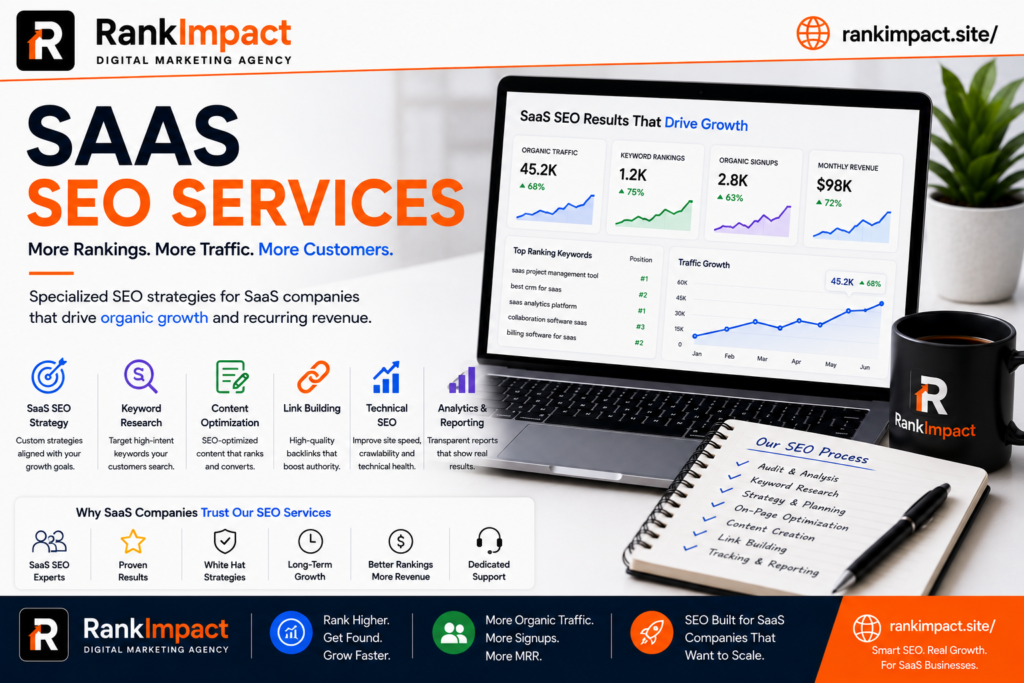
SaaS SEO services

SaaS SEO Services A Complete Guide to Choosing the Right Partner

Choosing between building an internal SEO function and hiring outside help is a decision nearly every growing SaaS company eventually faces, and it rarely has an obvious answer. SaaS SEO services occupy a specific niche within the broader digital marketing industry because ranking a software product involves technical considerations, buyer research patterns, and content depth requirements that differ meaningfully from SEO work in most other industries. A generalist agency comfortable optimizing an ecommerce product page or a local business listing often struggles when asked to build topical authority around a complex software category with a long, research intensive sales cycle.

This guide is written for founders, marketing leaders, and growth teams evaluating whether to bring in SaaS SEO services and, if so, how to actually choose a partner that will deliver genuine results rather than vanity traffic metrics. Readers researching this topic typically fall into a few groups. Some are early stage founders trying to understand what SaaS SEO services actually include before committing budget. Others are marketing leaders who have already tried a generalist agency without success and are trying to understand what a specialized provider does differently. And some are evaluating multiple SaaS SEO services providers and need a framework for comparing them meaningfully. This article addresses all three in depth.

What SaaS SEO Services Actually Include

SaaS SEO services typically cover a combination of strategic, technical, and content focused work specifically tailored to how software buyers research and evaluate products. This usually begins with keyword and topic research grounded in actual buyer intent rather than generic search volume, since a term with high search volume but low genuine buying intent often wastes resources that would be better spent targeting more specific, lower volume terms closer to an actual purchase decision.

Technical SEO work forms another core component, addressing site architecture, page speed, structured data, and crawlability issues that specifically affect how search engines index and understand a SaaS company’s often large and complex website, which frequently includes a marketing site, a documentation section, a blog, and sometimes a separate help center all needing to work together cohesively from a technical indexing standpoint.

Content strategy and production represents the most visible component of most SaaS SEO services, encompassing everything from top of funnel educational content to bottom of funnel comparison and product pages designed to convert readers already deep in an evaluation process. Link building and digital PR often round out a comprehensive service offering, since earning genuine authoritative backlinks remains one of the more difficult but impactful levers within any competitive SEO strategy.

Why SaaS Companies Need a Specialized Approach

Software buyers research differently than consumers or buyers in most other B2B categories, typically consuming a longer sequence of content before ever engaging directly with a sales team, often involving multiple stakeholders within the same purchasing company who each research independently before a group decision is made. SaaS SEO services built around this reality structure content specifically to support this extended, multi stakeholder research process rather than optimizing purely for a single conversion moment.

The competitive landscape within most software categories has also grown considerably more sophisticated, with well funded competitors regularly publishing detailed comparison content, in depth guides, and product led content specifically designed to intercept buyers at every stage of research. Generic SEO tactics that might work adequately in a less competitive industry frequently underperform significantly against this level of sophistication, which is precisely why specialized SaaS SEO services focused specifically on software company growth have become a distinct category within the broader agency landscape.

Search intent within software categories also carries unique complexity, since a single keyword can represent meaningfully different intent depending on subtle phrasing, and providers experienced specifically with SaaS companies tend to recognize these distinctions more reliably than generalist providers accustomed to industries with more straightforward, transactional search behavior.

Core Deliverables to Expect From a Quality Provider

A genuinely comprehensive SaaS SEO services engagement typically begins with a thorough technical and content audit identifying specific gaps and opportunities rather than generic recommendations that could apply to nearly any website. This audit should result in a clear, prioritized roadmap rather than an overwhelming list of every possible improvement without guidance on what actually matters most given the company’s current stage and resources.

Ongoing content production forms the backbone of most engagements, and quality providers typically involve subject matter expertise directly in the process rather than producing generic content written without genuine understanding of the software category or its buyers. This often means structured interviews with a company’s own product and customer success teams to extract genuine expertise that generic freelance writers simply cannot replicate independently.

Regular reporting tied to meaningful business metrics, rather than surface level traffic numbers alone, distinguishes providers genuinely focused on driving pipeline from those primarily focused on demonstrating activity. A provider should be able to clearly connect specific content or technical work to measurable outcomes like organic trial signups or demo requests, even if full attribution remains imperfect given the realistic complexity of a typical SaaS buying journey.

Technical implementation support, not just recommendations, matters considerably as well, since many internal teams lack the bandwidth or specific expertise to implement technical SEO recommendations independently, and a provider willing to work directly within a company’s content management system or alongside its engineering team tends to produce considerably faster and more reliable results than one that simply hands off a list of suggested changes.

How to Evaluate SaaS SEO Services Providers

Reviewing a prospective provider’s own case studies and client results provides useful signal but should be examined critically rather than taken entirely at face value, since traffic growth alone does not necessarily indicate genuine business impact. Asking specifically about how results connected to actual pipeline or revenue for previous SaaS clients reveals considerably more than a chart showing organic traffic climbing over time.

Requesting to speak directly with a current or recent client, ideally one in a similar stage or category to your own company, offers insight that marketing materials alone cannot provide, particularly around how responsive and collaborative the provider actually is once an engagement is underway rather than during the initial sales process when every provider naturally presents its best face.

Evaluating a provider’s own content and organic visibility offers a surprisingly direct signal, since a SaaS SEO services provider that cannot demonstrate strong organic performance for its own website raises legitimate questions about whether they can genuinely deliver that same outcome for a client’s more complex situation.

Understanding exactly who will work on your account day to day, rather than only the senior team members present during the sales process, prevents a common disappointment where impressive initial conversations give way to considerably less experienced staff handling the actual ongoing work once a contract begins.

Common Mistakes Companies Make When Hiring SaaS SEO Services

One of the most frequent mistakes is selecting a provider based primarily on price rather than evaluating genuine fit and experience within the software category specifically, since a lower cost provider lacking real SaaS expertise often ends up costing considerably more in wasted time and missed opportunity than a more expensive specialized provider would have.

Expecting rapid results within the first few months represents another common misstep, since meaningful organic SEO results generally require six to twelve months to materialize even with excellent execution, given how long search engines take to fully recognize and reward genuinely improved topical authority and content depth. Companies that abandon a provider prematurely based on impatience often never see the results that were beginning to build.

Many companies also fail to provide the internal access and collaboration a provider genuinely needs to succeed, treating an external SEO engagement as something that can operate entirely independently without input from product, sales, or customer facing teams who hold genuine expertise the provider needs to produce truly authoritative content rather than surface level material.

Neglecting to align on clear success metrics before an engagement begins creates ongoing friction and unclear expectations later, since a company expecting pipeline impact while a provider is measuring success primarily through traffic growth will inevitably experience a mismatch that becomes apparent only well into the engagement rather than being addressed proactively from the start.

In House SEO Versus Hiring SaaS SEO Services

Deciding between building an internal team and hiring an external provider depends considerably on company stage, budget, and how central organic growth is to the overall growth strategy. Very early stage companies often lack sufficient budget to hire a full internal team while simultaneously lacking sufficient content volume to fully occupy an outside agency’s typical retainer, making a smaller specialized freelancer or boutique provider a more practical starting point than either extreme.

Companies at a more established growth stage frequently find that a hybrid model works best, maintaining a smaller internal team responsible for strategy and internal subject matter coordination while outsourcing specific execution work like technical implementation or content production volume to specialized SaaS SEO services providers who can scale output more flexibly than hiring additional full time staff.

Larger, well resourced companies sometimes eventually build a fully internal team once organic growth has proven itself as a genuinely core growth channel worth dedicated permanent investment, though even at this stage many continue supplementing internal capacity with specialized outside expertise for specific technical audits or competitive analysis work that benefits from an outside perspective.

Pricing Models and Budget Expectations

SaaS SEO services pricing varies considerably depending on scope, provider experience level, and whether an engagement includes content production volume or focuses primarily on strategy and technical work. Monthly retainer models remain the most common structure, typically scaling based on the volume of content produced and the depth of ongoing technical and strategic involvement included within the engagement.

Project based pricing sometimes applies to discrete work like a comprehensive technical audit or a content migration project with a clearly defined scope and endpoint, though most SaaS companies benefit more from an ongoing retainer relationship given how much organic SEO results depend on sustained, consistent effort over an extended period rather than a single discrete project.

Companies should approach unusually low pricing with healthy skepticism, since genuinely effective SaaS SEO services require meaningful time investment from experienced practitioners, and pricing significantly below typical market rates often indicates either less experienced staff, production heavy content mills prioritizing volume over genuine quality, or unsustainable business practices that eventually affect service quality as a provider scales.

Questions to Ask Before Signing a Contract

Asking directly what specific SaaS categories a provider has worked within previously reveals whether their experience genuinely transfers to your own company’s situation, since expertise gained working with consumer subscription apps does not necessarily transfer smoothly to complex B2B software with a considerably longer and more technical buying process.

Understanding exactly how content topics get selected and approved throughout an engagement clarifies how much internal involvement will genuinely be required, preventing a mismatch where a company expects a provider to work entirely independently while the provider actually expects significant ongoing internal collaboration to produce genuinely authoritative content.

Clarifying what happens to content and any accumulated organic assets if the engagement ends helps avoid an unpleasant surprise later, since some providers structure contracts in ways that complicate a company’s ability to continue benefiting from work already completed after a relationship concludes.

Frequently Asked Questions

What do SaaS SEO services typically include?

SaaS SEO services typically include keyword and topic research grounded in buyer intent, technical SEO work, content strategy and production, and link building specifically tailored to how software buyers research and evaluate products.

How much do SaaS SEO services typically cost?

Pricing varies considerably based on scope and provider experience, though most SaaS companies should approach unusually low pricing with skepticism since genuinely effective work requires meaningful time investment from experienced practitioners.

How long does it take to see results from SaaS SEO services?

Meaningful organic results typically take six to twelve months to materialize, even with excellent execution, given how long search engines take to fully recognize genuinely improved topical authority and content depth.

Should an early stage SaaS startup hire SaaS SEO services or build an internal team?

Early stage companies often benefit most from a smaller specialized freelancer or boutique provider, since they typically lack sufficient budget for a full internal team while also lacking enough content volume for a large outside agency retainer.

What makes SaaS SEO services different from general SEO services?

SaaS SEO services address the longer, multi stakeholder buying process, technical complexity, and competitive content sophistication specific to software categories, requiring genuine category expertise that generalist providers often lack.

How can a company evaluate whether a SaaS SEO services provider is genuinely effective?

Companies should review case studies critically, speak directly with current or recent clients, and examine the provider’s own organic visibility as a direct signal of whether they can genuinely deliver similar results.

Do SaaS SEO services include technical implementation or only recommendations?

Quality providers typically offer direct implementation support rather than only recommendations, since many internal teams lack the bandwidth to execute technical SEO changes independently.

What is the biggest mistake companies make when hiring SaaS SEO services?

The biggest mistake is selecting a provider based primarily on price rather than genuine SaaS specific experience, since a cheaper but less specialized provider often costs more in wasted time and missed opportunity.

Can a hybrid model combining internal staff and outside SaaS SEO services work well?

Yes, many established growth stage companies find a hybrid model effective, maintaining internal strategy and subject matter coordination while outsourcing execution and content volume to a specialized provider.

What should be clarified before signing a contract with a SaaS SEO services provider?

Companies should clarify prior category specific experience, how content topics get selected and approved, and what happens to accumulated content and organic assets if the engagement ends.

Conclusion

Choosing among available SaaS SEO services providers requires looking well beyond a polished pitch deck toward genuine category specific experience, transparent reporting tied to real business outcomes, and a collaborative approach that treats a company’s own product and customer expertise as essential to producing content that actually deserves to rank. Companies that invest the time to evaluate providers rigorously, set realistic timeline expectations, and maintain genuine internal collaboration throughout an engagement consistently see stronger, more sustainable results than those that treat outside SEO help as a hands off solution requiring no meaningful internal involvement.
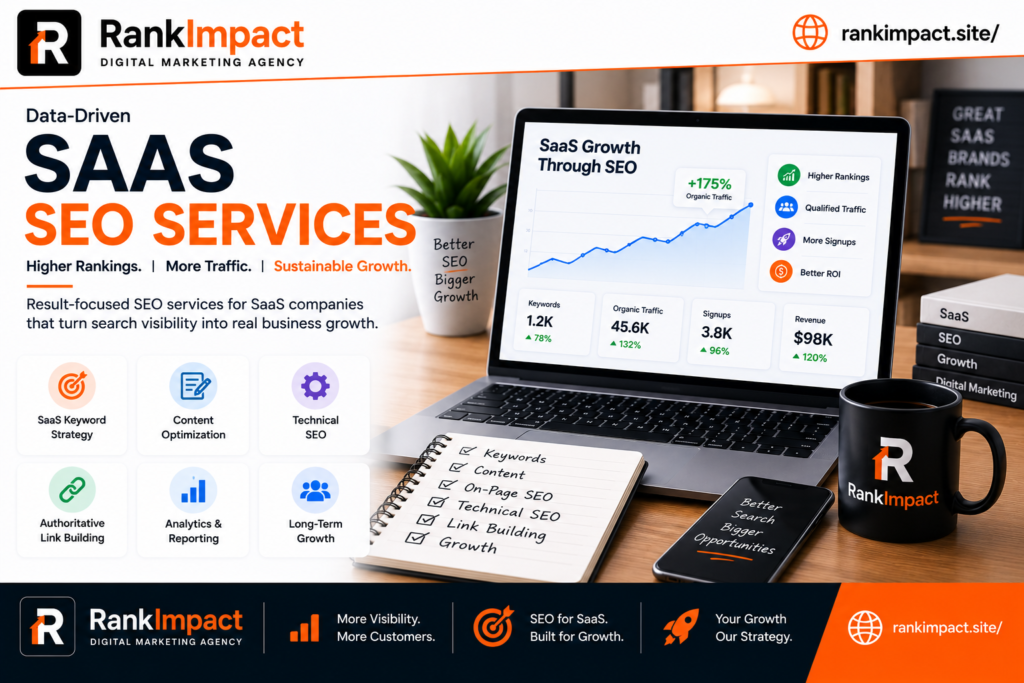
Key Takeaways

SaaS SEO services differ meaningfully from general SEO work due to longer buying cycles, multiple stakeholders, and considerably more sophisticated competitive content within most software categories. A comprehensive engagement should include technical implementation support, not only strategic recommendations left for an internal team to execute independently. Evaluating a provider’s own organic visibility and speaking directly with current clients reveals considerably more than marketing materials or case studies alone. Meaningful results typically require six to twelve months, and companies that abandon a provider prematurely often never see results that were genuinely beginning to build. A hybrid model combining internal strategic ownership with outsourced execution frequently works best for companies at a more established growth stage.
Top 7 Tips to Choose a SaaS Marketing Agency in 2026

Thinking about hiring a SaaS marketing agency. Learn what they do, how pricing works, and how to choose the right growth partner for your software company.

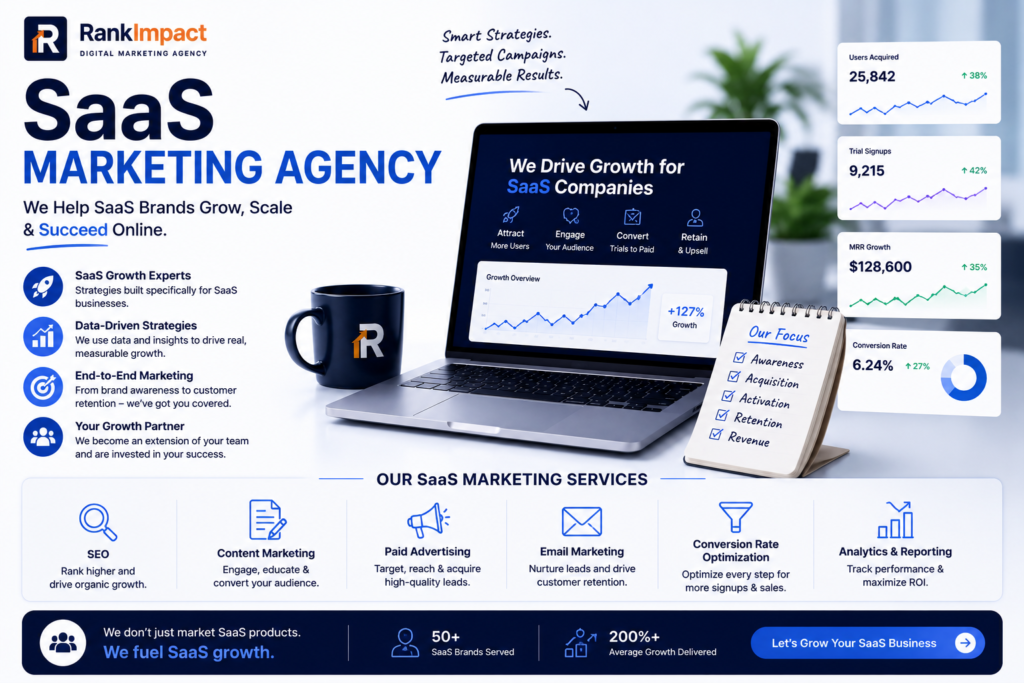
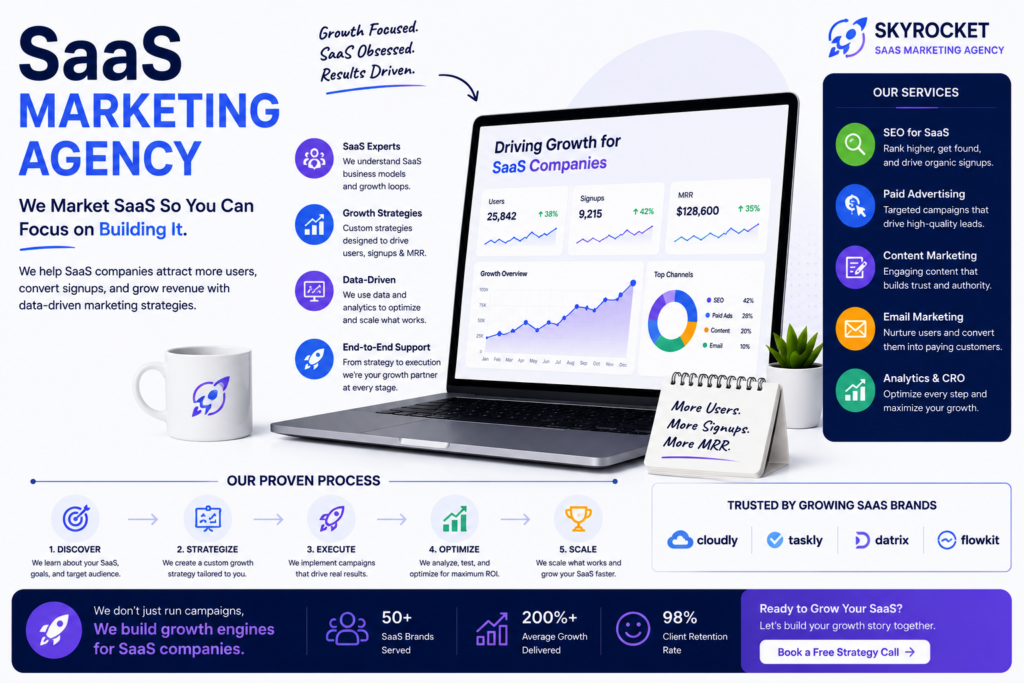
SaaS marketing agency

Why SaaS Companies Turn to Specialized Marketing

Software companies live and die by predictable customer acquisition. A brilliant product with no pipeline is a hobby, not a business, and this is exactly why so many SaaS founders eventually search for a SaaS marketing agency instead of continuing to guess their way through growth.

Building an internal marketing function from scratch is expensive, slow, and risky, especially for companies still trying to find product-market fit or scale past their first few million in annual recurring revenue. A specialized agency brings something an internal hire rarely can on day one: pattern recognition across dozens of software businesses, proven playbooks for demand generation, and a bench of specialists who already know how SaaS buyers behave.

This guide breaks down everything a founder, CMO, or marketing manager needs to know before hiring one. You will learn what these agencies actually do, how their pricing structures work, the difference between a generalist and a SaaS specialist, how to vet candidates properly, and the mistakes that quietly waste budget. The goal is not to sell you on outsourcing, but to give you the clarity to make a decision that fits your stage, budget, and growth goals, whether that means hiring an agency, building in-house, or blending both approaches.

What a SaaS Marketing Agency Actually Does

A SaaS marketing agency is a specialized firm that manages some or all of the marketing function for software companies, typically on a retainer basis. Unlike a broad digital marketing agency that might work with restaurants, ecommerce brands, and law firms in the same month, a SaaS focused agency lives inside the subscription business model. That distinction matters more than most buyers realize. Metrics like monthly recurring revenue, churn, customer acquisition cost, and lifetime value are not side considerations for these agencies, they are the entire framework the strategy is built around.

Day to day work typically spans several disciplines. Content marketing and SEO form the backbone for many SaaS companies because organic search remains one of the most cost efficient channels for reaching buyers who are actively researching a solution. Paid acquisition through search and social platforms fills the top of funnel faster but at a higher cost, and a good agency knows how to blend both. Product led growth support, including onboarding flows and in app messaging, has become increasingly common as more agencies expand beyond traditional marketing into activation and retention. Conversion rate optimization, marketing automation, email lifecycle campaigns, and analytics reporting round out the core service list.

What separates a strong agency from a mediocre one is not the list of services offered but the depth of SaaS specific expertise behind each one. A generalist writer can produce a blog post about your product, but a SaaS content strategist understands how to structure that post around buyer intent at each stage of a complex, often multi stakeholder sales cycle. That is the real value proposition.

Why SaaS Companies Choose Agencies Over In House Teams

The decision between building an internal team and hiring an agency usually comes down to speed, cost, and risk tolerance. Hiring a full internal marketing team, including a content strategist, paid media specialist, SEO expert, designer, and marketing operations manager, can easily run into six figures annually before accounting for tools, benefits, and management overhead. An agency lets a company access that same range of expertise for a fraction of the cost of five or six full time salaries, because the agency spreads its specialists across multiple client accounts.

Speed is another major factor. Recruiting, interviewing, and onboarding a single senior marketer can take two to three months, and building a full team can take the better part of a year. A capable agency can often start executing within a few weeks because the processes, tools, and templates already exist. For an early or mid stage SaaS company racing to hit growth targets before the next funding round or before runway runs out, that time savings is not a nice to have, it is often the entire point.

There is also the benefit of objectivity. Internal teams sometimes fall in love with a channel or tactic that used to work but has stopped delivering results, simply because changing course feels uncomfortable. Agencies that work across many SaaS clients can see patterns faster. They know when a tactic that worked well in 2023 has become saturated, and they can pivot budget toward what is actually converting today rather than what used to convert.

None of this means agencies are automatically the right choice. Companies with a clear, well tested growth model and the budget to hire strong in house talent may get more long term value from building internally, since institutional knowledge stays inside the company rather than walking out the door if the agency relationship ends. The right answer depends heavily on stage, budget, and how quickly the business needs to move.

Core Services Offered by a SaaS Marketing Agency

Most SaaS agencies structure their offerings around a handful of core pillars, even though the exact packaging varies from firm to firm.

Search engine optimization remains one of the most requested services because organic traffic compounds over time and tends to deliver a lower long term cost per lead than paid channels. A strong SEO program for a SaaS business goes well beyond keyword research. It includes building topical authority around the problems the product solves, optimizing product and comparison pages that influence bottom of funnel decisions, and creating content clusters that answer every stage of the buyer journey from early awareness to final evaluation.

Paid advertising, including search ads, LinkedIn campaigns, and increasingly short form video ads, gives companies a faster path to pipeline while organic efforts mature. A good agency treats paid spend as a controlled experiment rather than a blank check, constantly testing messaging, audiences, and landing pages to bring down acquisition costs.

Content marketing sits at the center of most SaaS growth strategies because software purchases are considered, research heavy decisions. Buyers read comparison articles, case studies, and technical guides before ever speaking to sales. Agencies that specialize in SaaS understand how to write content that educates without sounding like a sales pitch, which builds the trust needed to move a prospect down the funnel.

Marketing automation and lifecycle email round out the picture by nurturing leads who are not ready to buy today. For product led SaaS companies, this often extends into behavioral email triggers tied to in app activity, encouraging trial users to reach activation milestones before their trial expires.

Finally, many agencies now offer conversion rate optimization and analytics as standalone services, recognizing that driving traffic means little if the website and product experience do not convert visitors into paying customers.

How Pricing Works for SaaS Marketing Agencies

Pricing structures vary widely, and understanding the common models helps buyers avoid sticker shock or unrealistic expectations. Monthly retainers are the most common arrangement, typically ranging from a few thousand dollars a month for a narrow, single channel engagement to well over twenty thousand dollars a month for a full funnel program spanning SEO, paid media, and content. Retainers usually reflect the scope of work and the seniority of the team assigned to the account, so the cheapest option on paper is not always the best value if it comes with junior staff and limited strategic input.

Project based pricing suits companies that need a specific deliverable, such as a website redesign, a rebrand, or a one time content audit, rather than ongoing management. This model gives clear cost certainty but does not include the continuous optimization that ongoing growth work usually requires.

Performance based pricing, where fees are tied to results such as leads generated or revenue influenced, sounds appealing but is rarer than most buyers expect, largely because marketing results depend on factors outside the agency’s control, including sales follow up, product quality, and pricing. When agencies do offer performance components, they usually combine a smaller base retainer with a bonus structure rather than pure commission.

Buyers should be cautious of unusually low retainers, since they often signal outsourced or junior labor, limited strategic oversight, or a business model that depends on managing far more accounts than a team can realistically serve well. A fair price reflects the complexity of SaaS marketing, the experience level of the people doing the work, and the number of hours genuinely required to move the needle.

How to Choose the Right SaaS Marketing Agency

Selecting an agency is one of the highest leverage decisions a growth focused SaaS company will make, so it deserves a structured evaluation rather than a gut call after one sales conversation.

Start by reviewing case studies and asking for client references in your specific segment, whether that is B2B, product led growth, vertical SaaS, or enterprise software. Results in one segment do not always transfer to another, since the buyer psychology, sales cycle length, and channels that work can differ dramatically between, say, a self serve productivity tool and an enterprise security platform.

Ask direct questions about who will actually be working on your account. Many agencies sell the engagement using their most senior, most impressive team members, then hand day to day execution to junior staff once the contract is signed. Clarify staffing before signing anything, and ask how often you will interact with senior strategists versus account coordinators.

Look closely at how the agency talks about measurement. A trustworthy partner will be upfront about what is and is not attributable to their work, and will set realistic timelines, since SEO in particular often takes three to six months before meaningful results appear. Agencies that promise overnight results or guaranteed rankings are usually cutting corners in ways that create long term risk, including manipulative link building tactics that can trigger search engine penalties.

Finally, evaluate cultural fit and communication style during the sales process itself. If an agency is slow to respond, vague in its answers, or pushy about closing the deal quickly, that behavior tends to continue after the contract is signed. The best partnerships feel collaborative from the very first call, with the agency asking thoughtful questions about your business rather than immediately pitching a standard package.

Common Mistakes Companies Make When Hiring an Agency

One of the most frequent mistakes is hiring an agency without a clear internal owner. Even the best agency needs a point person on the client side who can provide product knowledge, approve content quickly, and make decisions about messaging and positioning. Without that internal champion, projects stall in review cycles and the agency ends up guessing at details only the client truly understands.

Another common error is expecting instant results from channels that are inherently slow to compound, particularly organic search and content marketing. Companies that judge an SEO focused engagement after sixty days are almost always setting themselves up for disappointment, since search engines need time to trust new or expanded content, and rankings typically build gradually rather than overnight.

Scope creep is a quieter but equally damaging problem. Clients often ask for additional deliverables outside the original agreement without adjusting the retainer, which spreads the agency’s time thin across too many priorities and dilutes the quality of everything being produced. Clear scope documents and regular check ins prevent this from happening gradually and invisibly.

Some companies also make the mistake of switching agencies too frequently, chasing the next shiny pitch deck instead of giving a strategy enough time to mature. Marketing programs, especially organic ones, often show their best results in months four through twelve. Constantly restarting with a new partner resets that clock every time.

Metrics That Actually Matter in a SaaS Agency Partnership

Vanity metrics like raw traffic or social media impressions feel good to report but rarely tell the full story of whether a marketing partnership is working. For SaaS businesses specifically, the metrics that matter most tie directly back to revenue and retention.

Pipeline generated and cost per qualified lead reveal whether marketing activity is translating into real sales opportunities, not just website visitors. Trial to paid conversion rate matters enormously for product led companies, since driving more signups means little if those signups never convert into paying customers. Customer acquisition cost relative to customer lifetime value is the ultimate test of whether the marketing spend is sustainable, because even a channel that generates plenty of leads can quietly destroy unit economics if the cost to acquire each customer exceeds what that customer will ever be worth.

A capable agency will proactively report on these numbers rather than waiting to be asked, and will connect marketing activity to business outcomes in a way that a founder or CFO can actually use in board meetings. If an agency’s reporting stops at traffic and rankings without ever tying back to pipeline or revenue, that is a signal worth raising directly with the account team.

In House, Agency, or a Hybrid Model

Many growing SaaS companies eventually land on a hybrid approach rather than choosing purely between building internally or outsourcing entirely. A common pattern is keeping strategic direction, product marketing, and brand voice in house, where deep product knowledge matters most, while outsourcing execution heavy work like SEO content production, paid media management, and design to a specialized agency.

This hybrid model tends to work well because it keeps institutional knowledge inside the company while still accessing specialist skill sets that would be expensive to hire full time. A single in house marketing lead who manages an agency relationship can often produce results comparable to a five person internal team, particularly at the growth stage where budgets are still tight but the need for sophisticated execution is already high.

The right structure ultimately depends on company stage. Early stage startups with limited budget often benefit most from a lean in house generalist paired with a focused agency engagement on one or two channels. Growth stage companies with more resources tend to build larger internal teams while using agencies for specialized, project based work like a website redesign or a major SEO overhaul. Enterprise SaaS companies frequently maintain large internal teams and use agencies more selectively, for overflow capacity or highly specialized skills like technical SEO audits or paid media platform expertise.

Frequently Asked Questions

What does a SaaS marketing agency actually do?

A SaaS marketing agency manages growth focused marketing activities for software companies, typically including SEO, content marketing, paid advertising, marketing automation, and conversion optimization, all built around subscription business metrics like recurring revenue, churn, and customer acquisition cost rather than one time sales.

How much does a SaaS marketing agency cost?

Monthly retainers typically range from a few thousand dollars for a single channel engagement to over twenty thousand dollars a month for a full funnel program covering SEO, paid media, and content. Cost depends on scope, team seniority, and the complexity of the growth strategy required.

How long does it take to see results from a SaaS marketing agency?

Paid advertising can generate leads within weeks, but organic channels like SEO and content marketing typically need three to six months before meaningful, compounding results appear, since search engines take time to build trust in new or expanded content.

Is a SaaS marketing agency better than an in house team?

Neither option is universally better. Agencies offer speed, lower upfront cost, and broad specialist expertise, while in house teams retain institutional knowledge and deep product understanding. Many companies land on a hybrid model that combines both.

What should I look for when choosing a SaaS marketing agency?

Look for case studies in your specific segment, clarity about who will staff your account, transparent measurement practices, realistic timelines, and strong communication during the sales process, since early behavior tends to predict how the partnership will run.

Do SaaS marketing agencies guarantee results?

Reputable agencies avoid guaranteeing specific rankings or lead volumes because too many variables, including sales follow up and product market fit, sit outside the agency’s control. Promises of guaranteed results are usually a warning sign rather than a reassurance.

What is the difference between a SaaS marketing agency and a general digital marketing agency?

A SaaS marketing agency specializes exclusively in software and subscription businesses, understanding metrics like monthly recurring revenue and churn, while a general digital marketing agency splits its attention across industries with very different sales cycles and buyer behavior.

Can a small SaaS startup afford a marketing agency?

Yes, many agencies offer scoped engagements focused on a single channel, such as SEO or content, which can fit smaller budgets. Startups often start narrow and expand the engagement as revenue grows and the value becomes clear.

What metrics should a SaaS marketing agency report on?

Beyond traffic and rankings, a strong agency reports on pipeline generated, cost per qualified lead, trial to paid conversion rate, and customer acquisition cost relative to lifetime value, connecting marketing activity directly to revenue outcomes.

How do I know if my SaaS marketing agency is underperforming?

Warning signs include reporting that never ties back to pipeline or revenue, frequent staff turnover on your account, missed deadlines, vague answers about strategy, and a lack of proactive recommendations based on performance data.

Conclusion

Choosing a SaaS marketing agency is ultimately a bet on speed and specialized expertise over the slower, more expensive path of building every capability internally from scratch. The businesses that get the most value from these partnerships treat the agency as an extension of their team rather than a vendor to hand things off to and forget about, staying involved in strategy, providing product context, and holding the partnership accountable to revenue outcomes rather than vanity metrics. Whether the right path forward is a full outsourced engagement, a narrow single channel retainer, or a hybrid model blending internal and outsourced talent, the decision should always trace back to your company’s stage, budget, and how quickly you genuinely need to move. Approached with clear expectations and the right partner, a SaaS marketing agency can compress years of trial and error into a growth engine that starts paying for itself well within the first year.

Key Takeaways

A SaaS marketing agency specializes in growth for subscription software companies, working around metrics like recurring revenue and churn rather than one time sales. The model offers faster time to execution and access to specialized skill sets compared to building a full internal team from scratch, though it comes with tradeoffs around institutional knowledge and long term cost. Pricing typically follows retainer, project, or hybrid performance structures, with fair pricing reflecting real strategic expertise rather than junior outsourced labor. Choosing the right partner requires reviewing segment specific case studies, clarifying staffing, and setting realistic timelines, especially for organic channels like SEO that take months to compound. The strongest outcomes tend to come from companies that stay actively involved in the partnership, track revenue focused metrics, and give the strategy enough time to mature before judging results.

Get Your FREE SEO Audit

Enter your details below. Our team will review your website and email you a comprehensive SEO and speed report within 24 hours.