+92 318 3068833 Get Free Audit

Google Workspace B2B SaaS Features A Complete Guide 2026

Explore the Google Workspace B2B SaaS features that matter most for growing software companies including security, AI tools and plan tiers.
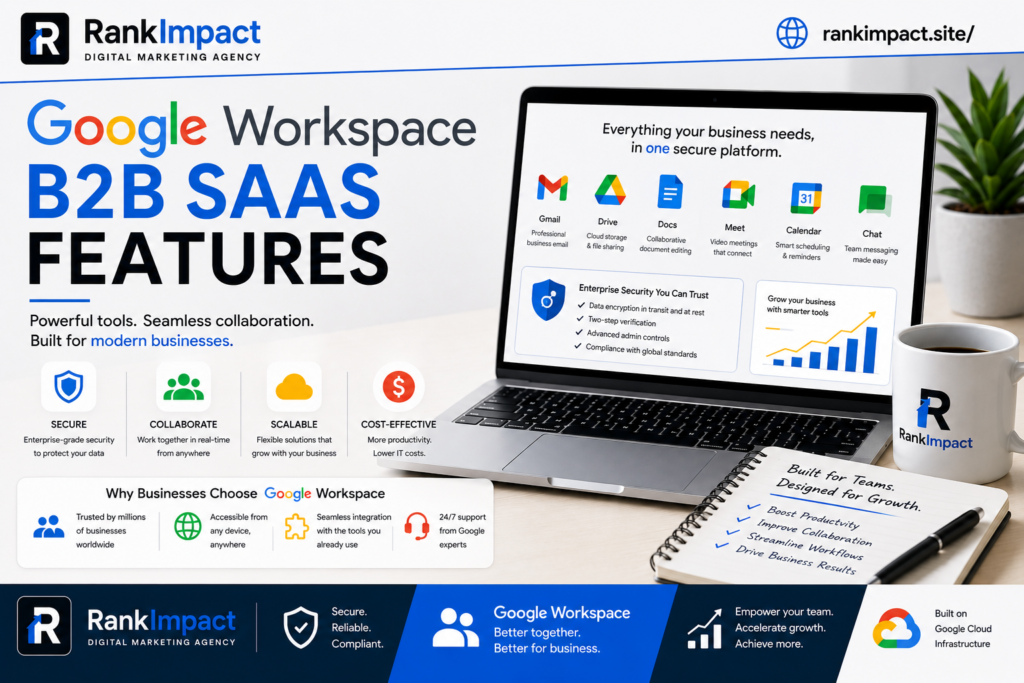
google workspace b2b saas features

Google Workspace B2B SaaS Features A Complete Guide for Growing Teams

B2B SaaS companies run on collaboration, and few decisions shape daily operations as quietly but significantly as which productivity suite a growing team standardizes on. Google Workspace B2B SaaS features have become a central part of that conversation because so many software companies, from early stage startups to companies preparing for enterprise sales, rely on the suite for everything from internal communication to client facing documentation and security compliance. Understanding exactly which features matter for a B2B SaaS context, rather than treating Workspace as a generic office tool, helps founders and operations leaders make a more informed decision and get significantly more value out of the platform once adopted.

This guide is written for founders, operations leaders, and IT decision makers at B2B SaaS companies evaluating or already using Google Workspace. Readers researching this topic typically fall into a few groups. Some are early stage founders comparing Workspace against alternatives before committing to a company wide tool. Others are operations or IT leads at a scaling SaaS company trying to understand which plan tier and features actually matter as headcount grows and enterprise customers start asking security questions. And some are simply trying to understand how Workspace’s collaboration and security capabilities map onto the specific needs of a subscription software business. This article addresses all three by covering the platform’s core capabilities, plan structure, and practical considerations in depth.

Why Google Workspace Matters Specifically for B2B SaaS Companies

Unlike many industries, B2B SaaS companies operate with a particular set of demands around collaboration, security, and scale. Product, engineering, sales, and customer success teams need to share documents and coordinate constantly, often across distributed or fully remote teams. At the same time, B2B SaaS companies frequently sell into enterprise customers who scrutinize vendor security practices closely, which means the internal tools a SaaS company uses can directly affect how credible it appears during a buyer’s own due diligence process.

Google Workspace is positioned as a cloud based productivity and communication suite that combines email, document creation, video meetings, and file storage into a single connected ecosystem, and its collaborative editing and flexible video meeting capabilities have made it a common default for companies operating in hybrid or fully remote structures where teams need real-time collaborative editing of documents and flexible video meetings to stay productive across distance. For a B2B SaaS company specifically, this means engineering documentation, sales proposals, customer onboarding materials, and internal knowledge bases can all live within one connected environment rather than fragmented across disconnected tools. Substack

Core Collaboration Features B2B SaaS Teams Actually Use

Real time collaborative editing across Docs, Sheets, and Slides remains one of the most heavily used capabilities for SaaS teams, allowing product managers, engineers, and customer facing teams to work on the same specification document, roadmap, or client presentation simultaneously without the version control chaos that plagues teams relying on emailed file attachments. Sheets in particular tends to become a lightweight operational tool for SaaS companies well beyond basic spreadsheets, often used for tracking sales pipelines, customer health scores, and lightweight reporting before a company invests in dedicated tools for those functions.

Google Chat and Spaces have grown into a genuine internal collaboration hub for many companies, functioning as lightweight project coordination spaces where project-based Spaces act like lightweight project management boards while AI-suggested tasks automatically create to-do lists from conversations. For a SaaS company juggling multiple concurrent projects across engineering sprints, customer escalations, and marketing campaigns, this kind of lightweight built in coordination reduces the need to immediately purchase a separate project management tool during early growth stages. Evolve Web Hosting

Google Meet handles video communication for internal standups, customer calls, and sales demonstrations, and increasingly includes AI supported capabilities such as live speech translation, which empowers seamless global collaboration in real time and is particularly relevant for B2B SaaS companies selling into international markets with distributed customer bases and support teams. Devoteam

Security and Compliance Features That Matter for B2B Sales

Security capability within Google Workspace becomes especially important for B2B SaaS companies because internal tool security directly intersects with the trust a company must build with its own enterprise customers. Higher tier plans include capabilities such as eDiscovery, data retention and archiving through Vault, secure LDAP, and advanced endpoint management, features specifically designed for companies that need added security and control features as they scale and begin handling more sensitive customer data internally. North Carolina Bar Association

For a SaaS company preparing for its first enterprise deals or pursuing a SOC 2 audit, having demonstrable data retention policies and endpoint management in place across its own internal tools strengthens its position significantly during a prospective customer’s own vendor security review. Enterprise plan tiers extend these controls further, offering the kind of granular administrative oversight that larger prospective customers often specifically ask about during procurement conversations.

Two step verification and built in spam and phishing protection within Gmail further reduce the risk of the kind of credential compromise that remains one of the most common entry points for security incidents at growing companies, an especially important consideration for SaaS companies handling customer data as part of their core product.

AI Features Reshaping How SaaS Teams Work

Artificial intelligence capability has expanded rapidly across Google Workspace and increasingly shapes how SaaS teams draft documentation, prepare customer materials, and manage information across scattered internal sources. A capability that generates a complete first draft from a prompt, synthesizing context directly from a company’s own Drive, Gmail, and Chat history, allows teams to produce polished internal reports or customer facing materials significantly faster than starting from a blank page, since Gemini pulls from your Drive, Gmail, and Chat to generate a fully formatted first draft based on a simple natural language description of what is needed. Data Pilot

A related capability addresses a common pain point in collaborative SaaS environments where multiple contributors write in noticeably different tones within the same document, since a feature that lets a user select a reference document allows Gemini to rewrite new content to match its style and register, which matters considerably for customer facing documentation like proposals or onboarding guides where a consistent voice affects how professional the material appears. Data Pilot

NotebookLM has also become genuinely useful for SaaS teams synthesizing large volumes of internal knowledge, whether product documentation, customer research, or competitive analysis, into more digestible formats. Higher tier AI access adds capabilities such as generating high-value outputs with infographics, audio overviews and mind maps, which SaaS teams increasingly use to turn dense internal research into material that is easier for other teams to actually absorb and act on. Devoteam

Choosing the Right Plan Tier as a B2B SaaS Company

Google Workspace offers several plan tiers, and choosing correctly matters considerably for a B2B SaaS company balancing cost against genuine operational need. The entry level Business Starter plan is the most limited in terms of applications, storage, and video meeting capacity, making it generally suitable only for very early stage teams with minimal storage and collaboration demands rather than a company preparing to scale.

Business Standard extends storage significantly and adds capabilities including NotebookLM, e-signatures, and appointment booking pages, which tend to matter more once a SaaS company has active sales and customer success motions requiring signed agreements and scheduled customer calls. This tier represents a reasonable middle ground for companies past the earliest founding stage but not yet large enough to require the most advanced security and compliance controls. North Carolina Bar Association

Business Plus becomes relevant once a company needs the security and compliance depth described earlier, including eDiscovery, Vault for data retention and archiving, secure LDAP, and advanced endpoint management alongside significantly expanded storage per user. Most B2B SaaS companies approaching their first serious enterprise sales conversations or beginning formal compliance work should evaluate whether Business Plus, or the Enterprise tier for companies with more advanced control requirements, better matches their actual operational and sales stage rather than defaulting to whichever plan was chosen at initial signup. North Carolina Bar Association

Common Mistakes B2B SaaS Companies Make With Workspace

One frequent mistake is selecting a plan tier during initial company setup and never revisiting that decision as the company scales, resulting in either paying for capability the team does not use or, more commonly, operating without security controls that become genuinely necessary once the company starts handling more sensitive customer data or pursuing enterprise deals. Revisiting plan tier alongside company milestones, such as the first enterprise customer or the beginning of a formal compliance audit, prevents this mismatch from persisting unnoticed.

Underutilizing the built in collaboration and lightweight project tools represents another common gap, where teams purchase additional dedicated tools for functions that Chat, Spaces, and Sheets could reasonably handle during earlier growth stages, adding unnecessary tool sprawl and cost before it becomes genuinely necessary. Conducting a periodic audit of which paid tools genuinely earn their cost against what Workspace already provides often reveals opportunities for consolidation.

Many companies also fail to configure administrative and security settings deliberately, instead relying entirely on default configurations that may not reflect the specific risk profile of a company handling customer data as part of its core product. Taking time to review admin console settings, particularly around data sharing defaults and third party app access, closes a gap that many growing SaaS companies overlook until a customer security questionnaire forces the issue.

Finally, companies frequently underinvest in training their own team on newer AI capabilities as they roll out, missing genuine productivity gains simply because staff continue using the platform the same way they did years earlier. A brief internal walkthrough whenever significant new capability becomes available meaningfully increases actual adoption compared to assuming staff will discover new features independently.

Integrating Google Workspace Into a Broader SaaS Tool Stack

Google Workspace rarely operates as a company’s only tool and instead functions as connective tissue between more specialized platforms a B2B SaaS company relies on, including its CRM, support desk, and engineering tools. Evaluating how well a prospective or existing integration connects with Workspace, particularly around calendar, Drive, and Gmail, meaningfully affects daily workflow efficiency for sales and customer success teams especially, since context switching between disconnected tools quietly consumes significant time across a growing team.

Single sign on integration connecting Workspace with other core company tools reduces both password fatigue and security risk simultaneously, and should be treated as a priority configuration step for any SaaS company running multiple connected platforms across its team rather than an optional convenience.

Frequently Asked Questions

What are the most important Google Workspace B2B SaaS features for a growing team?

The most important Google Workspace B2B SaaS features typically include real time document collaboration, Vault for data retention, advanced endpoint management, and AI capabilities like Gemini for drafting and NotebookLM for synthesizing internal knowledge.

Which Google Workspace plan is best for an early stage B2B SaaS startup?

Business Standard generally offers the best balance for early stage SaaS startups, providing expanded storage and features like e-signatures and appointment booking without the higher cost of enterprise level security controls not yet needed at that stage.

Does Google Workspace support the security requirements enterprise SaaS buyers expect?

Higher tier Workspace plans include eDiscovery, Vault data retention, secure LDAP, and advanced endpoint management, which can support the kind of internal security posture enterprise buyers often expect vendors to demonstrate during procurement review.

How does Google Workspace AI help B2B SaaS teams specifically?

Google Workspace AI features help B2B SaaS teams draft documentation faster by generating content directly from prompts using existing Drive and Gmail context, maintain consistent tone across collaborative documents, and synthesize large volumes of internal research into more digestible formats.

Can Google Workspace replace a dedicated project management tool for a SaaS company?

For early stage teams, Chat and Spaces can reasonably handle lightweight project coordination, though most SaaS companies eventually adopt a dedicated project management tool once team size and workflow complexity grow beyond what built in features comfortably support.

How often should a SaaS company review its Google Workspace plan tier?

A SaaS company should revisit its Workspace plan tier at major company milestones, such as landing its first enterprise customer or beginning a formal compliance audit, rather than leaving the original plan selection unreviewed indefinitely.

Is Google Workspace suitable for B2B SaaS companies with international teams?

Yes, features including live speech translation in Google Meet and broadly available cloud based access make Workspace particularly suitable for B2B SaaS companies with distributed international teams and customer bases.

What is the difference between Business Plus and Enterprise Workspace plans?

Business Plus provides substantial security and storage capability suitable for most scaling SaaS companies, while Enterprise plans extend administrative control and security depth further for larger organizations with more advanced compliance and governance requirements.

Conclusion

Google Workspace B2B SaaS features extend well beyond generic office productivity once a company understands which specific capabilities matter at each stage of growth. Collaboration tools support the fast moving coordination SaaS teams depend on daily, security and compliance features directly strengthen a company’s credibility during enterprise sales conversations, and rapidly expanding AI capability increasingly changes how quickly teams can produce polished internal and customer facing material. Companies that deliberately match their plan tier and configuration to their actual operational stage, rather than leaving early decisions unreviewed, consistently get significantly more value from the platform as they scale.
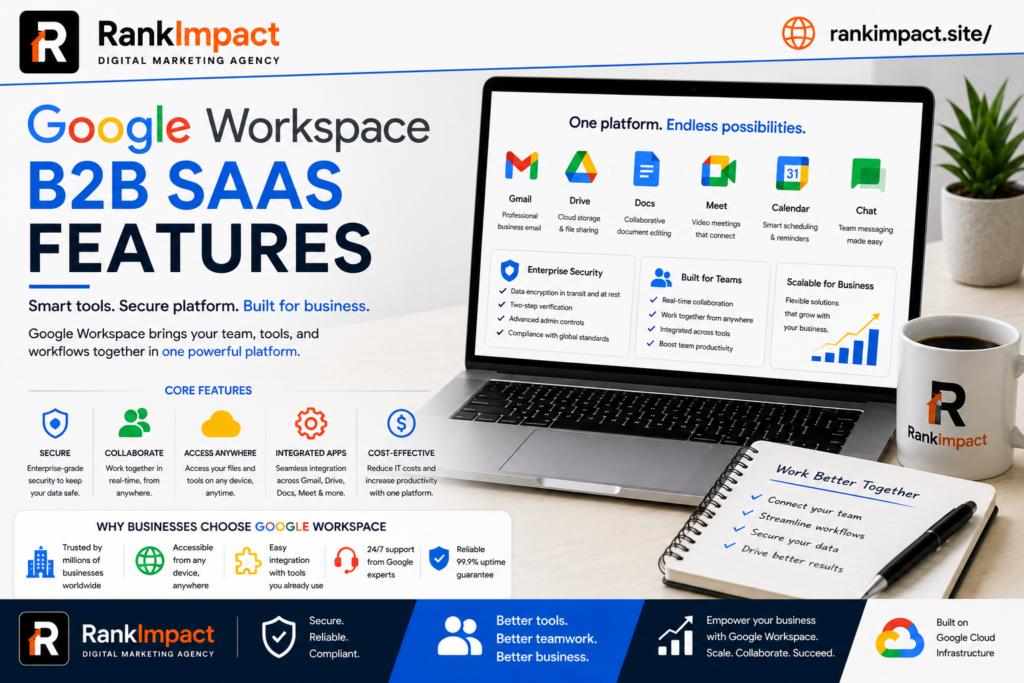
Key Takeaways

Google Workspace B2B SaaS features span collaboration, security, and increasingly sophisticated AI capability that directly supports how growing software companies operate daily. Security features like Vault, secure LDAP, and advanced endpoint management become particularly important once a SaaS company begins pursuing enterprise customers who scrutinize vendor security practices closely. AI capabilities including prompt based document generation and cross tool knowledge synthesis increasingly change how efficiently SaaS teams produce internal and customer facing material. Common mistakes include never revisiting plan tier as the company scales and relying on default security configurations without deliberate review. Treating Workspace as connective tissue across a broader SaaS tool stack, with attention to integrations and single sign on, improves daily efficiency significantly as a team grows.
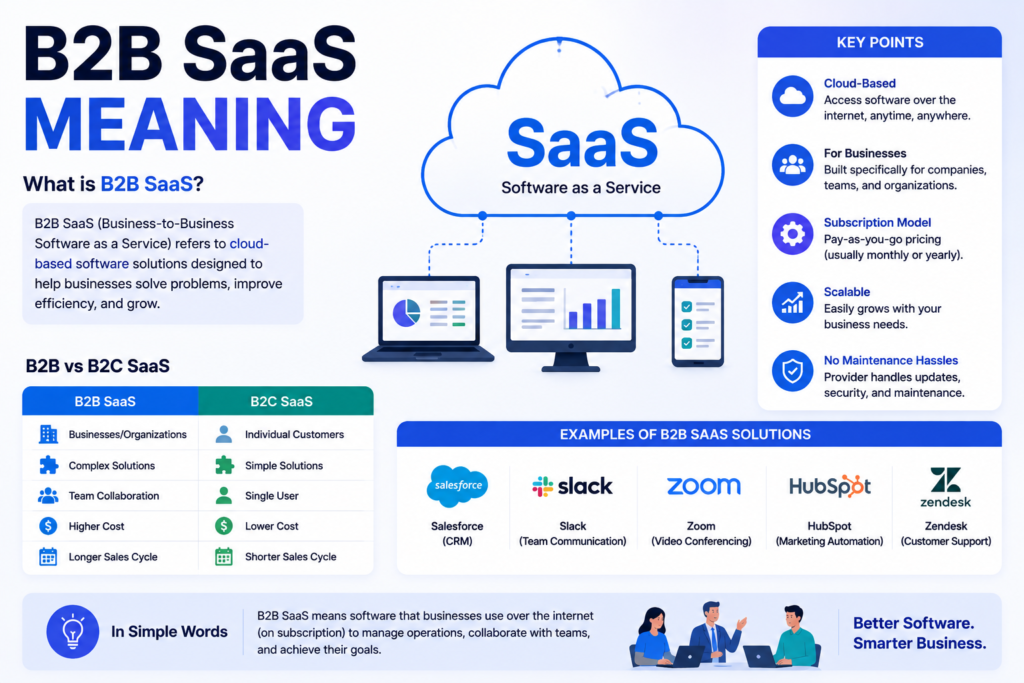
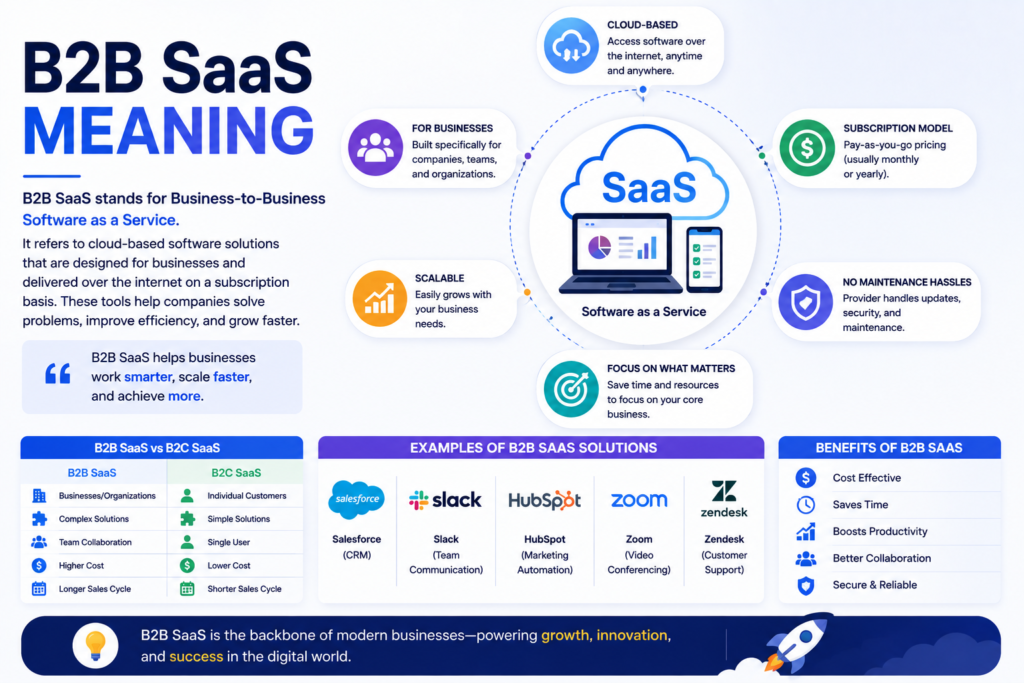
B2B SaaS Meaning What It Is & How It Works 2026

Discover the true B2B SaaS meaning, how it differs from B2C SaaS, real pricing models, key benefits, challenges, and proven best practices for 2026 growth.

B2B SaaS meaning

What Is B2B SaaS? Meaning, Business Model, and How It Works

If you have spent any time around startups or enterprise software, you have almost certainly run into the term B2B SaaS, thrown around in pitch decks, job titles, and investor calls though many people who use it daily could not explain it clearly if asked. Understanding the B2B SaaS meaning matters whether you are a founder building your first product, a marketer positioning a subscription tool, or simply someone making sense of the software economy that now quietly runs most modern businesses.

At its core, B2B SaaS meaning refers to software-as-a-service products that are sold by one business to another business, rather than to individual consumers. Instead of buying a one-time software license or installing a program on a single computer, companies subscribe to cloud-based tools that help them run payroll, manage customer relationships, track projects, secure their networks, or automate marketing. This article breaks down exactly what B2B SaaS is, how it differs from other software models, the business mechanics behind it, and the practical lessons that separate thriving SaaS companies from the ones that quietly fade away.

What Does B2B SaaS Actually Mean?

This term combines two concepts that are worth separating before putting them back together. B2B, short for business-to-business, describes a commercial relationship where the buyer and the seller are both organizations, not individual consumers. SaaS, short for software as a service, describes a software delivery model where the product is hosted in the cloud and accessed through a subscription rather than purchased outright and installed locally.

Put together, B2B SaaS meaning becomes straightforward: it is cloud-based software that one company sells to another company on a recurring subscription basis, typically billed monthly or annually. The vendor hosts, maintains, updates, and secures the software, while the customer accesses it through a browser or app without needing to manage servers, infrastructure, or manual updates. This is a fundamental shift from the old model of enterprise software, where a company might spend months installing a system on its own servers and paying a large upfront license fee.

A useful way to internalize this definition is to think about tools like Slack, HubSpot, Salesforce, or Zoom. None of these are sold to individual shoppers in a store. They are sold to companies that need better communication, customer relationship management, marketing automation, or video conferencing at scale. Employees use these tools daily, but the purchasing decision, contract, and invoice belong to the business, not the individual.

How B2B SaaS Differs From B2C SaaS

Understanding this model in isolation is helpful, but the distinction becomes much clearer when compared against B2C SaaS, which stands for business to consumer software as a service. B2C SaaS products, such as streaming services, fitness apps, or note taking tools, are sold directly to individual users who typically make fast, low-involvement purchasing decisions based on personal need or curiosity.

B2B SaaS, on the other hand, usually involves a longer and more complex sales cycle. Purchasing decisions are rarely made by a single person. Instead, they often pass through multiple stakeholders, including end users, department heads, finance teams, and sometimes IT or security reviewers who need to approve the tool before it touches company data. This means these companies must build not just a good product, but also a sales and onboarding process that can satisfy multiple decision-makers with different priorities.

Pricing structures also diverge sharply. B2C SaaS tends to favor simple, flat rate subscriptions because individual consumers want predictable, low friction pricing. This side of the market, by contrast, frequently uses tiered pricing, seat based pricing, or usage based pricing that scales with the size and needs of the customer organization. A ten person startup and a thousand person enterprise will often pay very different amounts for access to the same core platform, reflecting the value the tool delivers at different scales.

Finally, customer support expectations differ. B2C users generally accept self service help centers and chatbots. B2B customers, especially those on higher tier contracts, often expect dedicated account managers, onboarding specialists, and service level agreements that guarantee response times. This difference in support expectations shapes how these companies structure their entire customer success function.

Key Characteristics of B2B SaaS Companies

A handful of traits show up consistently across successful companies in this space, and recognizing them helps clarify the practical side of the definition beyond the textbook version.

Recurring revenue sits at the center of the model. Rather than earning a one time payment, these businesses generate monthly recurring revenue (MRR) and annual recurring revenue (ARR), which allows for more predictable financial forecasting and long term planning. This recurring structure also shifts the company’s incentives: retaining and expanding existing customers becomes just as important as acquiring new ones, because churn directly threatens future revenue.

Scalability is another defining feature. Because the software is cloud hosted, a single cloud software company can serve ten customers or ten thousand customers using largely the same underlying infrastructure, with incremental rather than linear cost increases. This scalability is part of why SaaS businesses can achieve high profit margins once they pass a certain customer volume.

Multi-tenancy architecture typically underpins this scalability. Most of these platforms run on a single shared codebase that serves all customers simultaneously, with each customer’s data logically separated and secured far more efficient than maintaining separate instances for every client, and it lets new features reach everyone at once.

Customer success functions as a growth engine rather than a support afterthought. Because this revenue model depends on renewals and upsells, these companies invest heavily in onboarding, training, and proactive account management to ensure customers actually adopt and benefit from the product, not just sign the contract.

Common Types of B2B SaaS Products

This category is broad, and understanding its subcategories helps illustrate just how deeply this model has embedded itself into modern business operations.

CRM platforms, used to track leads, deals, and client communication, represent one of the largest and most mature segments in this space. Marketing automation tools manage email campaigns, lead scoring, and multichannel outreach without manual repetition. HR and payroll platforms streamline hiring, benefits administration, and compliance. Project management tools help distributed teams coordinate work and communicate asynchronously. Accounting software automates invoicing and financial reporting for businesses that no longer want to rely on spreadsheets. Cybersecurity and compliance platforms help organizations protect sensitive data and meet regulatory requirements, a category that has grown substantially as privacy laws have tightened globally.

Each of these categories reflects a different operational pain point, but they all share the same underlying idea: cloud software, sold on subscription, built to help one business run more efficiently by solving a problem for another business.

How B2B SaaS Business Models and Pricing Work

Pricing is where the theory meets the practical reality of running a sustainable company, and it deserves close attention because getting it wrong is one of the most common reasons SaaS businesses struggle.

Seat-based pricing charges customers based on the number of users who access the platform. It’s intuitive and easy to forecast, which is why project management and communication tools often use it, though it can discourage adoption across large teams as customers try to limit paid seats.

Usage-based pricing charges customers according to how much they actually use the product, such as the number of API calls, emails sent, or data processed. This model aligns cost directly with value received and has become increasingly popular among infrastructure and developer focused SaaS companies, though it can make revenue less predictable for the vendor.

Tiered pricing offers multiple packages, often labeled something like Starter, Growth, and Enterprise, each unlocking additional features or higher usage limits. This approach allows a single product to serve small businesses and large enterprises simultaneously, capturing more of the market without building entirely separate products.

Freemium and free-trial models give potential customers limited access to the product before requiring payment, reducing the friction of the traditional B2B sales process and allowing the product itself to demonstrate its value before a purchasing conversation even begins.

Regardless of which pricing model a company chooses, most companies in this space track a similar set of core metrics: monthly recurring revenue, customer acquisition cost, customer lifetime value, and churn rate. These numbers determine whether a SaaS business is genuinely healthy or simply growing on the surface while losing money underneath.

Benefits of B2B SaaS for Businesses

The rapid rise of this model is not accidental. Businesses have adopted this model enthusiastically because it solves real, persistent problems that older software models struggled with.

Lower upfront costs make advanced software accessible even to small and mid-sized businesses that could never have afforded a traditional enterprise license, since there is no need to purchase servers or hire IT staff to maintain on-premise systems.

Automatic updates mean customers always have access to the latest features and security patches without managing upgrade cycles themselves, which also benefits the vendor, who avoids supporting multiple outdated product versions at once.

Accessibility from anywhere has become especially valuable as remote and hybrid work have become standard. Because these tools are cloud-based, employees can log in from any location or device with an internet connection, which has made these tools essential infrastructure for distributed teams.

Faster implementation compared to traditional enterprise software means businesses can start using a new tool in days or weeks rather than the months or years often required for on-premise deployments, allowing companies to solve problems and capture value much sooner.

Common Challenges in B2B SaaS

No business model is without friction, and understanding the challenges is just as important as understanding the benefits when it comes to grasping the full picture.

Long and complex sales cycles remain one of the biggest hurdles. Because multiple stakeholders are usually involved, closing a single enterprise deal can take months, requiring patience and a sales process built around trust rather than urgency.

Churn poses a constant threat to recurring revenue. A customer who cancels their subscription does not just represent a lost sale; they represent lost future revenue that must be replaced through new acquisition, which is typically far more expensive than retaining an existing customer.

Security and compliance expectations have grown significantly stricter. B2B customers, particularly larger enterprises, often require SaaS vendors to demonstrate compliance with frameworks such as SOC 2 or ISO 27001 before they will even consider a purchase, adding real operational overhead for the SaaS company.

Feature bloat can quietly damage a product over time. As these companies try to satisfy diverse customer requests, they risk cluttering their platform with features that serve a small subset of users while making the core product more confusing for everyone else.

Best Practices for B2B SaaS Success

Companies that succeed in this space tend to follow a consistent set of principles, regardless of their specific niche.

Focusing relentlessly on a narrow, well-defined problem before expanding tends to outperform trying to be everything to everyone from day one. The strongest companies in this space typically start by solving one problem exceptionally well for a specific type of customer, then expand outward once that foundation is solid.

Investing in onboarding early pays dividends throughout the customer relationship. A customer who understands how to use the product within their first week is far more likely to renew than one who signs up and struggles to find value, which is why many successful SaaS companies treat onboarding as a core product feature rather than an afterthought.

Building a product that is genuinely easy to use reduces the burden on customer support and increases organic word-of-mouth referrals, both of which lower the overall cost of growth. Aligning sales and customer success teams around shared retention goals, rather than treating the sale as the finish line, helps ensure customers actually achieve the outcomes that justified the purchase in the first place.

Common Mistakes to Avoid in B2B SaaS

Just as there are proven best practices, there are recurring mistakes that quietly undermine otherwise promising companies in this space.

Underpricing the product is one of the most frequent errors, particularly among early-stage companies eager to win their first customers. While it may feel safer to charge less, underpricing often attracts the wrong type of customer, signals lower quality, and makes it painfully difficult to raise prices later without significant pushback.

Ignoring churn until it becomes a crisis is another common misstep. Many teams focus almost exclusively on new customer acquisition while neglecting to monitor why existing customers leave, missing early warning signs that could have been addressed with a simple product change or a proactive support conversation.

Building features based on the loudest customer requests rather than genuine market patterns can lead a product away from its core value proposition, satisfying a handful of vocal users while diluting the experience for the broader customer base.

Neglecting security and compliance until an enterprise deal demands it puts companies in a reactive, high-pressure position. Building compliance readiness early, even as a smaller company, often opens doors to larger deals sooner than expected.

The Future of B2B SaaS

This landscape continues to evolve rapidly. Artificial intelligence is being embedded directly into existing SaaS platforms, automating tasks that once required manual effort and shifting the value proposition from simple software access toward genuine productivity gains. Vertical SaaS, which focuses on serving a single industry deeply rather than serving many industries broadly, continues to gain traction as founders recognize the advantage of deep, specialized expertise over broad, generic tools. Meanwhile, buyers are becoming more discerning, favoring platforms that integrate smoothly with their existing tech stack over standalone tools that create additional silos. Understanding this term today also means understanding that the model itself keeps adapting to new technology and changing buyer expectations.

Frequently Asked Questions

1. What is the simplest definition of B2B SaaS?

B2B SaaS refers to cloud based software that one business sells to another business on a recurring subscription basis, rather than software sold to individual consumers.

2. What does B2B SaaS meaning include that a regular SaaS definition does not?

While SaaS simply refers to cloud hosted, subscription based software, the B2B SaaS meaning adds the specific detail that the buyer is an organization, which shapes pricing, sales cycles, support, and product decisions in ways that consumer focused SaaS does not experience.

3. What are some well known examples of B2B SaaS companies?

Salesforce, HubSpot, Slack, Zoom, and Workday are widely recognized B2B SaaS companies, each serving businesses rather than individual consumers.

4. How is B2B SaaS different from traditional enterprise software?

Traditional enterprise software is often installed on premise with a large upfront license fee, while B2B SaaS is cloud hosted, subscription-based, and maintained entirely by the vendor, requiring far less internal IT infrastructure.

5. Why do B2B SaaS companies use tiered pricing?

Tiered pricing allows a single product to serve small businesses and large enterprises simultaneously by offering different feature sets and usage limits at different price points.

6. What is customer churn in B2B SaaS, and why does it matter?

Churn refers to the rate at which customers cancel their subscriptions. It matters because B2B SaaS revenue depends on ongoing subscriptions, so high churn directly threatens long term revenue stability.

7. Is B2B SaaS the same as SaaS in general?

Not exactly. SaaS is the broader delivery model, while B2B SaaS specifically describes SaaS products sold to businesses rather than individual consumers, which is an important distinction when discussing sales strategy and pricing.

8. What metrics matter most for evaluating a B2B SaaS company?

Monthly recurring revenue, annual recurring revenue, customer acquisition cost, customer lifetime value, and churn rate are the core metrics most commonly used to evaluate the health of a B2B SaaS business.

9. Why is onboarding so important in B2B SaaS?

Strong onboarding helps customers realize value quickly, which directly improves retention and reduces the likelihood of early cancellation, making it a critical part of long term SaaS growth.

10. Is B2B SaaS a good business model to start in 2026?

Yes, for founders who can identify a specific, underserved business problem, B2B SaaS remains a strong model due to its recurring revenue, scalability, and growing demand for AI enhanced automation across industries.

Conclusion

The B2B SaaS meaning goes far beyond a simple dictionary definition. It represents a fundamental shift in how businesses buy, deploy, and depend on software, replacing clunky, expensive, on premise systems with flexible, cloud based tools that scale alongside the companies that use them. From CRM platforms to payroll systems to cybersecurity tools, this category of software has quietly become the operational backbone of the modern business world. Understanding how this model works, including its pricing structures, its genuine benefits, and the real challenges companies face while building and scaling it, gives founders, marketers, and industry professionals a much clearer picture of why B2B SaaS continues to dominate the software economy and what it takes to succeed within it.

Key Takeaways

  • B2B SaaS meaning refers to cloud based software sold by one business to another business on a recurring subscription basis.
  • B2B SaaS differs from B2C SaaS through longer sales cycles, multiple decision-makers, and more complex pricing models.
  • Recurring revenue, scalability, multi tenancy, and strong customer success functions define successful B2B SaaS companies.
  • Common B2B SaaS pricing models include seat-based, usage based, tiered, and freemium structures.
  • Long sales cycles, churn, and compliance requirements remain among the biggest challenges in the B2B SaaS space.
  • Focusing on a narrow problem, investing in onboarding, and prioritizing retention are proven best practices for B2B SaaS success.
  • The future of B2B SaaS is increasingly shaped by AI integration and the rise of vertical, industry specific platforms.

Get Your FREE SEO Audit

Enter your details below. Our team will review your website and email you a comprehensive SEO and speed report within 24 hours.