Learn how SaaS B2B marketing really works channels, funnel strategy, metrics that matter, and mistakes that quietly stall growth. Read the full guide.
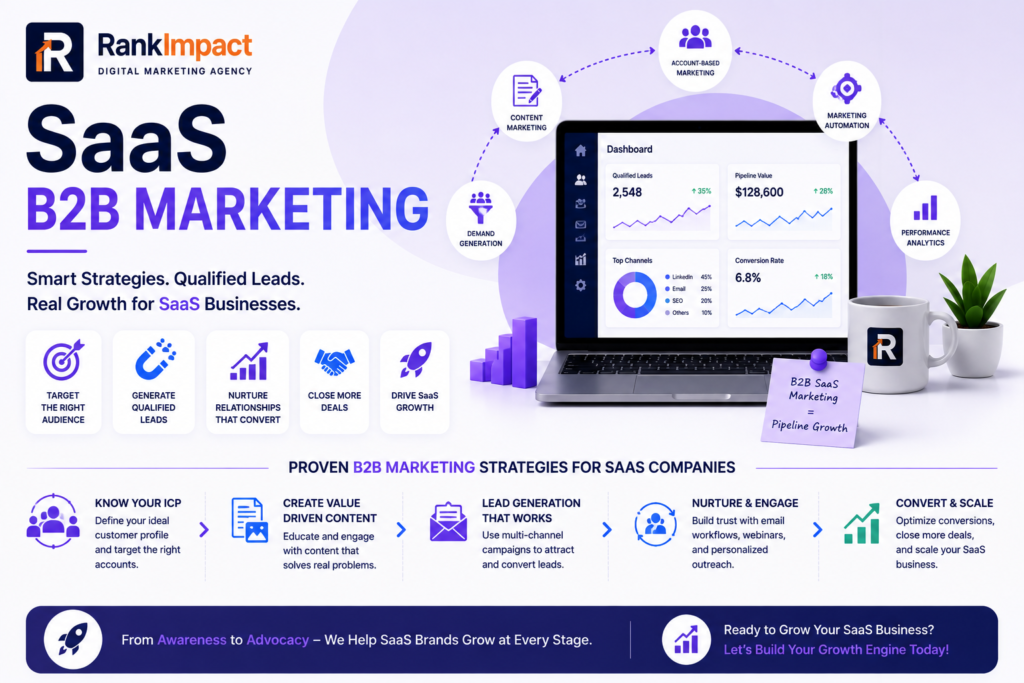
Table of Contents
What Is SaaS B2B Marketing?
SaaS B2B marketing runs on a completely different set of rules than marketing a physical product or a one time service. When a business buys software, the decision is rarely made by one person in one meeting. It typically involves a champion, budget holder, end-user team, and sometimes IT or procurement before a contract gets signed.
How SaaS B2B Marketing Drives LongTerm Growth
The work doesn’t stop after the contract is signed. Customers need to renew, expand their usage, and eventually become advocates for the product, or the recurring revenue model can suffer. Effective SaaS B2B marketing focuses on channels and tactics that generate qualified pipeline rather than vanity metrics, while aligning marketing with the realities of customer acquisition, retention, expansion, and long term growth.
What Makes SaaS B2B Marketing Different From Traditional B2B Marketing
Traditional B2B marketing often optimizes for a single closed won moment get the lead, get the demo, get the signature. Marketing a subscription product has to optimize for that same moment and then keep optimizing for months or years afterward, because monthly or annual recurring revenue depends on customers staying, upgrading, and expanding their usage over time. This shifts the job description considerably. Instead of just generating leads, teams working in this space are increasingly responsible for product adoption content, customer marketing, and expansion campaigns that sit much closer to the customer success function than a traditional demand generation team ever needed to be.
The buying committee is also larger and more distributed than in most traditional B2B categories. A mid market software deal might involve a department head who feels the pain point daily, a VP who controls budget, an IT security reviewer who needs to approve the vendor, and sometimes a procurement team focused purely on contract terms. Content has to speak to all of these audiences with different messaging, not a single generic value proposition repeated across every touchpoint. This complexity is exactly what separates SaaS B2B marketing from simpler transactional selling, and it’s why frameworks borrowed directly from consumer marketing rarely translate cleanly into this world.
Core Channels That Drive Results
Content Marketing and SEO
Organic search remains one of the highest-leverage channels available because buyers actively research solutions before ever speaking to a salesperson. The most effective content strategies map directly to the buyer journey top of funnel educational content that builds awareness, middle-of-funnel comparison and alternatives pages that capture people actively evaluating options, and bottom of funnel pages like pricing, integrations, and use case pages that support the final decision. Companies that treat content as a series of disconnected blog posts rather than a structured system rarely see it compound into meaningful pipeline over time.
Product-Led Growth and Free Trials
Product led growth has fundamentally reshaped how software companies approach acquisition over the last several years by shifting part of the sales process into the product itself. Instead of gating every interaction behind a sales call, PLG companies let prospects experience real value through a free trial or freemium tier before any conversation with a sales rep happens. This approach works exceptionally well for lower complexity products with fast time-to-value, though it tends to work less well for genuinely complex enterprise software where a guided evaluation and multiple stakeholders are simply unavoidable.
Paid Acquisition
Paid channels search ads, LinkedIn ads, and retargeting still play an important role, particularly for capturing high-intent searchers and re engaging visitors who didn’t convert on their first visit. The mistake many teams make is treating paid acquisition as a standalone growth lever rather than an amplifier for content and product-led motions that are already working organically. Paid spend tends to perform best when it’s pointed at proven, high converting pages rather than propping up weak messaging that hasn’t been validated any other way.
Email and Lifecycle Marketing
Because recurring revenue depends on retention as much as acquisition, lifecycle email deserves far more strategic attention than it typically receives. Onboarding sequences, usage based trigger emails, and renewal or expansion campaigns directly influence churn and net revenue retention two of the most important numbers in any subscription business. A well built lifecycle program can often move the needle on revenue more costeffectively than a comparable investment in new customer acquisition.
Customer Marketing and Advocacy
Case studies, customer testimonials, and communitydriven advocacy carry disproportionate weight in software buying decisions, since prospects trust peer validation far more than vendor claims. Building a structured customer marketing motion actively identifying happy customers, capturing their results, and turning them into referenceable stories is one of the most underinvested channels across this space, despite consistently strong returns.
Building a Funnel That Actually Converts
A funnel built around this kind of buying process needs to account for the fact that conversion isn’t a single event it’s a sequence of smaller commitments that build toward a signed contract and, eventually, a renewed one. Top of funnel content should focus on genuinely useful education rather than thinly veiled product pitches, since buyers can spot a sales pitch dressed up as an article within seconds and will simply leave. Middle of funnel content needs to directly address comparison and evaluation questions, because this is exactly where competitors are fighting hardest for the same searcher’s attention.
Bottom of funnel pages pricing, demo requests, and free trial signups deserve disproportionate optimization effort relative to their traffic volume, because even small improvements in conversion rate on these pages have an outsized impact on pipeline. Many companies invest heavily in top of funnel content while leaving their pricing page cluttered, vague, or missing the specific objections that stop a buyer from signing up. Auditing and improving these lower funnel pages is often the highest ROI project available at any given time, yet it’s frequently overlooked in favor of chasing new content volume.
Common Mistakes in SaaS B2B Marketing
One of the most persistent mistakes is chasing traffic instead of pipeline. A blog post that ranks well and drives thousands of visits but attracts the wrong audience contributes nothing to revenue, yet it’s easy to celebrate because the traffic graph looks impressive. Every piece of content and every campaign should be evaluated against whether it’s reaching people who could realistically become customers, not just people who are curious about the topic.
Another common error is neglecting the post-signup experience. Teams often pour resources into acquisition while treating onboarding, activation, and retention as someone else’s job. In a subscription business, a customer who churns after two months erases most of the value that acquisition work went into creating, which means marketing has a direct stake in making sure new customers actually succeed with the product.
Misaligned messaging across the buying committee is another frequent issue. Content written entirely from the perspective of the end user will fail to address the budget-holder’s concerns about ROI, and content that only speaks to ROI will fail to convince the day to day user that the product is actually pleasant and effective to work with. A well run SaaS B2B marketing strategy deliberately builds messaging tracks for each stakeholder rather than assuming one message fits everyone in the room.
Finally, many teams under invest in customer marketing and case studies relative to how much buying decisions actually depend on peer proof. It’s common to see a marketing team with a robust blog and a strong paid program but only two or three outdated customer stories, even though prospects consistently cite peer validation as one of the strongest factors in their final decision.
A subtler mistake worth naming separately is treating every stage of the funnel with equal urgency. Early stage teams especially tend to spread themselves thin across every possible channel at once, rather than getting one or two motions working well before expanding further. A content engine that’s actually driving qualified pipeline is worth far more than five half built channels that never individually reach critical mass.
Metrics That Actually Matter
Vanity metrics like total website traffic or social media followers rarely correlate with revenue outcomes in a subscription business. The metrics that genuinely matter include marketing qualified leads that convert into sales qualified opportunities, trial to-paid conversion rate, customer acquisition cost relative to lifetime value, and critically how marketing sourced customers perform on retention compared to customers acquired through other channels. A channel that generates cheap signups but poor retention is often more expensive in the long run than a slower, higher quality channel that costs more upfront.
Net revenue retention deserves particular attention because it reflects how well the entire customer lifecycle is being managed, not just the initial sale. Teams that track and influence this number, rather than treating it purely as a customer success metric, tend to build far stronger cases for their budget and their strategic value inside the business. When marketing leadership can point to a direct line between specific campaigns and improved retention, budget conversations become dramatically easier to win.
Attribution is another area worth getting right early, even if it stays imperfect. Multi touch attribution models are notoriously difficult to build accurately, especially in longer sales cycles involving several stakeholders and touchpoints spread across months. Rather than chasing a perfect model, most growing teams get more value from a simpler approach: tracking which content and channels show up most often in the journeys of customers who both closed and retained well, then doubling down on those patterns even without perfect certainty about causation. Directionally correct data used consistently tends to outperform a theoretically perfect model that takes a year to build and constantly needs recalibrating.
How to Structure a Marketing Team for This Kind of Business
Early-stage companies typically need generalists who can move across content, paid, and lifecycle marketing simultaneously, since there isn’t yet enough volume in any single channel to justify a dedicated specialist. As a company grows past product market fit and into a scaling phase, specialization becomes more valuable a dedicated content or SEO lead, a paid acquisition specialist, and a lifecycle or customer marketing owner each start to justify their own headcount because the volume and complexity in each channel increases significantly.
Regardless of team size, close alignment with sales and customer success is non negotiable. Marketing needs direct visibility into which content and campaigns are actually influencing closed deals, and customer success needs to feed real usage and satisfaction data back into marketing’s understanding of what a good fit customer actually looks like. Companies that keep these functions siloed consistently struggle to improve their funnel, because each team is optimizing against an incomplete picture of what’s really happening across the full customer lifecycle.
External expertise can also play a useful role at specific inflection points, even for teams that are otherwise building in-house. Bringing in a specialist for a defined project — auditing a stalled content program, restructuring a pricing page, or setting up lifecycle email infrastructure — can move faster than hiring a full-time employee for a problem that may only need concentrated attention for a few months. The key is treating outside help as a way to accelerate a clear internal strategy, not as a substitute for having one in the first place.
FA1. What is SaaS B2B marketing exactly?
Q: SaaS B2B Marketing
SaaS B2B marketing is the practice of promoting subscription based software to business buyers, with strategies built around a longer, multi stakeholder buying process and a revenue model that depends on ongoing retention and expansion rather than a single transaction.
2. How is SaaS B2B marketing different from B2C SaaS marketing?
It typically involves longer sales cycles, multiple decision makers, and higher price points, which means content and campaigns need to address several distinct audiences rather than a single individual consumer making a fast purchase decision.
3. What channels work best for this type of marketing?
Content marketing and SEO, product led growth motions like free trials, targeted paid acquisition, lifecycle email marketing, and customer advocacy programs consistently produce the strongest results, though the ideal mix depends heavily on deal size and product complexity.
4. How important is SEO in a subscription software strategy?
SEO is one of the highest-leverage long-term channels because it captures buyers who are actively researching solutions, and a well structured content strategy compounds in value over time rather than requiring continuous spend like paid channels.
5. What is product led growth and how does it relate to this discipline?
Product-led growth is a go to market strategy where the product itself, often through a free trial or freemium plan, drives acquisition and conversion, shifting part of the traditional sales process into hands on product usage.
6. How do you measure success in SaaS B2B marketing?
Success is best measured through pipeline driving metrics like marketing qualified to sales qualified conversion rates, trial to paid conversion, customer acquisition cost versus lifetime value, and how marketing sourced customers retain over time, rather than surface level traffic or engagement numbers.
7. Why does customer marketing matter in this strategy?
Case studies, testimonials, and peer validation carry significant weight in software buying decisions because prospects trust the experiences of similar companies far more than direct vendor claims, making customer marketing a high return but often underinvested channel.
8. How big should a marketing team be for a growing SaaS company?
Team size depends on company stage early stage companies usually rely on generalists covering multiple channels, while companies past product market fit benefit from specialized roles in content, paid acquisition, and lifecycle or customer marketing as channel complexity grows.
9. What’s the biggest mistake companies make in SaaS B2B marketing?
The most common mistake is optimizing for traffic and lead volume instead of pipeline and retention, which leads to marketing programs that look successful on paper but fail to contribute meaningfully to actual revenue growth.
10. How does marketing influence retention in a subscription business?
Marketing influences retention through onboarding content, lifecycle email sequences, and ensuring the customers being acquired are genuinely a good fit for the product, since poor fit customers acquired for a quick sale tend to churn faster and damage long term revenue.
Conclusion
SaaS B2B marketing succeeds or fails based on how well a team understands that a subscription business isn’t won at the moment of signature it’s won and re-won continuously through onboarding, retention, and expansion. The companies that consistently outperform their competitors treat content, product led growth, paid acquisition, lifecycle marketing, and customer advocacy as connected parts of a single system rather than isolated tactics, and they measure themselves against pipeline and retention rather than surface-level traffic. Building this kind of marketing function takes time and discipline, but it’s the difference between a growth engine that compounds and one that quietly stalls the moment a single channel underperforms.
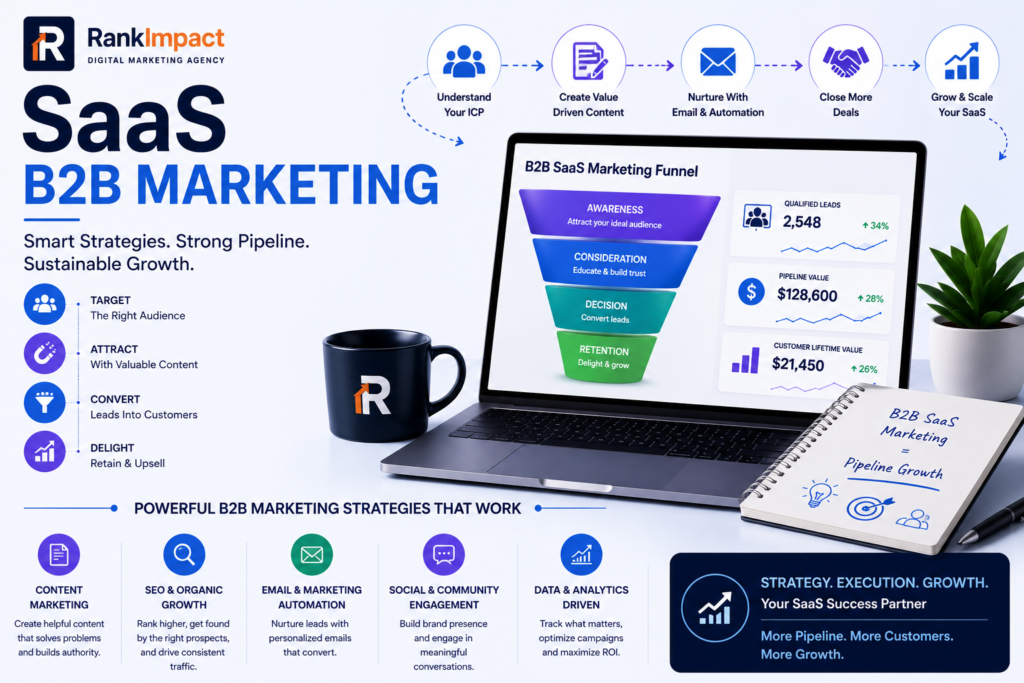
Key Takeaways
- SaaS B2B marketing has to account for a multi stakeholder buying committee and a revenue model built on retention, not just a single closed won moment.
- Content, product led growth, paid acquisition, lifecycle email, and customer advocacy work best as a connected system rather than isolated tactics.
- Bottom of funnel pages like pricing and trial signups deserve disproportionate optimization attention relative to their traffic volume.
- Vanity metrics like traffic and followers should be replaced with pipeline and retention focused metrics.
- Marketing has a direct stake in onboarding and retention, not just acquisition, in a subscription business.
- Team structure should evolve from generalists to specialists as the company scales past product market fit.
- Close alignment between marketing, sales, and customer success is essential for improving the full customer lifecycle.