Assistant project manager guide covering 7 core skills, daily duties, salary range, tools and a clear career path to project manager in 2026 with real examples.
Table of Contents
Every great project has a quiet hero and that hero is often the assistant project manager
Walk into any software company that ships on time and you will find a person who knows where every task stands, who is waiting on whom, and which deadline is about to slip. That person is very often an assistant project manager. The role rarely gets the spotlight, yet it decides whether a launch feels calm or chaotic. This person works beside the project manager, keeps plans moving, protects the schedule, and turns messy conversations into clear next steps. If you are exploring this career, hiring for it, or simply trying to understand how projects really run, this guide gives you a complete and honest picture.
In the next sections you will learn what the role involves every day, how it differs from a project manager and a project coordinator, the 7 skills that matter most, the tools to master, realistic salary data, and a clear path to get hired and grow. Every section includes practical SaaS examples, because software companies run some of the fastest and most demanding projects in the world. By the end you should know exactly what an assistant project manager is expected to deliver and how to become excellent at it.
What an assistant project manager actually does
An assistant project manager is a project management professional who supports a project manager in planning, tracking, communicating, and delivering a project on time and within budget. The role sits between the coordinator level and the full project manager level. A coordinator usually handles tasks and administrative work, while an assistant project manager also owns parts of the plan, such as one workstream, the timeline for a single feature, or the reporting for a specific client. That shared ownership is what makes the position a true stepping stone.
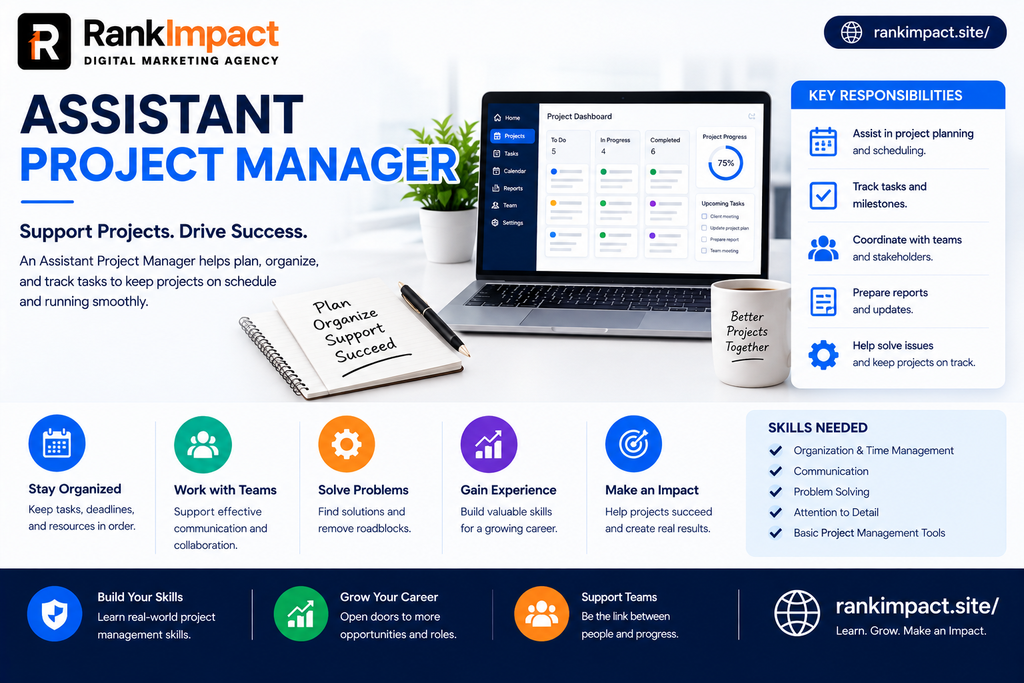
In practice the daily work falls into 5 areas. The first is planning, which means breaking a goal into tasks, estimating effort with the team, and building a schedule that people can actually follow. The second is tracking, which means checking progress against the plan, updating dashboards, and spotting risks before they become problems. The third is communication, which covers meeting notes, status reports, stakeholder updates, and quick clarifications between engineering, design, sales, and customer success. The fourth is documentation, including project charters, requirement lists, decision logs, and lessons learned. The fifth is budget and resource support, where the assistant project manager helps monitor spending, working hours, and team capacity. Each area may look small on its own, yet together they form the backbone of reliable delivery.
The United States Bureau of Labor Statistics describes project management specialists as professionals who coordinate the budget, schedule, staffing, and other details of a project. The SaaS setting is where the role has changed the most, because product teams now work in short sprints and release updates every week or two.
Assistant project manager versus project manager versus project coordinator
Job titles in project management overlap so much that even recruiters mix them up, so it helps to draw clear lines. A project coordinator focuses on administrative support such as scheduling meetings, tracking documents, and following up on tasks. A project manager carries full accountability for scope, time, cost, quality, and the client relationship. An assistant project manager works in the middle. This person shares planning duties, runs small projects or parts of a large one, and steps in for the project manager when needed, but usually does not sign off on final decisions about budget or scope.
Think about a SaaS company launching a new billing feature. The project manager talks with the head of product, sets the launch goal, and approves the budget. The assistant project manager builds the sprint plan with the engineering lead, tracks bugs, prepares the weekly status report, and coordinates the beta test with customer success. The project coordinator books meetings, sends reminders, and files documents. All three roles matter, but the middle role connects daily execution to the larger plan, and that visibility makes it one of the fastest ways to learn the craft.
A real day in the life of an assistant project manager on a SaaS team
Take Sara, a fictional assistant project manager at a company that sells subscription analytics software. Her day begins at 9 with a fifteen minute standup where developers, designers, and a quality tester share progress. She listens for blockers, and when a developer mentions that an integration is waiting on an access key from a customer, she notes it and messages the account manager before the meeting ends. By 10 she has updated the sprint board, moved finished tasks, and flagged 2 items that may slip.
Late morning is reserved for the risk log, where she rates each open risk by likelihood and impact and suggests a backup plan to the project manager. After lunch she joins a call with the customer success team to plan the rollout of a new dashboard, then turns the call into a short action list with owners and dates. The afternoon ends with the weekly status report covering what was completed, what is at risk, and what help is needed. The job is less about giving orders and more about removing friction so smart people can do their best work.
7 skills every assistant project manager needs to succeed
Hiring managers usually look for a blend of hard skills and people skills. These are the 7 that appear in almost every strong assistant project manager profile, along with a practical way to build each one.
Skill 1 Clear and calm communication. Nearly every project problem starts as a communication problem, which is why an assistant project manager must write updates that a busy executive can understand in thirty seconds. Replace vague lines like still working on it with specific lines like the login fix is ready for testing and needs review by Thursday. Practice by rewriting your own emails to be half as long without losing meaning.
Skill 2 Planning and scheduling. Good planning means turning a large goal into small tasks, linking tasks that depend on each other, and finding the critical path, which is the chain of tasks that decides the finish date. Learn to build a work breakdown structure and a simple Gantt chart, and add a buffer of 10 to 15 percent to estimates for uncertain work.
Skill 3 Risk and issue management. A risk is something that might happen, while an issue is something that has already happened. Keep a live risk log, score each item by probability and impact, assign an owner, and review the list every week. Teams that discuss risks early spend far less time firefighting later.
Skill 4 Tool fluency and data comfort. Modern projects live inside software, so you must be quick with boards, timelines, spreadsheets, and dashboards. Being able to pull a burndown chart or build a simple pivot table makes your reports credible.
Skill 5 Stakeholder management. Every project has people with different goals, such as a sales lead who wants speed, an engineer who wants quality, and a client who wants a lower price. A strong professional in this role listens carefully, repeats back what was heard, and negotiates realistic expectations. Learning to say not yet, and explain why, is one of the most valuable habits you can build.
Skill 6 Agile and Scrum knowledge. Most SaaS teams work in sprints, which are short cycles of one to four weeks that end with working software. You should understand sprint planning, daily standups, backlog grooming, reviews, and retrospectives. Reading the Scrum Guide and running a practice sprint on a personal project is a fast way to learn.
Skill 7 Leadership without authority. This role rarely carries formal power over the people doing the work, so influence must come from trust, preparation, and fairness. Follow through on every promise, give credit publicly, and raise problems privately and early. People follow those who make their work easier, and that reputation grows with every project.
Tools an assistant project manager uses every day
Tools change from company to company, but the categories stay the same. For task and sprint tracking, teams rely on Jira, Asana, Trello, Monday, and ClickUp. For documentation and knowledge sharing, Confluence and Notion are common. For communication, Slack and Microsoft Teams carry most of the daily conversation, while short recorded videos are becoming a popular way to share updates without another meeting. For planning and reporting, spreadsheets remain the quiet workhorse, and Microsoft Project or a simple Gantt template handles larger schedules.
Rather than trying to learn everything, choose one board tool and master it deeply, including custom fields, filters, dashboards, and chat integrations. A well organized Jira board with clear columns such as to do, in progress, in review, and done tells the whole story of a project at a glance, and it ends the need for extra status meetings.
Assistant project manager salary and job outlook in 2026
Pay depends on country, industry, company size, and experience, so any single number should be treated as a guide rather than a promise. A helpful benchmark comes from the Bureau of Labor Statistics, which reported a median annual wage of 100750 US dollars for project management specialists in the United States in May 2024. Because an assistant project manager sits below the full project manager level, entry pay usually starts lower and climbs as responsibility grows, especially once the person earns a certification or leads a full project from start to finish.
The demand picture is encouraging. The same agency projects that employment of project management specialists will grow 6 percent from 2024 to 2034, which is faster than the average for all occupations, with about 78200 openings each year once retirements and job changes are included. Readers outside the United States should check current local job listings and salary surveys, because pay in Canada, the United Kingdom, or South Asia differs sharply from American figures.
How to become an assistant project manager in 6 steps
Step 1 Build the educational foundation. Most employers prefer a four year degree in business, management, information technology, or a related field, although the Bureau of Labor Statistics notes that the degree can be in many subjects.
Step 2 Earn an entry level certification. The Certified Associate in Project Management from the Project Management Institute is designed for people who are new to the field, and it shows employers that you understand core terms and processes.
Step 3 Learn the tools. Open a free account on a project tool and manage a real project, even a small one such as planning a family event or a study schedule.
Step 4 Gain hands on experience. Look for coordinator roles, internships, or an internal move into the project office of your current company. Volunteer to take notes in project meetings, maintain the risk log, or run the weekly update.
Step 5 Build a simple portfolio. Create a sample project plan, a risk log, a status report, and a lessons learned summary for a realistic SaaS launch. A portfolio proves you can do the work before you are hired to do it.
Step 6 Prepare for interviews. Expect questions about handling a missed deadline, managing a difficult stakeholder, and prioritizing when everything feels urgent. Answer with short stories that show the situation, your action, and the measurable result. Numbers such as reduced delays by 3 days or saved 12 hours per sprint make your answers memorable.
Common mistakes an assistant project manager should avoid
The first mistake is tracking tasks without understanding the goal. An assistant project manager who only moves cards across a board cannot warn the team when a task no longer supports the outcome. Always ask what success looks like for the customer and for the business.
The second mistake is sending vague or overly long updates. Busy leaders want three things, which are what is done, what is at risk, and what decision is needed. When updates hide the real message inside long paragraphs, important warnings get missed.
The third mistake is hiding bad news. New professionals often fear that reporting a delay will look like failure, but late surprises damage trust far more than early warnings. Share the problem together with a proposed solution and a revised date.
The fourth mistake is saying yes to every request. Constant additions to the plan, often called scope creep, quietly destroy schedules. A strong assistant project manager records each request, explains the impact on time and cost, and lets the project manager or sponsor decide.
Best practices that make an assistant project manager indispensable
Start with one source of truth. When plans live in emails, chat threads, and personal notes, nobody trusts any of them. Choose one board and one document space, and make sure every update goes there first. Next, create a weekly rhythm that the team can rely on, such as planning on Monday, risk review on Wednesday, and a status report on Friday.
Finally, run a short retrospective after every milestone. Ask the team what went well, what slowed them down, and what to change next time, then turn the answers into two or three concrete actions. Teams that do this consistently improve with every release, and the assistant project manager who leads the habit becomes a natural candidate for promotion.
Career path after assistant project manager
Most people spend one to three years as an assistant project manager before moving up, though the timeline depends on results and opportunity. The most common next step is project manager, where you take full ownership of scope, budget, and client communication. From there the road branches. You can grow into senior project manager, program manager, or head of the project management office, where you oversee many projects at once. You can also move sideways into Scrum master, product operations, business analysis, or product management, since all of these roles reward the same planning and communication skills.
Certifications support each step. After gaining experience leading projects, many professionals pursue the Project Management Professional credential, and keeping a record of results such as projects delivered and hours reclaimed strengthens every salary discussion.
Frequently asked questions about the assistant project manager role
What does an assistant project manager do?
An assistant project manager supports the project manager by building schedules, tracking tasks, managing risks, preparing status reports, and coordinating communication between team members and stakeholders.
Is an assistant project manager the same as a project coordinator?
No. A coordinator mainly handles administrative support, while an assistant project manager also owns parts of the plan and may lead smaller projects or workstreams.
How much does an assistant project manager earn?
Pay varies by country and industry. The United States median for project management specialists was 100750 US dollars in May 2024, and assistant level roles usually start below that figure and rise with experience and certification.
Do you need a degree to become an assistant project manager?
A degree in business, management, or technology is common and helpful, but it is not always required. Certifications, practical experience, and a strong portfolio can also open the door.
Which certification is best for an assistant project manager?
The Certified Associate in Project Management from the Project Management Institute is a popular entry level choice. A Scrum foundation certificate is a useful addition for software teams.
What skills does an assistant project manager need?
The most important skills are clear communication, planning, risk management, tool fluency, stakeholder management, Agile knowledge, and leadership without formal authority.
How long does it take to move from assistant project manager to project manager?
Many people make the move in one to three years, depending on performance, company size, and the chance to lead a complete project.
Can an assistant project manager work remotely?
Yes. Because the work relies on digital tools and written communication, many SaaS companies hire remote assistant project managers, although some prefer overlap in time zones.
What tools should an assistant project manager learn first?
Begin with one task board such as Jira or Asana, then add a spreadsheet tool, a documentation tool like Notion or Confluence, and a team chat platform like Slack.
What are the biggest challenges an assistant project manager faces?
Common challenges include balancing many stakeholder demands, keeping plans realistic, influencing people without formal authority, and delivering bad news early and calmly.
Conclusion Your next step as an assistant project manager
The assistant project manager role is one of the best entry points into a lasting and well paid career. It teaches planning, communication, risk control, and leadership in real conditions, and it gives you a front row seat to how great products reach customers. Success in the role comes from a few repeatable habits, which are writing clear updates, surfacing risks early, learning your tools deeply, and understanding the goal behind every task. Start small by managing one real project this month, build a simple portfolio, and add an entry level certification. With steady practice, an assistant project manager can become a trusted project leader faster than most people expect.
Key Takeaways
Takeaway 1 An assistant project manager supports the project manager with planning, tracking, risk control, and communication.
Takeaway 2 The role sits between project coordinator and project manager and often owns a workstream or a small project.
Takeaway 3 The 7 core skills are communication, planning, risk management, tool fluency, stakeholder management, Agile knowledge, and leadership without authority.
Takeaway 4 The United States median wage for project management specialists was 100750 US dollars in May 2024, with 6 percent growth projected from 2024 to 2034.
Takeaway 5 Follow 6 steps to enter the field, which are education, certification, tools, experience, a portfolio, and interview preparation.
Takeaway 6 Avoid vague updates, hidden bad news, endless scope changes, and missing documentation.
Takeaway 7 Most professionals move up to project manager within one to three years when they deliver results and keep learning.