+92 318 3068833 Get Free Audit

SaaS SEO Services 7 Steps to Choose the Right Partner

Discover 7 key steps to choosing the right SaaS SEO services partner, including what to look for, common mistakes, and pricing tips.
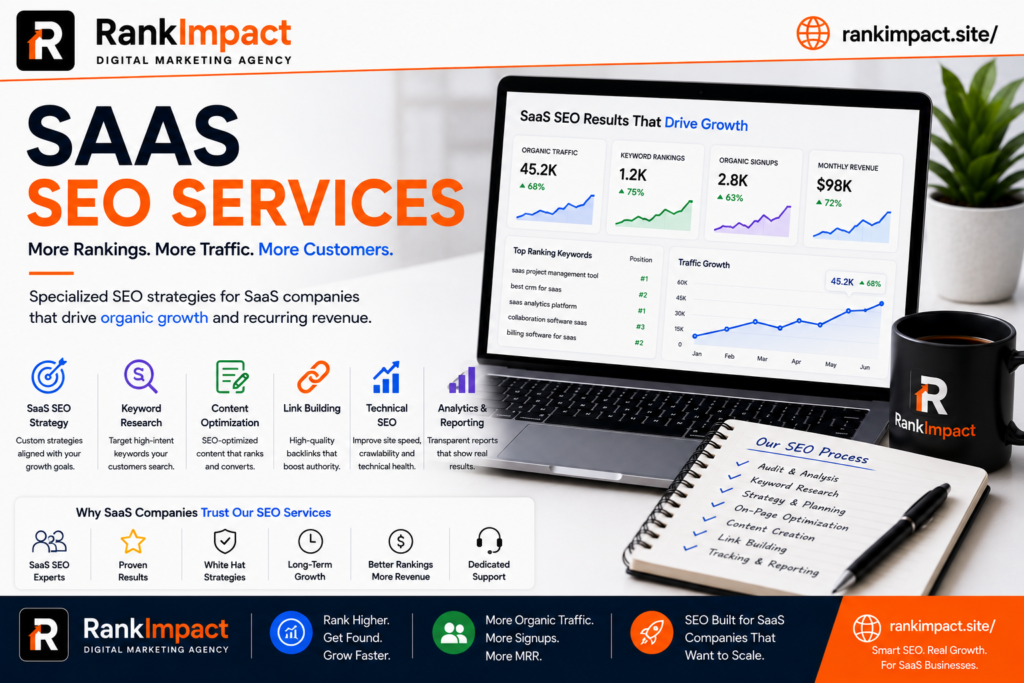
SaaS SEO services

SaaS SEO Services A Complete Guide to Choosing the Right Partner

Choosing between building an internal SEO function and hiring outside help is a decision nearly every growing SaaS company eventually faces, and it rarely has an obvious answer. SaaS SEO services occupy a specific niche within the broader digital marketing industry because ranking a software product involves technical considerations, buyer research patterns, and content depth requirements that differ meaningfully from SEO work in most other industries. A generalist agency comfortable optimizing an ecommerce product page or a local business listing often struggles when asked to build topical authority around a complex software category with a long, research intensive sales cycle.

This guide is written for founders, marketing leaders, and growth teams evaluating whether to bring in SaaS SEO services and, if so, how to actually choose a partner that will deliver genuine results rather than vanity traffic metrics. Readers researching this topic typically fall into a few groups. Some are early stage founders trying to understand what SaaS SEO services actually include before committing budget. Others are marketing leaders who have already tried a generalist agency without success and are trying to understand what a specialized provider does differently. And some are evaluating multiple SaaS SEO services providers and need a framework for comparing them meaningfully. This article addresses all three in depth.

What SaaS SEO Services Actually Include

SaaS SEO services typically cover a combination of strategic, technical, and content focused work specifically tailored to how software buyers research and evaluate products. This usually begins with keyword and topic research grounded in actual buyer intent rather than generic search volume, since a term with high search volume but low genuine buying intent often wastes resources that would be better spent targeting more specific, lower volume terms closer to an actual purchase decision.

Technical SEO work forms another core component, addressing site architecture, page speed, structured data, and crawlability issues that specifically affect how search engines index and understand a SaaS company’s often large and complex website, which frequently includes a marketing site, a documentation section, a blog, and sometimes a separate help center all needing to work together cohesively from a technical indexing standpoint.

Content strategy and production represents the most visible component of most SaaS SEO services, encompassing everything from top of funnel educational content to bottom of funnel comparison and product pages designed to convert readers already deep in an evaluation process. Link building and digital PR often round out a comprehensive service offering, since earning genuine authoritative backlinks remains one of the more difficult but impactful levers within any competitive SEO strategy.

Why SaaS Companies Need a Specialized Approach

Software buyers research differently than consumers or buyers in most other B2B categories, typically consuming a longer sequence of content before ever engaging directly with a sales team, often involving multiple stakeholders within the same purchasing company who each research independently before a group decision is made. SaaS SEO services built around this reality structure content specifically to support this extended, multi stakeholder research process rather than optimizing purely for a single conversion moment.

The competitive landscape within most software categories has also grown considerably more sophisticated, with well funded competitors regularly publishing detailed comparison content, in depth guides, and product led content specifically designed to intercept buyers at every stage of research. Generic SEO tactics that might work adequately in a less competitive industry frequently underperform significantly against this level of sophistication, which is precisely why specialized SaaS SEO services focused specifically on software company growth have become a distinct category within the broader agency landscape.

Search intent within software categories also carries unique complexity, since a single keyword can represent meaningfully different intent depending on subtle phrasing, and providers experienced specifically with SaaS companies tend to recognize these distinctions more reliably than generalist providers accustomed to industries with more straightforward, transactional search behavior.

Core Deliverables to Expect From a Quality Provider

A genuinely comprehensive SaaS SEO services engagement typically begins with a thorough technical and content audit identifying specific gaps and opportunities rather than generic recommendations that could apply to nearly any website. This audit should result in a clear, prioritized roadmap rather than an overwhelming list of every possible improvement without guidance on what actually matters most given the company’s current stage and resources.

Ongoing content production forms the backbone of most engagements, and quality providers typically involve subject matter expertise directly in the process rather than producing generic content written without genuine understanding of the software category or its buyers. This often means structured interviews with a company’s own product and customer success teams to extract genuine expertise that generic freelance writers simply cannot replicate independently.

Regular reporting tied to meaningful business metrics, rather than surface level traffic numbers alone, distinguishes providers genuinely focused on driving pipeline from those primarily focused on demonstrating activity. A provider should be able to clearly connect specific content or technical work to measurable outcomes like organic trial signups or demo requests, even if full attribution remains imperfect given the realistic complexity of a typical SaaS buying journey.

Technical implementation support, not just recommendations, matters considerably as well, since many internal teams lack the bandwidth or specific expertise to implement technical SEO recommendations independently, and a provider willing to work directly within a company’s content management system or alongside its engineering team tends to produce considerably faster and more reliable results than one that simply hands off a list of suggested changes.

How to Evaluate SaaS SEO Services Providers

Reviewing a prospective provider’s own case studies and client results provides useful signal but should be examined critically rather than taken entirely at face value, since traffic growth alone does not necessarily indicate genuine business impact. Asking specifically about how results connected to actual pipeline or revenue for previous SaaS clients reveals considerably more than a chart showing organic traffic climbing over time.

Requesting to speak directly with a current or recent client, ideally one in a similar stage or category to your own company, offers insight that marketing materials alone cannot provide, particularly around how responsive and collaborative the provider actually is once an engagement is underway rather than during the initial sales process when every provider naturally presents its best face.

Evaluating a provider’s own content and organic visibility offers a surprisingly direct signal, since a SaaS SEO services provider that cannot demonstrate strong organic performance for its own website raises legitimate questions about whether they can genuinely deliver that same outcome for a client’s more complex situation.

Understanding exactly who will work on your account day to day, rather than only the senior team members present during the sales process, prevents a common disappointment where impressive initial conversations give way to considerably less experienced staff handling the actual ongoing work once a contract begins.

Common Mistakes Companies Make When Hiring SaaS SEO Services

One of the most frequent mistakes is selecting a provider based primarily on price rather than evaluating genuine fit and experience within the software category specifically, since a lower cost provider lacking real SaaS expertise often ends up costing considerably more in wasted time and missed opportunity than a more expensive specialized provider would have.

Expecting rapid results within the first few months represents another common misstep, since meaningful organic SEO results generally require six to twelve months to materialize even with excellent execution, given how long search engines take to fully recognize and reward genuinely improved topical authority and content depth. Companies that abandon a provider prematurely based on impatience often never see the results that were beginning to build.

Many companies also fail to provide the internal access and collaboration a provider genuinely needs to succeed, treating an external SEO engagement as something that can operate entirely independently without input from product, sales, or customer facing teams who hold genuine expertise the provider needs to produce truly authoritative content rather than surface level material.

Neglecting to align on clear success metrics before an engagement begins creates ongoing friction and unclear expectations later, since a company expecting pipeline impact while a provider is measuring success primarily through traffic growth will inevitably experience a mismatch that becomes apparent only well into the engagement rather than being addressed proactively from the start.

In House SEO Versus Hiring SaaS SEO Services

Deciding between building an internal team and hiring an external provider depends considerably on company stage, budget, and how central organic growth is to the overall growth strategy. Very early stage companies often lack sufficient budget to hire a full internal team while simultaneously lacking sufficient content volume to fully occupy an outside agency’s typical retainer, making a smaller specialized freelancer or boutique provider a more practical starting point than either extreme.

Companies at a more established growth stage frequently find that a hybrid model works best, maintaining a smaller internal team responsible for strategy and internal subject matter coordination while outsourcing specific execution work like technical implementation or content production volume to specialized SaaS SEO services providers who can scale output more flexibly than hiring additional full time staff.

Larger, well resourced companies sometimes eventually build a fully internal team once organic growth has proven itself as a genuinely core growth channel worth dedicated permanent investment, though even at this stage many continue supplementing internal capacity with specialized outside expertise for specific technical audits or competitive analysis work that benefits from an outside perspective.

Pricing Models and Budget Expectations

SaaS SEO services pricing varies considerably depending on scope, provider experience level, and whether an engagement includes content production volume or focuses primarily on strategy and technical work. Monthly retainer models remain the most common structure, typically scaling based on the volume of content produced and the depth of ongoing technical and strategic involvement included within the engagement.

Project based pricing sometimes applies to discrete work like a comprehensive technical audit or a content migration project with a clearly defined scope and endpoint, though most SaaS companies benefit more from an ongoing retainer relationship given how much organic SEO results depend on sustained, consistent effort over an extended period rather than a single discrete project.

Companies should approach unusually low pricing with healthy skepticism, since genuinely effective SaaS SEO services require meaningful time investment from experienced practitioners, and pricing significantly below typical market rates often indicates either less experienced staff, production heavy content mills prioritizing volume over genuine quality, or unsustainable business practices that eventually affect service quality as a provider scales.

Questions to Ask Before Signing a Contract

Asking directly what specific SaaS categories a provider has worked within previously reveals whether their experience genuinely transfers to your own company’s situation, since expertise gained working with consumer subscription apps does not necessarily transfer smoothly to complex B2B software with a considerably longer and more technical buying process.

Understanding exactly how content topics get selected and approved throughout an engagement clarifies how much internal involvement will genuinely be required, preventing a mismatch where a company expects a provider to work entirely independently while the provider actually expects significant ongoing internal collaboration to produce genuinely authoritative content.

Clarifying what happens to content and any accumulated organic assets if the engagement ends helps avoid an unpleasant surprise later, since some providers structure contracts in ways that complicate a company’s ability to continue benefiting from work already completed after a relationship concludes.

Frequently Asked Questions

What do SaaS SEO services typically include?

SaaS SEO services typically include keyword and topic research grounded in buyer intent, technical SEO work, content strategy and production, and link building specifically tailored to how software buyers research and evaluate products.

How much do SaaS SEO services typically cost?

Pricing varies considerably based on scope and provider experience, though most SaaS companies should approach unusually low pricing with skepticism since genuinely effective work requires meaningful time investment from experienced practitioners.

How long does it take to see results from SaaS SEO services?

Meaningful organic results typically take six to twelve months to materialize, even with excellent execution, given how long search engines take to fully recognize genuinely improved topical authority and content depth.

Should an early stage SaaS startup hire SaaS SEO services or build an internal team?

Early stage companies often benefit most from a smaller specialized freelancer or boutique provider, since they typically lack sufficient budget for a full internal team while also lacking enough content volume for a large outside agency retainer.

What makes SaaS SEO services different from general SEO services?

SaaS SEO services address the longer, multi stakeholder buying process, technical complexity, and competitive content sophistication specific to software categories, requiring genuine category expertise that generalist providers often lack.

How can a company evaluate whether a SaaS SEO services provider is genuinely effective?

Companies should review case studies critically, speak directly with current or recent clients, and examine the provider’s own organic visibility as a direct signal of whether they can genuinely deliver similar results.

Do SaaS SEO services include technical implementation or only recommendations?

Quality providers typically offer direct implementation support rather than only recommendations, since many internal teams lack the bandwidth to execute technical SEO changes independently.

What is the biggest mistake companies make when hiring SaaS SEO services?

The biggest mistake is selecting a provider based primarily on price rather than genuine SaaS specific experience, since a cheaper but less specialized provider often costs more in wasted time and missed opportunity.

Can a hybrid model combining internal staff and outside SaaS SEO services work well?

Yes, many established growth stage companies find a hybrid model effective, maintaining internal strategy and subject matter coordination while outsourcing execution and content volume to a specialized provider.

What should be clarified before signing a contract with a SaaS SEO services provider?

Companies should clarify prior category specific experience, how content topics get selected and approved, and what happens to accumulated content and organic assets if the engagement ends.

Conclusion

Choosing among available SaaS SEO services providers requires looking well beyond a polished pitch deck toward genuine category specific experience, transparent reporting tied to real business outcomes, and a collaborative approach that treats a company’s own product and customer expertise as essential to producing content that actually deserves to rank. Companies that invest the time to evaluate providers rigorously, set realistic timeline expectations, and maintain genuine internal collaboration throughout an engagement consistently see stronger, more sustainable results than those that treat outside SEO help as a hands off solution requiring no meaningful internal involvement.
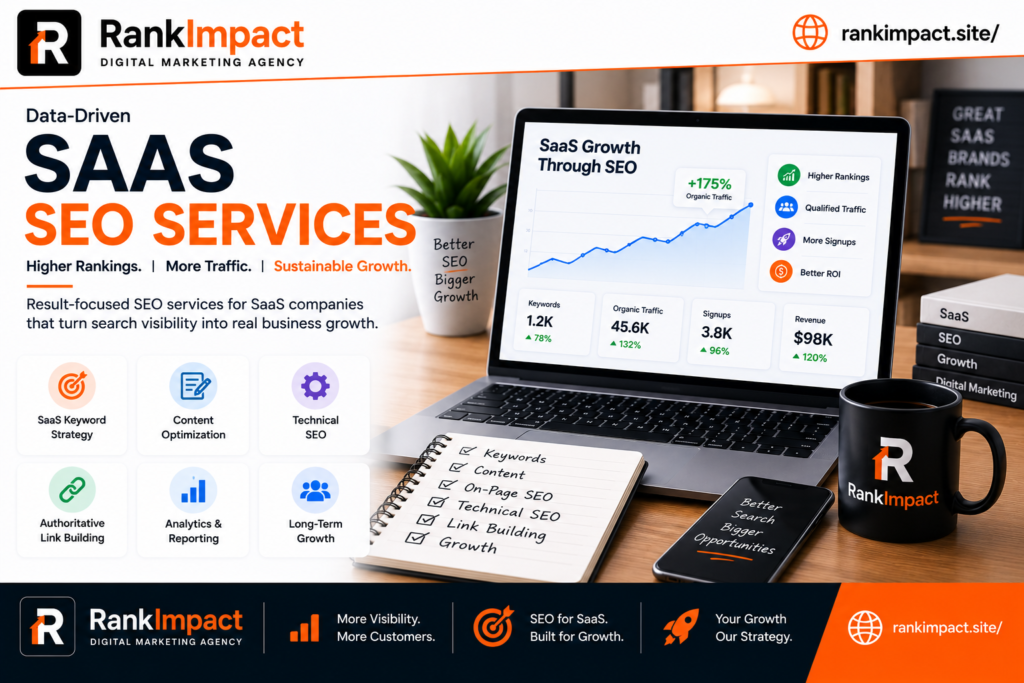
Key Takeaways

SaaS SEO services differ meaningfully from general SEO work due to longer buying cycles, multiple stakeholders, and considerably more sophisticated competitive content within most software categories. A comprehensive engagement should include technical implementation support, not only strategic recommendations left for an internal team to execute independently. Evaluating a provider’s own organic visibility and speaking directly with current clients reveals considerably more than marketing materials or case studies alone. Meaningful results typically require six to twelve months, and companies that abandon a provider prematurely often never see results that were genuinely beginning to build. A hybrid model combining internal strategic ownership with outsourced execution frequently works best for companies at a more established growth stage.
SaaS Development Services Guide and Cost Breakdown 2026

Explore what saas development services actually include, real 2026 pricing by project stage, and how to choose a partner who delivers on time and on budget.

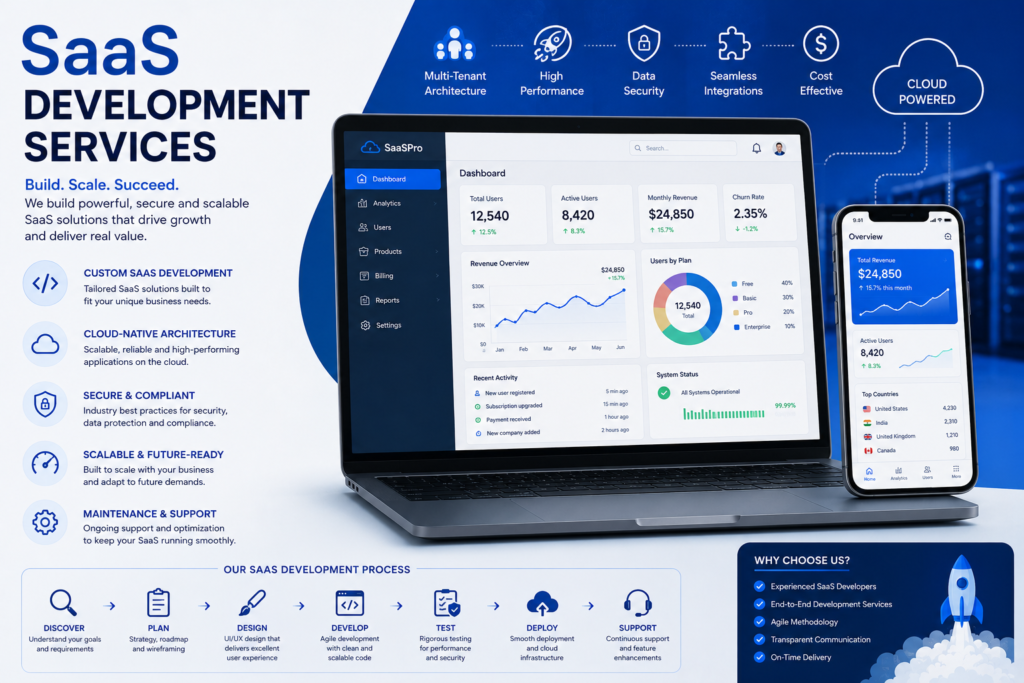
saas development services

SaaS Development Services: What They Include, Costs, and How to Choose the Right Partner

Building a SaaS product is one of the most capital efficient business models available today, but only if the software actually gets built well the first time. Founders who try to save money by cutting corners on development usually end up paying for it twice, once in wasted engineering hours and again in the rebuild that follows. Saas development services exist to close that gap, giving founders and product teams access to the architecture experience, delivery discipline, and specialized skills that a typical in house team may not have yet, especially in the early stages of a company. This guide walks through exactly what these services include, how pricing actually breaks down, what the engagement process looks like from discovery to launch, and how to choose a partner that will still be a good decision eighteen months from now. Whether you are scoping your first MVP or bringing in support for a mature product, understanding what these services really cover will save you both time and money.

What SaaS Development Services Actually Include

The phrase gets used loosely across the industry, so it helps to be specific about what a genuine engagement covers rather than treating it as a vague catch all term for writing code.

Product discovery and technical scoping typically comes first, where a development partner works with you to translate a business idea into a defined feature set, data model, and architecture plan before a single line of production code gets written. Skipping this phase is one of the most common reasons SaaS projects run over budget, since undefined scope tends to expand quietly during the build.

Architecture and infrastructure design covers decisions like multi tenancy strategy, database structure, authentication approach, and hosting environment, all of which are far more expensive to change after launch than to get right during planning. A rushed architecture decision made in week one can quietly cost tens of thousands of dollars in rework a year later.

Core application development is the part most people picture when they think of saas development services, covering the actual frontend and backend build, API design, and integration work needed to bring the product to a usable state.

Billing and subscription logic deserves its own mention because it is genuinely more complex than founders expect, covering trial periods, proration, plan upgrades and downgrades, dunning management for failed payments, and usage based pricing where applicable.

Quality assurance and testing should run in parallel with development rather than as an afterthought squeezed in before launch, covering automated testing, security review, and performance testing under realistic load.

DevOps and deployment pipeline setup ensures the product can actually ship reliably once built, covering continuous integration, staging environments, monitoring, and rollback procedures so a bad deploy does not become a customer facing outage.

Post launch support and iteration rounds out a complete engagement, since a SaaS product is never really finished at launch, and ongoing support often shifts toward bug fixes, performance tuning, and new feature delivery based on real user feedback.

Types of SaaS Development Services Engagement Models

Not every project needs the same relationship structure, and choosing the wrong model is a common source of friction between founders and their development partner.

Fixed price engagements work well for narrowly scoped projects with a clear, stable set of requirements, giving budget certainty in exchange for less flexibility if priorities shift mid project.

Dedicated team models place a group of developers, designers, and a project lead under your direction for an extended period, functioning much like an extension of your own team while giving you more control over day to day priorities than a fixed price contract allows.

Time and materials arrangements bill based on actual hours worked, which suits projects where requirements are expected to evolve as the product takes shape, though it requires more active oversight from the client to keep scope and budget aligned.

Staff augmentation is a lighter touch option where a provider supplies individual specialists, such as a backend engineer or a DevOps specialist, to slot directly into an existing in house team rather than delivering an entire self contained engagement.

How Much SaaS Development Services Cost in 2026

Pricing is the question every founder actually wants answered, and the honest response is that it depends heavily on scope, region, and compliance requirements rather than any single flat number.

A basic validation prototype built purely to test demand generally runs in the low five figures, since the goal is speed and learning rather than production grade polish. A lean minimum viable product with core functionality and clean design typically lands in the range of seventy five thousand to one hundred forty thousand dollars depending on feature complexity and integrations required. A market ready product with a fuller feature set, stronger security, and production grade infrastructure commonly falls between one hundred forty thousand and two hundred eighty thousand dollars. Enterprise grade platforms requiring single sign on, detailed audit trails, and strict compliance certifications can run from two hundred eighty thousand dollars well past half a million depending on scope.

Regional rate differences move the final number more than almost any other single factor. United States based development teams commonly bill in the range of one hundred fifty to three hundred dollars per hour, while experienced teams in regions such as Eastern Europe or South Asia often deliver comparable technical quality in the range of thirty five to ninety nine dollars per hour, which is why so many founders blend a US based product lead with an offshore engineering team to balance cost and communication.

Hidden costs are worth planning for explicitly, since design, quality assurance, DevOps setup, and post launch maintenance together commonly add forty to sixty percent on top of the base development quote, and a project quoted at eighty thousand dollars can realistically land closer to one hundred twenty or one hundred thirty thousand once those line items are included.

The SaaS Development Services Process From Discovery to Launch

Understanding the typical delivery timeline helps set realistic expectations before signing a contract with any provider offering this type of engagement.

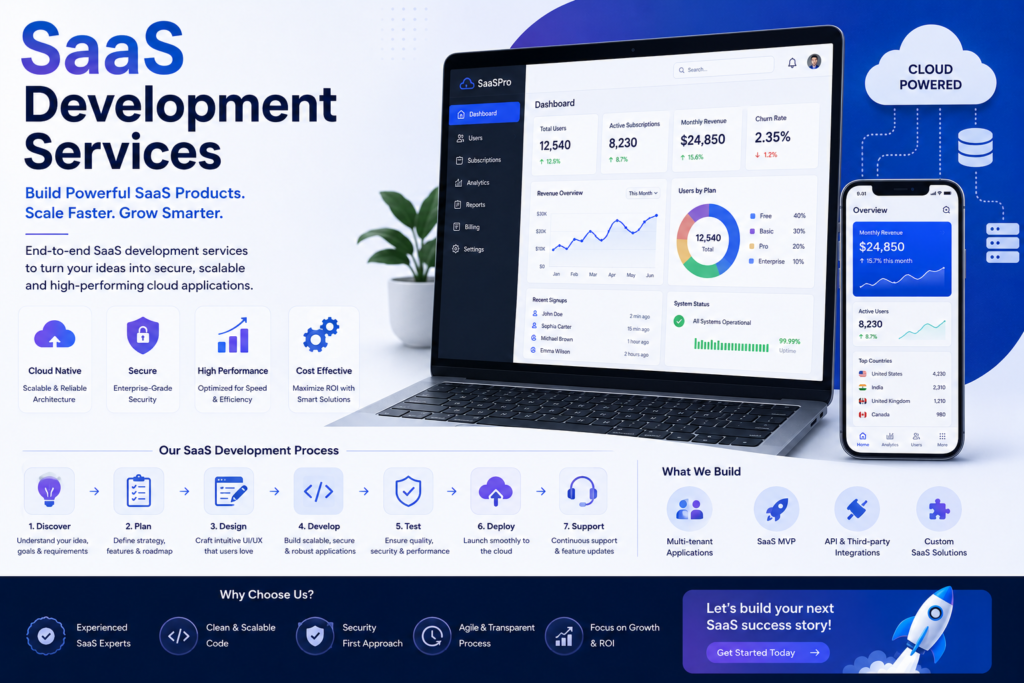
Discovery and scoping usually takes two to four weeks and produces a documented feature list, technical architecture plan, and a realistic budget range, giving both sides a shared reference point before real development spending begins.

Design and prototyping follows, translating the scoped requirements into wireframes and eventually high fidelity interface designs that stakeholders can review and approve before expensive engineering time gets committed to building screens that might change.

Iterative development typically runs in two week sprints, with regular demos so the client can see working software incrementally rather than waiting months for a single large reveal that may miss the mark on important details.

Quality assurance runs continuously throughout development rather than as a single phase at the end, though a dedicated hardening period before launch is still common to catch edge cases and performance issues under realistic conditions.

Launch and stabilization covers the actual release along with close monitoring in the days and weeks that follow, since real user behavior almost always surfaces issues that internal testing did not catch.

Ongoing iteration continues after launch for most successful products, with saas development services shifting toward a lighter, ongoing cadence focused on new features, performance improvements, and fixes driven by actual usage data.

Core Technology Choices in SaaS Development

The technical stack a provider recommends should be driven by your specific product needs rather than simply what that team happens to know best, though certain patterns show up consistently across strong SaaS builds.

Cloud infrastructure choices typically center on providers such as AWS, Google Cloud, or Azure, with managed services increasingly preferred over self managed infrastructure for early stage products, since managed options reduce the need for a dedicated infrastructure hire during a stage when engineering focus should stay on the product itself.

Multi tenancy architecture decisions made early in a project determine how efficiently the platform can scale later, and getting this wrong is one of the more expensive mistakes to correct after a product already has paying customers on it.

API design and integration capability matters enormously for SaaS products, since most modern platforms need to connect with payment processors, CRM systems, analytics tools, and increasingly with artificial intelligence services, and a well designed API layer makes each new integration faster than the last.

Security and compliance requirements should be scoped early rather than bolted on near launch, particularly for products serving regulated industries such as healthcare or finance, where standards like HIPAA, GDPR, or PCI DSS shape core architecture decisions rather than being a checklist item handled at the end.

How to Choose the Right SaaS Development Services Partner

Selecting a provider is ultimately a bet on a working relationship that may run for years, not just a one time purchase decision, so the evaluation criteria should reflect that.

Review a provider’s actual portfolio for products similar in complexity to what you are building, rather than being swayed by an impressive logo wall that may not reflect the specific technical challenges your product will face.

Ask directly about their discovery process and how they handle scope changes mid project, since a provider without a clear answer here is likely to produce budget surprises once development is already underway.

Evaluate communication style and time zone overlap honestly, since even the most technically skilled team becomes frustrating to work with if updates are inconsistent or feedback loops take days instead of hours.

Clarify ownership of code and intellectual property in writing before signing anything, ensuring your contract explicitly states that you retain full rights to the codebase, since disputes over ownership become far harder to resolve after a product is already live.

Ask for references and actually call them, focusing your questions on how the provider handled a difficult moment in the project rather than only asking about the parts that went smoothly.

Common Mistakes Companies Make When Hiring a Development Partner

Even strong providers cannot save a project from a handful of avoidable mistakes made on the client side of the relationship.

Choosing a provider based purely on the lowest hourly rate frequently backfires, since the true cost of a project includes rework, delays, and miscommunication, all of which tend to be higher with providers who compete primarily on price rather than process.

Skipping a proper discovery phase to save a few weeks almost always costs far more time later, as undefined requirements surface mid build and force expensive rework that a clear scoping phase would have caught early.

Failing to define success metrics before development begins leaves both sides guessing at what a successful launch actually looks like, making it difficult to evaluate whether the engagement delivered real value.

Underestimating the importance of post launch support leads many founders to treat launch as the finish line, when in reality it is closer to the starting point of a product’s real lifecycle, and budgeting nothing for iteration after launch is a common and costly oversight.

Not involving internal stakeholders early enough in the process creates a disconnect between what gets built and what the business actually needs, since a development team can only build what it clearly understands about your goals.

In House Team Versus Outsourced SaaS Development Services

This comparison comes up constantly for founders deciding how to structure their build, and the right answer depends heavily on stage and available capital rather than a universal best practice.

An in house team offers deeper long term product context and tighter day to day alignment with company strategy, but building that team from scratch is slow and expensive, particularly for early stage companies that need to move quickly without a large payroll commitment.

Outsourced saas development services offer faster access to a full range of specialized skills without the overhead of recruiting, onboarding, and retaining a full internal team, which is especially valuable during the initial build phase when speed to market matters most.

Many growing companies land on a hybrid model, keeping core product and leadership roles in house while relying on outsourced custom development for specialized needs such as DevOps setup, a specific feature build, or scaling support during a period of rapid growth.

The Future of SaaS Development Services

The SaaS development landscape is shifting quickly as artificial intelligence changes both how software gets built and what customers expect from the finished product.

AI assisted development is accelerating build timelines industry wide, with development teams increasingly using AI tools for code generation, testing, and documentation, which is shifting the value of a strong provider away from typing speed and toward architecture judgment and product thinking.

AI features are moving from optional add ons to a baseline customer expectation in many SaaS categories, meaning saas development services increasingly need to scope AI integration from the start of a project rather than treating it as a later phase addition.

No code and low code tooling is expanding what founders can validate before committing to a full custom build, though most products that reach meaningful scale still transition to custom development once they outgrow what no code platforms can support.

Compliance requirements continue to tighten across regulated industries, meaning development partners with genuine experience in frameworks like HIPAA, GDPR, and SOC 2 are becoming more valuable rather than less as the market matures.

Frequently Asked Questions

What exactly do saas development services include?

A complete engagement typically covers discovery and scoping, architecture and infrastructure design, core application development, billing and subscription logic, quality assurance, deployment setup, and post launch support, rather than just writing application code.

How much does SaaS development cost for a small startup ?

A lean MVP with core functionality commonly falls in the range of seventy five thousand to one hundred forty thousand dollars, though a basic validation prototype can cost significantly less if the goal is early demand testing rather than a full production build.

How long does a typical SaaS development engagement take ?

A lean MVP often takes three to six months from discovery through launch, while a fuller market ready product can take six to twelve months depending on feature complexity and integration requirements.

Should a startup hire an in house team or use outsourced saas development services?

Early stage startups often benefit from outsourced services to move quickly without a large payroll commitment, while more mature companies frequently shift toward a hybrid model that keeps core roles in house.

What is the difference between fixed price and dedicated team engagement models?

Fixed price arrangements suit narrowly scoped projects with stable requirements, while dedicated team models offer more flexibility for projects where priorities are expected to evolve throughout development.

Does this type of engagement include ongoing maintenance after launch?

Many providers offer ongoing support as a separate phase after the initial build, covering bug fixes, performance improvements, and new feature development based on real user feedback after launch.

How do I protect my intellectual property when outsourcing development?

Ensure your contract explicitly states that you retain full ownership of the codebase and any related intellectual property, and confirm this in writing before development begins rather than assuming it by default.

What questions should I ask before hiring a SaaS development partner ?

Ask about their discovery process, how they handle scope changes, their communication cadence, who specifically will work on your project, and request references you can actually call and question directly.

Can AI tools replace the need for professional development support ?

AI tools can accelerate parts of the development process, but architecture decisions, security judgment, and product strategy still require experienced human oversight, particularly for products handling sensitive data or complex business logic.

What is the biggest hidden cost in SaaS development projects?

Design, quality assurance, DevOps setup, and post launch maintenance together commonly add forty to sixty percent on top of the initial development quote, which is why the headline number in a proposal rarely reflects the full project cost.

Conclusion

Choosing the right development partner is one of the highest leverage decisions a founder or product team will make, since the quality of that early architecture and delivery discipline shapes how expensive every future change becomes. The founders who get the most value from these engagements are rarely the ones who found the cheapest hourly rate, but the ones who invested in a real discovery phase, chose an engagement model that matched their actual needs, and treated post launch iteration as part of the plan rather than an afterthought. Whether you outsource the entire build or bring in specialized saas development services to support an existing team, the fundamentals stay the same, which are clear scope, honest communication, and a partner who is thinking about your product’s next two years rather than just the next sprint.

Key Takeaways

A complete engagement covers far more than writing code, spanning discovery, architecture, billing logic, quality assurance, deployment, and post launch support as a complete engagement.

Pricing depends heavily on scope and region, with lean MVPs commonly landing between seventy five thousand and one hundred forty thousand dollars and hidden costs often adding forty to sixty percent on top of the base quote.

Choosing between fixed price, dedicated team, time and materials, or staff augmentation should match your project’s actual requirements rather than defaulting to whichever model a provider prefers to sell.

The strongest partner relationships come from a real discovery process, clear intellectual property terms, and honest references, not from selecting the lowest hourly rate on the table.

Artificial intelligence is reshaping how saas development services get delivered, shifting the value of a strong provider toward architecture judgment and product strategy rather than raw coding speed alone.

Get Your FREE SEO Audit

Enter your details below. Our team will review your website and email you a comprehensive SEO and speed report within 24 hours.