Compare the best customer success platform options for SaaS companies over 500 customers, with real vendors, pricing shape, and a framework to choose.
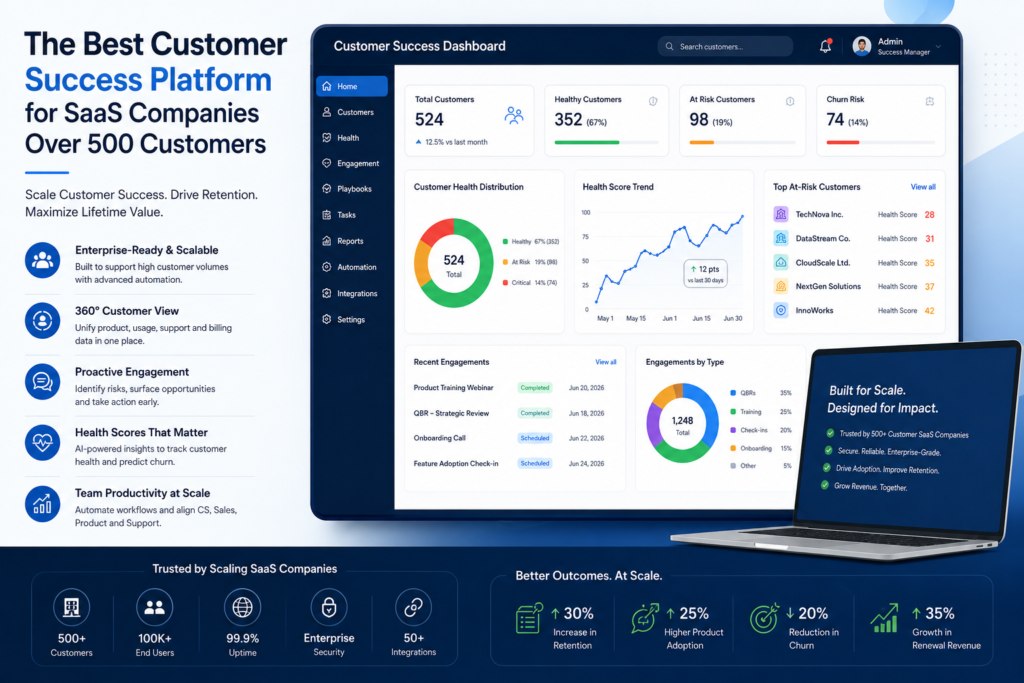
Table of Contents
Best Customer Success Platform for SaaS Companies Over 500 Customers
Somewhere between one hundred and five hundred customers, most SaaS companies feel the first cracks in their customer success process. Somewhere past five hundred, those cracks turn into real revenue risk. Manual health checks stop scaling. A single spreadsheet cannot represent hundreds of active accounts with any accuracy. Renewal dates slip through the gaps between tools, and churn signals that used to be obvious in a founder’s gut feeling now hide inside product usage data that nobody has time to read manually. Finding the best customer success platform for SaaS companies over 500 customers is less about buying more software and more about buying the right operating layer for a team that can no longer manage growth by memory. This guide walks through what changes at this stage, the capabilities worth paying for, how the leading platforms actually compare, and the mistakes that turn a promising rollout into another underused tool.
What Changes When a SaaS Company Passes 500 Customers
The jump past five hundred customers is not just a bigger number, it is a structural shift in how customer success has to operate. Below that line, a small team can often get away with manual check ins, shared spreadsheets, and a CSM who simply knows most of the accounts by name. Above that line, the math stops working. A CSM covering eighty accounts with weekly manual reviews physically cannot repeat that process across a base that has quadrupled, so either headcount grows in a way finance will not support, or the process has to become software driven.
This is also the point where segmentation becomes essential rather than optional. Not every account past the five hundred mark deserves the same level of attention. High touch accounts still need a human relationship, mid tier accounts need automated playbooks with human oversight, and long tail accounts often need a fully automated digital motion built on in app messaging and usage triggers. A platform that cannot support this kind of tiered coverage forces every account into the same generic workflow, which wastes CSM time on accounts that do not need it and starves the accounts that do.
Data volume is the third shift. At five hundred customers and beyond, product usage events, support tickets, billing data, and NPS responses generate far more signal than any team can review manually. The platform’s job changes from simply storing customer notes to actively surfacing which accounts need attention today, based on real behavioral signals rather than a CSM’s memory of the last call.
Core Capabilities to Look For in a Customer Success Platform at This Scale
Feature lists across vendors look remarkably similar on a sales call, so the real differentiation shows up in depth and in how well the pieces work together rather than as separate bolted on modules.
Health scoring needs to be explainable rather than a black box number. A score of sixty two means very little to a CSM trying to decide what to do next. The strongest platforms break the score down into the underlying drivers, such as declining login frequency, a support ticket spike, or a feature adoption gap, so the CSM knows exactly what conversation to have and when to have it.
Automated playbooks and journey orchestration matter enormously once manual coverage becomes impossible. A good platform triggers a specific outreach sequence the moment a risk signal appears, rather than waiting for a CSM to notice a dashboard change during a quarterly review.
Native integrations with your CRM, billing system, product analytics, and support desk determine whether the platform becomes a true system of record or just another disconnected tab. At this scale, manually reconciling data between five different tools is not sustainable, and any gap in integration becomes a blind spot in your churn risk visibility.
Segmentation and tiering functionality should let you build genuinely different workflows for high touch, tech touch, and fully digital accounts within the same platform, rather than forcing every customer through an identical process regardless of contract value or risk profile.
Revenue and expansion tracking is often underweighted in early evaluations but becomes critical once a company depends on net revenue retention to hit growth targets. The platform should surface upsell and cross sell opportunities from usage data, not just churn risk, since retention alone is rarely enough to satisfy a board past this stage of growth.
Reporting built for both CSMs and leadership is the final differentiator. Frontline CSMs need a task focused view of what to do today, while leadership needs portfolio level visibility into net revenue retention, churn by segment, and CSM capacity, and the strongest platforms serve both audiences without forcing a choice.
How to Choose the Best Customer Success Platform for SaaS Companies Over 500 Customers
Choosing well at this stage starts with an honest read of your current bottleneck rather than a generic feature comparison. A company drowning in manual health checks needs automation first. A company with plenty of automation but poor visibility into revenue risk needs stronger reporting first. Naming the actual bottleneck before evaluating vendors keeps demos honest instead of letting a slick presentation set the agenda.
Match implementation complexity to your team’s capacity. Some platforms are genuinely powerful but require a dedicated CS operations person to configure and maintain, while others are built to go live within weeks with a leaner setup. A five hundred plus customer base does not automatically mean you need the most complex enterprise platform on the market, and choosing more sophistication than your team can operate often produces worse outcomes than choosing something simpler and using it consistently.
Evaluate pricing structure carefully, since costs at this customer volume can scale in very different ways depending on the vendor. Per seat pricing can become expensive quickly as your CS team grows, while usage based or tiered pricing by account count may better match how your business actually scales.
Ask for reference customers at a similar stage rather than trusting general case studies. A platform built primarily for companies with tens of thousands of customers may be overkill for a team just past the five hundred mark, while a platform built for early stage startups may not hold up once your account volume and data complexity increase.
Test the actual CSM experience during a trial or sandbox, not just the leadership dashboard shown in a sales demo. Adoption ultimately determines whether the platform delivers value, and a system your team finds clunky to use daily will quietly get abandoned no matter how impressive its reporting looks in a boardroom.
Comparing Leading Customer Success Platforms for Growing SaaS Teams
A handful of platforms consistently show up on shortlists once a SaaS company passes the five hundred customer mark, each with a different strength worth understanding before you commit to a demo cycle.
Gainsight is the most established enterprise option, built for large, complex customer portfolios with deep health scoring, journey orchestration, and revenue forecasting capabilities. It suits companies with dedicated CS operations resources who need maximum configurability and are prepared for a longer implementation timeline in exchange for that depth.
Totango offers strong account management and AI driven insights aimed at identifying growth opportunities alongside churn risk, and it is often shortlisted by enterprises that want scalable personalized engagement without building every workflow from scratch.
ChurnZero focuses heavily on real time churn detection and intuitive segmentation, and teams frequently describe its interface as more approachable than traditional enterprise platforms, making it a common choice for mid market SaaS companies that want strong automation without a steep learning curve.
Vitally has become a popular choice for teams that have outgrown spreadsheets but find the largest enterprise platforms to be overkill, pairing solid automation with an interface CSMs tend to actually enjoy using, and it typically reaches go live faster than heavier enterprise systems.
Planhat and Catalyst round out the group frequently evaluated by companies scaling past five hundred customers, each offering strong customization and reporting depth suited to teams that want flexibility in how workflows and dashboards are built without committing to the heaviest enterprise footprint.
The right answer among these depends far less on brand recognition and far more on which platform matches your actual bottleneck, your team’s implementation capacity, and the pricing shape that fits your growth stage.
Common Mistakes Companies Make When Scaling Customer Success Software
Even a genuinely strong platform can underdeliver when a handful of avoidable mistakes creep into the buying and rollout process.
Buying based on feature count rather than actual workflow fit leaves teams paying for enterprise depth they never configure or use, while the specific automation and reporting their team actually needs sits underutilized because it was never prioritized during setup.
Skipping proper data cleanup before go live means importing inconsistent account records, outdated contact information, and incomplete usage history directly into the new platform, which produces unreliable health scores and erodes trust in the system before it has a fair chance to prove itself.
Treating the rollout as purely a tooling change rather than a process change leaves CSMs unclear on how their daily workflow is supposed to shift, and without that clarity, teams tend to keep working the old way alongside the new software rather than fully adopting it.
Underinvesting in segmentation strategy forces every account through the same workflow regardless of value or risk, wasting CSM attention on low risk accounts while high value accounts do not get the proactive outreach they actually need.
Ignoring the CSM experience in favor of leadership reporting produces a platform that looks impressive in board meetings but that frontline teams find frustrating to use daily, and low daily adoption quietly undermines the accuracy of every dashboard built on top of it.
Implementation Best Practices for Customer Success Platforms at Scale
A strong platform choice still needs a disciplined rollout to deliver real value once the account base is past five hundred customers.
Start with a defined segment rather than the entire customer base at once. Rolling out new health scoring and playbooks to one tier first lets the team refine configuration and build confidence in the data before extending the same model across the full portfolio.
Involve frontline CSMs in configuring health score weightings and playbook triggers rather than designing the model in isolation. The people managing accounts daily often understand which signals genuinely predict churn far better than a generic default configuration provided by the vendor.
Clean and standardize your account data before migration, including consistent naming conventions, accurate contract dates, and complete usage history wherever possible, since even a powerful platform can only be as reliable as the data feeding its scoring model.
Define clear success metrics before launch, typically including net revenue retention, gross churn rate, time to value for new accounts, and CSM capacity utilization, so the organization can measure real impact rather than relying on subjective impressions of whether the tool feels helpful.
Phase in advanced features gradually rather than activating every module simultaneously. Getting core health scoring and playbooks stable first, then layering in revenue forecasting and deeper automation later, produces a far more stable and trusted rollout than an all at once activation.
Measuring ROI and Success After Adoption
Once a customer success platform is live, the real test is whether it measurably changes outcomes rather than simply changing where CSM notes are stored.
Net revenue retention is the clearest headline metric, since a platform genuinely improving proactive engagement should show measurable movement in expansion revenue relative to churn over the following quarters.
Time to detect risk is another strong indicator, comparing how quickly the team now identifies a churn signal against how long that same signal used to sit unnoticed in a spreadsheet or a CSM’s personal notes.
CSM capacity is worth tracking directly, since a well configured platform should allow each CSM to responsibly manage a larger book of accounts through automation, freeing up time for the high touch relationships that genuinely need a human.
Adoption rate among the CS team itself is a quieter but equally important signal, since a platform with low daily logins from the people meant to use it will not deliver the outcomes shown in a vendor’s case study, no matter how strong its theoretical capabilities are.
The Future of Customer Success Platforms for Growing SaaS Companies
Customer success platforms built for growing SaaS companies are shifting quickly from passive reporting tools toward systems that actively act on risk and opportunity rather than simply displaying it.
Artificial intelligence is increasingly embedded directly into health scoring and playbook triggers, allowing platforms to recommend or even initiate specific outreach based on patterns identified across thousands of historical accounts rather than static rules configured manually by an admin.
Explainable scoring is becoming a baseline expectation rather than a premium feature, since CSMs and leadership alike have grown skeptical of opaque risk scores that cannot be traced back to a specific underlying driver.
Tighter integration between customer success platforms and product analytics is narrowing the gap between what a customer does inside the product and what the CS team sees, reducing the manual reconciliation that used to slow down risk detection.
Faster time to value is reshaping vendor positioning generally, as more companies past the five hundred customer mark look for platforms that can go live in weeks rather than committing to lengthy enterprise implementations before seeing any measurable benefit.
Frequently Asked Questions
What is the best customer success platform for SaaS companies over 500 customers?
There is no single universal answer, since the right choice depends on your team’s implementation capacity, budget, and specific bottleneck, though Gainsight, Totango, ChurnZero, Vitally, and Planhat are the platforms most commonly shortlisted by SaaS companies at this stage.
How much does a customer success platform cost at this scale?
Pricing varies widely by vendor and account volume, with mid market platforms often starting in the low hundreds of dollars per month and scaling into the low thousands, while enterprise platforms with the deepest feature sets can run into five or six figures annually.
Do we need a dedicated CS operations person to run this software ?
Larger enterprise platforms generally benefit from a dedicated operations resource to manage configuration and reporting, while several mid market platforms are specifically built to be managed by CSM leadership without a separate operations role.
How long does implementation typically take ?
Timelines range from a few weeks for lighter mid market platforms to several months for the most configurable enterprise systems, largely depending on data complexity and how many integrations are required at launch.
Can a customer success platform actually reduce churn?
A platform itself does not reduce churn directly, but it gives teams the visibility and automation needed to intervene earlier and more consistently, which measurably improves retention when paired with a team that actually acts on the signals it surfaces.
Is it worth switching platforms if we already have one?
Switching makes sense when the current tool cannot support your segmentation needs, integration requirements, or reporting depth at your current scale, but a poorly implemented rollout on any platform will underperform regardless of how strong the underlying software is.
What integrations matter most for a customer success platform?
CRM, billing, product analytics, and support desk integrations tend to matter most, since gaps in any of these create blind spots in the health score and force CSMs to manually reconcile data across tools.
How is customer success software different from a CRM ?
A CRM is generally built around sales pipeline and contact management, while customer success software is built around post sale health scoring, playbooks, and retention workflows, and the two are meant to work together rather than replace each other.
What is the biggest reason customer success platform rollouts fail?
Treating the rollout as a purely technical setup rather than a process and adoption change is the most common reason implementations underdeliver, since CSM adoption ultimately determines whether the data and automation are actually used.
How do we know if we have outgrown our current customer success tool?
Common signs include manual health checks that no longer scale, CSMs missing renewal risk until it is too late, and leadership lacking clear visibility into net revenue retention across the account base.
Conclusion
There is no single best customer success platform for SaaS companies over 500 customers that fits every team, since the right choice depends heavily on your bottleneck, your implementation capacity, and how your pricing needs to scale with account volume. What separates the companies that get real value from their investment is not the brand name on the contract, but a clear read of what is actually breaking today, a platform matched honestly to that need, and a rollout that treats adoption as seriously as configuration. Get those three things right, and the platform becomes the operating layer that lets your CS team scale coverage without scaling headcount at the same rate. Get them wrong, and even the most powerful software on the market becomes another underused tool sitting quietly beside the spreadsheet it was supposed to replace.
Key Takeaways
Crossing five hundred customers is a structural shift that breaks manual health checks and spreadsheet based tracking, not just a bigger number to manage with the same process.
The strongest platforms combine explainable health scoring, automated playbooks, deep integrations, and reporting that serves both CSMs and leadership without forcing a tradeoff between the two audiences.
Gainsight, Totango, ChurnZero, Vitally, Planhat, and Catalyst are the platforms most frequently shortlisted at this stage, each suited to a different balance of implementation complexity and team capacity.
Implementation success depends far more on data cleanup, CSM involvement, and phased rollout than on the platform itself, which is why segment first launches consistently outperform full portfolio rollouts on day one.
Measuring real ROI means tracking net revenue retention, time to detect risk, and CSM capacity, not just counting logins or assuming the software is working because it was purchased.