Discover how cloud integration software connects your apps automates workflows and eliminates manual data entry Learn features types and best practices
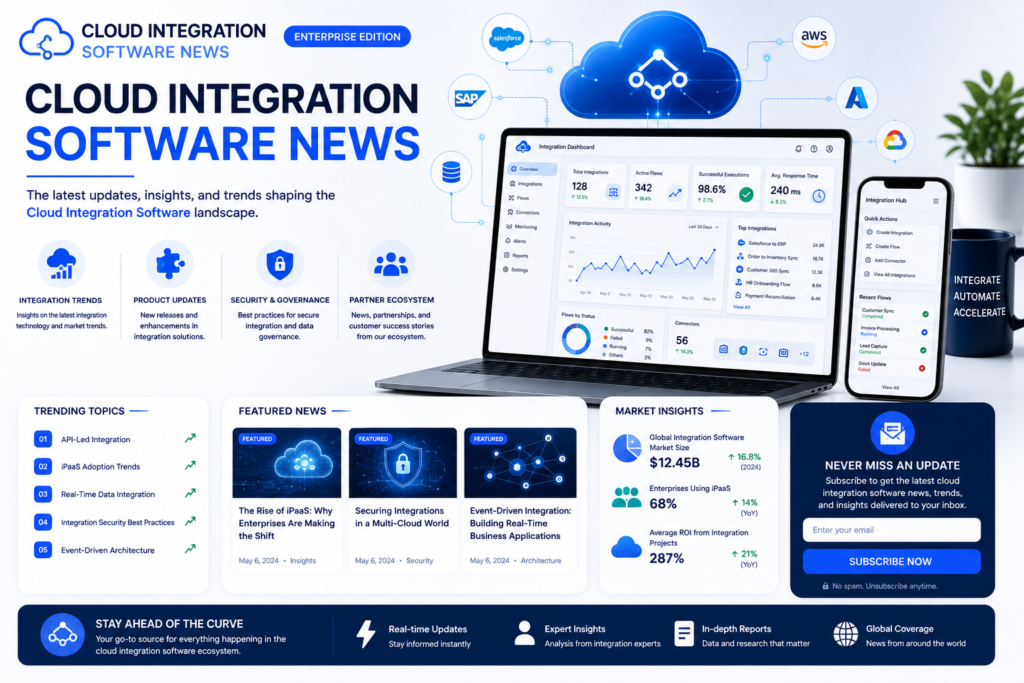
Table of Contents
What Is Cloud Integration Software and Why Is It Essential for Growing Companies?
Every growing company eventually hits the same wall. Data lives in one tool sales activity lives in another customer support tickets sit somewhere else entirely and finance is stuck exporting spreadsheets just to close the books each month. This is the exact problem that this type of software was built to solve. Instead of forcing teams to manually move information between systems cloud integration software connects applications databases and services so data flows automatically in real time. For SaaS companies in particular this is not a nice to have feature anymore it is the backbone of how modern operations actually function.
In this guide we will break down what cloud integration software really is how it works the different types available on the market today the business value it creates the common mistakes companies make when adopting it and the practical steps required to choose and implement the right solution. Whether you are a technical founder trying to reduce engineering overhead or an operations leader trying to eliminate manual data entry this article will give you a complete and honest picture of cloud integration software so you can make a confident decision.
What Is this technology
Cloud integration software is a category of technology that connects two or more applications databases or systems that are hosted in the cloud so they can share data and work together automatically. Rather than relying on developers to build and maintain custom point to point connections between every tool a company uses such platforms provides pre built connectors workflow automation and data mapping tools that make it possible to link systems in hours instead of weeks.
At its core cloud integration software solves a very old problem in a new environment. Companies have always needed their software systems to talk to each other but as businesses moved from on premise servers to cloud based applications the old integration methods stopped scaling. A typical SaaS company today might use a customer relationship management platform a billing system a support desk a marketing automation tool a data warehouse and dozens of smaller apps for specific tasks. these tools exists to stitch all of these together into one connected ecosystem instead of a patchwork of disconnected silos.
How Cloud Integration Software Works
Most this category of software operates on a few core mechanisms that are worth understanding before you evaluate any platform. The first is application programming interfaces which are the standardized ways that software systems expose their data and functionality to the outside world. Cloud integration software uses these interfaces to pull data from one system and push it into another.
The second mechanism is data transformation and mapping. Different systems often store the same type of information in different formats. One tool might label a customer record as full name while another splits it into first name and last name. Good the platform automatically maps and transforms these fields so information stays accurate and usable no matter where it lands.
The third mechanism is workflow orchestration. This is what allows cloud integration software to move beyond simple data syncing into true automation. For example when a new customer signs up in a billing platform an orchestrated workflow inside the integration software can automatically create a record in the customer relationship management tool send a welcome email through the marketing platform and open an onboarding task in the project management tool all without a single person touching a keyboard.
Finally most modern these systems includes monitoring and error handling. Integrations fail from time to time because of rate limits authentication issues or unexpected data formats. Reliable cloud integration software detects these failures logs them clearly and in many cases retries automatically so teams are not left guessing why data stopped flowing.
Types Of this type of software
Not all cloud integration software is built the same way and understanding the categories will help you choose the right fit for your organization.
Integration platform as a service solutions are the most common type for growing SaaS companies. These platforms provide a visual interface where non developers can build and manage integrations using pre built connectors and simple logic. They are ideal for operations and marketing teams that need to connect popular tools quickly without waiting on engineering resources.
Enterprise service bus solutions are older and more traditional forms of cloud integration software that focus on large scale complex integrations across many internal and external systems. These tend to require significant technical expertise and are more common in large enterprises with dedicated integration teams.
Application programming interface management platforms focus specifically on building securing and monitoring custom application programming interfaces. These are typically used by engineering teams that need full control over how data is exposed and consumed rather than relying on pre built connectors.
Data integration and extract transform load tools specialize in moving large volumes of data into data warehouses and analytics platforms. These are essential for companies that rely heavily on business intelligence and need clean centralized data for reporting.
Embedded integration platforms are a newer category built specifically for SaaS companies that want to offer native integrations inside their own product. Instead of building and maintaining dozens of custom integrations in house these companies use embedded cloud integration software to let their customers connect third party tools directly within the product itself.
Why this technology Matters For SaaS Companies
The value of cloud integration software becomes obvious once you look at what happens without it. Teams end up duplicating data entry across multiple systems which introduces errors and wastes hours every week. Customer information becomes inconsistent because one team updates a record in one tool while another team is working from outdated information in a different tool. Reporting becomes unreliable because data is scattered and no one is confident the numbers are accurate.
such platforms eliminates these problems by creating a single source of truth that flows automatically across the entire tech stack. This has a direct impact on customer experience because support teams have full context the moment a customer reaches out. It has a direct impact on revenue because sales and marketing teams can act on real time data instead of stale reports. And it has a direct impact on operational efficiency because employees spend their time on meaningful work instead of copying and pasting information between tabs.
For SaaS companies specifically cloud integration software also plays a strategic role in the product itself. Customers increasingly expect the software they buy to connect seamlessly with the other tools they already use. A SaaS product that offers strong native integrations through embedded these tools becomes stickier reduces churn and becomes easier to sell because it fits naturally into a customer existing workflow rather than forcing them to change how they work.
Key Features To Look For In Cloud Integration Software
Choosing the right this category of software requires looking past marketing claims and focusing on features that actually determine long term success.
Pre built connectors matter because they reduce implementation time dramatically. The best cloud integration software offers hundreds of ready made connectors for popular business applications so teams are not starting from scratch every time they need a new integration.
Scalability is another critical factor. As a company grows the volume of data flowing through integrations grows with it. the platform needs to handle increasing data loads without slowing down or breaking, which means evaluating rate limits processing speed and infrastructure reliability before committing to a platform.
Security and compliance capabilities are non negotiable for any serious evaluation. Since cloud integration software often handles sensitive customer and financial data it should offer encryption in transit and at rest role based access controls and compliance certifications relevant to your industry.
Error handling and observability determine how much trust a team can place in an integration running quietly in the background. Strong these systems provides clear logs real time alerts and automatic retry logic so issues are caught and resolved before they cause bigger problems downstream.
Ease of use is especially important for teams without dedicated engineering resources. A visual workflow builder clear documentation and responsive customer support all make a significant difference in how quickly a team can get real value out of cloud integration software.
Flexibility for custom logic is the final piece. Even the best pre built connectors cannot anticipate every business rule so the ability to add custom code transformations or conditional logic ensures the this type of software can adapt to your specific needs rather than forcing your business to adapt to it.
Common Mistakes Companies Make With Cloud Integration Software
Even with the right tool in place many companies run into avoidable problems when adopting cloud integration software.
One common mistake is treating integration as a one time project rather than an ongoing responsibility. Systems change application programming interfaces get updated and business processes evolve. Cloud integration software needs regular monitoring and maintenance or integrations quietly break and no one notices until customer data starts looking wrong.
Another frequent mistake is choosing a platform based purely on price without evaluating whether it can actually scale with the business. A cheap solution that cannot handle growing data volumes ends up costing far more in lost productivity and emergency fixes than a slightly more expensive platform built for scale.
Many teams also underestimate the importance of data governance. Without clear ownership of which team is responsible for which integration and without documented data mapping rules this technology can create more confusion than it solves, especially as more integrations get added over time.
A final common mistake is ignoring the end user experience when integrations are customer facing. If a SaaS company embeds cloud integration software into its product but the setup process is confusing or unreliable customers will abandon the integration entirely, which defeats the purpose of offering it in the first place.
Best Practices For Implementing such platforms
Successful implementation of cloud integration software starts with mapping out exactly which systems need to be connected and why. Rather than integrating everything at once it is far more effective to start with the highest impact workflows such as syncing customer data between a customer relationship management platform and a support tool, then expanding from there once the foundation is proven stable.
Documentation should be treated as a core part of the process rather than an afterthought. Every integration built with these tools should have clear documentation covering what data flows where how errors are handled and who owns the integration going forward.
Testing in a staging environment before pushing integrations live is essential, particularly for workflows that touch billing or customer facing data. A small mapping error in cloud integration software can cause significant downstream problems if it is not caught before deployment.
Setting up proactive monitoring and alerts ensures that any failures are caught within minutes rather than being discovered days later when a customer complains or a report looks wrong. Most modern this category of software includes built in alerting but it needs to be actively configured rather than left on default settings.
Finally reviewing integrations on a regular schedule helps catch issues before they become expensive. As business processes evolve the logic inside cloud integration software should evolve with them rather than being built once and forgotten.
How To Choose The Right the platform For Your Business
Choosing cloud integration software should start with a clear inventory of the systems that need to be connected and the specific outcomes the business is trying to achieve. A company focused on syncing marketing and sales data has very different needs than a company trying to build a data warehouse for advanced analytics.
Next it is worth evaluating whether the team implementing the integrations is technical or non technical. Some these systems is built for developers with full coding flexibility while other platforms are designed specifically for business users who need a visual no code experience.
Budget matters but should be evaluated in terms of total cost of ownership rather than sticker price alone. This includes implementation time ongoing maintenance and the cost of switching platforms later if the chosen solution cannot scale with the business.
It is also worth testing customer support responsiveness before committing to a long term contract. Since cloud integration software often becomes a critical part of daily operations, slow or unhelpful support during an outage can create serious business risk.
Finally requesting a trial or proof of concept with your actual systems rather than relying solely on demos gives a far more accurate picture of how well a given this type of software will perform in your specific environment.
The Future Of Cloud Integration Software
these platforms continues to evolve rapidly as businesses adopt more specialized applications and generate larger volumes of data. Artificial intelligence is increasingly being built into these platforms to automatically suggest data mappings detect anomalies in data flow and even predict integration failures before they happen. This shift is making cloud integration software more proactive rather than purely reactive.
There is also a clear trend toward embedded integration becoming a standard expectation rather than a competitive advantage. SaaS buyers increasingly assume that the tools they purchase will connect natively with their existing stack, which means more companies will rely on embedded this technology to meet customer expectations without building every integration from scratch internally.
Real time data processing is also becoming the standard rather than the exception. Batch syncing that updates data every few hours is being replaced by event driven cloud integration software that reflects changes the instant they happen, giving businesses a genuinely live view of their operations.
Frequently Asked Questions
What is cloud integration software used for?
Cloud integration software is used to connect different cloud based applications so data and processes flow automatically between them. It eliminates manual data entry keeps information consistent across systems and enables automated workflows that save time and reduce errors.
Is such platforms the same as an application programming interface?
No. An application programming interface is the technical method a system uses to expose its data and functionality. Cloud integration software is the platform that uses these interfaces along with additional tools like data mapping and workflow automation to actually connect multiple systems together.
How much does these tools cost ?
Pricing varies widely depending on the platform the number of integrations and the volume of data processed. Smaller platforms aimed at startups may cost a modest monthly fee while enterprise grade cloud integration software with advanced features and dedicated support can cost significantly more based on usage and scale.
Can small businesses benefit from this category of software?
Yes. Small businesses often benefit the most from cloud integration software because they typically have limited staff and cannot afford the time lost to manual data entry. Automating even a few key workflows can free up significant time for a small team.
What is the difference between the platform and traditional middleware ?
Traditional middleware was typically built for on premise systems and required significant custom development. Cloud integration software is designed specifically for cloud based applications and generally offers pre built connectors and visual tools that make implementation much faster and more accessible.
Do I need a developer to use these systems?
It depends on the platform. Many modern cloud integration software solutions are designed with visual no code interfaces so business users can build integrations without writing code. More complex or highly customized integrations may still benefit from developer involvement.
How long does it take to implement this type of software?
Simple integrations using pre built connectors can often be set up within hours. More complex integrations involving custom data mapping or multiple systems can take days or weeks depending on the complexity of the business requirements.
Is cloud integration software secure ?
Reputable these platforms providers implement strong security measures including encryption access controls and compliance certifications. That said security also depends on how well the integrations are configured internally, so following best practices during implementation matters just as much as the platform itself.
What industries rely most heavily on cloud integration software?
this technology is widely used across SaaS companies e commerce businesses financial services healthcare and any industry that relies on multiple digital systems working together in real time.
Can cloud integration software help with data analytics ?
Yes. Many companies use such platforms to move data from multiple sources into a central data warehouse where it can be cleaned organized and analyzed, giving leadership teams a more accurate and complete view of business performance.
Conclusion
Cloud integration software has moved from being a technical nice to have into a foundational part of how modern SaaS businesses operate. It eliminates the friction of disconnected systems reduces manual work and gives teams the real time accurate data they need to make confident decisions. Choosing the right platform requires looking beyond flashy features and evaluating scalability security ease of use and long term reliability. Companies that treat cloud integration software as an ongoing strategic investment rather than a one time setup task consistently see stronger operational efficiency happier customers and a tech stack that grows smoothly alongside the business.
Key Takeaways
Cloud integration software connects cloud based applications so data flows automatically without manual effort. It works through application programming interfaces data mapping and workflow orchestration to keep systems synchronized in real time. Different types of cloud integration software exist for different needs including integration platform as a service solutions enterprise service bus platforms and embedded integration tools built directly into SaaS products. Choosing the right solution requires evaluating scalability security ease of use and total cost of ownership rather than price alone. Companies that avoid common mistakes like neglecting maintenance and documentation get significantly more long term value from their cloud integration software investment.