Learn how SaaS content marketing turns organic traffic into trial signups and revenue, with strategies, formats, and mistakes to avoid in 2026.
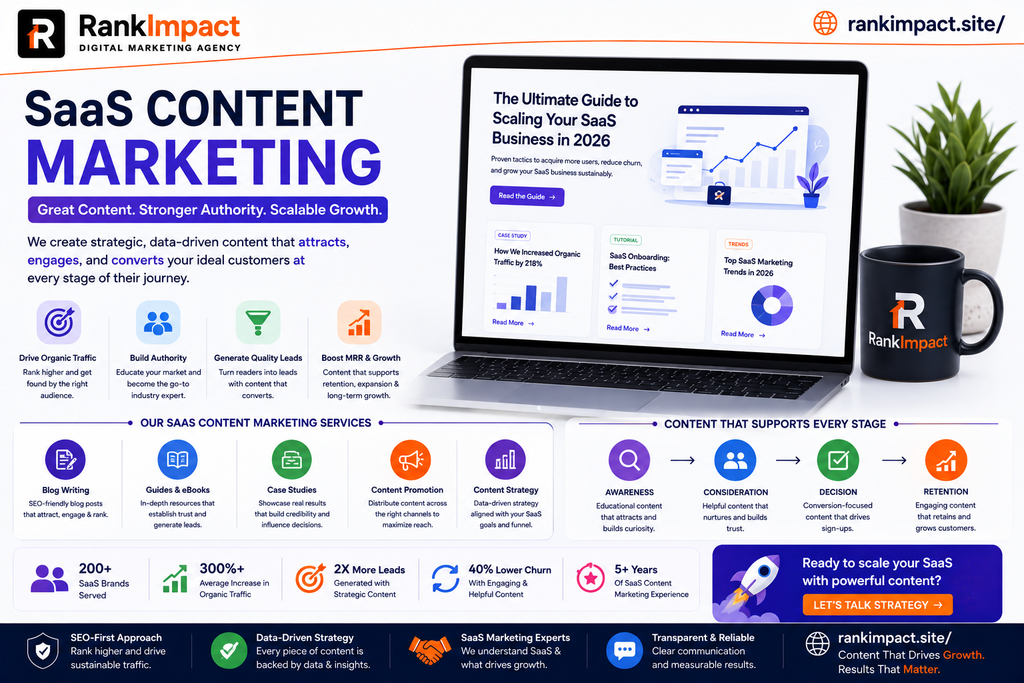
Table of Contents
Why SaaS Content Marketing Decides Who Wins the Category
Every SaaS category eventually reaches a point where the product features start to look the same across vendors. When that happens, the company that wins is usually the one that has built the most trust with buyers before they ever request a demo. That trust is built almost entirely through content.
SaaS content marketing is the practice of creating and distributing educational, product aware, and decision stage content that moves software buyers from first discovering a problem to signing up for a trial and eventually becoming a paying customer. Unlike traditional content marketing, it has to serve a longer, more research heavy buying journey, support both marketing and product teams, and speak to technical and non technical stakeholders at the same time.
Research from First Page Sage’s 2026 benchmarking study found that cite index=59-3 B2B SaaS SEO produces an average return of 702 percent with a break even period of roughly seven months when measured over a three year window cite. Few other marketing channels for software companies come close to that kind of long term payoff, which is exactly why so many SaaS founders and marketing leaders treat content as a core growth lever rather than a side project.
This guide breaks down what SaaS content marketing actually involves, how it differs from generic B2B content, and the specific strategies, formats, and workflows that experienced SaaS marketers rely on to turn blog traffic into trial signups and expansion revenue.
What Makes SaaS Content Marketing Different From Regular Content Marketing
On the surface, SaaS content marketing looks like any other form of content marketing. There is still keyword research, blog writing, distribution, and measurement. The differences show up in the details, and they matter enormously if you want your content to actually move the needle.
First, SaaS products are usually intangible and often hard to explain in a single sentence, which means content has to do more educational heavy lifting before a prospect understands why the product matters. Second, the buying committee for most B2B software purchases includes several people with different priorities, so a single blog post rarely closes a deal on its own. Third, SaaS is a subscription business, so content does not stop mattering after the sale. Onboarding guides, feature announcements, and best practice articles all influence whether a customer renews or churns.
Finally, SaaS competes in some of the most saturated search results on the internet. Review sites like G2 and Capterra, along with a handful of large incumbent brands, dominate the top rankings for many high intent software queries. Winning visibility requires content that is more specific, more technically credible, and better structured than what a generic content marketing playbook produces.
Understanding Buyer Intent Across the SaaS Funnel
The single biggest mistake in SaaS content marketing is treating every piece of content the same way. Buyers at different stages of the funnel need fundamentally different information, and mapping content to each stage is what separates a strategy that generates leads from one that just generates traffic.
Top of funnel content targets people who are aware of a problem but not yet aware that software can solve it. These readers respond well to broad educational guides, industry trend pieces, and original research. Middle of funnel content targets people actively comparing approaches or evaluating categories of tools, so templates, calculators, and how to guides tend to perform best here. Bottom of funnel content targets people who already know they need a solution and are deciding between specific vendors, which is where comparison pages, alternative pages, and detailed case studies do the heavy lifting.
A useful rule of thumb shared by several experienced SaaS content strategists is that alternative and versus pages, while lower in search volume than broad educational terms, convert at dramatically higher rates because the searcher is closer to a buying decision. Mapping your keyword list to funnel stage before you write a single article prevents the common trap of producing dozens of top of funnel posts that generate traffic but never move anyone toward a purchase.
Building a SaaS Content Marketing Strategy That Aligns With Product Led Growth
Many SaaS companies now rely on product led growth, where the product itself, often through a free trial or freemium tier, does much of the selling. This changes what a content strategy needs to accomplish. It is no longer enough to generate a lead for a sales team to call. Content also needs to drive self serve signups and help users discover value inside the product quickly.
A strong SaaS content marketing strategy for a product led company typically includes use case pages that show specific job to be done scenarios, in app content and empty states that guide new users, and comparison content that helps prospects self select the right plan or feature set without a sales conversation. It also means writing content with clear, low friction calls to action, since a reader who is ready to act should be able to start a trial in one click rather than fill out a lengthy contact form.
The strategy also needs a clear point of view on what the company stands for. Buyers increasingly choose vendors that demonstrate real expertise rather than generic best practices they could find anywhere. Original research, proprietary benchmarks, and opinionated frameworks consistently outperform recycled listicle content because they cannot be easily replicated by competitors or summarized away by an AI answer engine.
Keyword Research and Topical Authority for SaaS Companies
Keyword research for SaaS content marketing works best when it starts from the product rather than from a generic keyword tool. Begin by listing every job your product helps a user accomplish, every problem it solves, and every alternative approach a buyer might currently be using instead of your software. From there, expand into adjacent topics your audience cares about, even if those topics are not directly about your product category.
Topical authority is built by covering a subject area exhaustively rather than publishing isolated posts. A useful structure is the pillar and cluster model, where a broad pillar page targets a competitive head term and a set of supporting articles targets the specific long tail questions related to that topic, all linked back to the pillar. This structure signals to search engines that your site has depth on the subject, and it also gives readers a clear path to explore related content, which improves engagement metrics.
Keyword difficulty matters more for newer SaaS sites than for established ones. A site with limited domain authority should prioritize lower competition, high commercial intent terms first to build early wins, then gradually move into more competitive head terms as authority grows. Chasing the highest volume keyword in a category before your site has earned enough authority is one of the most common ways early stage SaaS content programs waste months of effort.
Content Formats That Work Best for SaaS Companies
Blog posts remain the backbone of most SaaS content marketing programs, but the format mix matters. Comparison and alternative pages convert exceptionally well because they meet buyers at the exact moment they are deciding between vendors. Customer case studies build the kind of social proof that no amount of self authored content can replicate, especially when they include specific, measurable outcomes.
Webinars deserve more attention than many SaaS marketers give them. Industry data shows that cite index 58 4 a majority of marketers report webinars generate higher quality leads than any other content format cite, largely because live formats create a level of engagement and trust that static content cannot match. Templates, calculators, and other interactive tools also perform well because they let prospects experience the value of your thinking, and often your product, before they ever sign up.
Changelogs and product update posts are frequently overlooked, but they matter for retention. Existing customers who understand what is new and why it matters are less likely to churn, and public changelogs also give your sales and customer success teams fresh material to share with prospects and accounts. A well rounded SaaS content marketing plan blends acquisition focused formats with retention focused formats rather than treating content purely as a top of funnel activity.
Structuring a SaaS Content Team and Workflow
Small SaaS companies often start with a single content marketer wearing several hats, while larger organizations build dedicated teams that include a content strategist, writers or freelancers, an SEO specialist, and a designer or video producer. Regardless of team size, the workflow that separates high performing programs from stagnant ones is consistency paired with a documented editorial process.
Every piece of content should move through a clear pipeline that includes topic research and validation, an outline or brief that captures search intent and key points to cover, a draft reviewed by someone with subject matter expertise, and a publishing checklist that covers onpage SEO, internal linking, and calls to action. Subject matter review is especially important in SaaS, where technical inaccuracies or outdated feature claims damage credibility with the exact audience you are trying to win over.
Publishing frequency matters less than most marketers assume, but consistency does not. Research on SaaS blogging performance found that cite index=56 2 roughly 98 percent of top performing SaaS companies maintain an active blog, and those publishing eleven or more posts per month see over three times more traffic than less frequent publishers cite. The takeaway is not that every company needs to publish daily, but that a realistic, sustainable cadence beats sporadic bursts of content followed by long gaps.
SEO Best Practices for SaaS Content Marketing
Technical SEO issues quietly undermine a surprising number of otherwise strong SaaS content programs. Product subdomains that are not properly blocked from crawling can waste crawl budget on thin, session specific pages instead of your marketing content. Duplicate pricing pages, parameter heavy URLs, and slow loading, JavaScript heavy marketing sites all suppress rankings that good content should otherwise earn.
On page optimization for SaaS content should focus on matching search intent precisely, using clear heading structure, and answering the core question a reader is searching for within the first few sentences of the page. This approach also happens to align well with how featured snippets and AI generated answer summaries pull information, since both favor content that states a direct answer early and supports it with detail afterward.
Backlinks remain one of the strongest ranking factors for competitive SaaS keywords. Analysis from uSERP found that <cite index=”65 6″>pages ranking in the top position have nearly four times as many backlinks as lower ranked pages on the same results page</cite>. For SaaS companies, earning links through original research, tool based content, and genuine expert commentary tends to outperform outreach campaigns built around generic guest posts.
Using SaaS Content Marketing to Reduce Churn and Grow Existing Accounts
Most conversations about SaaS content marketing focus entirely on acquisition, but some of the highest-leverage content a SaaS company can produce is aimed at existing customers. Onboarding guides, feature deep dives, and workflow-specific tutorials directly influence whether a new customer reaches the point of realizing value, often called the activation moment, before their trial ends or their first invoice arrives.
For customers already using the product, ongoing educational content helps drive feature adoption, which is one of the strongest predictors of renewal. A customer who only uses a fraction of what your software offers is far more likely to churn than one who has adopted several core workflows. Content that proactively teaches underused features, shares customer success patterns, and explains new releases keeps the product relevant in the customer’s daily work.
This retention focused content also supports expansion revenue. Case studies and use case content that show what is possible at a higher tier or with an add on feature give customer success and sales teams natural material for upsell conversations, without content ever feeling like a hard sell.
Common SaaS Content Marketing Mistakes to Avoid
The most common mistake is writing generic, surface level content that could have been published by any company in any industry. Buyers evaluating software are usually more sophisticated than the average reader, and shallow content erodes trust rather than building it. The second most common mistake is ignoring bottom of funnel content in favor of broad, high volume topics that look impressive in traffic reports but rarely convert.
Many SaaS teams also underestimate how much technical SEO and site structure affect content performance, publishing excellent articles on a site that search engines struggle to crawl efficiently. Others treat content as a one time project rather than a compounding asset, failing to update older posts as the product evolves, which leaves outdated screenshots, pricing, and feature claims live on the site for years.
A final and increasingly important mistake is failing to differentiate content from what a search engine or AI assistant can already summarize. As more informational queries get resolved directly within search results and AI tools, purely explanatory content loses value over time. The content that continues to earn attention going forward is content built on original data, direct product expertise, and a clear point of view that cannot be easily reproduced by a machine summarizing publicly available information.
Measuring the ROI of SaaS Content Marketing
Traffic is the easiest metric to track and the least useful one on its own. A mature SaaS content marketing program measures performance against business outcomes, including trial signups attributed to organic content, content influenced pipeline, and the eventual conversion of content sourced leads into paying customers. Tools like Google Search Console and product analytics platforms can be connected to track a reader’s path from first blog visit to signup.
Assisted conversions matter as much as last click conversions in SaaS, since the buying journey often spans weeks or months and touches multiple pieces of content before a decision is made. Attribution models that only credit the final touchpoint will consistently undervalue top and middle of funnel content, leading teams to defund the very content that built initial awareness and trust.
For retention focused content, the relevant metrics shift to feature adoption rate, time to activation, and support ticket deflection. A knowledge base article that reduces support volume for a common question delivers measurable value even though it will never appear in a traditional marketing attribution report, which is why SaaS content ROI should be evaluated holistically across acquisition, activation, and retention rather than through a single funnel top metric.
Real World SaaS Content Marketing Examples
Several well known SaaS companies illustrate what disciplined content marketing looks like in practice. Ahrefs built its blog around detailed, data backed guides written by practitioners who use the product daily, which reinforces product credibility while ranking for competitive SEO terms. HubSpot has long relied on a massive library of educational content across every stage of the funnel, supported by tools and templates that generate leads independent of the blog itself.
Smaller, more focused companies show that scale is not a prerequisite for strong results. Niche SaaS products have grown organic traffic significantly by publishing narrowly focused, highly specific content that speaks directly to a well defined audience rather than trying to compete for broad, generic terms. The common thread across every successful example is specificity. Companies that describe exactly who a piece of content is for, and exactly what problem it solves, consistently outperform companies producing broader, less targeted material aimed at everyone and no one in particular.
Frequently Asked Questions
What is SaaS content marketing?
SaaS content marketing is the process of creating and distributing content, such as blog posts, comparison pages, case studies, and guides, to attract, convert, and retain customers for a software as a service business. It differs from general content marketing because it must support a longer buying cycle, multiple stakeholders, and both new customer acquisition and existing customer retention.
How is SaaS content marketing different from B2B content marketing in general?
SaaS content marketing shares many principles with broader B2B content marketing but places heavier emphasis on product education, comparison content, and post sale retention material, since SaaS revenue depends on ongoing subscriptions rather than one time purchases.
How long does it take to see results from SaaS content marketing?
Most SaaS companies begin seeing measurable organic traffic and lead generation within three to six months, though competitive terms and newer domains often take longer. Results tend to compound over time as topical authority and backlink profiles grow.
What type of content converts best for SaaS companies?
Bottom of funnel content such as comparison pages, alternative pages, and detailed case studies typically converts at the highest rate, since it targets readers who are actively evaluating vendors and close to a purchase decision.
How often should a SaaS company publish blog content?
Consistency matters more than raw frequency. A sustainable cadence that a team can maintain long term, whether that is weekly or a few times a month, generally outperforms sporadic bursts of publishing followed by long gaps.
Should SaaS companies create content for existing customers, not just prospects?
Yes. Onboarding guides, feature updates, and educational content for current users directly influence activation, feature adoption, and renewal rates, making retention focused content one of the highest leverage areas of a content program.
How does SEO fit into a SaaS content marketing strategy?
SEO and content marketing are deeply intertwined for SaaS companies, since organic search is typically the largest source of long term, low cost traffic. Keyword research, technical site health, and backlink acquisition all directly affect how much value a content program generates.
What are the biggest mistakes SaaS companies make with content marketing?
Common mistakes include publishing generic content that lacks real expertise, over indexing on top of funnel topics while neglecting bottom of funnel conversion content, ignoring technical SEO issues, and treating content as a one time project instead of an asset that requires ongoing updates.
How should a SaaS company measure content marketing ROI?
ROI should be measured across the full customer lifecycle, including organic traffic, trial signups, content influenced pipeline, and retention metrics like feature adoption and support ticket deflection, rather than relying on a single top of funnel metric like page views.
Do small SaaS startups need a large content team to succeed with content marketing?
No. Many successful SaaS content marketing programs start with a single dedicated marketer or a small team, focused on a narrow set of high intent topics, before scaling up as the strategy proves itself and budget allows.
Conclusion
SaaS content marketing is no longer optional for software companies competing in crowded categories. It is the mechanism through which buyers build trust, evaluate alternatives, and ultimately decide who deserves their business, and it continues working long after the sale by driving activation and reducing churn. The companies that treat content as a disciplined, funnel aware program, backed by real subject matter expertise and sound technical execution, consistently outperform those treating it as an occasional blogging exercise. Whether you are a founder writing your first ten articles or a marketing leader scaling a mature program, the fundamentals stay the same: understand exactly who you are writing for, map content to where they are in their decision, and never stop refining what you publish as your product and market evolve.
Conclusion
SaaS content marketing is no longer optional for software companies competing in crowded categories. It is the mechanism through which buyers build trust, evaluate alternatives, and ultimately decide who deserves their business, and it continues working long after the sale by driving activation and reducing churn. The companies that treat content as a disciplined, funnel aware program, backed by real subject matter expertise and sound technical execution, consistently outperform those treating it as an occasional blogging exercise. Whether you are a founder writing your first ten articles or a marketing leader scaling a mature program, the fundamentals stay the same: understand exactly who you are writing for, map content to where they are in their decision, and never stop refining what you publish as your product and market evolve.
Key Takeaways
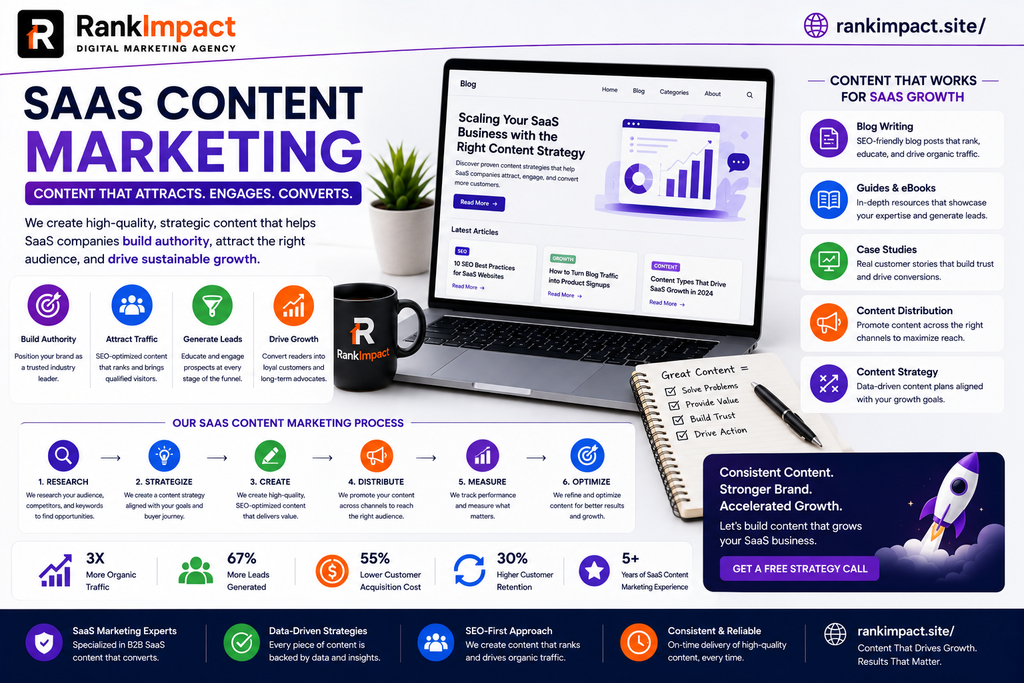
Effective SaaS content marketing requires mapping content to every stage of the buyer journey rather than producing generic educational posts alone. Bottom of funnel formats like comparison pages and case studies typically deliver the strongest conversion rates. Topical authority, built through a structured pillar and cluster approach, outperforms isolated, disconnected blog posts. Technical SEO health directly affects whether strong content can actually rank. Retention focused content for existing customers is often undervalued despite its direct impact on renewal and expansion revenue. Original research, proprietary data, and genuine product expertise increasingly separate content that earns lasting attention from content that gets summarized away by search engines and AI tools. Finally, ROI should be tracked holistically across acquisition, activation, and retention, not through traffic alone.