Learn what security as a service includes how it compares to alternatives what it costs common mistakes and how to choose the right provider.
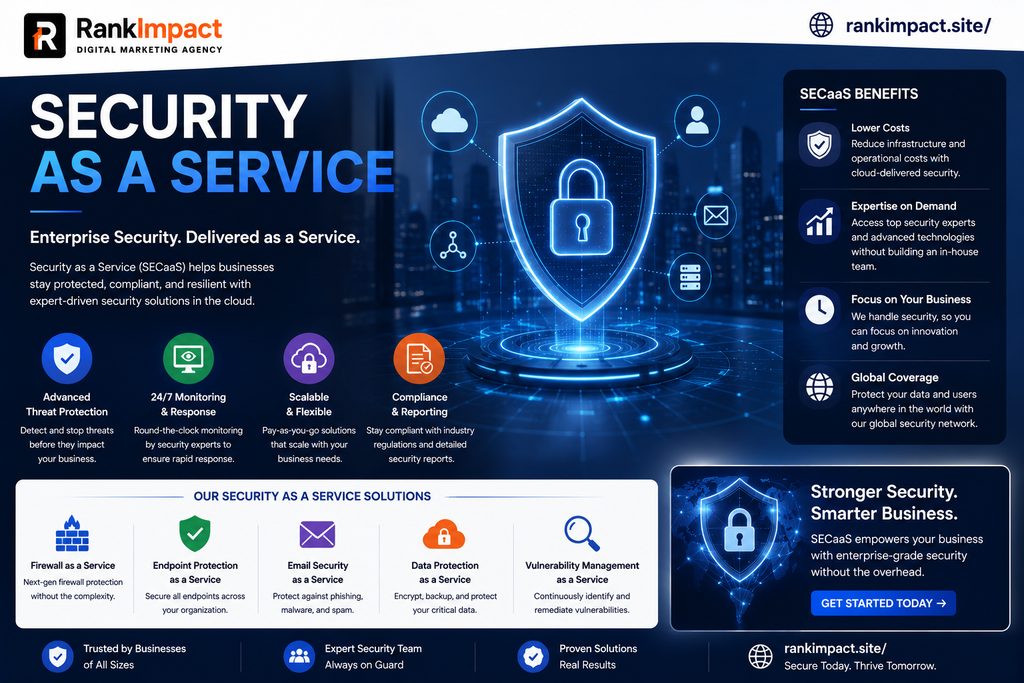
Table of Contents
1 What Security As A Service Actually Means
Security as a service is a delivery model where a company pays a subscription fee to access security tools, monitoring, and expertise through the cloud rather than building and maintaining that infrastructure in house. Instead of purchasing hardware appliances, hiring a full time security operations team, and managing software updates internally, a business subscribes to a provider that handles the technology, the monitoring, and often the incident response as part of an ongoing relationship. This model covers a wide range of specific services, including managed firewalls, endpoint detection and response, identity and access management, email security, and continuous vulnerability scanning, all delivered and updated by the provider rather than an internal team. The appeal is straightforward, a growing company gets access to enterprise grade protection and specialized expertise without the capital expense and hiring challenge of building that capability from scratch, which matters enormously for organizations that cannot compete with large enterprises for scarce cybersecurity talent.
2 Why Security As A Service Has Become So Important
Cyber threats have grown more sophisticated and more constant, and small and mid sized businesses are increasingly targeted precisely because attackers know these organizations often lack dedicated security staff. Building an internal security operations center requires round the clock staffing, expensive tooling, and continuous training to keep pace with evolving attack techniques, which is simply out of reach for most companies outside the largest enterprises. Security as a service solves this by pooling expertise and infrastructure across many customers, which lets a provider offer monitoring and response capabilities that would be far too expensive for any single mid sized company to build alone. Regulatory pressure has added another layer of urgency, since industries like healthcare, finance, and retail face compliance requirements around data protection that are difficult to satisfy without dedicated security expertise, and a strong security as a service provider often has compliance frameworks already built into their offering. The result is that security as a service has moved from a nice to have option to something close to a baseline expectation for any company that handles sensitive customer data or operates in a regulated industry. Insurance requirements are reinforcing this shift as well, since many cyber insurance policies now require documented monitoring and response capabilities before they will issue coverage, and demonstrating an active subscription with a reputable provider often satisfies underwriters far more easily than describing an ad hoc internal process.
3 How Security As A Service Differs From Traditional Security Models
Traditional on premise security requires a company to purchase hardware, license software, and staff a team capable of configuring, monitoring, and updating that infrastructure continuously, which creates significant upfront capital expense and ongoing operational burden. Security as a service shifts this to an operating expense model, where a predictable subscription fee replaces large upfront purchases and the provider absorbs the burden of keeping tools updated against the latest threats. This also differs from a managed security service provider model in an important way, since managed security providers typically manage a company’s existing security tools, while a security as a service provider usually delivers the tools themselves as part of the subscription, bundling technology and expertise together rather than separating them. Scalability is another meaningful difference, since a growing company can typically add users, locations, or additional protection layers to a security as a service subscription far more easily than it could scale an internally built security program, which often requires new hardware purchases and additional hiring every time the business grows. Speed to deployment also tends to favor the subscription model, since a provider can typically activate coverage for a new company within days, while building an equivalent internal capability from the ground up can take many months of hiring, procurement, and configuration before it is genuinely operational.
4 Core Components Of A Security As A Service Offering
A comprehensive security as a service package typically includes several distinct layers working together rather than a single standalone tool. Endpoint detection and response protects individual devices like laptops and servers by continuously monitoring for suspicious behavior and automatically containing threats before they spread. Identity and access management controls who can access which systems and data, often including multi factor authentication and single sign on to reduce the risk of compromised credentials leading to a breach. Email security filters phishing attempts and malicious attachments before they reach an employee inbox, which matters enormously since phishing remains one of the most common ways attackers gain initial access to a company’s systems. Continuous vulnerability scanning identifies weaknesses in a company’s systems and applications before attackers can exploit them, while a security operations center staffed by the provider monitors alerts around the clock and responds to genuine incidents rather than leaving that responsibility entirely to an internal team that may only work standard business hours. Data loss prevention is another component worth understanding, since it watches for sensitive information leaving the company through email, file transfers, or cloud storage, catching accidental leaks as well as deliberate exfiltration attempts before they become a reportable incident. Backup and disaster recovery capabilities are sometimes bundled in as well, ensuring that even if an attack succeeds, the company can restore systems and data quickly rather than facing extended downtime. Not every provider bundles all of these components together, which is exactly why understanding what is actually included in a specific offering matters more than comparing price alone.
5 How To Choose The Right Security As A Service Provider
Choosing a security as a service provider starts with understanding your own risk profile, including what type of data you handle, which regulations apply to your industry, and where your current security gaps actually sit, since this shapes which components matter most for your specific business. Smaller companies without a dedicated IT function often benefit most from a provider that offers guided onboarding and plain language reporting, since technical jargon in an alert dashboard is not useful if nobody on staff knows how to act on it. Ask any provider under consideration exactly what is included in the base subscription versus what costs extra, since some providers advertise a low starting price but charge significantly more once you add the monitoring or response capabilities that actually matter during a real incident. Response time commitments deserve careful scrutiny, since a provider that promises monitoring but takes hours to respond to a genuine alert offers far less protection in practice than the marketing material suggests. It is also worth asking for references from customers in a similar industry and company size, since a provider that excels at protecting a small retail business may not have the depth of expertise needed for a healthcare company facing stricter compliance requirements. Finally, review the exit terms carefully before signing, since switching security providers involves transferring sensitive configuration and access details, and a contract that makes this transition difficult can trap a company with a provider that is no longer meeting their needs. It also helps to ask how the provider handles onboarding, since a rushed setup process often leaves gaps in coverage during the first few weeks when a company is most vulnerable to having something fall through the cracks.
6 Common Mistakes Companies Make With Security As A Service
The most common mistake is treating a security as a service subscription as a complete solution that eliminates the need for any internal security awareness, when in reality even the best provider cannot fully protect a company where employees regularly click phishing links or reuse weak passwords. Another frequent mistake is failing to clarify incident response responsibilities before signing a contract, which leads to confusion during an actual breach about who is responsible for containment, communication, and recovery, precious time that should be spent responding to the threat instead of arguing over contract terms. Many companies also underestimate the importance of integration, choosing a provider whose security tools do not connect well with existing business systems, which creates blind spots and makes monitoring less effective than it should be. Some organizations select a provider based purely on price without evaluating actual coverage, only to discover during a real incident that critical protections they assumed were included actually required a more expensive tier. Finally, many companies set up this protection once and never revisit it as the business grows, leaving new employees, new locations, or new cloud applications outside the scope of protection simply because nobody updated the account after the initial setup.
7 What Security As A Service Typically Costs
Pricing for security as a service varies significantly based on company size, industry, and which components are included in the subscription. Small businesses with basic needs, such as endpoint protection and email security for a limited number of users, might pay a modest monthly fee per user, while mid sized companies requiring a full stack including identity management, continuous monitoring, and incident response typically pay considerably more as coverage expands. Enterprise level contracts with dedicated security operations center coverage, custom compliance reporting, and guaranteed response times can run into significant monthly costs, but these are usually justified by the scale of data and systems being protected. It helps to think about cost in the context of what a breach would actually cost the business, including regulatory fines, customer trust, and operational downtime, since this comparison usually makes even a robust subscription look inexpensive relative to the financial damage of a serious incident. When comparing quotes, always confirm whether pricing is per user, per device, or a flat organizational fee, since these structures can produce very different total costs as a company grows.
8 The Future Of Security As A Service
Artificial intelligence is increasingly built into security as a service platforms, helping providers detect unusual behavior patterns and respond to threats faster than manual monitoring alone ever could, since AI models can process far more signal data than a human analyst reviewing alerts one at a time. Zero trust architecture, which assumes no user or device should be automatically trusted regardless of location, is becoming a standard component of leading security as a service offerings rather than an optional add on. As remote and hybrid work remain common, providers are also expanding coverage to protect distributed teams working across personal networks and devices, which traditional perimeter based security models were never designed to handle. Consolidation is another trend worth watching, as more providers bundle previously separate tools into unified platforms, making it easier for a growing company to manage security through a single relationship instead of stitching together multiple point solutions. Companies evaluating security as a service today should look for providers actively investing in these areas, since a provider that is not evolving its capabilities will struggle to keep pace with how quickly the threat landscape continues to change. Asking a prospective provider about their product roadmap and how recently their platform was updated can reveal a lot about whether they are genuinely investing in these emerging capabilities or simply marketing older technology under newer terminology.
Frequently Asked Questions
What is security as a service in simple terms?
Security as a service is a subscription based model where a company accesses security tools, monitoring, and expertise through a cloud provider instead of building and maintaining that infrastructure internally, similar in spirit to how other business software has shifted from owned infrastructure to subscription access.
How is security as a service different from a managed security service provider?
Security as a service typically delivers the security tools themselves as part of the subscription, while a managed security service provider usually manages a company’s existing tools rather than supplying new ones, though the two models increasingly overlap.
Is security as a service suitable for small businesses?
Yes, security as a service is often especially valuable for small businesses since it provides access to enterprise grade protection and expertise without the cost of hiring a dedicated internal security team.
What does a typical security as a service package include?
Most packages include endpoint detection and response, identity and access management, email security, vulnerability scanning, and around the clock monitoring, though the exact components vary significantly by provider.
How much does security as a service typically cost?
Costs vary based on company size and coverage level, ranging from a modest per user monthly fee for basic protection to significantly higher enterprise pricing for full stack coverage with dedicated incident response.
Does security as a service replace the need for an internal IT team?
No, security as a service complements rather than fully replaces internal IT staff, since someone within the company still needs to manage the relationship, enforce security policies, and support employees on day to day issues, and that internal point of contact is often what determines how smoothly the provider relationship actually works in practice.
What questions should I ask a security as a service provider before signing?
Ask exactly what is included in the base subscription, what response time commitments look like during an actual incident, and what the process is for switching providers if the relationship does not work out.
Can security as a service help with regulatory compliance?
Yes, many providers build compliance frameworks for regulations like HIPAA or PCI DSS directly into their offering, which can significantly simplify meeting industry specific data protection requirements.
What is the biggest mistake companies make when adopting security as a service?
The biggest mistake is treating the subscription as a complete solution that removes the need for employee security awareness, when human error remains one of the leading causes of security incidents regardless of what tools are in place.
How is AI changing security as a service?
AI is helping providers detect unusual behavior and respond to threats faster than manual monitoring alone, and it is becoming a core part of how leading security as a service platforms identify and contain incidents in real time.
Conclusion
Security as a service has become one of the most practical ways for growing companies to access serious protection without the cost and complexity of building an internal security program from scratch. The businesses that get the most value from security as a service treat it as one part of a broader security culture, pairing strong provider coverage with employee awareness and clear internal ownership of the relationship, rather than assuming a subscription alone guarantees safety. Whether you are evaluating your first provider or reconsidering an existing one, focus on understanding exactly what is included, how quickly the provider actually responds to real incidents, and whether their offering can grow alongside your business. Approached this way, security as a service stops being just another line item and becomes a genuine foundation for protecting the company as it scales.
Key Takeaways
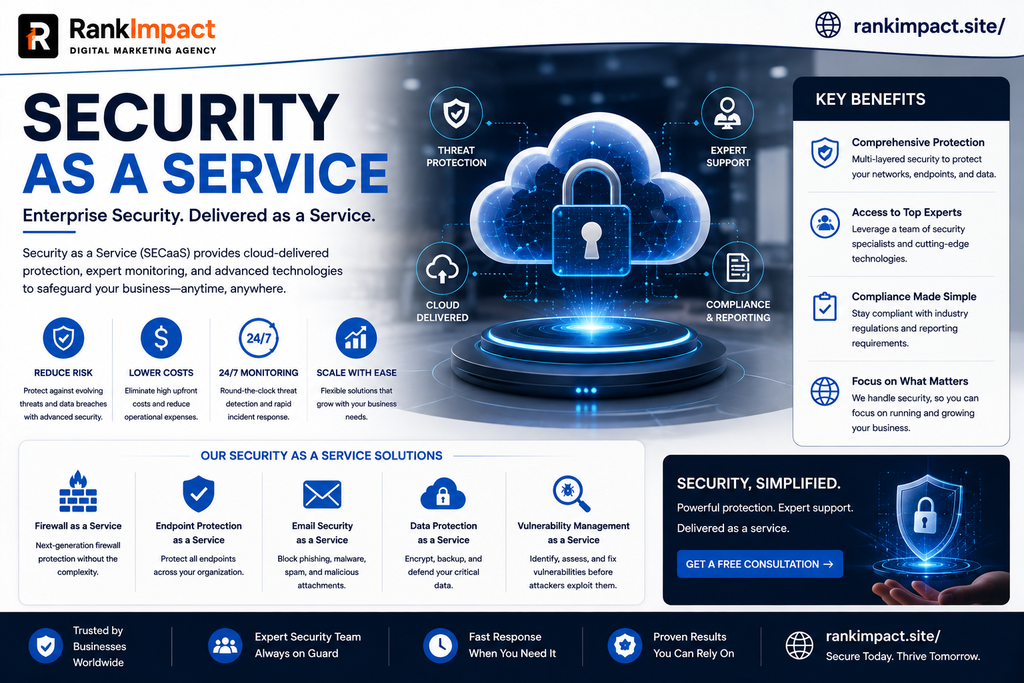
Security as a service delivers security tools, monitoring, and expertise through a subscription rather than internal infrastructure It differs from managed security providers by typically supplying the tools themselves as part of the offering Core components usually include endpoint protection, identity management, email security, and continuous monitoring Choosing the right provider requires understanding your own risk profile and clarifying incident response responsibilities upfront Pricing varies widely based on company size and coverage level, so always confirm exactly what each tier includes AI and zero trust architecture are becoming standard parts of leading security as a service platforms.