Thinking about the google project management certificate? Get real cost timelines job outcomes and how it compares to CAPM and PMP before you enroll.
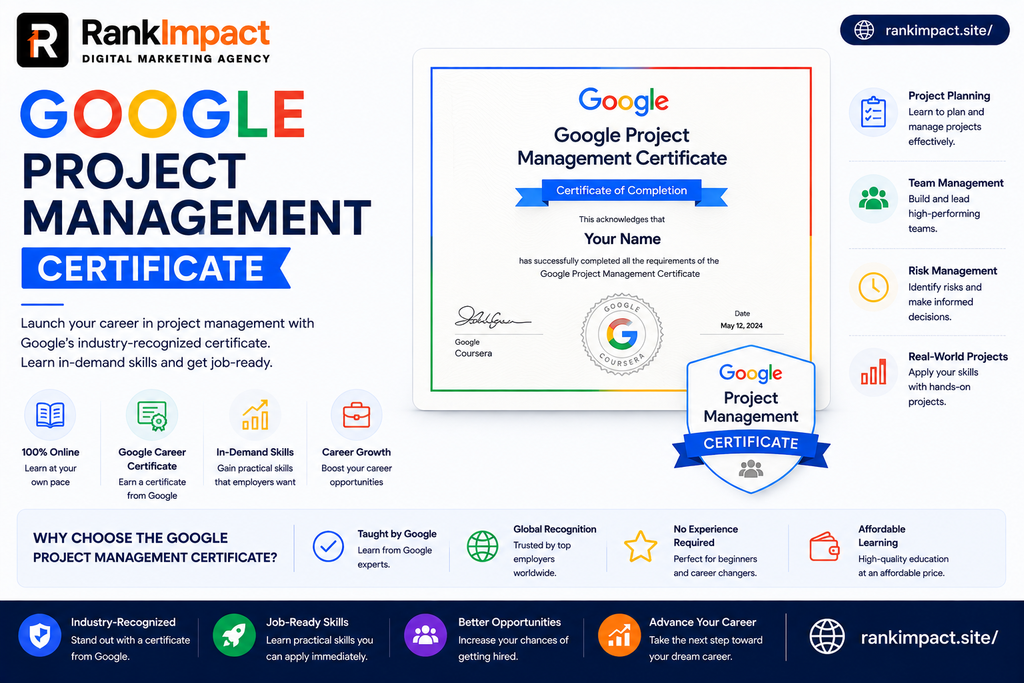
Table of Contents
What The Google Project Management Certificate Actually Is
The Google Project Management Certificate is a beginner friendly online program built by Google and hosted entirely on Coursera. It requires no degree, no prior project management experience, and no prerequisites of any kind, which is exactly why it has become one of the most recommended starting points for career changers. The program is structured as a 7 course series covering more than 140 hours of instruction, walking learners through the full project lifecycle from initiation and planning through execution, monitoring, and closing, with dedicated modules on Agile and Scrum methodology, risk management, budgeting, stakeholder communication, and quality assurance.
What sets this certificate apart from a typical online course is the hands on nature of the assignments. Learners are not simply watching videos and answering quiz questions. They work through real project scenarios using tools like Google Sheets, presentation software, and Asana, and the program even includes exposure to generative AI tools for tasks like drafting project plans and organizing job applications. By the end of the program, learners complete a capstone project that becomes a portfolio piece they can show directly to hiring managers, which is often more persuasive in an interview than the certificate itself.
How Much The Google Project Management Certificate Actually Costs
Cost is one of the most searched questions attached to this certificate, and the answer is more specific than most articles let on. The program runs through a Coursera subscription priced at 49 dollars per month in the United States and Canada, following an initial 7 day free trial. Since the certificate is entirely self paced, your total cost depends entirely on how quickly you move through the material rather than a fixed enrollment fee.
Most learners who study at a moderate pace of around 10 hours per week finish in roughly 3 to 6 months, which puts the realistic total cost somewhere between 150 and 300 dollars. Learners who dedicate themselves full time and push through in 6 to 8 weeks can complete the entire program for close to 100 dollars, making it one of the least expensive meaningful credentials available in the project management space. On the other end, someone studying just 5 to 7 hours per week may take 7 months or longer, pushing the total closer to 345 dollars. Coursera also offers financial aid for learners who qualify, which can bring the total cost down to zero for those who cannot afford the monthly subscription.
How Long It Really Takes To Finish
Google estimates the certificate takes about 6 months when studying 10 hours per week, but this number is intentionally conservative and many learners finish considerably faster. Someone with a dedicated block of free time, such as a gap between jobs or a summer break, can realistically complete the coursework in 2 to 3 months by studying 15 to 20 hours per week. Highly motivated learners who treat the certificate like a full time job and study 20 or more hours weekly have finished the entire 7 course series in as little as 6 to 8 weeks.
The honest answer is that pacing is entirely up to you, since Coursera allows you to move through material as quickly or slowly as your schedule allows, with no fixed class dates or cohort deadlines to keep up with. This flexibility is one of the biggest advantages of the program for working adults who cannot commit to a rigid class schedule.
Is The Google Project Management Certificate Actually Worth It
Whether this certificate is worth it depends heavily on where you currently stand in your career. For someone with zero project management background trying to break into an entry level coordinator or associate project manager role, the certificate offers strong return on investment. Entry level project coordinator roles have reported median starting salaries around 70,500 dollars, which means even a full 294 dollar investment pays for itself many times over within the first paycheck if the credential helps you land the role.
The certificate also carries genuine institutional weight beyond just Google’s name recognition. Google holds status as an approved member of the Project Management Institute’s Authorized Training Partner program, and the certificate delivers over 100 hours of instruction that count directly toward the education requirement for the Certified Associate in Project Management credential, commonly known as CAPM. Graduates are also offered CAPM at a discounted price, which makes this certificate function as a practical stepping stone toward more advanced PMI credentials rather than a dead end.
Where the certificate offers less value is for people who already have several years of hands on project management experience. If you already manage complex projects professionally, the CAPM or the full Project Management Professional credential, known as the PMP, will likely carry more weight with hiring managers and demonstrate a level of expertise this beginner program is not designed to prove.
Google Certificate Versus CAPM Versus PMP
Understanding how this certificate stacks up against the two major PMI credentials clarifies exactly who it is built for. The Google certificate requires no prior experience at all, has no proctored exam, and costs somewhere between 150 and 300 dollars total. CAPM also requires no experience but does require a proctored 150 question exam lasting three hours and typically costs between 400 and 600 dollars once you include exam and study material fees. PMP sits at the far end of the spectrum, requiring 36 to 60 months of verified project management experience, a proctored 180 question exam lasting nearly four hours, and total costs that frequently exceed 600 dollars and can climb past 1500 dollars depending on training resources used.
This comparison makes the practical use case obvious. The Google certificate is the on ramp for people with no experience who need to build foundational knowledge and a portfolio piece. CAPM is the next logical step once foundational knowledge is in place but real world experience is still limited. PMP is reserved for professionals who already have years of verified project leadership experience and want the most respected credential in the industry.
What You Actually Learn Inside The Program
The curriculum is broken into distinct courses that build on each other progressively. Early courses introduce the foundations of project management as a discipline, covering key terminology, project lifecycle stages, and the different roles involved in a typical project team. From there, the program moves into practical planning skills, teaching learners how to define project scope, build realistic timelines, and manage stakeholder expectations from day one rather than after problems arise.
Agile and Scrum receive dedicated attention, which matters significantly since most modern SaaS companies and technology teams run at least part of their workflow using Agile principles. Learners practice running sprints, managing a product backlog, and facilitating Scrum ceremonies like standups and retrospectives, which are directly transferable skills for anyone hoping to work at a software company. Risk management and quality assurance modules teach learners how to anticipate problems before they derail a project and how to build quality checks into a workflow rather than catching mistakes only at the end.
The program closes with career preparation content that many competing certificates skip entirely. Learners get direct help building a standout resume, organizing their job search using spreadsheets, and even practicing interview responses using AI powered tools. This career support layer is part of why graduates frequently mention feeling genuinely job ready rather than just academically informed by the time they finish.
Real World Ways This Certificate Gets Used
A career changer working a retail management job might use the certificate to formally validate skills they were already applying informally, such as coordinating staff schedules and managing inventory timelines, then use that validation to apply for entry level project coordinator roles at logistics or retail companies. A recent college graduate with a degree unrelated to business might use the certificate to pivot into tech adjacent roles, since the Agile and Scrum training translates directly into software team environments even without a computer science background.
A small business owner might complete the certificate not to get hired elsewhere but to run their own operations more efficiently, applying the risk management and stakeholder communication frameworks directly to client projects. An administrative assistant looking to move up within their current company might use the certificate alongside their existing institutional knowledge to make a strong internal case for a promotion into a formal project management title, since the combination of company familiarity and a recognized credential is often more persuasive to an internal hiring committee than either factor alone.
Common Mistakes People Make While Pursuing This Certificate
The most common mistake is treating the estimated 6 month timeline as a requirement rather than a suggestion, which leads some learners to pace themselves unnecessarily slowly and pay for extra months of subscription fees they did not need to spend. Setting a personal deadline and studying consistently, even just 5 to 7 hours a week, moves most learners through the material faster than the default estimate suggests.
Another frequent mistake is skipping the capstone project or completing it with minimal effort, since some learners view it as a formality rather than the single most valuable asset the program produces. Hiring managers respond far more strongly to a polished portfolio piece demonstrating real project planning work than to the certificate title alone, so this final project deserves more time investment, not less.
A third mistake is assuming the certificate alone guarantees a job offer. The certificate is a strong signal of foundational knowledge, but pairing it with networking, tailored resume language, and genuine practice articulating your new skills in interviews makes a measurable difference in actual hiring outcomes. Treating the certificate as one part of a broader job search strategy rather than the entire strategy itself leads to significantly better results.
Finally, many learners forget to cancel or manage their Coursera subscription properly once they finish, continuing to pay monthly fees for a certificate they have already completed. Since Coursera renews automatically, marking a calendar reminder to cancel immediately after finishing the final assessment avoids paying for unused months.
Best Practices For Getting The Most Value From The Program
Take full advantage of the 7 day free trial before committing financially, using that window to explore the course structure and confirm the pacing works with your schedule. Set a personal weekly study goal that is realistic for your actual life rather than blindly following Google’s default 10 hour estimate, since consistency matters more than raw hours logged in any single week.
Treat every assignment, especially the capstone project, as a piece of your professional portfolio rather than busywork to get through. Save drafts, refine your final capstone submission, and consider publishing a polished version of it publicly on a platform like LinkedIn or a personal portfolio site once complete. Actively engage with the career support materials near the end of the program rather than skipping them, since the resume and interview preparation content is specifically designed to convert your new knowledge into an actual job offer rather than just a line on a certificate.
Frequently Asked Questions
What is the google project management certificate?
It is a beginner level online program created by Google and hosted on Coursera that teaches the fundamentals of project management, including Agile and Scrum, risk management, and stakeholder communication, requiring no prior experience or degree.
How much does the google project management certificate cost?
It costs 49 dollars per month through a Coursera subscription after a 7 day free trial, with most learners paying a total of 150 to 300 dollars depending on how quickly they complete the 7 course series.
How long does it take to complete the certificate?
Google estimates about 6 months at 10 hours per week, though motivated learners studying full time have completed it in as little as 6 to 8 weeks.
Is the google project management certificate respected by employers?
Yes, it is accepted by an employer consortium that includes companies like Google, Deloitte, and T-Mobile for entry level project coordination roles, and it also counts toward CAPM education requirements through PMI.
Does this certificate replace the PMP credential?
No, it does not replace PMP, which requires several years of verified project management experience. The Google certificate is better understood as an entry point or a stepping stone toward CAPM rather than a PMP substitute.
Can I get this certificate for free?
Yes, Coursera offers financial aid for learners who qualify, which can bring the total cost down to zero, and the 7 day free trial lets you explore the content before paying anything.
What jobs can I get with the google project management certificate?
Common entry points include project coordinator, associate project manager, and junior program coordinator roles, particularly at companies participating in the employer hiring consortium tied to the certificate.
Do I need any prior experience to enroll?
No prior experience, degree, or prerequisite coursework is required, which is one of the main reasons this certificate is recommended so frequently for career changers.
Is the google project management certificate worth it in 2026?
For beginners aiming at entry level project roles, yes, since the low cost relative to potential entry level salaries and the CAPM education credit make it a strong return on investment, though experienced professionals may benefit more from CAPM or PMP directly.
What topics does the certificate cover?
The curriculum covers project lifecycle fundamentals, Agile and Scrum methodology, risk management, budgeting, stakeholder communication, quality assurance, and career preparation including resume building and interview practice.
Conclusion
The google project management certificate has earned its reputation as one of the most practical entry points into project management for a simple reason, it combines a low realistic cost, a flexible self paced structure, and genuine institutional credibility through its PMI partnership into a single beginner friendly package. Whether you are switching careers entirely, formalizing skills you already use informally, or looking for a stepping stone toward CAPM or PMP down the road, this certificate delivers real value when you approach it with a clear study plan and take the capstone project seriously. The numbers make the case on their own, a total investment usually under 300 dollars measured against a median entry level salary well into the seventy thousand dollar range is a return few other credentials in any field can match.
Key Takeaways
The google project management certificate costs 49 dollars per month on Coursera with most learners paying a total of 150 to 300 dollars over 3 to 6 months.
No degree experience or prerequisites are required to enroll making it accessible to complete beginners.
The program includes over 140 hours of instruction across 7 courses covering Agile Scrum risk management and stakeholder communication.
More than 100 hours of the certificate count toward CAPM education requirements through Google’s PMI Authorized Training Partner status.
The certificate works best as an entry point for beginners while CAPM and PMP remain better suited for learners with existing project experience.
Taking the capstone project seriously and pairing the certificate with active job search effort meaningfully improves real hiring outcomes.