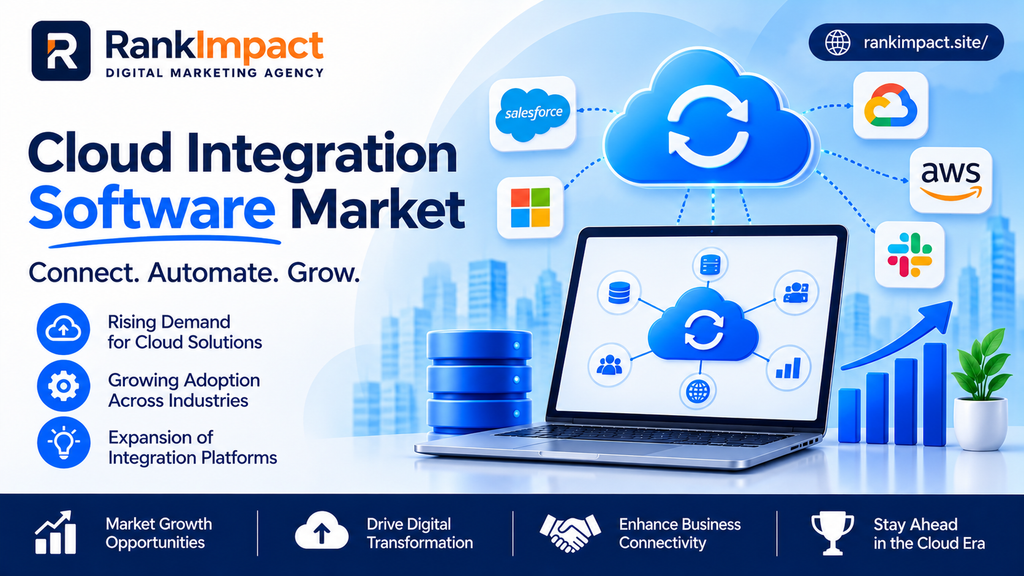
Explore the cloud integration software market with size estimates growth drivers top vendors and buying tips so you can plan smarter for 2026 and beyond.
Table of Contents
What Cloud Integration Software Actually Does
Cloud integration software connects applications, data sources, and business processes that live in different environments so they can exchange information reliably. It sits in the middle of your technology stack and handles the tasks that would otherwise require custom scripts, including moving records between systems, transforming data formats, triggering workflows when an event happens, managing application programming interfaces, and monitoring failures so someone can fix them quickly.
The category includes several overlapping approaches. Integration platform as a service, usually shortened to iPaaS, is the best known model and delivers prebuilt connectors, a visual designer, and managed hosting in one subscription. API management tools focus on publishing, securing, and monitoring the interfaces that applications use to talk to each other. Data integration and extract transform load tools concentrate on moving large volumes of data into warehouses and lakes. Event streaming and messaging platforms handle real time communication between services. Many modern vendors blend all four, which is one reason market estimates are so hard to compare.
Cloud Integration Software Market Size and Growth in 2026
Anyone who has searched for a single number quickly discovers that research firms disagree. One estimate attributed to Mordor Intelligence and published through Research and Markets values the cloud integration software market at about 7.68 billion dollars in 2025, rising to 8.71 billion in 2026 and 16.35 billion by 2031, a compound annual growth rate of roughly 13.4 percent. The Business Research Company reports a similar picture, with the market growing from about 7.72 billion dollars in 2025 to 8.87 billion in 2026 at a rate near 14.9 percent. Grand View Research estimates 7.11 billion dollars in 2025 and projects 20.5 billion by 2033 at 14.4 percent. Other firms land far outside that range, with one report placing 2025 at 11.65 billion dollars and another at just 3.89 billion.
The differences come from definitions. Some analysts count only software subscriptions, while others include implementation services, support, and hardware. Some limit the scope to pure cloud integration, while others fold in the wider iPaaS category, which several firms size at well above 15 billion dollars for 2026 with growth rates between 15 and 27 percent. The practical lesson is to treat any single figure as a directional estimate rather than a fact. What the reports agree on is more useful than what they disagree on. Almost all of them project double digit annual growth, and most cluster between 13 and 15 percent for the narrow cloud integration software market, which means the category is expected to roughly double within six or seven years.
If you plan to cite a number in a business case or an investor deck, name the source, state the year, and note the definition. That small habit makes your argument far more credible than quoting a headline figure with no context.
Key Forces Driving the Cloud Integration Software Market
Several forces are pushing demand upward at the same time, and understanding them helps you judge which vendor features will matter in three years instead of only today.
SaaS sprawl is the first force. Departments buy tools on their own, and a mid sized company can easily run 100 or more cloud applications. Every new tool creates a fresh need to sync customers, invoices, tickets, and usage events with the rest of the stack, and manual exports collapse under that load.
Hybrid and multi cloud environments are the second. Few enterprises have moved everything to a single provider. Core systems often remain on premises while new workloads run across two or three clouds, so integration software has to bridge old and new worlds without forcing a risky migration.
The API economy is the third. Partners, customers, and internal teams increasingly expect programmatic access to data, which makes API management and reusable integration assets a competitive advantage rather than a back office chore.
Automation and artificial intelligence form the fourth force. Companies want agents and workflows that act on live data, and those systems are only as good as the connections that feed them. Vendors are racing to add natural language workflow building, intelligent mapping, and connectors designed for AI agents.
Compliance and governance are the fifth. Regulations around privacy and data residency require clear audit trails of where information moves, and a managed integration layer provides that visibility far better than scattered scripts.
How the Cloud Integration Software Market Is Segmented
Research reports slice the market in several ways, and knowing the main segments helps you read them intelligently.
By type, many reports separate offerings delivered as infrastructure, software, and platform services, with the platform and software categories capturing most spending as buyers prefer managed solutions over building their own. By enterprise size, large organizations account for the biggest share of revenue because their landscapes are complex, while small and medium businesses are often described as the faster growing group thanks to no code tools and lower entry prices. By end use, the largest buyers include information technology and telecom, banking and financial services, healthcare, retail and ecommerce, and manufacturing, each with its own compliance and data format needs.
By region, North America is generally reported as the largest market because of early cloud adoption and the concentration of vendors, while Asia Pacific is frequently cited as the fastest growing region as digital transformation spreads across large economies. For a SaaS company, these segments matter because they shape which connectors, security certifications, and pricing models vendors prioritize.
Leading Vendors Shaping the Cloud Integration Software Market
The vendor landscape can be grouped into four clusters, and most buyers end up comparing two or three companies from different groups.
The first cluster is enterprise integration platforms. MuleSoft, owned by Salesforce, is known for an API led approach to connecting systems. Boomi offers a widely used iPaaS with a large connector library and strong support for hybrid environments. Informatica and SnapLogic bring data management and integration pipelines for complex enterprise needs, and Workato combines integration with business automation for operations teams.
The second cluster is cloud provider services. Microsoft Azure Integration Services, Amazon Web Services integration tools, and Google Cloud integration products appeal to companies already committed to one cloud because billing, security, and identity are unified.
The third cluster is mid market and no code tools. Zapier and Make let small teams build workflows quickly with minimal technical skill, and platforms such as Celigo target growing companies that need pre built flows between popular business applications.
The fourth cluster is embedded and unified API providers, which let a software company offer native integrations to its own customers without building each connector from scratch. This group matters if you are a SaaS vendor whose buyers demand integrations with their existing tools.
Vendor strengths shift quickly through product releases, partnerships, and acquisitions, so verify current capabilities and pricing on each vendor site before you finalize a shortlist.
Practical SaaS Examples of Cloud Integration in Action
Concrete scenarios make the category easier to grasp. Consider a 60 person B2B software company that sells subscriptions. When a deal closes in the customer relationship system, an integration automatically creates the customer in the billing platform, provisions an account in the product, and opens an onboarding task for the success team. Without integration, someone copies those details by hand three times, and one typo can delay the customer for days.
Now consider a product led growth company that wants sales to follow up on high intent users. Product usage events flow from the application into a data warehouse, a scoring model flags accounts that hit key activity thresholds, and the integration layer pushes those scores into the sales tool in near real time. Reps spend their day on accounts that are ready to buy instead of guessing.
Each case shows the same pattern, which is that integration turns isolated tools into a connected workflow.
How to Choose Cloud Integration Software
Choosing well starts with your use cases rather than a feature list. Use these seven criteria to compare vendors fairly.
First, check connector coverage for the applications you actually use today and expect to adopt within two years. Second, evaluate how easily your team can build and change workflows, because a tool that only engineers can operate will create a new bottleneck. Third, examine reliability features such as error handling, retries, alerting, and detailed logs, since a silent failure that corrupts data is worse than no automation at all.
Fourth, review security and compliance, including encryption, role based access, audit trails, and the certifications your industry requires. Fifth, test scalability by asking how the platform behaves when record volumes grow ten times. Sixth, study the pricing model closely, since vendors charge by connections, tasks, data volume, or a mix, and the cheapest plan at small scale can become the most expensive at large scale. Seventh, assess support, documentation, and community, because you will rely on them during your first difficult integration.
Run a proof of concept with two vendors using one real workflow before you sign a multi year contract. A two week pilot reveals more than any demo.
Pricing Models and Cost Planning
Pricing in this market is often confusing, so it helps to know the common structures. Subscription tiers based on the number of connectors or workflows are simple to budget but can limit growth. Usage based pricing charges for tasks, API calls, or data volume, which is flexible but unpredictable if traffic spikes. Enterprise agreements bundle platform fees, support, and professional services into a custom quote, and they usually include annual commitments.
Budget beyond the license itself. Implementation, training, monitoring, and ongoing maintenance often add significant cost, and many teams underestimate the time needed to clean data before connecting systems. A practical rule is to plan for the subscription plus an equal or larger amount in the first year for setup and change management, then adjust once you see real usage.
Common Mistakes Buyers Make
The first mistake is buying on brand name alone. A famous platform may be heavy and expensive for a team that needs five simple workflows. The second is ignoring data quality, which means automating the flow of messy records and spreading errors faster. The third is building point to point connections for every new need, which creates a tangled web that nobody can map or maintain.
The fourth mistake is skipping governance. Without naming standards, ownership, and documentation, integrations multiply and break silently when employees leave. The fifth is underestimating monitoring, since an integration that fails at night can leave sales and finance working from stale numbers for days. The sixth is locking into a long contract before testing real workloads, which turns a fixable choice into an expensive one.
Best Practices for Implementing Cloud Integration Software
Start small and deliver visible value quickly. Pick one high impact workflow, such as syncing closed deals to billing, and measure the time saved before expanding. Document every integration with its purpose, owner, systems involved, and failure plan.
Design for reuse by building modular components such as a standard customer record mapping that many workflows can share. Set up alerts and dashboards from day one so failures reach a human within minutes. Review access permissions each quarter and rotate credentials regularly. Finally, appoint an owner for the integration layer, whether a small platform team or a named operations lead, because shared responsibility usually means no responsibility.
Future Outlook for the Cloud Integration Software Market
Several trends are likely to shape the next few years. Artificial intelligence will move from a marketing label to a practical layer, helping teams map fields automatically, suggest workflows, and detect anomalies in data flows. Connectors designed for AI agents will grow in importance, since agents need governed access to business systems to be useful and safe.
Event driven architectures will gain ground as companies demand real time responses rather than nightly batches. Composable approaches, where businesses assemble capabilities from interchangeable services, will increase the value of reusable APIs. Expect continued consolidation as large software companies acquire integration specialists, and expect competition between all in one suites and focused best of breed tools. For buyers, the safest strategy is to favor open standards, clear data portability, and vendors with a visible product roadmap.
Frequently Asked Questions
How big is the cloud integration software market ?
Estimates vary by definition, but most reports place the cloud integration software market at roughly 7 to 9 billion dollars around 2025 and 2026, with some outliers higher or lower depending on whether services and the wider iPaaS category are included.
How fast is the cloud integration software market growing?
Most research firms project compound annual growth between about 13 and 15 percent for the narrow category, while broader iPaaS estimates run higher, in some reports above 20 percent.
What is the difference between cloud integration and iPaaS?
Cloud integration is the general practice of connecting cloud applications and data, while iPaaS is a specific delivery model in which a vendor hosts a platform with connectors and tools for building integrations.
Who are the leading companies in the cloud integration software market?
Well known names include MuleSoft, Boomi, Informatica, SnapLogic, Workato, Celigo, Zapier, Make, and the integration services from Microsoft, Amazon, and Google.
Which industries use cloud integration software the most?
Information technology and telecom, banking and financial services, healthcare, retail and ecommerce, and manufacturing are commonly reported as the largest end users.
Why do market research reports show different numbers?
Firms use different definitions, base years, and methods. Some include services and hardware, and some combine cloud integration with the broader iPaaS or data integration markets.
Is cloud integration software suitable for small businesses?
Yes. No code tools and tiered pricing make it accessible, and small teams often start with a handful of automations before moving to a more advanced platform as complexity grows.
Should a SaaS company build integrations in house or buy a platform ?
Building makes sense for a few strategic, high volume connections you want to control fully. Buying or embedding a platform is usually faster and cheaper for the long tail of customer requested integrations.
What should I look for when choosing cloud integration software?
Prioritize connector coverage, ease of use, reliability features, security, scalability, pricing model fit, and quality of support, then confirm your choice with a short proof of concept.
How will artificial intelligence change the cloud integration software market?
AI is expected to speed up workflow building, improve data mapping, and enable governed access for software agents, which should raise demand for platforms that combine integration with strong security controls.
Conclusion
The cloud integration software market is growing because modern businesses run on connected tools, and manual workarounds simply cannot keep pace. Estimates differ, yet the direction is consistent, with steady double digit growth driven by SaaS sprawl, hybrid environments, APIs, automation, and artificial intelligence. If you are evaluating the space, define your use cases first, compare vendors against clear criteria, test with a real workflow, and plan for governance and monitoring from the start. Treat the numbers in market reports as helpful context, but let your own workflows decide what you buy. Done well, investing in this part of the cloud integration software market turns a scattered stack into a reliable system that saves time, reduces errors, and supports growth.
Key Takeaways
The cloud integration software market is commonly estimated at about 7 to 9 billion dollars around 2026, but figures vary widely because analysts define the category differently, so always cite the source and scope.
Most forecasts project double digit growth, with the narrow category clustering between 13 and 15 percent each year and broader iPaaS estimates growing faster.
Demand is driven by SaaS sprawl, hybrid and multi cloud environments, the API economy, automation and artificial intelligence, and compliance needs.
Vendors fall into four clusters, namely enterprise platforms, cloud provider services, no code mid market tools, and embedded integration providers, so compare options across groups.
Choose with seven criteria, test with a two week proof of concept, budget for implementation as well as licenses, and avoid the common mistakes of ignoring data quality, governance, and monitoring.