+92 318 3068833 Get Free Audit

SaaS And B2B Explained The 2026 Business Model Guide

Understand how saas and b2b work together covering the business model pricing key metrics real examples and the trends shaping software sales in 2026.
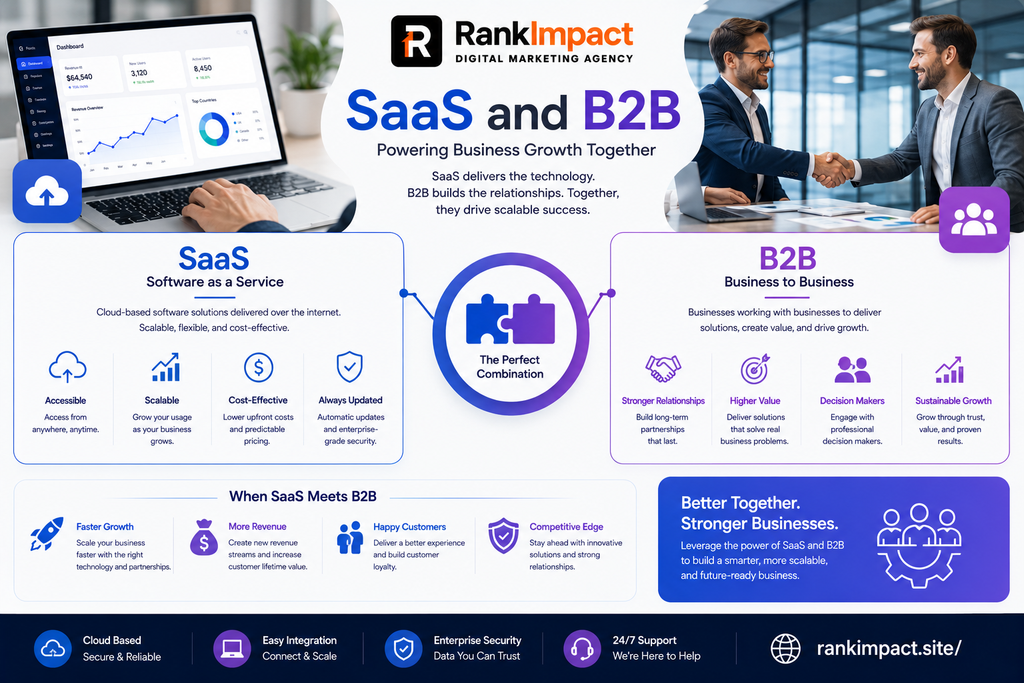
saas and b2b business model guide illustration for 2026.

SaaS And B2B Explained The 2026 Business Model Guide

Walk into almost any modern office and the tools running day to day operations from the CRM tracking deals to the platform processing payroll all share the same underlying business model. Understanding how saas and b2b fit together is no longer a niche topic reserved for software founders it is essential knowledge for anyone building selling or investing in a business today. This guide breaks down exactly what the relationship between saas and b2b actually means how the business model works in practice the metrics that separate healthy companies from struggling ones and the mistakes that consistently trip up founders and marketers trying to succeed in this space.

What SaaS And B2B Actually Mean Together

SaaS stands for software as a service meaning an application hosted in the cloud and delivered to customers through a browser or app rather than installed on a local machine. B2B stands for business to business meaning the customer buying that software is another company rather than an individual consumer. Put these two terms together and saas and b2b describe cloud hosted software sold on a recurring subscription specifically to other businesses rather than to the general public.

This combination changed the software industry fundamentally. Before this model became standard buying enterprise software meant a large upfront license fee a lengthy on premise installation and an internal IT team dedicated to keeping servers running. The vendor now hosts everything manages infrastructure and pushes updates automatically while the customer simply logs in and pays monthly or annually. Recent market research shows the global b2b saas market reached roughly 390 billion dollars in 2025 with projections placing it near 492 billion dollars in 2026 and continued growth toward 1.5 trillion dollars by the early 2030s driven by nearly every business function from finance to customer support moving onto subscription platforms.

How The B2B SaaS Business Model Actually Works

The financial engine behind saas and b2b companies looks completely different from a traditional product business and understanding this difference explains almost every strategic decision these companies make. Instead of earning revenue once at the point of sale a b2b saas company earns a smaller recurring payment every month or year meaning the real profit only materializes after a customer has stayed subscribed long enough to cover the cost of acquiring them in the first place. This is why customer retention and expansion revenue matter just as much as closing new deals and often matter considerably more.

Selling specifically to businesses rather than individual consumers shapes nearly everything downstream in this model. B2B purchase decisions typically involve multiple stakeholders including an end user a budget owner and sometimes a security or legal reviewer which naturally extends the sales cycle compared to a consumer buying decision made by one person in a few minutes. Average contract values also differ dramatically with typical b2b saas deals ranging anywhere from 5 thousand to well over 100 thousand dollars annually compared to consumer subscription products that often charge somewhere between 50 and 300 dollars per year. This gap in deal size explains why b2b saas companies invest so heavily in dedicated sales teams and account management rather than relying purely on self service signup the way many consumer products do.

Key Metrics Every B2B SaaS Company Must Track

Anyone working seriously in saas and b2b needs fluency in a specific set of metrics because traditional profit and loss thinking does not capture what actually predicts long term success in a subscription business. Annual recurring revenue commonly abbreviated as ARR represents the predictable yearly revenue a company can count on from active subscriptions and serves as the primary yardstick investors and leadership teams use to measure growth. Churn rate measures the percentage of customers or revenue lost over a given period and even a seemingly small monthly churn rate compounds into a serious growth headwind over a full year.

Net revenue retention often shortened to NRR captures whether existing customers are expanding their spend fast enough to offset the revenue lost from those who cancel with the strongest companies in the space regularly reporting NRR above 110 percent meaning their existing customer base alone grows revenue even before counting a single new sale. Customer acquisition cost paired with CAC payback period tells a company how much it costs to win a new customer and how many months of revenue it takes to recover that investment which directly determines how aggressively a company can afford to spend on sales and marketing. Gross margin rounds out the core metric set and tends to run higher in software than almost any other industry since the marginal cost of serving one additional customer is extremely low once the platform itself has been built.

Common Pricing Models In B2B SaaS

Pricing strategy sits at the intersection of saas and b2b decision making because the wrong model can quietly cap growth even when the underlying product is genuinely excellent. Per seat pricing charges customers based on the number of individual users accessing the platform and works particularly well for collaboration tools where value scales naturally with headcount. Usage based pricing charges customers according to actual consumption such as API calls processed or data volume stored and has grown significantly in popularity because it aligns cost directly with the value a customer receives rather than an arbitrary seat count.

Tiered pricing bundles different feature sets into good better and best packages giving customers a clear upgrade path as their needs grow while flat rate pricing simply charges one fixed fee regardless of usage or seats which works best for simpler products with a narrow feature set. Many companies increasingly blend these approaches combining a base platform fee with usage based add ons for specific high value features. Choosing the right model requires genuinely understanding how your specific customers perceive value rather than copying whatever pricing structure a competitor happens to use since the same structure can produce completely different results depending on the product category and buyer psychology involved.

Real World Examples Of Successful B2B SaaS Companies

Looking at concrete examples makes the abstract concept of saas and b2b far easier to grasp in practical terms. Salesforce built its entire empire on selling customer relationship management software to sales teams across every industry proving early that businesses would trust mission critical data to a cloud hosted platform rather than an on premise system. HubSpot took a different entry point building inbound marketing tools that gradually expanded into a full customer platform covering sales service and operations demonstrating how a company can start narrow and expand horizontally over time.

Slack transformed workplace communication by making team messaging so genuinely useful that individual employees pulled the product into their organizations from the bottom up rather than waiting for a top down IT purchasing decision a pattern now commonly called product led growth. Zoom scaled explosively by making video conferencing simple enough that a business could adopt it without any dedicated training while still building the security and administrative controls large enterprises require. Each of these companies solved a genuine business problem with software delivered through the cloud and built pricing and go to market strategies specifically tailored to how businesses actually make purchasing decisions rather than borrowing a consumer playbook wholesale.

How B2B SaaS Buyers Actually Make Purchasing Decisions

Understanding buyer behavior is essential for anyone marketing or selling within the saas and b2b space because business purchasing decisions follow a fundamentally different path than consumer buying. Research now shows the vast majority of business to business buyers use AI powered chat tools at some point during their evaluation process meaning a growing share of research happens before a prospect ever fills out a form or speaks with a sales representative. By the time a genuine sales conversation begins many buyers have already formed a strong opinion about which vendors deserve serious consideration.

Multiple stakeholders typically weigh in on any meaningful purchase with a technical evaluator focused on integration and security a financial approver focused on budget and a day to day user focused on ease of use all needing to reach agreement before a deal closes. This reality means marketing and sales content needs to address several distinct audiences simultaneously rather than writing for a single generic buyer persona. Free trials product demonstrations and detailed case studies all serve the practical purpose of giving each stakeholder in this buying committee the specific type of proof they personally need before signing off on a purchase.

Best Practices For Building A Successful B2B SaaS Company

Companies that consistently succeed in the saas and b2b space tend to share a specific set of disciplined habits regardless of what product category they operate in. Prioritizing customer retention from the very first day rather than treating it as an afterthought once growth slows protects the recurring revenue foundation the entire business model depends on. Building a genuinely useful free trial or freemium experience that lets prospects experience real value before ever speaking with a salesperson consistently shortens sales cycles and improves close rates compared to a fully gated sales led approach.

Investing early in customer success as a dedicated function rather than folding it into support tickets pays dividends through higher renewal rates and more organic expansion revenue over time. Treating pricing as a living strategy that gets revisited and tested regularly rather than a decision made once at launch and never revisited again allows a company to capture more value as the product matures and customer understanding deepens. Finally building content and thought leadership that genuinely helps your target audience solve real problems rather than purely promoting your own product tends to compound into a durable competitive advantage that outlasts any single marketing campaign.

Common Mistakes Companies Make In B2B SaaS

Watching struggling companies in the saas and b2b space reveals the same avoidable mistakes appearing again and again. Chasing new customer acquisition aggressively while ignoring churn creates a leaky bucket problem where a company can spend enormous sums on marketing and sales only to see existing customers quietly cancel at nearly the same rate new ones sign up. Copying a competitor’s pricing model without understanding why it works for their specific customer base often produces disappointing results since the same structure can feel perfectly fair to one audience and confusing or unfair to another.

Underinvesting in onboarding is another frequent misstep since a customer who never reaches real value in their first few weeks rarely renews regardless of how good the underlying product actually is. Treating marketing and sales as entirely separate functions with no shared data or handoff process consistently produces friction that costs deals and frustrates prospects who have to repeat the same information multiple times. Many companies also underestimate how much research today’s buyers complete before ever engaging a sales team which means a thin or generic content strategy quietly disqualifies a company from consideration long before anyone from the sales team even knows a prospect existed.

The Future Of SaaS And B2B In 2026 And Beyond

The relationship between saas and b2b continues evolving rapidly and a handful of clear trends are shaping where the industry heads next. Artificial intelligence is moving from a feature bolted onto existing products toward a core part of how software actually functions with AI agents increasingly handling tasks that previously required a human operator inside the platform itself. Generative engine optimization is becoming as important as traditional search engine optimization since a growing share of buyer research now happens through AI chat tools rather than a traditional search engine alone requiring companies to structure their content differently to earn citations inside these AI generated answers.

Product led growth and traditional sales led growth continue merging into hybrid motions where usage data identifies which accounts show genuine buying intent before a human seller ever gets involved making the entire process more efficient for both the vendor and the buyer. Vertical specific software built for a single industry rather than a horizontal tool meant for every business is also gaining ground since buyers increasingly prefer a solution built specifically around their unique workflows rather than a generic platform requiring extensive customization. Companies that stay ahead of these shifts while maintaining the fundamentals of strong retention and genuine customer value will continue to define what success looks like across the saas and b2b landscape for years to come.

Frequently Asked Questions

What is the difference between B2B SaaS and B2C SaaS?

B2B SaaS sells software to other businesses typically involving multiple stakeholders longer sales cycles and higher contract values while B2C SaaS sells directly to individual consumers with simpler purchasing decisions and much lower price points.

What are examples of saas and b2b companies?

Well known examples include Salesforce for customer relationship management HubSpot for marketing and sales tools Slack for team communication and Zoom for video conferencing all of which sell cloud hosted subscription software specifically to business customers.

How big is the b2b saas market in 2026 ?

Current market research places the global b2b saas market at approximately 492 billion dollars in 2026 with continued strong growth projected as more business functions move onto cloud subscription platforms in the years ahead.

What metrics matter most in a b2b saas business ?

Annual recurring revenue churn rate net revenue retention customer acquisition cost and gross margin together form the core metric set that investors and leadership teams use to evaluate the health of a b2b saas company.

Why do b2b saas companies have longer sales cycles than consumer companies ?

Business purchases typically require approval from multiple stakeholders including technical financial and end user reviewers which naturally extends the time needed to reach a final purchasing decision compared to an individual consumer buying alone.

Is product led growth replacing sales led growth in b2b saas?

Not entirely rather the two approaches are increasingly merging with product usage data helping identify high intent accounts that are then handed to a human sales team at exactly the right moment in their evaluation.

What pricing model works best for a new b2b saas product ?

There is no universal answer since the ideal model depends on how your specific customers perceive value though per seat usage based and tiered pricing all remain common starting points worth testing against your actual customer base.

How does artificial intelligence affect b2b saas buying decisions?

A large and growing share of business buyers now use AI powered chat tools during their research process meaning companies increasingly need to structure their content so it can be accurately cited by these tools before a prospect ever contacts sales directly.

What is net revenue retention and why does it matter ?

Net revenue retention measures whether existing customers are expanding their spend fast enough to offset revenue lost from cancellations with the strongest b2b saas companies consistently reporting figures above 110 percent.

How can a growing saas company improve its marketing results?

Many companies partner with a specialized saas digital marketing agency to build the content and demand generation systems needed to reach business buyers effectively without overextending a small internal team.

Conclusion

The connection between saas and b2b represents one of the most important business models shaping the modern economy touching everything from how companies communicate to how they manage finances and serve their own customers. Understanding the mechanics behind this model from recurring revenue and retention metrics to pricing strategy and buyer behavior gives founders marketers and business leaders a genuine advantage whether they are building a new product or simply trying to make smarter purchasing decisions for their own company. Focus on the fundamentals that consistently separate thriving companies from struggling ones including disciplined retention efforts a pricing strategy grounded in real customer value and content that genuinely helps your buyers make informed decisions. Get these basics right and you position yourself to succeed in a business model that continues to grow and evolve at a genuinely remarkable pace.
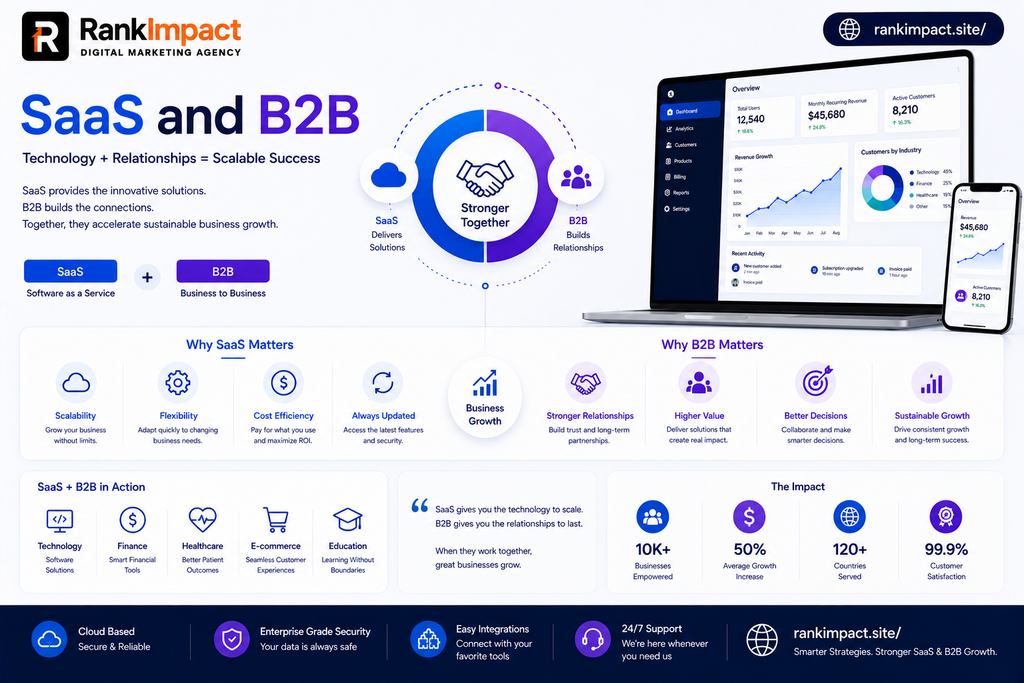
Key Takeaways

  • SaaS and b2b together describe cloud hosted software sold on a recurring subscription specifically to business customers rather than individual consumers
  • The global b2b saas market is projected near 492 billion dollars in 2026 with continued strong growth expected through the early 2030s
  • Key metrics including annual recurring revenue churn rate net revenue retention and customer acquisition cost matter more than traditional profit measures in this business model
  • Multiple stakeholders and longer sales cycles are standard in b2b saas purchasing decisions compared to simpler consumer buying behavior
  • Common pricing models include per seat usage based tiered and flat rate with the right choice depending entirely on how customers perceive value
  • Retention and expansion revenue often matter more to long term success than new customer acquisition alone
  • Artificial intelligence and generative engine optimization are reshaping how business buyers research and discover software solutions
  • Partnering with an experienced saas digital marketing agency can help growing companies build the demand generation systems needed to compete effectively.
Things To Know About What Is B2B SaaS In 2026

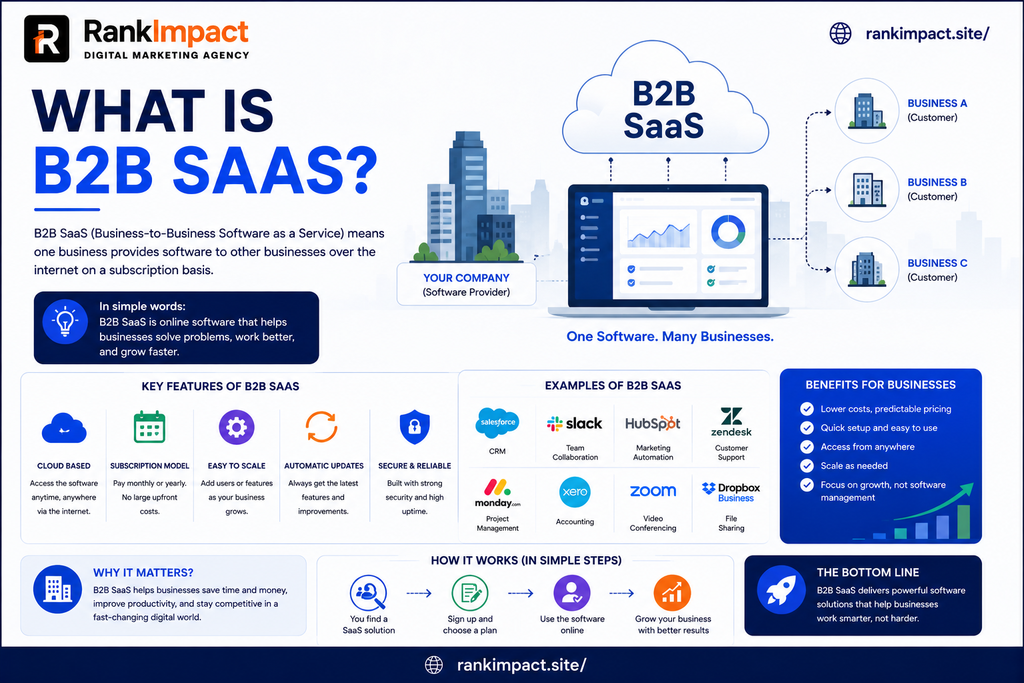
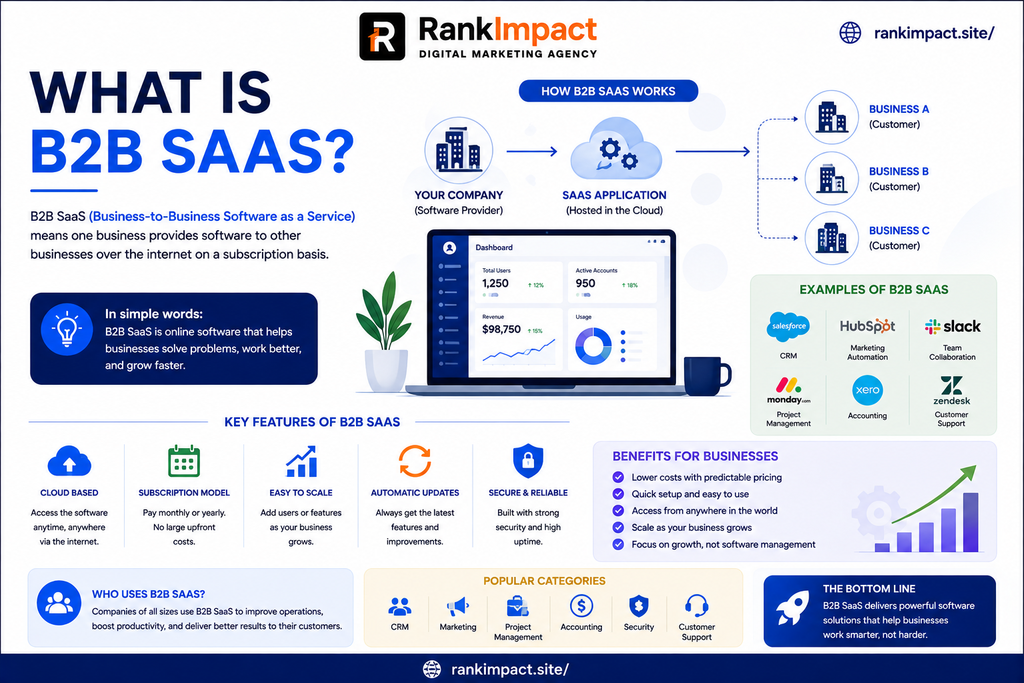
Learn what is b2b saas with a complete beginner friendly guide covering the definition examples key characteristics and how to evaluate a product.

What is b2b saas dashboard being reviewed by a business team on a laptop screen

What Is B2B SaaS

What is b2b saas, put simply, refers to software as a service products sold by one business to another business, rather than to individual consumers, and delivered through a subscription accessed over the internet rather than installed on a company’s own servers. The term itself combines two ideas, the business to business relationship, meaning the customer is a company rather than a person buying for personal use, and the software as a service delivery model, meaning the product is hosted in the cloud and accessed through a subscription rather than purchased outright as a one time license. Common examples include tools like customer relationship management platforms, project management software, accounting systems, and communication tools that companies use internally to run their operations, all delivered and updated continuously by the provider rather than installed once and left unchanged for years. Understanding this distinction matters because business buyers evaluate purchases very differently than individual consumers, often involving multiple stakeholders, a formal budget approval process, and a much longer research period before committing to a purchase decision. Anyone new to the software industry benefits from starting with this basic definition before moving into more advanced strategy, since a solid answer to what is b2b saas makes every later concept, from pricing to sales cycles, much easier to understand.

Why B2B SaaS Has Become So Widespread

Businesses of every size have shifted heavily toward subscription based software over the past decade because it eliminates the significant upfront cost and technical burden of maintaining software on internal servers, replacing that with a predictable monthly or annual fee and a provider responsible for updates and maintenance. Understanding what is b2b saas at this level of detail helps explain exactly why this shift happened so quickly across nearly every industry. This shift has been especially valuable for smaller companies that could never have afforded traditional enterprise software licenses and the dedicated technical staff needed to run them, since a subscription model gives them access to powerful tools at a fraction of what building or licensing equivalent capability once cost. Remote and hybrid work have accelerated this trend further, since cloud delivered software allows teams to access the same tools and data from anywhere with an internet connection, which simply was not practical with software installed on physical office servers. The recurring revenue model also benefits providers by creating a more predictable and often more valuable business than one time software sales, which has attracted enormous investment into building better and more specialized tools across nearly every business function imaginable. Together, these forces have made subscription software the default way most companies now buy and use business technology rather than the exception it once was, which is exactly why understanding what is b2b saas has become genuinely useful knowledge for almost anyone working in a modern business.

How B2B SaaS Differs From B2C SaaS

The most significant difference lies in who the buyer actually is and how that buyer makes a decision, which is often the clearest way to explain what is b2b saas to someone more familiar with consumer software. A consumer subscribing to a streaming service or a fitness app usually makes that decision alone and quickly, often based on price and immediate personal interest, while a business purchase typically requires justification to a manager, involvement from multiple departments, and formal budget approval before a contract is signed. Pricing structures also differ meaningfully, since business products are often priced per user or per feature tier with room for negotiation on larger deals, while consumer products usually have simple, fixed, non negotiable pricing available to anyone who wants to sign up. Sales and marketing approaches diverge significantly as well, since reaching business buyers typically requires content that addresses specific professional problems, direct sales outreach, and a longer nurture process, while consumer marketing often relies more heavily on broad advertising and rapid, low friction conversion paths. Support expectations differ too, since business customers frequently expect dedicated account management and guaranteed response times, particularly for larger contracts, while consumer support is generally handled through more automated, self serve channels at scale. These differences together form a fairly complete practical answer to what is b2b saas compared to its consumer facing counterpart.

Common Examples Of B2B SaaS Products

Customer relationship management platforms help sales and marketing teams track prospects and customers throughout the buying journey, representing one of the most widely adopted categories in this space across companies of nearly every size and industry. Seeing these concrete examples often makes what is b2b saas click for someone who has only encountered the term in the abstract. Project management and collaboration tools help teams coordinate work, track progress, and communicate across departments, which have become especially essential as remote and hybrid work arrangements have become far more common. Accounting and financial management software helps businesses handle invoicing, payroll, and financial reporting without maintaining that infrastructure internally, replacing what was once handled through expensive desktop software or manual processes entirely. Human resources platforms manage everything from recruiting and onboarding to performance reviews and benefits administration, consolidating functions that previously required multiple disconnected systems or significant manual paperwork. Marketing automation and email platforms help businesses manage campaigns, track engagement, and nurture leads at scale, supporting the kind of sustained, multi touch outreach that modern business buyers typically expect before making a purchase decision. Each of these categories offers a slightly different angle on what is b2b saas actually looks like when applied to a real business function.

Key Characteristics That Define B2B SaaS

Subscription based pricing is the most defining characteristic, with customers paying on a recurring basis rather than making a single upfront purchase, which creates an ongoing financial relationship that continues well beyond the initial sale. This recurring relationship is arguably the single most important detail in any complete answer to what is b2b saas. Cloud based delivery means the software runs on the provider’s servers and is accessed through a web browser or application rather than installed locally, allowing the provider to push updates and improvements continuously without requiring customers to manually install new versions. Scalability is another defining trait, since these products typically allow a business to add users, features, or capacity as they grow, without the significant upfront investment required to scale traditional on premise software. Multi tenancy, a technical architecture where many customers share the same underlying infrastructure while their individual data remains securely separated, allows providers to serve large numbers of customers efficiently while keeping costs manageable for everyone involved. Integration capability also matters significantly, since business software rarely operates in isolation, and the strongest products in this category are designed to connect smoothly with the other tools a company already relies on rather than functioning as a disconnected standalone system. Taken together, these five characteristics form the most technically complete answer to what is b2b saas that a buyer or newcomer to the field is likely to need.

The Business Model Behind B2B SaaS

Revenue in this space is measured very differently than in traditional one time product sales, with metrics like monthly recurring revenue and annual recurring revenue serving as the primary indicators of business health rather than total units sold in a given period. These metrics are a core part of understanding what is b2b saas from an operator’s perspective rather than just a buyer’s perspective. Customer retention becomes just as important as new customer acquisition, since losing existing subscribers through churn can quietly undermine growth even when new sales numbers look strong on the surface. Because of this, providers invest heavily in onboarding and ongoing customer success efforts to ensure customers actually adopt and see value from the product, since usage and satisfaction directly influence whether a customer renews their subscription. Expansion revenue, meaning additional revenue generated from existing customers upgrading to a higher tier or adding more users over time, has also become an increasingly important growth lever, since it is generally far more cost effective to grow revenue from an existing satisfied customer than to acquire an entirely new one. This combination of predictable recurring revenue and the ongoing need to deliver continuous value is what makes the underlying business model fundamentally different from selling a traditional software license once and moving on to the next customer, and it is the part of what is b2b saas that surprises people most when they first study the model closely.

How To Evaluate A B2B SaaS Product As A Buyer

Start by clearly defining the specific problem you need to solve and the outcome you expect, since evaluating options against a vague sense of needing better software rarely leads to a confident, well justified purchase decision. Approaching a purchase this way turns what is b2b saas from an abstract question into a practical decision making framework you can actually use. Request a trial or demo whenever possible, since hands on experience with real data and real use cases reveals far more about whether a product actually fits your needs than any marketing page or sales pitch alone. Investigate integration capability carefully, confirming the product connects smoothly with the other tools your team already relies on, since a powerful standalone tool that creates data silos can ultimately cause more friction than it solves. Review pricing structure in detail, including what happens as your usage or team size grows, since a price that looks attractive today can become significantly more expensive as your company scales if you do not fully understand the tiers involved. Finally, check for genuine customer reviews and, where possible, speak directly with existing customers in a similar industry or company size, since their honest experience often reveals practical strengths and limitations that a vendor’s own marketing material is unlikely to mention. Following this evaluation process consistently is the most practical, real world application of understanding what is b2b saas as a buyer rather than just as a definition.

Frequently Asked Questions

What is b2b saas in the simplest terms?

What is b2b saas comes down to this, it refers to subscription based software sold by one business to another, delivered through the cloud and accessed on a recurring basis rather than purchased once and installed locally.

What is an example of a b2b saas company?

Common examples include customer relationship management platforms, project management tools, accounting software, and marketing automation systems, all sold to businesses rather than individual consumers for personal use, giving a very concrete sense of what is b2b saas in practice.

How is b2b saas different from b2c saas?

The key difference is the buyer, since b2b saas is sold to businesses through a longer, more formal purchase process involving multiple decision makers, while b2c saas is sold directly to individual consumers who typically decide alone and quickly.

Is b2b saas the same as enterprise software?

Not exactly, since enterprise software specifically refers to solutions built for very large organizations, while what is b2b saas describes a broader category that includes products serving businesses of every size, from small startups to large enterprises.

Why do businesses prefer b2b saas over traditional software?

Businesses generally prefer this model because it eliminates large upfront licensing costs, removes the burden of internal maintenance, and allows access from anywhere, all through a predictable and often more affordable recurring subscription.

How is a b2b saas company’s success typically measured?

Success is typically measured through metrics like monthly and annual recurring revenue, customer retention rate, and expansion revenue from existing customers, rather than through total one time unit sales, which is another important layer of what is b2b saas beyond the basic definition.

What should I look for before buying a b2b saas product?

Look for a trial or demo opportunity, clear evidence the product integrates with your existing tools, transparent pricing that explains costs as you scale, and genuine customer reviews from businesses similar to your own, all of which turn what is b2b saas into an actionable buying checklist rather than just a definition.

Can a small business benefit from b2b saas products?

Yes, small businesses often benefit significantly from this model, since it provides access to powerful tools that would otherwise be unaffordable without the upfront investment and technical staff traditional software once required, which is a big part of why understanding what is b2b saas matters even for very small teams.

What does multi tenancy mean in b2b saas?

Multi tenancy refers to a technical architecture where many customers share the same underlying infrastructure while their individual data stays securely separated, allowing providers to serve customers efficiently while keeping costs manageable, and it is one of the more technical details worth knowing once you understand what is b2b saas at a basic level.

How is artificial intelligence changing b2b saas products?

Artificial intelligence is increasingly built directly into b2b saas products, helping automate repetitive tasks, generate insights from data, and personalize the user experience in ways that were not practical with earlier generations of business software, which is quickly becoming part of any modern answer to what is b2b saas.

Conclusion

What is b2b saas ultimately comes down to a straightforward idea, it is subscription based software built for businesses rather than individual consumers, delivered through the cloud and priced to scale alongside the customer using it. Understanding this concept matters whether you are a buyer trying to make a confident purchase decision, a job seeker exploring a career in the software industry, or a founder considering building a product in this space. The fundamentals stay consistent across nearly every example in this category, recurring revenue tied to ongoing value, cloud based delivery that scales with the customer, and a business relationship that continues well beyond the initial signature. Understanding these fundamentals gives you a genuinely solid foundation, whether your next step is evaluating a purchase, starting a new role, or building something entirely your own, and the next time someone asks you what is b2b saas, you will have a genuinely complete answer rather than a one line definition.

Key Takeaways

What is b2b saas comes down to subscription based software sold by one business to another through cloud delivery Common examples include CRM, project management, accounting, HR, and marketing automation platforms Key characteristics include recurring pricing, cloud delivery, scalability, multi tenancy, and strong integration capability Business purchase decisions typically involve multiple stakeholders and a longer evaluation process than consumer purchases Success is measured through recurring revenue, retention, and expansion rather than one time unit sales AI is increasingly built directly into these products to automate tasks and personalize the user experience, and this is now a standard part of any current answer to what is b2b saas.

8 Software As A Service Sales Strategies That Convert

Learn how software as a service sales works with a complete guide covering funnel stages sales models common mistakes and the metrics that matter.

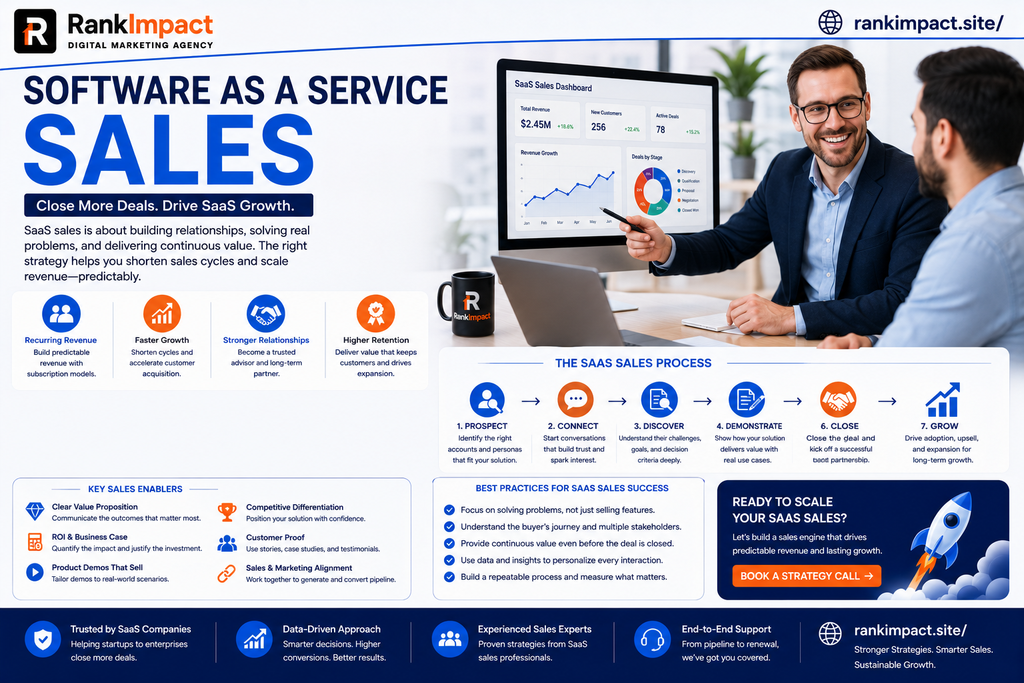
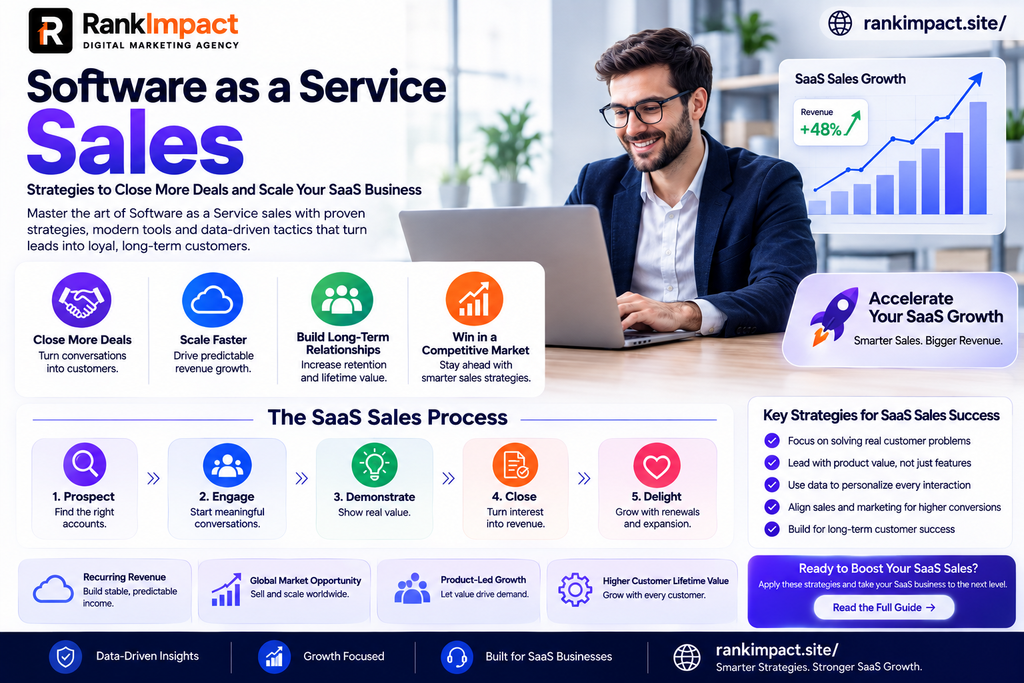
Sales team closing a software as a service sales deal in a modern office.

1 What Software As A Service Sales Really Means

Software as a service sales is the process of guiding a prospective customer from first awareness of a problem to a signed subscription agreement, and then continuing to support that relationship so the customer renews and ideally expands their usage over time. Unlike a traditional one time sale, the transaction itself is only the beginning of the relationship rather than the end of it. A rep who closes a deal but ignores onboarding and early usage is setting up the account for churn within the first renewal cycle, which erases the value of the original sale. This is why software as a service sales teams increasingly measure success not just by closed revenue but by net revenue retention, which tracks how much recurring revenue survives and grows after the initial contract. Selling a subscription also means the buyer is evaluating ongoing value, not a one time feature set, so every conversation during the sales process needs to build confidence that the product will keep solving the problem months and years into the future, not just on day one.

2 Why Software As A Service Sales Differs From Traditional Sales

Traditional sales optimizes for a single transaction, while software as a service sales optimizes for a long term relationship built on renewals and expansion. This changes almost everything about how a deal should be structured. A traditional sales rep can walk away the moment a contract is signed, but a subscription sales rep has a strong incentive to make sure the customer actually adopts the product, because a churned customer in month four erases months of recurring revenue and often costs more to replace than it did to acquire in the first place. Pricing structure also differs significantly, since most software as a service deals involve tiered plans, seat based pricing, or usage based pricing rather than a single flat fee, which means a rep needs to understand the buyer’s growth trajectory to recommend the right plan rather than just the biggest one. Buying committees tend to be larger too, especially for mid market and enterprise deals, often including a economic buyer, a technical evaluator, and an end user champion, each of whom cares about a different aspect of the product. A rep who only pitches to one persona in this committee will consistently lose deals to a competitor who addresses all three.

3 Building A Software As A Service Sales Process That Scales

A scalable software as a service sales process starts with a clearly defined and documented set of stages that every deal moves through, typically something like qualification, discovery, demo, proposal, negotiation, and close. Without documented stages, forecasting becomes guesswork and new reps take far longer to ramp because they have no repeatable playbook to follow. Qualification deserves special attention in a subscription business, since chasing a prospect who is not a strong fit wastes not only the sales cycle but also the future support and success resources required to keep that account from churning after signing. A common qualification framework asks whether the prospect has a genuine pain point your product solves, whether they have budget and authority to buy, and whether the timeline for solving the problem aligns with your sales cycle. Discovery calls should focus on understanding the specific outcome the buyer needs to achieve rather than walking through a generic feature list, because buyers remember how well a rep understood their situation far more than they remember a list of product capabilities. As the process matures, layering in clear exit criteria for each stage, meaning specific actions that must happen before a deal can move forward, keeps the pipeline honest and prevents deals from sitting in a stage indefinitely with no real progress.

4 Key Stages Of The Software As A Service Sales Funnel

The top of a software as a service sales funnel usually starts with marketing qualified leads generated through content, paid channels, or referrals, and the job at this stage in software as a service sales is simply to confirm genuine interest and basic fit before investing sales time. The middle of the funnel is where discovery and evaluation happen, and this is typically the longest stage because the buyer is comparing your solution against alternatives, checking references, and often running a trial or pilot to validate that the product delivers on its promises. The bottom of the funnel involves proposal, pricing negotiation, and internal approval on the buyer’s side, which can move quickly for smaller deals but often stretches for weeks or months in mid market and enterprise accounts due to procurement and legal review. A stage that is frequently underestimated is the post sale onboarding period, which some teams treat as a separate customer success function but which strongly influences whether the deal actually pays off, since a customer who never reaches meaningful product usage is a customer who will not renew regardless of how smoothly the initial sale went. Mapping conversion rates at each of these stages lets a sales leader spot exactly where deals are stalling, whether that is a messaging problem at the top of the funnel or a pricing objection at the bottom.

5 Sales Models Used In Software As A Service Sales

Most software as a service sales organizations operate under one of three broad models or a hybrid of them, and choosing correctly among these software as a service sales models shapes almost every other decision a growing company makes. Sales led growth relies on a traditional rep driven process where an account executive owns the relationship from first conversation through close, which tends to work best for higher priced products with longer evaluation cycles and multiple stakeholders. Product led growth flips this structure by letting users try or use the product with minimal friction, often through a free trial or freemium tier, with sales only entering the picture once usage signals indicate a strong likelihood of conversion or expansion, which works well for lower priced or highly self serve products. A growing number of companies now run a hybrid model where product led growth handles smaller accounts and self serve conversion, while a dedicated sales team focuses on larger accounts that need a more consultative approach and custom contract terms. Choosing the right model, or the right mix, depends heavily on price point, deal complexity, and how much value a prospect can experience on their own before needing human guidance, and getting this choice wrong is one of the most expensive strategic mistakes a growing software company can make.

6 Common Mistakes That Kill Software As A Service Sales Deals

The most common mistake in software as a service sales is pitching product features instead of the outcome the buyer actually cares about, which makes even a strong product sound generic and interchangeable with competitors. Another frequent mistake is neglecting the multi threaded nature of larger deals, where a rep who only builds a relationship with a single champion loses the deal the moment that person changes roles or loses internal influence, which happens more often than most reps expect. Underpricing to win a deal quickly is another costly mistake, since a customer who negotiates an unsustainably low price in year one often churns when the price normalizes at renewal, and that churn frequently costs more than the value of winning the deal in the first place. Poor handoffs between sales and customer success also quietly damage renewal rates, since a customer who was promised something during the sales process that the product cannot actually deliver becomes frustrated and disengaged almost immediately after signing. Finally, many teams rely too heavily on discounting as the default response to price objections instead of addressing the underlying value question, which trains buyers to expect a discount on every renewal and steadily erodes margins across the entire customer base.

7 Tools And Metrics That Support Software As A Service Sales Teams

A modern software as a service sales stack typically includes a customer relationship management platform to track pipeline and deal stages, a sales engagement tool to manage outreach cadences, and a conversation intelligence tool that records and analyzes sales calls to identify what top performers in software as a service sales do differently from the rest of the team. Beyond tools, the metrics that matter most in a subscription business go well beyond traditional close rate and deal size. Net revenue retention shows whether existing customers are expanding, staying flat, or shrinking over time, and it is often considered one of the single most important health indicators for a software as a service business. Customer acquisition cost measured against customer lifetime value tells a leadership team whether the sales motion is actually sustainable, since acquiring customers who churn quickly can look fine on a monthly revenue report while quietly destroying long term profitability. Sales velocity, which combines deal count, average deal size, win rate, and sales cycle length into a single formula, helps a sales leader understand how efficiently the team is converting pipeline into closed revenue and where the biggest opportunity for improvement actually sits.

8 How AI Is Changing Software As A Service Sales

Artificial intelligence has started reshaping software as a service sales at almost every stage of the funnel, and teams that ignore this shift in software as a service sales are already falling behind. Lead scoring models now analyze behavioral signals such as product usage, email engagement, and website activity to flag which accounts are most likely to convert, which lets reps prioritize their time far more effectively than manual scoring ever allowed. Conversation intelligence tools use AI to transcribe and analyze sales calls, surfacing objection patterns and coaching opportunities that would take a sales manager weeks to identify manually across a full team. AI powered forecasting is also becoming more common, pulling from historical deal data and current pipeline activity to produce more accurate revenue predictions than the gut feel estimates many teams still rely on. None of this replaces the human relationship building that closes complex deals, but it does mean that reps who use these tools well are consistently outperforming reps who still run their pipeline entirely from memory and instinct, and that gap is likely to keep widening as these tools continue to mature.

Frequently Asked Questions

What is software as a service sales in simple terms?

Software as a service sales is the process of selling a subscription based software product, which involves not only closing the initial deal but also supporting the customer through onboarding and renewal so the recurring revenue relationship actually lasts.

How is software as a service sales different from traditional sales?

The biggest difference is that software as a service sales optimizes for renewal and expansion revenue over time rather than a single transaction, which changes pricing strategy, deal structure, and how success is measured across the entire customer relationship.

What is the typical sales cycle length for software as a service sales?

Sales cycle length varies widely by price point and buyer complexity, ranging from a few days for low cost self serve products to several months for enterprise deals involving multiple stakeholders and a formal procurement process.

Is product led growth replacing traditional software as a service sales?

Product led growth is not fully replacing sales led approaches, but rather complementing them, with many companies now running a hybrid model where self serve handles smaller accounts and a sales team focuses on larger, more complex deals.

What metrics matter most in software as a service sales?

Net revenue retention, customer acquisition cost compared to lifetime value, and sales velocity tend to matter more in software as a service sales than traditional metrics like raw close rate, since they reflect the long term health of the subscription relationship.

How do you qualify a lead in software as a service sales?

A strong qualification framework checks whether the prospect has a genuine pain point the product solves, whether they hold budget and buying authority, and whether their timeline for solving the problem realistically aligns with your sales cycle.

Why do software as a service sales deals fail after closing?

Deals often fail after closing because of a poor handoff to onboarding, unrealistic promises made during the sales process, or low product usage that prevents the customer from experiencing real value before the first renewal decision.

What tools do software as a service sales teams typically use?

Most teams rely on a customer relationship management platform for pipeline tracking, a sales engagement tool for outreach, and increasingly a conversation intelligence tool to analyze sales calls and coach reps at scale.

How important is multi threading in software as a service sales?

Multi threading is critical for larger deals, since relying on a single champion leaves a deal vulnerable to stalling or collapsing entirely if that person changes roles, loses influence, or leaves the company during the evaluation process.

Can a small software company build an effective sales process without a large team?

Yes. A small team can build an effective process by documenting clear deal stages, qualifying leads rigorously, and focusing sales time only on prospects with strong fit, which often outperforms a larger team working without a defined process.

Conclusion

Software as a service sales is fundamentally different from traditional selling because the transaction is only the starting point of a much longer customer relationship built on renewal and expansion. The companies that consistently win at software as a service sales treat qualification, discovery, and onboarding as equally important parts of the same process rather than separate functions that hand off and forget about each other. Whether you are building your first sales process or refining one that already exists, the fundamentals stay the same, understand the buyer’s real outcome, multi thread every meaningful deal, price for long term sustainability rather than short term wins, and measure success through retention and expansion, not just closed revenue. Build the process this way and software as a service sales stops being a series of one off wins and becomes a genuine growth engine for the business, one that compounds with every renewal your software as a service sales team protects.

Key Takeaways

Software as a service sales optimizes for renewal and expansion revenue, not just the initial closed deal Qualification and discovery should focus on the buyer’s real outcome rather than a generic feature pitch Sales led growth, product led growth, and hybrid models each fit different price points and deal complexity Multi threading larger deals protects against losing momentum when a single champion changes roles Net revenue retention and sales velocity matter more than raw close rate in a subscription business AI powered lead scoring, conversation intelligence, and forecasting are becoming standard parts of the sales stack

SaaS Company Evaluation Criteria Checklist 7 Steps

Follow this 7 step SaaS company evaluation criteria checklist to compare vendors on security pricing support and scalability before you buy.

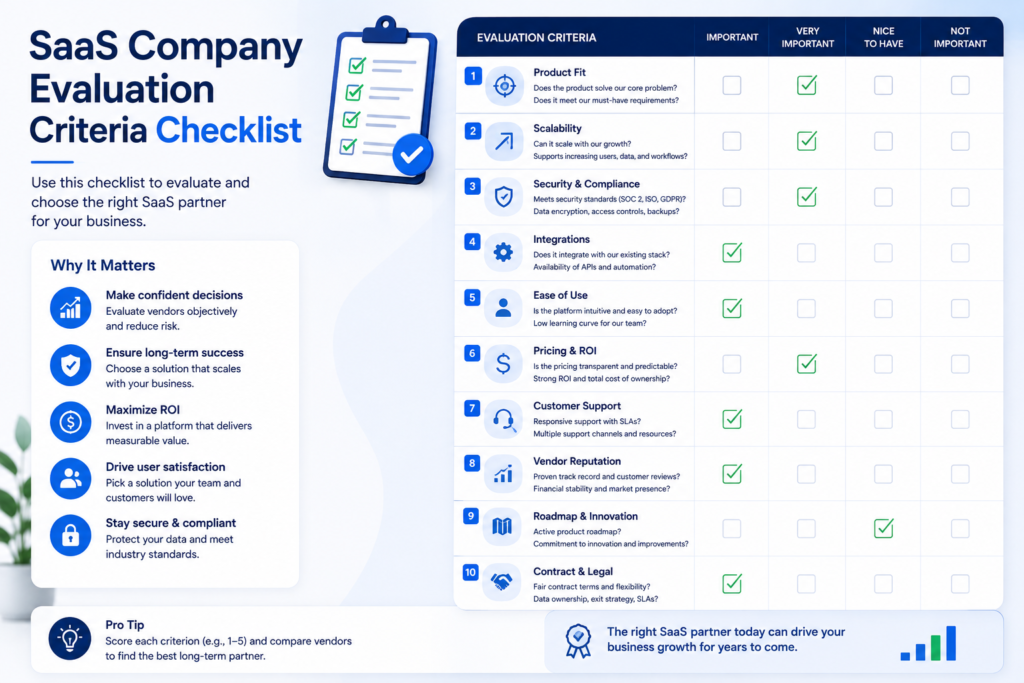
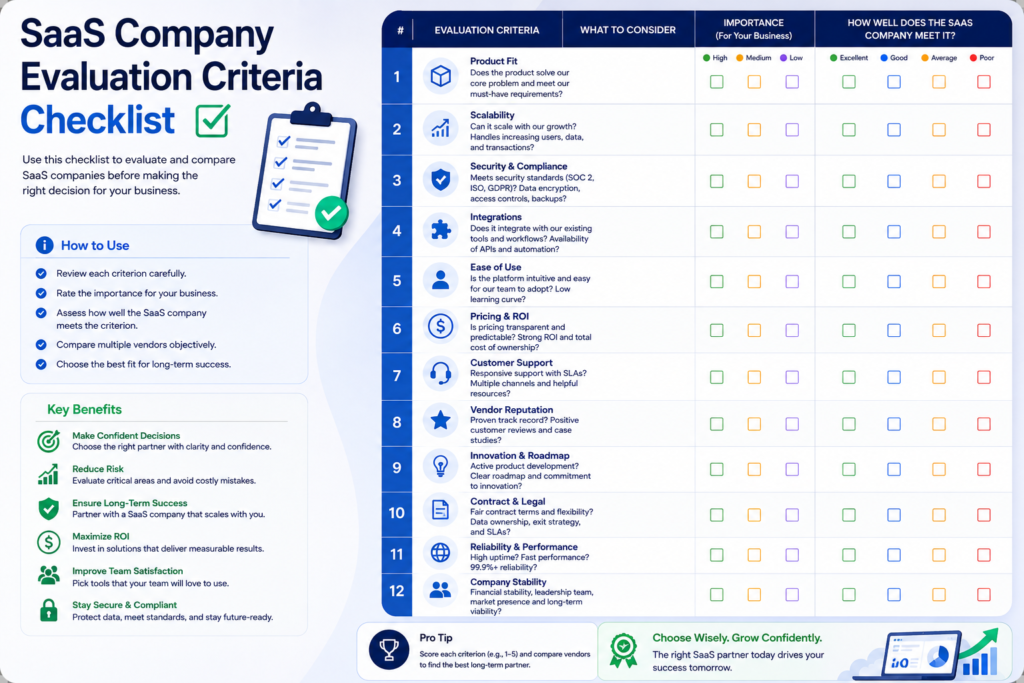
SaaS company evaluation criteria checklist

SaaS Company Evaluation Criteria Checklist A Complete Guide for 2026

Choosing a software vendor used to be simple because most companies bought a handful of licenses and installed the software once. That world no longer exists. Modern businesses run on dozens of interconnected SaaS platforms that touch finance operations customer data and daily workflows so a poor vendor choice can quietly cost a company months of lost productivity and thousands of dollars in wasted spend. This is exactly why a structured SaaS company evaluation criteria checklist has become essential reading for anyone responsible for software purchasing decisions in 2026. Rather than relying on a sales demo and a gut feeling buyers now need a repeatable framework that examines a vendor from every angle including their financial health their security practices their support quality and their long term product roadmap. In this guide we will walk through every criterion that belongs on a serious SaaS company evaluation criteria checklist explain why each one matters and show you how experienced buyers apply this checklist in real purchasing decisions. By the end you will have a practical framework you can adapt for your own organization whether you are buying your first CRM or renewing an enterprise wide platform.

What a SaaS Company Evaluation Criteria Checklist Actually Covers

A proper SaaS company evaluation criteria checklist is not a single question like does this tool have the features we need. It is a multi dimensional scorecard that looks at the vendor as a business partner rather than just a piece of software. Think of it in four broad buckets: the product itself the company behind the product the commercial terms and the operational fit within your organization. Many buyers make the mistake of spending ninety percent of their evaluation time on features and only ten percent on everything else which is backwards because features can usually be replicated or worked around while a financially unstable vendor or a weak security program can end a partnership overnight. A mature checklist forces you to slow down and score each category independently so that a flashy interface does not overshadow a real weakness in data governance or customer support. When you build your own version of this checklist you should assign a weight to each category based on what matters most to your business because a healthcare company will weight compliance far higher than a small marketing agency would.

Financial Health and Business Stability

One of the most overlooked items on any SaaS company evaluation criteria checklist is the financial stability of the vendor itself. Software as a service is a subscription relationship not a one time purchase so you are effectively betting that this company will still exist and still be investing in the product three or five years from now. Ask vendors about their funding history their customer growth rate and how long they have been profitable or on a clear path to profitability. Publicly traded companies make this easier because their financials are available but private companies especially venture backed startups can be harder to assess. Look for signals like recent funding rounds customer count growth industry analyst reports and how transparent the company is when you ask direct questions about runway. A vendor that dodges financial questions or seems evasive about growth metrics should raise a flag. Vendor lock in becomes a real risk when a company goes out of business or gets acquired and sunsets the product you depend on so treating financial due diligence as a core part of your evaluation protects your business from a painful migration down the road.

Product Architecture and Technical Fit

The technical foundation of a SaaS platform tells you a great deal about how the company builds and maintains its product. When evaluating architecture look at whether the platform is built on modern cloud infrastructure whether it offers a documented API for integrations and whether it has a track record of reliable uptime. Ask vendors to share their uptime history over the past twelve months along with their incident response process because a company that hides this information is usually hiding a problem. Multi tenancy versus single tenancy architecture also matters depending on your data isolation requirements especially in regulated industries. Beyond raw architecture examine how often the company ships updates and whether those updates come with clear release notes because a stagnant product roadmap often signals a company that has stopped investing in innovation. Mobile access offline functionality and how the platform performs under heavy data loads are also worth testing directly rather than trusting a sales deck. A strong SaaS company evaluation criteria checklist always includes a technical trial period where your own engineers or power users stress test the product in conditions that mirror your actual daily workflow.

Security Compliance and Data Governance

Security has moved from a nice to have to an absolute requirement on every serious SaaS company evaluation criteria checklist because a data breach at a vendor becomes your problem the moment your customer data is involved. Start by confirming which compliance certifications the vendor holds such as SOC 2 Type II ISO 27001 or industry specific standards like HIPAA for healthcare or PCI DSS for payment processing. Ask for their most recent audit report rather than accepting a badge on their website at face value. Data encryption both at rest and in transit should be standard along with clear documentation on where customer data is physically stored since data residency rules vary significantly across regions and industries. Review their incident response plan and ask how quickly they notify customers when a breach occurs because response speed often matters more than whether an incident happened at all since even the best companies occasionally face security events. Role based access controls single sign on support and detailed audit logs are additional signals of a mature security program. Any vendor that treats security questions as an inconvenience rather than a normal part of the sales process is telling you something important about their internal culture.

Customer Support and Success Programs

Support quality is one of those criteria that only becomes obvious after you have already signed a contract which is exactly why it needs careful evaluation upfront. During your evaluation ask about support channels response time guarantees and whether dedicated customer success managers are included or sold as an add on. Request to speak with existing customers who are similar in size and industry to your own company because reference calls reveal patterns that a polished demo never will. Pay close attention to how the vendor handles onboarding since a rushed or confusing onboarding process often predicts how the rest of the relationship will feel. Look for evidence of proactive support such as regular check ins usage reviews and health scoring rather than a support team that only responds when something breaks. Community resources like knowledge bases user forums and training academies also indicate whether a company invests in customer enablement beyond the initial sale. A vendor with strong retention numbers usually has strong support behind it so ask directly about their net revenue retention rate since that single metric reflects both product satisfaction and support quality combined.

Pricing Structure and Total Cost of Ownership

Pricing looks simple on a website but becomes complicated once you factor in implementation fees training costs premium support tiers and the cost of add on modules that were not part of the initial quote. A thorough SaaS company evaluation criteria checklist requires you to calculate total cost of ownership over a realistic contract length usually two to three years rather than comparing sticker prices for a single year. Ask vendors directly about annual price increases at renewal since many SaaS contracts include automatic escalators that surprise buyers later. Clarify whether pricing is based on seats usage tiers or a flat organizational license because each model creates different incentives and risks as your company scales. Hidden costs such as data export fees API rate limit overages and charges for additional environments like staging or sandbox instances should all be documented before signing. It also helps to model a worst case growth scenario and ask the vendor how pricing changes if your usage doubles within a year because some platforms become dramatically more expensive at scale in ways that are not obvious from an initial quote. Comparing total cost of ownership rather than headline price is one of the clearest ways experienced buyers separate themselves from first time software purchasers.

Integration Capabilities and Ecosystem Fit

Modern businesses rarely buy a single tool in isolation so integration capability deserves its own dedicated section on any SaaS company evaluation criteria checklist. Start by mapping the tools already in your stack and confirming that the vendor offers native integrations or a well documented API for each one. Native integrations tend to be more reliable than custom built connections because the vendor maintains them directly and updates them when either platform changes. Ask about integration marketplaces such as Zapier or dedicated iPaaS partnerships since these can bridge gaps when native integrations do not exist. Data synchronization frequency also matters because real time sync behaves very differently from a nightly batch update when your teams need current information throughout the day. For companies with existing data warehouses inquire about direct database connections or reverse ETL support so your data team can pull information without relying entirely on the vendor’s dashboards. A platform that fits cleanly into your existing ecosystem reduces both the technical burden on your engineering team and the risk of data silos forming across departments.

Scalability and Long Term Roadmap Alignment

A tool that fits your company today might not fit your company in two years so scalability deserves careful attention during evaluation. Ask vendors directly how their platform performs for companies at your projected future size not just your current size since some SaaS products are built for small teams and struggle once usage or data volume grows significantly. Request their public product roadmap or at minimum a conversation with their product team about upcoming features especially any that align with your growth plans such as international expansion or new business units. Look at how frequently the company acquires other startups and folds those acquisitions into the core product because a pattern of poorly integrated acquisitions often creates a fragmented user experience. Customer advisory boards and public changelogs are good indicators of whether the vendor actively incorporates customer feedback into development priorities. Choosing a platform that can scale alongside your business protects you from a costly migration project just as your company hits its stride.

Common Mistakes Companies Make During SaaS Evaluation

Even experienced buyers fall into predictable traps when evaluating software vendors. One of the most common mistakes is letting a single influential stakeholder fall in love with a flashy demo without involving the actual end users who will use the tool daily. Another frequent error is skipping reference calls entirely because the sales cycle feels time pressured even though reference calls consistently reveal information that a vendor will never volunteer proactively. Many teams also underestimate implementation time and assume a new platform will be live within days when enterprise rollouts often take months especially when data migration and employee training are involved. Ignoring contract terms around data ownership and export rights is another costly oversight because some vendors make it deliberately difficult to extract your own data if you decide to leave. Finally many buyers evaluate price in isolation without weighing it against the total cost of ownership over the full contract length which leads to budget surprises at renewal time. Avoiding these mistakes is often what separates a smooth software rollout from a painful one that damages trust across departments.

Building Your Own SaaS Evaluation Scorecard

Turning everything above into a practical tool means building a simple weighted scorecard that your team can apply consistently across every vendor you evaluate. Start by listing each category discussed in this guide including financial stability product architecture security compliance customer support pricing integrations and scalability. Assign each category a weight based on what matters most to your organization since a company in a regulated industry should weight security and compliance more heavily than a small startup evaluating a marketing tool. Score each vendor on a simple scale from one to five within every category based on documented evidence rather than sales claims and require your team to write a short justification for each score so the reasoning stays transparent. Bring this scorecard into every stakeholder meeting so decisions are grounded in shared criteria instead of individual preference or the loudest voice in the room. Over time this same scorecard becomes a reusable asset that speeds up every future software evaluation your company runs because the framework already exists and only needs minor adjustments for each new use case.

Frequently Asked Questions

What is a SaaS company evaluation criteria checklist used for?

A SaaS company evaluation criteria checklist is used to systematically compare software vendors across categories like financial stability security product architecture customer support and total cost of ownership so that buying decisions are based on documented evidence rather than a single sales demo.

How many criteria should be included in a SaaS evaluation checklist?

Most thorough checklists include between seven and ten major categories such as financial health security compliance product architecture customer support pricing integrations and scalability with several sub questions under each category to guide deeper investigation.

What is the most important criterion when evaluating a SaaS vendor ?

There is no single most important criterion because the right weighting depends on your industry and risk tolerance although security and financial stability are consistently rated among the highest priorities across most industries because both carry long term business continuity risk.

How do you evaluate the financial stability of a SaaS company?

You can evaluate financial stability by reviewing public financial statements when available asking directly about funding rounds and customer growth requesting analyst reports and paying attention to how transparent the company is when answering direct questions about runway and profitability.

Why is total cost of ownership more important than the listed price?

Total cost of ownership captures implementation fees training costs support tiers and renewal price increases over the full contract length which often reveals a very different cost picture than the initial quoted price shown during the sales process.

Should reference calls be part of every SaaS evaluation ?

Yes reference calls with existing customers who are similar in size and industry to your own company consistently reveal information about support quality onboarding experience and product reliability that a sales team will rarely share proactively.

How long should a typical SaaS evaluation process take ?

A thorough evaluation for a mid size business purchase typically takes between four and eight weeks to allow time for technical trials reference calls security review and internal stakeholder alignment although enterprise purchases can take considerably longer.

What security certifications should a SaaS vendor have?

Common certifications to look for include SOC 2 Type II and ISO 27001 along with industry specific standards such as HIPAA for healthcare companies or PCI DSS for any vendor that processes payment data.

How do you compare integration capabilities across vendors?

Compare integration capabilities by mapping your existing technology stack against each vendor’s native integration list checking whether they offer a documented API and asking about data synchronization frequency since real time sync differs significantly from batch updates.

What happens if a company skips a structured evaluation checklist ?

Skipping a structured checklist increases the risk of choosing a vendor based on an appealing demo rather than long term fit which often leads to unexpected costs poor adoption among end users and a difficult migration if the platform later proves unsuitable.

Conclusion

A well built SaaS company evaluation criteria checklist transforms software buying from a rushed guessing game into a disciplined process that protects your budget your data and your team’s productivity for years to come. The categories covered in this guide including financial stability product architecture security compliance customer support pricing structure integration capability and long term scalability each play a distinct role in determining whether a vendor will become a reliable long term partner or a costly mistake. Buyers who take the time to build a weighted scorecard involve real end users in the evaluation and insist on reference calls consistently make better decisions than those who rely solely on a polished sales presentation. As your organization continues to add software tools to its stack revisit this checklist regularly because the criteria that mattered during your last purchase may need to shift as your company grows and your risk profile changes. Treat every SaaS evaluation as an investment in operational stability rather than a simple purchasing task and your future self will thank you when renewal season arrives without any unpleasant surprises.

SaaS company evaluation criteria checklist

Key Takeaways

A complete SaaS company evaluation criteria checklist looks beyond features and examines the vendor as a full business partner including their financial health and long term stability. Security compliance certifications like SOC 2 and ISO 27001 should be verified directly rather than assumed from marketing materials. Total cost of ownership over a full contract term gives a far more accurate financial picture than a single year’s listed price. Reference calls with similar customers reveal support quality and onboarding realities that sales demos rarely show. Integration capability and long term product roadmap alignment protect your company from a painful migration as your needs evolve. Building a weighted internal scorecard turns this checklist into a reusable framework that speeds up every future software decision your team makes.

Get Your FREE SEO Audit

Enter your details below. Our team will review your website and email you a comprehensive SEO and speed report within 24 hours.