Explore what saas development services actually include, real 2026 pricing by project stage, and how to choose a partner who delivers on time and on budget.
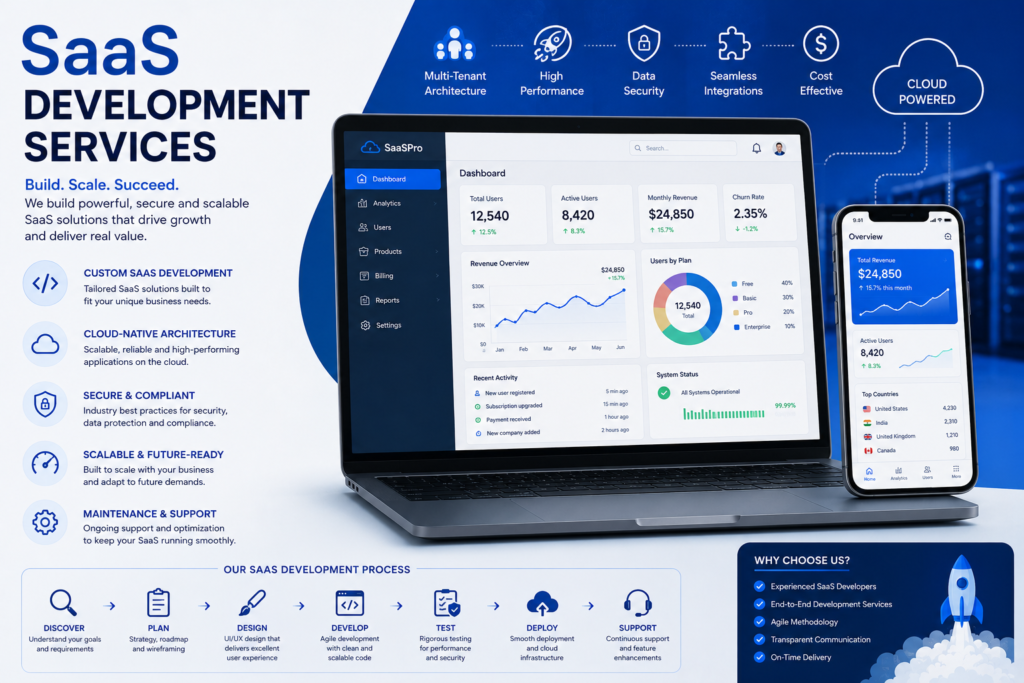
Table of Contents
SaaS Development Services: What They Include, Costs, and How to Choose the Right Partner
Building a SaaS product is one of the most capital efficient business models available today, but only if the software actually gets built well the first time. Founders who try to save money by cutting corners on development usually end up paying for it twice, once in wasted engineering hours and again in the rebuild that follows. Saas development services exist to close that gap, giving founders and product teams access to the architecture experience, delivery discipline, and specialized skills that a typical in house team may not have yet, especially in the early stages of a company. This guide walks through exactly what these services include, how pricing actually breaks down, what the engagement process looks like from discovery to launch, and how to choose a partner that will still be a good decision eighteen months from now. Whether you are scoping your first MVP or bringing in support for a mature product, understanding what these services really cover will save you both time and money.
What SaaS Development Services Actually Include
The phrase gets used loosely across the industry, so it helps to be specific about what a genuine engagement covers rather than treating it as a vague catch all term for writing code.
Product discovery and technical scoping typically comes first, where a development partner works with you to translate a business idea into a defined feature set, data model, and architecture plan before a single line of production code gets written. Skipping this phase is one of the most common reasons SaaS projects run over budget, since undefined scope tends to expand quietly during the build.
Architecture and infrastructure design covers decisions like multi tenancy strategy, database structure, authentication approach, and hosting environment, all of which are far more expensive to change after launch than to get right during planning. A rushed architecture decision made in week one can quietly cost tens of thousands of dollars in rework a year later.
Core application development is the part most people picture when they think of saas development services, covering the actual frontend and backend build, API design, and integration work needed to bring the product to a usable state.
Billing and subscription logic deserves its own mention because it is genuinely more complex than founders expect, covering trial periods, proration, plan upgrades and downgrades, dunning management for failed payments, and usage based pricing where applicable.
Quality assurance and testing should run in parallel with development rather than as an afterthought squeezed in before launch, covering automated testing, security review, and performance testing under realistic load.
DevOps and deployment pipeline setup ensures the product can actually ship reliably once built, covering continuous integration, staging environments, monitoring, and rollback procedures so a bad deploy does not become a customer facing outage.
Post launch support and iteration rounds out a complete engagement, since a SaaS product is never really finished at launch, and ongoing support often shifts toward bug fixes, performance tuning, and new feature delivery based on real user feedback.
Types of SaaS Development Services Engagement Models
Not every project needs the same relationship structure, and choosing the wrong model is a common source of friction between founders and their development partner.
Fixed price engagements work well for narrowly scoped projects with a clear, stable set of requirements, giving budget certainty in exchange for less flexibility if priorities shift mid project.
Dedicated team models place a group of developers, designers, and a project lead under your direction for an extended period, functioning much like an extension of your own team while giving you more control over day to day priorities than a fixed price contract allows.
Time and materials arrangements bill based on actual hours worked, which suits projects where requirements are expected to evolve as the product takes shape, though it requires more active oversight from the client to keep scope and budget aligned.
Staff augmentation is a lighter touch option where a provider supplies individual specialists, such as a backend engineer or a DevOps specialist, to slot directly into an existing in house team rather than delivering an entire self contained engagement.
How Much SaaS Development Services Cost in 2026
Pricing is the question every founder actually wants answered, and the honest response is that it depends heavily on scope, region, and compliance requirements rather than any single flat number.
A basic validation prototype built purely to test demand generally runs in the low five figures, since the goal is speed and learning rather than production grade polish. A lean minimum viable product with core functionality and clean design typically lands in the range of seventy five thousand to one hundred forty thousand dollars depending on feature complexity and integrations required. A market ready product with a fuller feature set, stronger security, and production grade infrastructure commonly falls between one hundred forty thousand and two hundred eighty thousand dollars. Enterprise grade platforms requiring single sign on, detailed audit trails, and strict compliance certifications can run from two hundred eighty thousand dollars well past half a million depending on scope.
Regional rate differences move the final number more than almost any other single factor. United States based development teams commonly bill in the range of one hundred fifty to three hundred dollars per hour, while experienced teams in regions such as Eastern Europe or South Asia often deliver comparable technical quality in the range of thirty five to ninety nine dollars per hour, which is why so many founders blend a US based product lead with an offshore engineering team to balance cost and communication.
Hidden costs are worth planning for explicitly, since design, quality assurance, DevOps setup, and post launch maintenance together commonly add forty to sixty percent on top of the base development quote, and a project quoted at eighty thousand dollars can realistically land closer to one hundred twenty or one hundred thirty thousand once those line items are included.
The SaaS Development Services Process From Discovery to Launch
Understanding the typical delivery timeline helps set realistic expectations before signing a contract with any provider offering this type of engagement.
Discovery and scoping usually takes two to four weeks and produces a documented feature list, technical architecture plan, and a realistic budget range, giving both sides a shared reference point before real development spending begins.
Design and prototyping follows, translating the scoped requirements into wireframes and eventually high fidelity interface designs that stakeholders can review and approve before expensive engineering time gets committed to building screens that might change.
Iterative development typically runs in two week sprints, with regular demos so the client can see working software incrementally rather than waiting months for a single large reveal that may miss the mark on important details.
Quality assurance runs continuously throughout development rather than as a single phase at the end, though a dedicated hardening period before launch is still common to catch edge cases and performance issues under realistic conditions.
Launch and stabilization covers the actual release along with close monitoring in the days and weeks that follow, since real user behavior almost always surfaces issues that internal testing did not catch.
Ongoing iteration continues after launch for most successful products, with saas development services shifting toward a lighter, ongoing cadence focused on new features, performance improvements, and fixes driven by actual usage data.
Core Technology Choices in SaaS Development
The technical stack a provider recommends should be driven by your specific product needs rather than simply what that team happens to know best, though certain patterns show up consistently across strong SaaS builds.
Cloud infrastructure choices typically center on providers such as AWS, Google Cloud, or Azure, with managed services increasingly preferred over self managed infrastructure for early stage products, since managed options reduce the need for a dedicated infrastructure hire during a stage when engineering focus should stay on the product itself.
Multi tenancy architecture decisions made early in a project determine how efficiently the platform can scale later, and getting this wrong is one of the more expensive mistakes to correct after a product already has paying customers on it.
API design and integration capability matters enormously for SaaS products, since most modern platforms need to connect with payment processors, CRM systems, analytics tools, and increasingly with artificial intelligence services, and a well designed API layer makes each new integration faster than the last.
Security and compliance requirements should be scoped early rather than bolted on near launch, particularly for products serving regulated industries such as healthcare or finance, where standards like HIPAA, GDPR, or PCI DSS shape core architecture decisions rather than being a checklist item handled at the end.
How to Choose the Right SaaS Development Services Partner
Selecting a provider is ultimately a bet on a working relationship that may run for years, not just a one time purchase decision, so the evaluation criteria should reflect that.
Review a provider’s actual portfolio for products similar in complexity to what you are building, rather than being swayed by an impressive logo wall that may not reflect the specific technical challenges your product will face.
Ask directly about their discovery process and how they handle scope changes mid project, since a provider without a clear answer here is likely to produce budget surprises once development is already underway.
Evaluate communication style and time zone overlap honestly, since even the most technically skilled team becomes frustrating to work with if updates are inconsistent or feedback loops take days instead of hours.
Clarify ownership of code and intellectual property in writing before signing anything, ensuring your contract explicitly states that you retain full rights to the codebase, since disputes over ownership become far harder to resolve after a product is already live.
Ask for references and actually call them, focusing your questions on how the provider handled a difficult moment in the project rather than only asking about the parts that went smoothly.
Common Mistakes Companies Make When Hiring a Development Partner
Even strong providers cannot save a project from a handful of avoidable mistakes made on the client side of the relationship.
Choosing a provider based purely on the lowest hourly rate frequently backfires, since the true cost of a project includes rework, delays, and miscommunication, all of which tend to be higher with providers who compete primarily on price rather than process.
Skipping a proper discovery phase to save a few weeks almost always costs far more time later, as undefined requirements surface mid build and force expensive rework that a clear scoping phase would have caught early.
Failing to define success metrics before development begins leaves both sides guessing at what a successful launch actually looks like, making it difficult to evaluate whether the engagement delivered real value.
Underestimating the importance of post launch support leads many founders to treat launch as the finish line, when in reality it is closer to the starting point of a product’s real lifecycle, and budgeting nothing for iteration after launch is a common and costly oversight.
Not involving internal stakeholders early enough in the process creates a disconnect between what gets built and what the business actually needs, since a development team can only build what it clearly understands about your goals.
In House Team Versus Outsourced SaaS Development Services
This comparison comes up constantly for founders deciding how to structure their build, and the right answer depends heavily on stage and available capital rather than a universal best practice.
An in house team offers deeper long term product context and tighter day to day alignment with company strategy, but building that team from scratch is slow and expensive, particularly for early stage companies that need to move quickly without a large payroll commitment.
Outsourced saas development services offer faster access to a full range of specialized skills without the overhead of recruiting, onboarding, and retaining a full internal team, which is especially valuable during the initial build phase when speed to market matters most.
Many growing companies land on a hybrid model, keeping core product and leadership roles in house while relying on outsourced custom development for specialized needs such as DevOps setup, a specific feature build, or scaling support during a period of rapid growth.
The Future of SaaS Development Services
The SaaS development landscape is shifting quickly as artificial intelligence changes both how software gets built and what customers expect from the finished product.
AI assisted development is accelerating build timelines industry wide, with development teams increasingly using AI tools for code generation, testing, and documentation, which is shifting the value of a strong provider away from typing speed and toward architecture judgment and product thinking.
AI features are moving from optional add ons to a baseline customer expectation in many SaaS categories, meaning saas development services increasingly need to scope AI integration from the start of a project rather than treating it as a later phase addition.
No code and low code tooling is expanding what founders can validate before committing to a full custom build, though most products that reach meaningful scale still transition to custom development once they outgrow what no code platforms can support.
Compliance requirements continue to tighten across regulated industries, meaning development partners with genuine experience in frameworks like HIPAA, GDPR, and SOC 2 are becoming more valuable rather than less as the market matures.
Frequently Asked Questions
What exactly do saas development services include?
A complete engagement typically covers discovery and scoping, architecture and infrastructure design, core application development, billing and subscription logic, quality assurance, deployment setup, and post launch support, rather than just writing application code.
How much does SaaS development cost for a small startup ?
A lean MVP with core functionality commonly falls in the range of seventy five thousand to one hundred forty thousand dollars, though a basic validation prototype can cost significantly less if the goal is early demand testing rather than a full production build.
How long does a typical SaaS development engagement take ?
A lean MVP often takes three to six months from discovery through launch, while a fuller market ready product can take six to twelve months depending on feature complexity and integration requirements.
Should a startup hire an in house team or use outsourced saas development services?
Early stage startups often benefit from outsourced services to move quickly without a large payroll commitment, while more mature companies frequently shift toward a hybrid model that keeps core roles in house.
What is the difference between fixed price and dedicated team engagement models?
Fixed price arrangements suit narrowly scoped projects with stable requirements, while dedicated team models offer more flexibility for projects where priorities are expected to evolve throughout development.
Does this type of engagement include ongoing maintenance after launch?
Many providers offer ongoing support as a separate phase after the initial build, covering bug fixes, performance improvements, and new feature development based on real user feedback after launch.
How do I protect my intellectual property when outsourcing development?
Ensure your contract explicitly states that you retain full ownership of the codebase and any related intellectual property, and confirm this in writing before development begins rather than assuming it by default.
What questions should I ask before hiring a SaaS development partner ?
Ask about their discovery process, how they handle scope changes, their communication cadence, who specifically will work on your project, and request references you can actually call and question directly.
Can AI tools replace the need for professional development support ?
AI tools can accelerate parts of the development process, but architecture decisions, security judgment, and product strategy still require experienced human oversight, particularly for products handling sensitive data or complex business logic.
What is the biggest hidden cost in SaaS development projects?
Design, quality assurance, DevOps setup, and post launch maintenance together commonly add forty to sixty percent on top of the initial development quote, which is why the headline number in a proposal rarely reflects the full project cost.
Conclusion
Choosing the right development partner is one of the highest leverage decisions a founder or product team will make, since the quality of that early architecture and delivery discipline shapes how expensive every future change becomes. The founders who get the most value from these engagements are rarely the ones who found the cheapest hourly rate, but the ones who invested in a real discovery phase, chose an engagement model that matched their actual needs, and treated post launch iteration as part of the plan rather than an afterthought. Whether you outsource the entire build or bring in specialized saas development services to support an existing team, the fundamentals stay the same, which are clear scope, honest communication, and a partner who is thinking about your product’s next two years rather than just the next sprint.
Key Takeaways
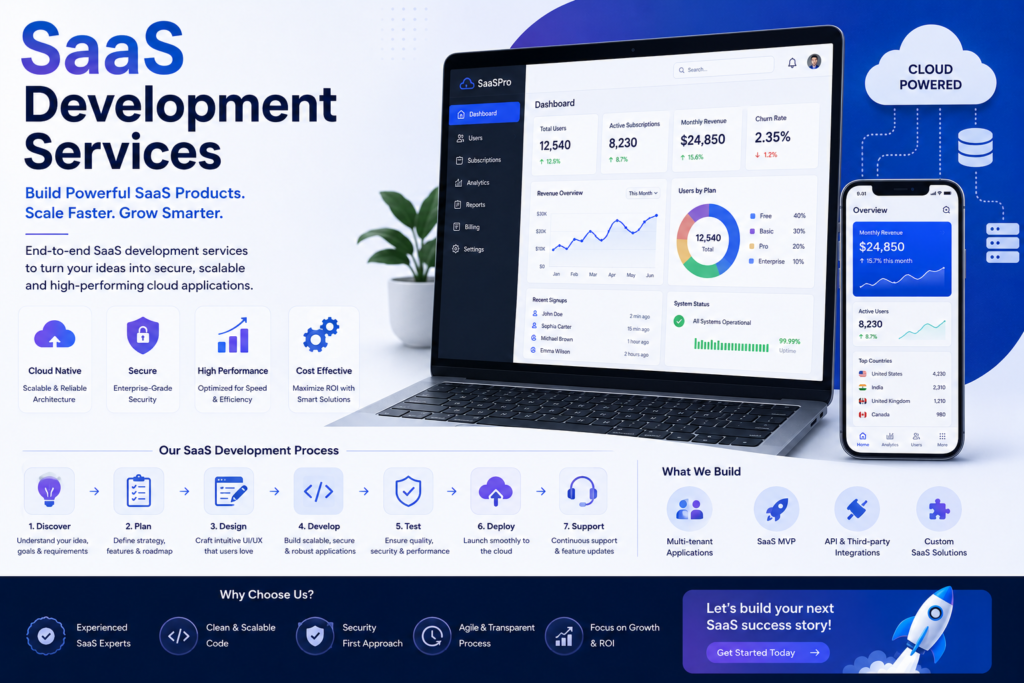
A complete engagement covers far more than writing code, spanning discovery, architecture, billing logic, quality assurance, deployment, and post launch support as a complete engagement.
Pricing depends heavily on scope and region, with lean MVPs commonly landing between seventy five thousand and one hundred forty thousand dollars and hidden costs often adding forty to sixty percent on top of the base quote.
Choosing between fixed price, dedicated team, time and materials, or staff augmentation should match your project’s actual requirements rather than defaulting to whichever model a provider prefers to sell.
The strongest partner relationships come from a real discovery process, clear intellectual property terms, and honest references, not from selecting the lowest hourly rate on the table.
Artificial intelligence is reshaping how saas development services get delivered, shifting the value of a strong provider toward architecture judgment and product strategy rather than raw coding speed alone.