Learn what is b2b saas with a complete beginner friendly guide covering the definition examples key characteristics and how to evaluate a product.
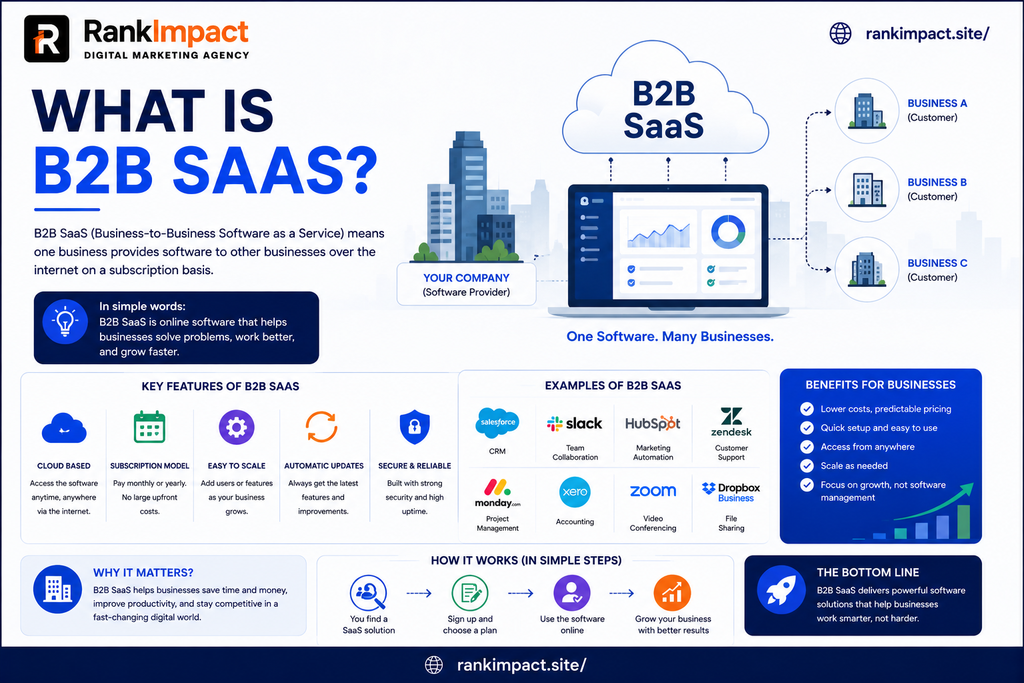
Table of Contents
What Is B2B SaaS
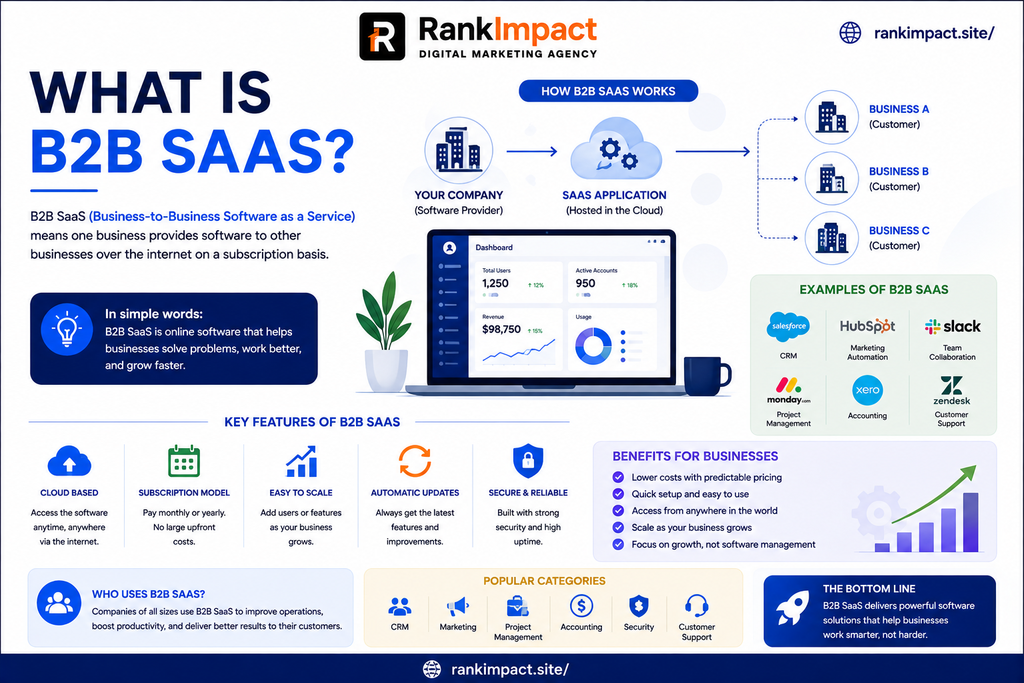
What is b2b saas, put simply, refers to software as a service products sold by one business to another business, rather than to individual consumers, and delivered through a subscription accessed over the internet rather than installed on a company’s own servers. The term itself combines two ideas, the business to business relationship, meaning the customer is a company rather than a person buying for personal use, and the software as a service delivery model, meaning the product is hosted in the cloud and accessed through a subscription rather than purchased outright as a one time license. Common examples include tools like customer relationship management platforms, project management software, accounting systems, and communication tools that companies use internally to run their operations, all delivered and updated continuously by the provider rather than installed once and left unchanged for years. Understanding this distinction matters because business buyers evaluate purchases very differently than individual consumers, often involving multiple stakeholders, a formal budget approval process, and a much longer research period before committing to a purchase decision. Anyone new to the software industry benefits from starting with this basic definition before moving into more advanced strategy, since a solid answer to what is b2b saas makes every later concept, from pricing to sales cycles, much easier to understand.
Why B2B SaaS Has Become So Widespread
Businesses of every size have shifted heavily toward subscription based software over the past decade because it eliminates the significant upfront cost and technical burden of maintaining software on internal servers, replacing that with a predictable monthly or annual fee and a provider responsible for updates and maintenance. Understanding what is b2b saas at this level of detail helps explain exactly why this shift happened so quickly across nearly every industry. This shift has been especially valuable for smaller companies that could never have afforded traditional enterprise software licenses and the dedicated technical staff needed to run them, since a subscription model gives them access to powerful tools at a fraction of what building or licensing equivalent capability once cost. Remote and hybrid work have accelerated this trend further, since cloud delivered software allows teams to access the same tools and data from anywhere with an internet connection, which simply was not practical with software installed on physical office servers. The recurring revenue model also benefits providers by creating a more predictable and often more valuable business than one time software sales, which has attracted enormous investment into building better and more specialized tools across nearly every business function imaginable. Together, these forces have made subscription software the default way most companies now buy and use business technology rather than the exception it once was, which is exactly why understanding what is b2b saas has become genuinely useful knowledge for almost anyone working in a modern business.
How B2B SaaS Differs From B2C SaaS
The most significant difference lies in who the buyer actually is and how that buyer makes a decision, which is often the clearest way to explain what is b2b saas to someone more familiar with consumer software. A consumer subscribing to a streaming service or a fitness app usually makes that decision alone and quickly, often based on price and immediate personal interest, while a business purchase typically requires justification to a manager, involvement from multiple departments, and formal budget approval before a contract is signed. Pricing structures also differ meaningfully, since business products are often priced per user or per feature tier with room for negotiation on larger deals, while consumer products usually have simple, fixed, non negotiable pricing available to anyone who wants to sign up. Sales and marketing approaches diverge significantly as well, since reaching business buyers typically requires content that addresses specific professional problems, direct sales outreach, and a longer nurture process, while consumer marketing often relies more heavily on broad advertising and rapid, low friction conversion paths. Support expectations differ too, since business customers frequently expect dedicated account management and guaranteed response times, particularly for larger contracts, while consumer support is generally handled through more automated, self serve channels at scale. These differences together form a fairly complete practical answer to what is b2b saas compared to its consumer facing counterpart.
Common Examples Of B2B SaaS Products
Customer relationship management platforms help sales and marketing teams track prospects and customers throughout the buying journey, representing one of the most widely adopted categories in this space across companies of nearly every size and industry. Seeing these concrete examples often makes what is b2b saas click for someone who has only encountered the term in the abstract. Project management and collaboration tools help teams coordinate work, track progress, and communicate across departments, which have become especially essential as remote and hybrid work arrangements have become far more common. Accounting and financial management software helps businesses handle invoicing, payroll, and financial reporting without maintaining that infrastructure internally, replacing what was once handled through expensive desktop software or manual processes entirely. Human resources platforms manage everything from recruiting and onboarding to performance reviews and benefits administration, consolidating functions that previously required multiple disconnected systems or significant manual paperwork. Marketing automation and email platforms help businesses manage campaigns, track engagement, and nurture leads at scale, supporting the kind of sustained, multi touch outreach that modern business buyers typically expect before making a purchase decision. Each of these categories offers a slightly different angle on what is b2b saas actually looks like when applied to a real business function.
Key Characteristics That Define B2B SaaS
Subscription based pricing is the most defining characteristic, with customers paying on a recurring basis rather than making a single upfront purchase, which creates an ongoing financial relationship that continues well beyond the initial sale. This recurring relationship is arguably the single most important detail in any complete answer to what is b2b saas. Cloud based delivery means the software runs on the provider’s servers and is accessed through a web browser or application rather than installed locally, allowing the provider to push updates and improvements continuously without requiring customers to manually install new versions. Scalability is another defining trait, since these products typically allow a business to add users, features, or capacity as they grow, without the significant upfront investment required to scale traditional on premise software. Multi tenancy, a technical architecture where many customers share the same underlying infrastructure while their individual data remains securely separated, allows providers to serve large numbers of customers efficiently while keeping costs manageable for everyone involved. Integration capability also matters significantly, since business software rarely operates in isolation, and the strongest products in this category are designed to connect smoothly with the other tools a company already relies on rather than functioning as a disconnected standalone system. Taken together, these five characteristics form the most technically complete answer to what is b2b saas that a buyer or newcomer to the field is likely to need.
The Business Model Behind B2B SaaS
Revenue in this space is measured very differently than in traditional one time product sales, with metrics like monthly recurring revenue and annual recurring revenue serving as the primary indicators of business health rather than total units sold in a given period. These metrics are a core part of understanding what is b2b saas from an operator’s perspective rather than just a buyer’s perspective. Customer retention becomes just as important as new customer acquisition, since losing existing subscribers through churn can quietly undermine growth even when new sales numbers look strong on the surface. Because of this, providers invest heavily in onboarding and ongoing customer success efforts to ensure customers actually adopt and see value from the product, since usage and satisfaction directly influence whether a customer renews their subscription. Expansion revenue, meaning additional revenue generated from existing customers upgrading to a higher tier or adding more users over time, has also become an increasingly important growth lever, since it is generally far more cost effective to grow revenue from an existing satisfied customer than to acquire an entirely new one. This combination of predictable recurring revenue and the ongoing need to deliver continuous value is what makes the underlying business model fundamentally different from selling a traditional software license once and moving on to the next customer, and it is the part of what is b2b saas that surprises people most when they first study the model closely.
How To Evaluate A B2B SaaS Product As A Buyer
Start by clearly defining the specific problem you need to solve and the outcome you expect, since evaluating options against a vague sense of needing better software rarely leads to a confident, well justified purchase decision. Approaching a purchase this way turns what is b2b saas from an abstract question into a practical decision making framework you can actually use. Request a trial or demo whenever possible, since hands on experience with real data and real use cases reveals far more about whether a product actually fits your needs than any marketing page or sales pitch alone. Investigate integration capability carefully, confirming the product connects smoothly with the other tools your team already relies on, since a powerful standalone tool that creates data silos can ultimately cause more friction than it solves. Review pricing structure in detail, including what happens as your usage or team size grows, since a price that looks attractive today can become significantly more expensive as your company scales if you do not fully understand the tiers involved. Finally, check for genuine customer reviews and, where possible, speak directly with existing customers in a similar industry or company size, since their honest experience often reveals practical strengths and limitations that a vendor’s own marketing material is unlikely to mention. Following this evaluation process consistently is the most practical, real world application of understanding what is b2b saas as a buyer rather than just as a definition.
Frequently Asked Questions
What is b2b saas in the simplest terms?
What is b2b saas comes down to this, it refers to subscription based software sold by one business to another, delivered through the cloud and accessed on a recurring basis rather than purchased once and installed locally.
What is an example of a b2b saas company?
Common examples include customer relationship management platforms, project management tools, accounting software, and marketing automation systems, all sold to businesses rather than individual consumers for personal use, giving a very concrete sense of what is b2b saas in practice.
How is b2b saas different from b2c saas?
The key difference is the buyer, since b2b saas is sold to businesses through a longer, more formal purchase process involving multiple decision makers, while b2c saas is sold directly to individual consumers who typically decide alone and quickly.
Is b2b saas the same as enterprise software?
Not exactly, since enterprise software specifically refers to solutions built for very large organizations, while what is b2b saas describes a broader category that includes products serving businesses of every size, from small startups to large enterprises.
Why do businesses prefer b2b saas over traditional software?
Businesses generally prefer this model because it eliminates large upfront licensing costs, removes the burden of internal maintenance, and allows access from anywhere, all through a predictable and often more affordable recurring subscription.
How is a b2b saas company’s success typically measured?
Success is typically measured through metrics like monthly and annual recurring revenue, customer retention rate, and expansion revenue from existing customers, rather than through total one time unit sales, which is another important layer of what is b2b saas beyond the basic definition.
What should I look for before buying a b2b saas product?
Look for a trial or demo opportunity, clear evidence the product integrates with your existing tools, transparent pricing that explains costs as you scale, and genuine customer reviews from businesses similar to your own, all of which turn what is b2b saas into an actionable buying checklist rather than just a definition.
Can a small business benefit from b2b saas products?
Yes, small businesses often benefit significantly from this model, since it provides access to powerful tools that would otherwise be unaffordable without the upfront investment and technical staff traditional software once required, which is a big part of why understanding what is b2b saas matters even for very small teams.
What does multi tenancy mean in b2b saas?
Multi tenancy refers to a technical architecture where many customers share the same underlying infrastructure while their individual data stays securely separated, allowing providers to serve customers efficiently while keeping costs manageable, and it is one of the more technical details worth knowing once you understand what is b2b saas at a basic level.
How is artificial intelligence changing b2b saas products?
Artificial intelligence is increasingly built directly into b2b saas products, helping automate repetitive tasks, generate insights from data, and personalize the user experience in ways that were not practical with earlier generations of business software, which is quickly becoming part of any modern answer to what is b2b saas.
Conclusion
What is b2b saas ultimately comes down to a straightforward idea, it is subscription based software built for businesses rather than individual consumers, delivered through the cloud and priced to scale alongside the customer using it. Understanding this concept matters whether you are a buyer trying to make a confident purchase decision, a job seeker exploring a career in the software industry, or a founder considering building a product in this space. The fundamentals stay consistent across nearly every example in this category, recurring revenue tied to ongoing value, cloud based delivery that scales with the customer, and a business relationship that continues well beyond the initial signature. Understanding these fundamentals gives you a genuinely solid foundation, whether your next step is evaluating a purchase, starting a new role, or building something entirely your own, and the next time someone asks you what is b2b saas, you will have a genuinely complete answer rather than a one line definition.
Key Takeaways
What is b2b saas comes down to subscription based software sold by one business to another through cloud delivery Common examples include CRM, project management, accounting, HR, and marketing automation platforms Key characteristics include recurring pricing, cloud delivery, scalability, multi tenancy, and strong integration capability Business purchase decisions typically involve multiple stakeholders and a longer evaluation process than consumer purchases Success is measured through recurring revenue, retention, and expansion rather than one time unit sales AI is increasingly built directly into these products to automate tasks and personalize the user experience, and this is now a standard part of any current answer to what is b2b saas.