Discover proven crm best practices for data hygiene automation adoption and governance that turn your CRM into a real driver of revenue growth.
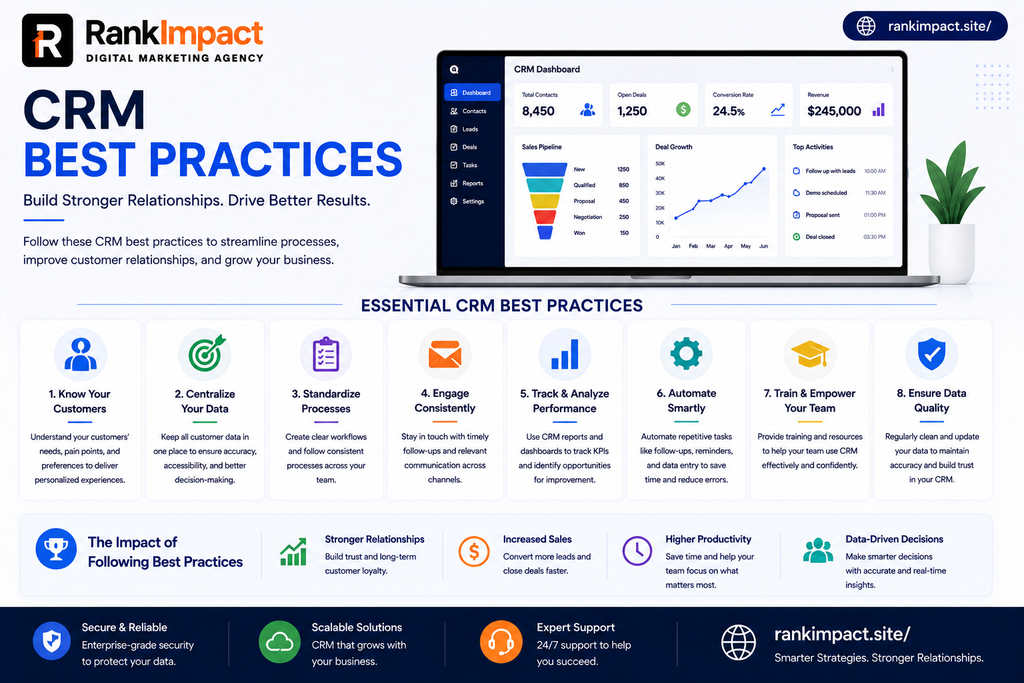
Table of Contents
Why CRM Best Practices Matter More Than the Software Itself
Most CRM failures have very little to do with the software vendor and almost everything to do with how the system gets configured, adopted, and maintained inside the organization using it. Two companies can purchase the exact same CRM platform and end up with completely different outcomes, where one builds a reliable source of truth that drives forecasting and coaching decisions while the other watches reps quietly slip back into spreadsheets within a few months. This gap almost always comes down to the discipline applied around data entry standards, ongoing training, and internal accountability rather than any missing feature in the software itself. Understanding this early changes how a business approaches CRM strategy, shifting the focus away from constantly evaluating whether to switch platforms and toward building the habits and processes that make any platform succeed. Companies that treat CRM adoption as an ongoing organizational discipline, rather than a one time technical implementation, consistently see stronger long term results regardless of which specific tool they use.
Establish Clean Data Entry Standards From the Start
Data quality is the single most important factor determining whether a CRM becomes genuinely useful or slowly turns into a pile of unreliable information nobody trusts. A sales team that allows reps to enter company names inconsistently, skip required fields, or leave deal stages outdated quickly ends up with reporting that leadership cannot rely on for forecasting or strategic decisions. Establishing clear, written data entry standards before a CRM even fully rolls out, covering exactly how contacts, companies, and deal stages should be labeled, prevents this problem from taking root in the first place. Many high performing teams also build mandatory fields directly into their CRM configuration, ensuring reps cannot advance a deal to the next pipeline stage without entering critical information like next steps or expected close date. Running a recurring data audit, even a simple monthly check for duplicate records or missing fields, catches small inconsistencies before they compound into a much larger cleanup project down the road.
Build Automation Around Repetitive Administrative Tasks
One of the most valuable crm best practices involves identifying which manual tasks eat up the most time for your sales team and systematically automating them rather than accepting them as an unavoidable cost of doing business. A sales team that manually sends every follow up email after a demo call is spending time that could go toward actual selling activity, when a simple automated sequence triggered by a specific deal stage could handle that task consistently and immediately. Automating lead assignment based on territory, company size, or industry ensures new leads reach the right rep instantly rather than sitting untouched while someone manually reviews and distributes them. Many teams also build automated internal notifications, alerting a manager when a high value deal has not been updated in a set number of days, which helps catch stalled opportunities before they quietly die in the pipeline. The goal of automation should always be removing friction from necessary but repetitive work, not replacing the genuine human judgment and relationship building that actually closes deals.
Prioritize User Adoption Over Feature Complexity
A CRM loaded with advanced features means nothing if the sales team does not actually use it consistently, which makes user adoption one of the most critical and most frequently neglected areas of CRM strategy. Rolling out a new system with a single training session and no ongoing reinforcement almost guarantees that reps will forget half of what they learned within a few weeks and default back to whatever workflow felt more familiar. Successful organizations typically build a phased training approach, starting with the core daily workflows every rep needs immediately and gradually introducing more advanced features once the basics have become habit. Involving frontline reps early in the configuration process, asking for their input on pipeline stages and required fields before finalizing the setup, significantly increases buy in because the system reflects how they actually sell rather than how leadership imagines they sell. Recognizing and reinforcing good CRM usage publicly, such as highlighting a rep whose consistent data entry led to an accurate forecast, also helps build a culture where using the system correctly becomes the expected norm rather than an optional extra task.
Align Sales and Marketing Data Inside the Same System
Sales and marketing teams working from disconnected data sources represent one of the most common and costly problems that strong crm best practices are specifically designed to solve. When marketing generates a lead through a webinar or content download but that engagement history does not transfer cleanly into the CRM record sales reps see, reps end up calling prospects without any context about what actually brought them to the table. Building a proper integration between marketing automation tools and the CRM, so that every touchpoint a lead has with marketing content appears directly on their contact record, gives sales reps significantly more context heading into their first conversation. Establishing a shared definition of what qualifies as a marketing qualified lead versus a sales qualified lead, agreed upon by both departments and reflected consistently in the CRM, prevents the common friction where marketing feels leads are being ignored while sales feels leads are low quality. Regular joint reviews between sales and marketing leadership, using CRM data to examine which lead sources and campaigns are actually converting into closed revenue, keeps both teams focused on the same shared goals rather than operating in separate silos.
Use CRM Reporting to Drive Real Decisions Not Just Track Activity
Many organizations build detailed CRM dashboards that track dozens of metrics but rarely translate that reporting into actual decisions, which wastes the analytical potential a well maintained CRM genuinely offers. Reviewing pipeline health on a consistent weekly cadence, looking specifically for deals that have stalled in a stage far longer than the typical sales cycle, helps managers intervene with coaching or support before a deal quietly dies. Tracking conversion rates between individual pipeline stages, rather than just overall win rate, reveals exactly where prospects are dropping out of the process and allows teams to address that specific bottleneck rather than guessing at broad improvements. Comparing forecasted revenue against actual closed revenue over several consecutive quarters helps a sales organization calibrate how accurately their team is estimating deal probability, which directly improves the reliability of future forecasting. The most effective sales leaders treat CRM reporting as an ongoing diagnostic tool woven into regular team meetings, rather than a report generated once a quarter purely for executive review.
Establish Clear Data Governance and Ownership
As a CRM grows in size and complexity, having a single person or small team responsible for its ongoing configuration, data quality, and process updates becomes essential rather than optional. Without a designated owner, CRM configuration tends to drift over time as different managers add fields, change pipeline stages, or introduce inconsistent processes without any centralized oversight, eventually creating a system that feels confusing and unreliable to everyone using it. A dedicated CRM administrator or revenue operations lead should be responsible for approving significant configuration changes, maintaining documentation of current processes, and running periodic data cleanup projects to catch duplicate records or outdated information. Establishing clear rules around who can create new custom fields or modify pipeline stages prevents the common problem of a CRM becoming cluttered with abandoned fields nobody remembers the purpose of. Documenting your CRM processes in a living internal reference, updated whenever a significant change happens, also makes onboarding new team members considerably faster and reduces the institutional knowledge lost whenever an experienced employee leaves the company.
Common Mistakes That Undermine CRM Best Practices
One of the most frequent mistakes organizations make is treating CRM implementation as a single completed project rather than an ongoing discipline that requires continuous attention as the business evolves. Many teams also fail to define what success actually looks like before rolling out new processes, making it impossible to objectively measure whether a change in CRM strategy is actually improving outcomes or simply adding more administrative overhead. Allowing inconsistent data entry to persist without correction is another critical mistake, since even a small percentage of unreliable records can quickly erode leadership trust in the entire reporting system, making people revert to manual spreadsheets they perceive as more accurate. Overloading the CRM with too many custom fields and mandatory requirements, often introduced with good intentions but never removed once they become obsolete, creates unnecessary friction that slows reps down and encourages shortcuts or incomplete data entry. Finally, many organizations neglect to revisit their CRM processes as the business scales, continuing to use a configuration built for a five person sales team long after the organization has grown into fifty reps with much more complex reporting needs.
Building a CRM Culture That Lasts Beyond Initial Rollout
The organizations that sustain strong CRM discipline over multiple years typically treat it as a core part of their sales culture rather than an isolated technical system managed separately from how the business actually operates. Leadership involvement plays a significant role here, since sales managers who actively use CRM data during one on one coaching sessions and pipeline reviews send a clear signal that the system matters, while managers who ignore it in favor of gut feeling quietly undermine adoption across the entire team. Building CRM proficiency into onboarding for every new sales hire, rather than treating it as an optional add on training session, ensures consistent habits form from day one instead of needing to be corrected later. Celebrating specific examples where accurate CRM data led to a better business decision, such as catching a stalling deal early enough to save it or identifying an underperforming lead source before wasting further budget on it, reinforces the tangible value of consistent data discipline in a way abstract policy reminders rarely achieve. A CRM culture built on these habits tends to survive leadership changes, team growth, and even platform migrations far better than one dependent entirely on a single champion pushing for compliance.
How CRM Best Practices Differ by Team Size and Maturity
Early stage sales teams with just a handful of reps typically benefit most from focusing on basic data hygiene and consistent pipeline stage usage, since the priority at this stage is simply building the habit of using the system at all rather than layering on complex automation. Growing mid sized teams usually reach a point where automation becomes essential, particularly around lead routing and follow up sequences, since manual processes that worked fine with five reps quickly become bottlenecks once the team doubles or triples in size. Larger organizations with dedicated sales operations functions typically need to invest heavily in governance and documentation, since the complexity of multiple teams, territories, and reporting requirements makes informal, undocumented processes unsustainable at scale. Companies going through significant growth or restructuring should revisit their CRM best practices specifically during those transition periods, since processes that worked well for the previous organizational structure often need meaningful adjustment to remain effective under new reporting lines or expanded team responsibilities.
Frequently Asked Questions
What are the most important crm best practices?
The most important crm best practices include maintaining clean and consistent data entry standards, automating repetitive administrative tasks, prioritizing genuine user adoption, aligning sales and marketing data, and establishing clear ownership over ongoing system governance.
How often should CRM data be cleaned?
Most organizations benefit from a monthly review for obvious issues like duplicate records or missing required fields, combined with a more thorough quarterly audit to catch deeper data quality problems before they significantly affect reporting accuracy.
Why do sales teams stop using their CRM?
Sales teams commonly stop using a CRM when the system feels more like an administrative burden than a genuine sales tool, often due to poor initial training, overly complex configuration, or a lack of visible leadership reinforcement around consistent usage.
How do you improve CRM adoption among sales reps?
Improving adoption typically requires involving reps early in system configuration, providing phased training focused on daily workflows first, and having managers actively reference CRM data during coaching conversations to reinforce its ongoing importance.
What is the biggest mistake companies make with CRM implementation?
The biggest mistake is treating CRM implementation as a single completed project rather than an ongoing discipline that requires continuous training, governance, and process updates as the business and team continue to evolve.
Should marketing and sales share the same CRM data ?
Yes, sharing the same CRM data between sales and marketing significantly improves lead context, conversion tracking, and overall alignment between the two departments, reducing the friction that often occurs when teams work from disconnected systems.
How do you measure whether CRM best practices are working?
Success can be measured through improvements in data accuracy, forecast reliability compared to actual closed revenue, pipeline conversion rates between stages, and overall consistency of daily CRM usage across the sales team.
Who should own CRM governance inside a company?
A dedicated CRM administrator or revenue operations lead should typically own ongoing governance, including approving configuration changes, maintaining documentation, and running periodic data quality audits across the system.
Do small businesses need formal CRM best practices?
Yes, even small businesses benefit significantly from establishing basic data entry standards and consistent pipeline usage early on, since habits formed with a small team become considerably harder to correct once the organization grows larger.
How does automation fit into CRM best practices?
Automation should be used to remove friction from repetitive administrative tasks like lead routing and follow up reminders, freeing sales reps to focus more time on actual selling activity rather than manual data entry and task management.
Conclusion
Getting real value from a CRM system depends far more on the habits and discipline built around it than on any single feature the software itself provides. Following consistent crm best practices, including clean data entry standards, thoughtful automation, genuine user adoption, and clear long term governance, is what transforms a CRM from an expensive piece of shelfware into a genuine driver of sales performance and revenue predictability. The organizations that succeed long term treat these practices as an ongoing cultural commitment rather than a one time implementation checklist, revisiting and adjusting their approach as the team grows and the business evolves. Start by identifying which area from this guide represents your biggest current gap, whether that is inconsistent data, weak adoption, or missing governance, and build a specific improvement plan around that single area before trying to fix everything at once.
Key Takeaways
Strong crm best practices depend far more on organizational discipline and consistent habits than on any specific software feature or platform choice.
Establishing clean data entry standards from the very beginning prevents the compounding data quality problems that quietly erode trust in CRM reporting over time.
Automating repetitive administrative tasks like lead routing and follow up reminders frees sales reps to focus more time on genuine selling activity.
User adoption improves significantly when frontline reps are involved early in configuration and when managers actively reference CRM data during coaching conversations.
Aligning sales and marketing data inside the same system reduces friction and gives sales reps far more context before their first conversation with a lead.
Clear governance and a designated system owner become essential as a CRM grows in complexity, preventing configuration drift and unnecessary clutter over time.
CRM best practices should evolve as a team grows in size and maturity, with early stage teams focusing on basic hygiene and larger organizations investing more heavily in automation and formal governance.