Learn what SFDC SaaS means, how Salesforce built the model, core products, career paths, common challenges, and proven best practices for lasting success.
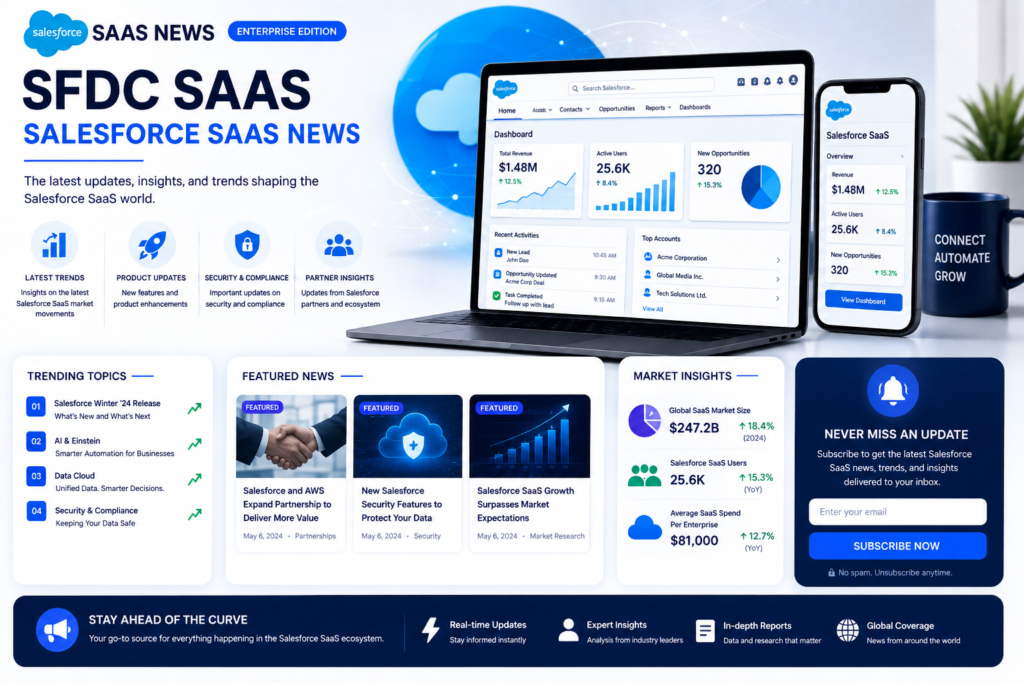
Table of Contents
Anyone who has spent time inside the CRM world, whether as a sales rep, an administrator, or a job seeker scrolling through listings, has likely come across the term SFDC. It shows up in job titles like SFDC Administrator, in certification names, and in casual conversation among people who work with Salesforce every day. Understanding SFDC SaaS matters because it connects two ideas that are often discussed separately, the identity of Salesforce as a company and the software delivery model that made it one of the most influential businesses in modern enterprise technology.
SFDC stands for Salesforce dot com, the original legal and stock market name of the company before it shortened its public identity to simply Salesforce. SaaS, short for software as a service, describes cloud hosted software that customers access through a subscription rather than installing it on local servers. Put the two together and SFDC SaaS refers to Salesforce as one of the earliest and most successful examples of the software as a service business model, a company that helped define what modern SaaS looks like for millions of businesses that followed its lead.
What SFDC Actually Stands For
The abbreviation SFDC traces back to Salesforce dot com, the name the company used from its founding in 1999 through its early years as a young cloud software startup challenging traditional, on premise CRM systems. Even after the company rebranded its public facing name to Salesforce, the SFDC abbreviation stuck around inside the industry, largely because it was already baked into job titles, internal documentation, and community terminology on platforms like Trailhead and various Salesforce user groups.
Today, SFDC is used almost interchangeably with Salesforce in casual professional conversation, though it appears most often in three specific contexts. Recruiters and hiring managers use it in job titles such as SFDC Administrator or SFDC Developer, since these shorter terms are easier to scan in a list of postings. Salesforce professionals use it as shorthand among themselves, the same way developers might say JS instead of JavaScript. And documentation or internal wikis at companies that have used Salesforce for a long time often default to SFDC simply because that was the accepted term when the systems were first implemented.
How SFDC Became a Defining Example of SaaS
Salesforce launched at a time when nearly all serious business software was sold as an on premise license, requiring companies to buy servers, install the software internally, and hire IT staff to maintain it. Salesforce challenged that model directly with a simple pitch, access your CRM through a web browser and pay a subscription instead of a massive upfront license fee. This approach was unusual enough at the time that the company built its early marketing around the phrase no software, deliberately positioning itself against the installed software vendors that dominated the enterprise market.
That bet paid off. Salesforce grew from a startup selling a single CRM product into a sprawling platform offering sales tools, customer service tools, marketing automation, analytics, and a full ecosystem of third party applications available through its AppExchange marketplace. Because of how early and how successfully it proved the subscription based, cloud hosted model at enterprise scale, SFDC is frequently cited in business and technology courses as one of the companies that legitimized SaaS as a viable way to sell serious business software, not just simple consumer tools.
Core Products Inside the SFDC SaaS Platform
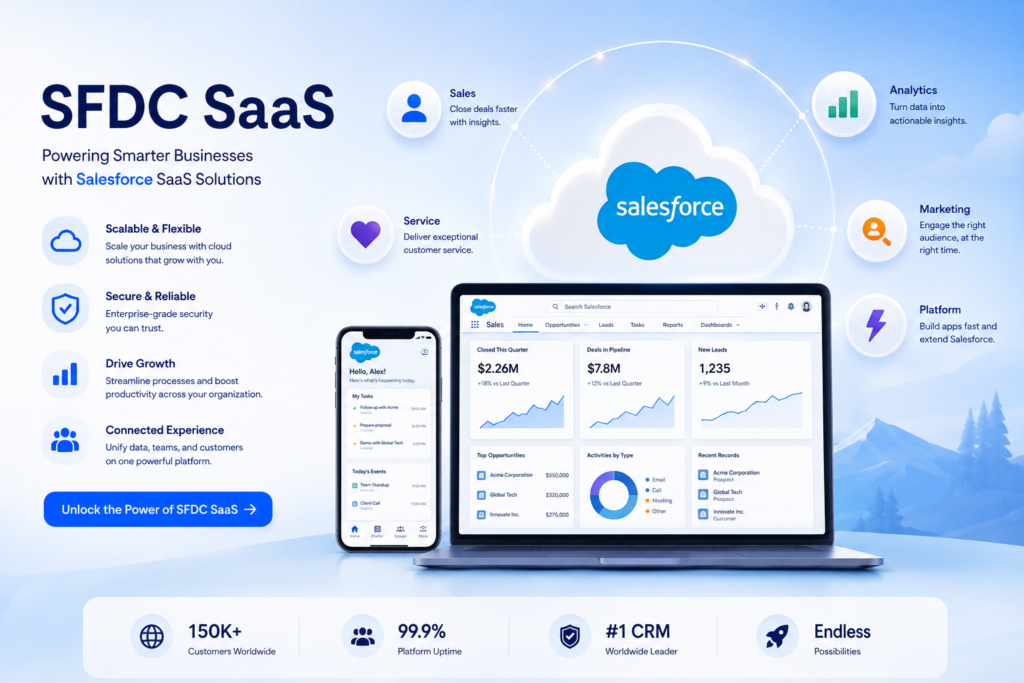
Understanding SFDC SaaS in practice means understanding what the platform actually includes, since Salesforce today is far broader than a single CRM tool. Sales Cloud remains the original core product, giving sales teams a system to track leads, manage pipelines, and forecast revenue. Service Cloud extends the same underlying platform toward customer support teams, offering case management, knowledge bases, and omnichannel communication tools. Marketing Cloud handles email campaigns, customer journeys, and marketing automation for teams trying to coordinate outreach across multiple channels.
Beyond these flagship products, the SFDC SaaS platform includes Salesforce Platform itself, a set of tools that let developers build custom applications directly on top of the same infrastructure, and Tableau, a data visualization tool Salesforce acquired to strengthen its analytics offering. Slack, another Salesforce acquisition, has since been folded into the broader SFDC SaaS ecosystem as a collaboration layer that sits alongside the core CRM products, giving teams a way to discuss deals, cases, and campaigns without leaving their day to day workflow. Each of these products shares the same underlying multi tenant, cloud hosted architecture that defines the SaaS model, meaning customers across industries run on shared infrastructure while their individual data stays logically separated and secure.
For businesses new to the ecosystem, it helps to think of SFDC SaaS less as a single application and more as a connected suite, where a company might start with just Sales Cloud and gradually layer in Service Cloud or Marketing Cloud as its needs grow, without needing to migrate to a different vendor each time a new department wants cloud software of its own.
SFDC SaaS in the Job Market
One of the most practical reasons people search for SFDC SaaS is career related. Job titles referencing SFDC are common across a wide range of roles, and understanding the terminology helps candidates search more effectively and helps hiring managers write clearer postings. An SFDC Administrator manages user access, builds workflows, customizes objects and fields, and keeps the system running smoothly for the business teams that depend on it daily. An SFDC Developer writes custom code using Apex, the platform’s proprietary programming language, and builds integrations that connect Salesforce to other business systems. Beyond these two common titles, roles like SFDC Business Analyst and SFDC Consultant have also grown steadily, reflecting how deeply this particular SaaS platform has embedded itself into modern business operations.
Certifications play a large role in this career path. The Salesforce Administrator certification, often referred to informally as an SFDC Admin certification, has become a recognized credential that many companies list as a preferred or required qualification. Because Salesforce maintains its own free learning platform through Trailhead, career changers without a traditional computer science background have a realistic path into SFDC focused roles, which has made this corner of the SaaS job market unusually accessible compared to other enterprise software ecosystems. Recruiters searching specifically for SFDC SaaS experience often use the abbreviation as a quick filter, assuming candidates who list it on a resume already understand the platform’s core terminology and workflows without needing it spelled out in full.
Why Businesses Choose SFDC SaaS as Their CRM
Businesses evaluating SFDC SaaS as a CRM option tend to weigh a specific set of advantages against the SFDC SaaS cost and complexity. Customization stands out as one of the strongest selling points, since the platform allows businesses to reshape nearly every object, field, and workflow to match their existing processes rather than forcing teams to adapt to a rigid, out of the box structure. The AppExchange marketplace adds further flexibility, giving businesses access to thousands of pre built integrations and add on applications built by third party developers, which often removes the need for custom development work entirely.
Scalability is another major draw of SFDC SaaS. A five person sales team and a five thousand person enterprise sales organization can both run on the same underlying platform, scaling up through additional licenses and more advanced product tiers rather than migrating to an entirely different system as the business grows. This scalability, combined with the platform’s long track record and large talent pool of trained administrators and developers, makes SFDC a lower risk choice for businesses that plan to grow significantly over the coming years and want a CRM that can grow with them.
Common Challenges Businesses Face With SFDC SaaS
Despite its strengths, businesses adopting SFDC SaaS run into a consistent set of challenges worth understanding before implementation begins. Cost is the most frequently cited concern, since Salesforce pricing scales with both the number of user licenses and the specific product tier a business selects, which can grow substantially as a company adds more users and more advanced features over time.
Implementation complexity catches many businesses off guard when adopting SFDC SaaS, particularly those moving from a simpler CRM or from spreadsheets. Because the platform offers so much configurability, businesses without clear internal ownership of the system often end up with a cluttered, poorly organized setup that confuses users rather than helping them, a problem that typically stems from rushing the implementation phase rather than any flaw in the platform itself. Over customization is a related trap, where well meaning administrators add so many custom fields, workflows, and automations that the system becomes difficult to maintain and slow to adapt when business needs change.
User adoption also remains a genuine hurdle for SFDC SaaS rollouts. A CRM only delivers value when sales and service teams actually use it consistently and enter accurate data, and businesses that skip proper training or fail to demonstrate clear personal value to end users often see poor adoption regardless of how well the system itself is configured.
Best Practices for Getting the Most Out of SFDC SaaS
Companies that succeed with SFDC SaaS implementations tend to follow a consistent set of practices that separate a smooth SFDC SaaS rollout from a frustrating one. Starting with a clean, well planned data structure before heavy customization begins prevents the clutter and confusion that often plague rushed implementations, since it is far easier to build good habits into the system from day one than to untangle a messy setup later.
Investing in proper training for end users, not just administrators, pays off directly in adoption rates and data quality. Teams that understand why they are entering data into the system, not just how, tend to engage with it far more consistently than teams that view it as an administrative burden imposed from above. Regularly auditing custom fields, workflows, and automations helps prevent the over customization trap, keeping the system lean enough that new administrators can understand and maintain it without needing to decode years of accumulated complexity. Finally, leaning on the Trailhead learning platform and the broader Salesforce community, including user groups and forums, gives internal teams access to a huge base of shared knowledge that can solve most implementation questions without expensive outside consulting.
The Future of SFDC as a SaaS Leader
SFDC SaaS continues to evolve well beyond its original CRM roots, and understanding where the platform is heading helps businesses plan for the long term rather than just the immediate implementation. Artificial intelligence has become a central focus, with tools built directly into the platform that can draft customer communications, summarize case histories, and surface predictive insights without requiring separate software. This mirrors a broader trend across the SaaS industry, where vendors are embedding intelligence directly into existing workflows rather than treating it as a bolt on feature.
Industry specific versions of SFDC SaaS, built for sectors like financial services, healthcare, and manufacturing, reflect a broader shift toward vertical specialization across the SaaS world, where generic tools increasingly compete against industry tailored alternatives built to handle sector specific compliance and workflow needs out of the box. As competition in the CRM SaaS space continues to intensify, SFDC’s long head start, large partner ecosystem, and trained talent pool remain significant advantages that newer competitors have struggled to fully replicate.
Frequently Asked Questions
What does SFDC stand for in the SaaS world.
Answer SFDC stands for Salesforce dot com, the original legal name of the company that became one of the earliest and most influential examples of the software as a service business model.
Is SFDC the same thing as Salesforce.
Answer Yes, SFDC and Salesforce refer to the same company. SFDC is simply an older abbreviation that remains common in job titles, certifications, and everyday professional conversation.
Is Salesforce actually a SaaS company.
Answer Yes. Salesforce delivers its products entirely through the cloud on a subscription basis, which places SFDC SaaS firmly within the broader SaaS category and makes it one of the model’s earliest large scale success stories.
What does an SFDC Administrator actually do.
Answer An SFDC Administrator manages user access, customizes objects and workflows, maintains data quality, and keeps the overall system aligned with how the business actually operates day to day.
What is the difference between SFDC SaaS and traditional on premise CRM software.
Answer Traditional on premise CRM software requires companies to install and maintain the system on their own servers, while SFDC SaaS is hosted entirely by Salesforce and accessed through a subscription, removing the need for internal infrastructure.
Do I need a technical background to work in SFDC SaaS roles.
Answer Not necessarily. Many SFDC Administrators come from business or operations backgrounds and build technical skills through Salesforce’s free Trailhead learning platform rather than a traditional computer science degree.
Why is SFDC pricing considered expensive by some businesses.
Answer Salesforce pricing scales with the number of user licenses and the specific product tier selected, which can add up quickly for growing teams, particularly once businesses move beyond the most basic plan.
What is the AppExchange in relation to SFDC SaaS.
Answer The AppExchange is Salesforce’s marketplace of third party applications and integrations, allowing businesses to extend the core SFDC SaaS platform without building custom solutions from scratch.
How long does it typically take to implement SFDC SaaS.
Answer Implementation timelines vary widely depending on business complexity, but a straightforward setup can take a few weeks while a large enterprise rollout with heavy customization can take several months.
Is SFDC SaaS a good long term choice for growing businesses.
Answer For businesses expecting significant growth, SFDC SaaS is often a strong long term choice due to its scalability, large talent pool, and extensive ecosystem, though smaller teams should weigh the cost against simpler CRM alternatives first.
Conclusion
SFDC SaaS is more than an abbreviation borrowed from an old company name, and understanding SFDC SaaS in full context helps professionals speak the language of the industry with confidence. It represents one of the clearest real world examples of how the software as a service model reshaped enterprise technology, turning Salesforce from a small startup with a simple pitch into a company whose products, certifications, and job titles now shape careers across the business world. Whether the goal is understanding a job posting, evaluating a CRM purchase, or simply making sense of industry terminology, grasping what SFDC SaaS actually means gives professionals and businesses alike a clearer picture of both where cloud software came from and where it continues to head.
Key Takeaways
SFDC stands for Salesforce dot com, the original name behind one of the most influential SaaS companies in enterprise software history.
SFDC SaaS refers to Salesforce’s cloud hosted, subscription based CRM platform, which helped legitimize the broader SaaS business model.
Core SFDC products include Sales Cloud, Service Cloud, Marketing Cloud, and the developer focused Salesforce Platform.
SFDC terminology shows up heavily in job titles and certifications, making it especially relevant to career changers and hiring teams.
Common challenges with SFDC SaaS include cost, implementation complexity, over customization, and user adoption struggles.
Clean data structure, proper training, and regular system audits are proven best practices for long term SFDC success.
The future of SFDC as a SaaS leader is being shaped by embedded artificial intelligence and industry specific product versions.