Looking for reliable SaaS development services. Learn what they include, how pricing works, and how to choose a partner that builds software right.
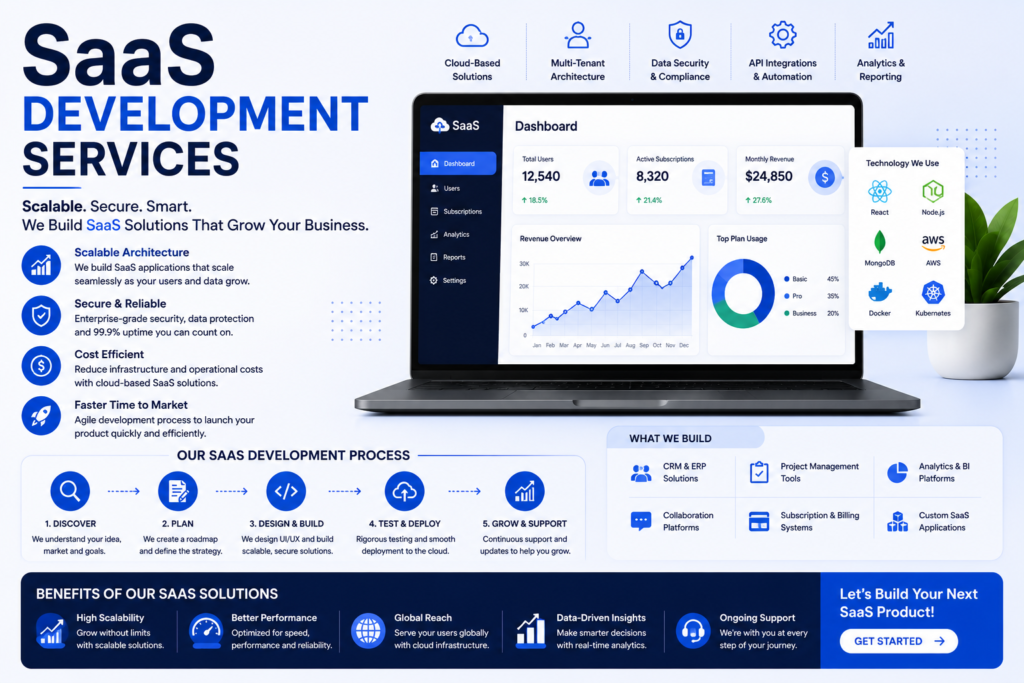
Table of Contents
Things to Know Before Choosing SaaS Development Services
Every successful SaaS company eventually confronts the same hard truth: building great software is only half the battle, and building it efficiently, securely, and at the right cost is where most companies actually struggle.
Whether you are a non technical founder trying to turn an idea into a working product, or an established company that needs to scale engineering capacity without the twelve month hiring cycle that comes with building an internal team from scratch, SaaS development services exist to close that gap.
These providers specialize in designing, building, and maintaining subscription based software products, bringing structured processes and specialized expertise that many companies simply cannot replicate quickly on their own.
This guide walks through everything you need to know before engaging a development partner. You will learn exactly what these services typically include, how engagement and pricing models work, what technology and security considerations matter most, how to evaluate a vendor properly, and the mistakes that quietly derail so many outsourced software projects. The intent here is not to convince you that outsourcing is always right. It is to equip you with enough clarity to choose the path, whether that is a full outsourced build, a staff augmentation arrangement, or a hybrid model, that actually fits your product stage, budget, and risk tolerance.
What SaaS Development Services Actually Include
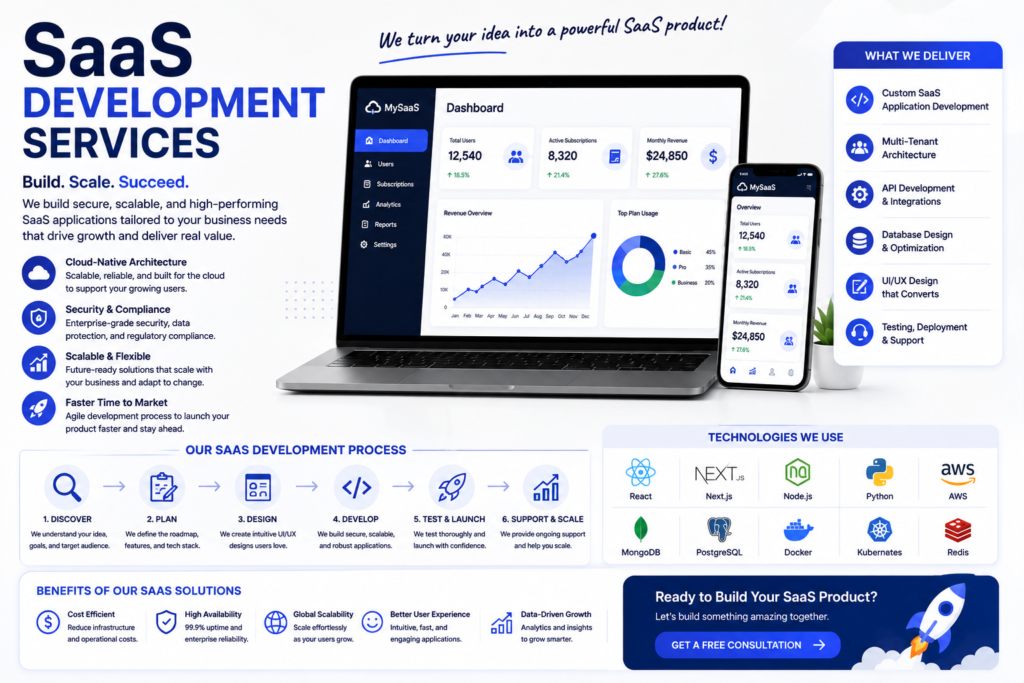
At its core, a SaaS development service is a team of engineers, designers, and product specialists who build and maintain cloud based, subscription delivered software on behalf of a client. The scope of that work varies significantly depending on the provider and the stage of the product, but most engagements touch several common areas.
Product strategy and discovery often come first, especially for early stage companies. A strong partner does not simply take a feature list and start coding. They help validate assumptions, define a minimum viable product scope, and map out a technical architecture that can actually support future growth rather than requiring a costly rebuild eighteen months later. Skipping this step is one of the most expensive mistakes a first time SaaS founder can make, because a rushed architecture decision made in week one can create technical debt that takes months to unwind later.
Application development itself covers front end interfaces, back end logic, database design, and API architecture. For multi tenant SaaS products specifically, this includes decisions around tenant isolation, data security boundaries, and how the system will scale as customer accounts multiply. Cloud infrastructure and DevOps work sits alongside this, covering deployment pipelines, hosting architecture on platforms like AWS, Azure, or Google Cloud, and the automation needed to ship updates safely and frequently.
Quality assurance and testing, often underinvested in by teams racing to launch, protect against the kind of bugs that quietly erode customer trust after go live. Ongoing maintenance and support extend the relationship well past initial launch, since a SaaS product is never really finished, it requires continuous updates, security patching, and performance monitoring for as long as the business exists. Many providers also offer specialized services like third party integrations, payment and billing system implementation, and compliance work for standards such as SOC 2 or HIPAA when the target market demands it.
Common Engagement Models
Understanding how these engagements are structured helps buyers choose the right fit and avoid mismatched expectations. The fixed scope project model works well for clearly defined, bounded work, such as building a specific feature or completing a well documented MVP. Pricing and timeline are agreed upfront, which offers cost certainty but requires the requirements to be genuinely stable, since any significant scope change usually triggers a renegotiation.
Time and materials billing charges based on actual hours worked, which suits projects where requirements are expected to evolve as the team learns more about the market or the product. This model offers flexibility but requires more active client oversight to keep the budget on track, since costs are not capped the way they are in a fixed scope arrangement.
Dedicated team or staff augmentation arrangements embed contracted developers directly into a company’s existing workflow, often working alongside an internal product manager and reporting into internal leadership rather than an external account manager. This model is popular with companies that already have strong internal product direction but need additional engineering capacity, and it tends to feel closer to an extension of the internal team than a traditional vendor relationship.
Product as a partner or outcome based models are less common but growing, where the development partner takes on a broader stake in product success, sometimes including equity or revenue share arrangements in exchange for a reduced upfront fee. These arrangements can work well for very early stage startups with limited cash but require careful legal structuring to avoid disputes down the line.
How Pricing Works for SaaS Development Services
Cost is one of the first questions most buyers ask, and the honest answer is that it depends heavily on team location, seniority, and project complexity. Hourly rates for development talent vary enormously by region, with North American and Western European agencies typically charging significantly more per hour than teams based in Eastern Europe, Latin America, or South and Southeast Asia, though the gap in quality between regions has narrowed considerably as remote work has matured.
A simple MVP with limited functionality might run anywhere from thirty thousand to eighty thousand dollars depending on scope and location, while a more complex, feature rich SaaS platform with multiple integrations, advanced permissions, and enterprise grade security can easily run into the several hundred thousand dollar range before launch. Ongoing maintenance typically costs a percentage of the original build cost annually, often in the range of fifteen to twenty five percent, to cover bug fixes, security updates, and minor enhancements.
Buyers should be cautious of quotes that seem dramatically lower than every other bid received, since unusually cheap pricing often signals inexperienced junior developers, a lack of proper testing and code review processes, or a business model that depends on volume over quality. The cheapest bid on paper frequently becomes the most expensive option in practice once technical debt, security vulnerabilities, and rework costs are factored in.
Choosing the Right Technology Stack
One of the most consequential early decisions in any SaaS build is the technology stack, and a good development partner should be able to explain their recommendations clearly rather than defaulting to whatever they personally prefer. The right stack depends on factors including expected scale, the complexity of the data model, team hiring availability for long term maintenance, and specific performance requirements.
Popular back end frameworks like Node.js, Django, Ruby on Rails, and Laravel each carry tradeoffs in development speed, scalability, and hiring pool size. Front end choices, most commonly built around React, Vue, or Angular, affect how quickly new interfaces can be built and how maintainable the codebase remains as the product grows. Database selection between relational systems like PostgreSQL and non relational options like MongoDB depends heavily on how structured and interrelated the underlying data actually is.
A trustworthy development partner will walk through these tradeoffs with a client rather than making unilateral decisions, and will factor in what happens after launch, since the stack chosen at the beginning of a project has long term implications for who can be hired to maintain it and how expensive that maintenance becomes over time.
Security, Compliance, and Data Protection
Security cannot be an afterthought in SaaS development, since a single breach can destroy years of accumulated customer trust and, in regulated industries, trigger significant legal liability. A serious development partner builds security into the process from the earliest architecture decisions rather than bolting it on before launch.
This includes practices like secure authentication and authorization design, encryption of sensitive data both at rest and in transit, regular dependency and vulnerability scanning, and proper tenant isolation for multi tenant applications so that one customer’s data can never leak into another’s environment. For SaaS products serving regulated industries such as healthcare, finance, or education, compliance requirements like HIPAA, SOC 2, GDPR, or PCI DSS need to be designed into the system architecture from day one, since retrofitting compliance into an already built product is far more expensive and risky than building it in from the start.
Buyers evaluating a development partner should ask directly about their security practices, request evidence of past compliance work if relevant to their industry, and clarify who owns responsibility for security incidents after launch. A partner who cannot answer these questions clearly and specifically is a warning sign worth taking seriously.
How to Choose the Right SaaS Development Partner
Selecting a development partner is a decision with long term consequences, since the codebase they build will likely outlive the original engagement by years. A structured evaluation process protects against costly mistakes.
Start by reviewing a portfolio of comparable projects, ideally in a similar industry or with similar technical complexity to your own, and ask to speak directly with past clients rather than relying solely on case studies written by the vendor’s own marketing team. Ask specifically about how the team handles requirement changes mid project, since flexibility here often separates a mature process from a rigid one that will fight every reasonable adjustment.
Clarify who will actually be assigned to the project and their seniority level, since some vendors sell the engagement using senior architects during the sales process and then staff execution with far more junior developers once the contract is signed. Understand the code ownership terms in the contract explicitly, since some agreements retain more rights over the codebase than clients realize until a dispute arises later.
Evaluate communication style and time zone overlap carefully if working with a distributed or offshore team, since consistent, clear communication during the sales process is usually a strong predictor of what the working relationship will feel like after signing. Finally, ask about their testing and quality assurance process in specific, technical terms rather than accepting a vague assurance that quality is a priority, since the difference between a team that tests rigorously and one that does not becomes painfully clear only after launch, when bugs surface in production.
Common Mistakes Companies Make
One of the most frequent and costly mistakes is starting development before requirements are clearly documented, which leads to scope creep, budget overruns, and a final product that does not actually match what the business needed. Investing time in a proper discovery and specification phase before writing a single line of code consistently pays for itself many times over.
Another common error is choosing a partner based purely on the lowest hourly rate without evaluating actual delivery quality, which frequently results in a product that requires significant, expensive rework within the first year. Companies also often underestimate the ongoing cost of maintenance, treating development as a one time expense rather than a continuous investment that a SaaS product requires for its entire lifespan.
Poor communication structures cause problems as well, particularly when a client has no dedicated internal point of contact available to answer questions quickly, which slows the development team down and often leads to incorrect assumptions being built into the product. Finally, many companies fail to plan for scale early enough, building an architecture that works fine for the first hundred customers but collapses under the weight of the first major growth spurt, forcing an expensive and disruptive rebuild at exactly the moment the business can least afford the distraction.
Measuring Success Beyond Launch Day
Launching a SaaS product is a milestone, not a finish line, and the metrics that matter most extend well beyond whether the initial build shipped on time. System uptime and reliability directly affect customer trust and retention, since even a technically impressive product will lose customers quickly if it goes down frequently or performs poorly under load. Page load speed and application responsiveness influence both user satisfaction and, for customer facing marketing pages, organic search performance.
Bug resolution time and the frequency of production incidents reveal whether the underlying codebase was built with genuine quality in mind or rushed to meet an arbitrary deadline. Customer support ticket volume related to technical issues, rather than feature requests, often signals whether the product genuinely works as intended or whether users are quietly struggling with problems the team has not yet identified. A development partner worth continuing to work with after launch will track these metrics proactively and bring them to the client rather than waiting to be asked.
In House Team, Outsourced Partner, or Hybrid Approach
Much like the broader marketing function, many growing SaaS companies eventually land on a hybrid engineering model rather than choosing purely between an internal team and a fully outsourced one. A common pattern keeps core product architecture, security critical components, and strategic technical decisions in house, where deep institutional knowledge matters most, while using an outsourced partner for well defined feature work, staff augmentation during growth spurts, or specialized skills that would be expensive to hire full time.
This hybrid structure tends to work well because it preserves critical technical knowledge inside the company while still accessing flexible capacity for less sensitive or more clearly scoped work. Early stage startups without deep pockets often benefit most from a fully outsourced initial build paired with a plan to bring core engineering in house once the product proves itself and funding allows for permanent hires. Growth stage companies frequently maintain a solid internal core team while using outsourced partners for overflow capacity during major initiatives, and enterprise companies tend to use outsourced development more selectively, often for legacy system modernization or highly specialized technical work that falls outside their core internal expertise.
Frequently Asked Questions
What do SaaS development services actually include?
SaaS development services typically cover product strategy and discovery, application development across front end and back end systems, cloud infrastructure and DevOps, quality assurance, and ongoing maintenance and support for the lifetime of the product.
How much do SaaS development services cost?
Costs vary significantly by scope and team location. A simple MVP might cost thirty to eighty thousand dollars, while a complex, feature rich platform with enterprise grade security can run into the hundreds of thousands, with ongoing maintenance typically costing fifteen to twenty five percent of the original build annually.
How long does it take to build a SaaS product?
A basic MVP can often be built in three to six months, while a more complex platform with multiple integrations and advanced functionality can take nine to eighteen months or longer, depending on scope and team size.
What is the difference between fixed scope and time and materials pricing?
Fixed scope pricing sets a firm cost and timeline for clearly defined work, offering budget certainty, while time and materials billing charges for actual hours worked, offering more flexibility for projects where requirements are expected to evolve.
How do I protect my intellectual property when outsourcing SaaS development?
Review the contract carefully for explicit code ownership and intellectual property assignment clauses, ensure a signed non disclosure agreement is in place before sharing sensitive product details, and confirm the vendor transfers full rights to the completed codebase upon final payment.
What technology stack should I choose for my SaaS product?
The right stack depends on expected scale, data complexity, and long term hiring availability rather than any single universally correct answer. A trustworthy development partner will explain the tradeoffs of their recommendation rather than defaulting to a stack chosen purely for their own convenience.
Should I hire an in house team or use SaaS development services instead?
The right choice depends on budget, timeline, and how much institutional technical knowledge the business needs to retain internally. Many companies use a hybrid approach, keeping core architecture decisions in house while outsourcing well defined feature work or overflow capacity.
How do I evaluate whether a SaaS development partner is trustworthy?
Review portfolios of comparable projects, speak directly with past clients, clarify who will actually staff the project and their seniority level, and evaluate communication quality during the sales process itself, since it tends to predict the working relationship afterward.
What security practices should a SaaS development partner follow?
Look for secure authentication design, encryption of data at rest and in transit, regular vulnerability scanning, proper multi tenant data isolation, and relevant compliance experience such as SOC 2, HIPAA, or GDPR depending on your industry.
What happens after my SaaS product launches?
Launch is the beginning of an ongoing relationship rather than the end of the engagement, since the product requires continuous maintenance, security patching, performance monitoring, and iterative improvement based on real user behavior for as long as the business operates.
Conclusion
Choosing the right SaaS development services provider is one of the most consequential decisions a growing software company will make, because the codebase, architecture, and technical foundation built today will shape what is possible for years afterward. The businesses that get the most value from these partnerships treat the relationship as a genuine collaboration rather than a simple transaction, investing real time in the discovery phase, asking hard questions about security and code ownership before signing anything, and staying actively engaged through development rather than disappearing until launch day. Whether the right path is a fully outsourced build, a dedicated staff augmentation team, or a hybrid model that blends internal ownership with outsourced execution, the decision should ultimately trace back to your product stage, budget, technical complexity, and how much institutional knowledge your business needs to retain in house. Approached with clear expectations, rigorous vetting, and a genuine partnership mindset, SaaS development services can compress years of trial and error into a technical foundation built to scale.
Key Takeaways
SaaS development services cover the full lifecycle of building and maintaining subscription software, from early product strategy through ongoing post launch maintenance. Engagement models range from fixed scope projects to time and materials billing to dedicated staff augmentation, each suited to different levels of requirement certainty. Pricing depends heavily on scope, team location, and seniority, and unusually low bids often signal quality risks that surface expensively later. Security and compliance need to be designed into the architecture from the earliest stages rather than added afterward, particularly for products serving regulated industries. Choosing the right partner requires reviewing comparable portfolio work, speaking with past clients directly, clarifying staffing and code ownership terms, and evaluating communication quality well before signing a contract.