Compare manufacturing execution system software options and features to choose the right MES platform and avoid the costly mistakes that stall implementation.
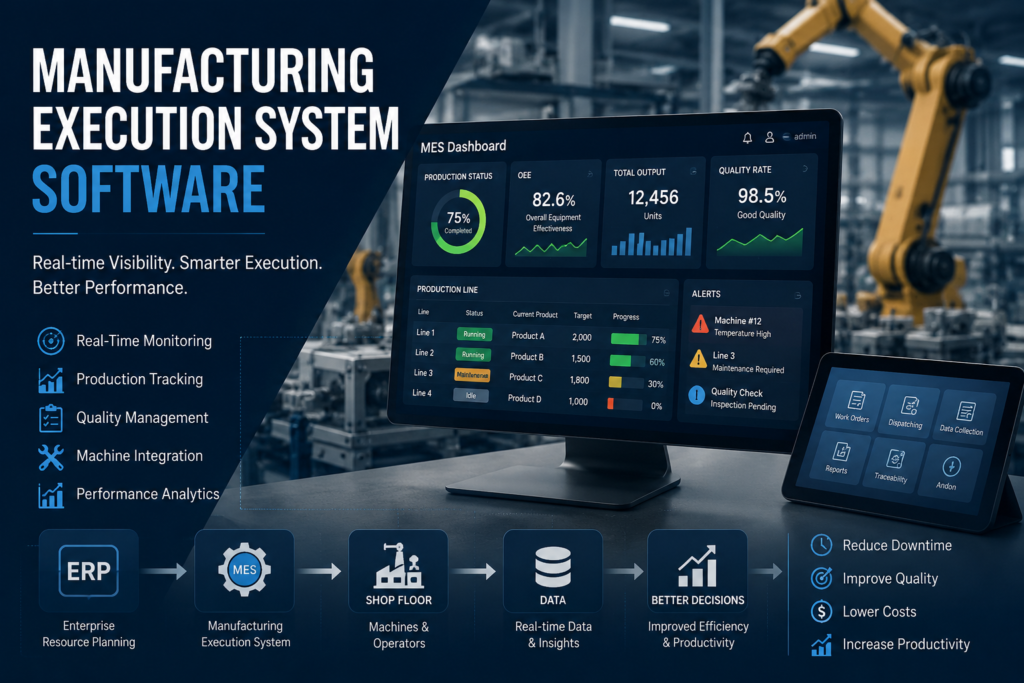
Table of Contents
What Is an MES System and Why Does Manufacturing Need It?
Every manufacturer eventually hits the same wall. Spreadsheets cannot keep up with a growing product mix. Paper travelers get lost between work centers. Supervisors spend their mornings chasing down yesterday’s numbers instead of planning today’s production. The MES system exists to remove that wall. It sits between your enterprise resource planning system and the actual machines and operators on the floor, turning raw activity into a live, accurate picture of what is happening right now. This guide walks through what this software actually does, how it differs from the tools you may already own, what a strong implementation looks like, and how to avoid the mistakes that cause so many MES projects to underdeliver. By the end you will have a practical framework for evaluating an MES platform and a realistic view of what it takes to get value from it.
What Manufacturing Execution System Software Actually Does
At its core, the system captures data from the shop floor as work happens and uses that data to guide, track, and report on production. Instead of relying on an operator writing numbers on a clipboard at the end of a shift, the system records cycle times, scrap counts, machine states, and material consumption as events occur. This real time visibility is the single biggest difference between a plant running on such software and one running on spreadsheets and paper.
The Manufacturing Enterprise Solutions Association originally defined eleven core functions that a true MES should cover, including resource allocation, scheduling, dispatching, document control, data collection, labor management, process management, maintenance management, quality management, product tracking, and performance analysis. Not every implementation needs all eleven on day one, but understanding this framework helps buyers see past marketing language and evaluate whether a vendor’s software genuinely covers the operational ground it claims to cover.
The international standard known as ISA 95 places MES platforms at what is often called Level 3 of the automation hierarchy, sitting between enterprise planning systems above it and the programmable controllers and sensors on the plant floor below it. This positioning matters because it explains why manufacturing execution system software is not a replacement for your ERP and not a replacement for your machine controls. It is the connective layer that translates business orders into shop floor instructions and translates shop floor reality back into information the business can act on.
Core Features to Look For in an MES Platform
When you start comparing vendors, feature lists can look nearly identical on paper. The difference shows up in depth and in how well features integrate with each other rather than functioning as isolated modules.
Production scheduling and dispatching should let planners sequence work orders based on real capacity rather than theoretical capacity, accounting for changeovers, tooling availability, and labor skills. A strong platform will let a scheduler see the impact of a rush order on the rest of the week before committing to it.
Real time data collection is the backbone of any credible system. This includes automated data capture from PLCs and sensors where possible, along with structured manual entry screens for steps that still require a human to confirm. The goal is accuracy without slowing the operator down.
Quality management functionality should support in process inspections, statistical process control, nonconformance tracking, and corrective action workflows, all tied back to the specific batch, lot, or serial number involved. This is what makes traceability possible when a customer complaint or a regulatory audit arrives months later.
Genealogy and traceability features record exactly which raw material lots, which machine, and which operator touched a given unit of finished product. In regulated industries such as medical devices, aerospace, and food production, this feature alone can justify the cost of these systems.
Performance monitoring and overall equipment effectiveness reporting turn raw machine data into the metrics that matter, including availability, performance, and quality, so plant leaders can see exactly where downtime and waste are concentrated instead of guessing.
Integration capability determines whether your platform becomes the single source of truth or just another disconnected island. Look for proven connectors to common ERP platforms, PLM systems, and machine protocols rather than vague promises of open architecture.
Manufacturing Execution System Software Versus ERP
This is one of the most common points of confusion for buyers new to the category, and it deserves a direct answer because it repeatedly shows up in search results as a related question.
Enterprise resource planning software manages the business side of manufacturing. It handles purchasing, financials, sales orders, and high level material requirements planning. ERP tells you what needs to be built and roughly when it needs to be built by, but it was never designed to track a machine cycle that lasts ninety seconds or an operator scanning a barcode every few minutes.
MES software manages the execution side. It takes the work order that ERP releases and turns it into detailed shop floor instructions, then captures everything that happens during production and reports it back. Where ERP thinks in days and weeks, the MES system thinks in minutes and seconds.
The two systems are meant to work together rather than compete. A manufacturer that tries to force an ERP system to do the job of this software usually ends up with clunky workarounds, delayed data, and supervisors who stop trusting the numbers because they never reflect what actually happened on the floor.
Benefits Manufacturers See After Adopting an MES Platform
The business case for manufacturing execution system software becomes clearer once you look past the feature list and toward outcomes.
Shorter cycle times are one of the most consistently reported benefits. When operators know exactly what to build next and supervisors can spot a bottleneck the moment it forms rather than at the end of the shift, work simply moves faster through the plant.
Reduced work in process inventory follows naturally once scheduling and dispatching are driven by real capacity data instead of estimates. Plants stop overproducing at one station just to keep it busy, which frees up cash that was previously tied up sitting on the floor.
Fewer defects and less scrap result from tighter quality controls built directly into the production sequence, catching problems at the station where they occur rather than downstream where rework is far more expensive.
Better labor utilization comes from visibility into which stations are understaffed and which are overstaffed at any given moment, letting supervisors move people before a bottleneck turns into a missed shipment.
Audit ready compliance is a major benefit for regulated manufacturers, since traceability records that used to take days to assemble from paper logs can be generated in minutes directly from the system.
Faster decision making happens because plant leaders are no longer waiting for tomorrow’s report to understand today’s problem. Dashboards built into a modern MES platform update as events happen.
How to Choose the Right MES Software for Your Plant
Selecting this type of system is not a one size fits all decision, and the right choice depends heavily on your industry, your existing technology stack, and the complexity of your production processes.
Start by mapping your actual pain points before you look at a single demo. A discrete manufacturer struggling with changeovers has very different priorities than a process manufacturer struggling with batch genealogy. Vendors are very good at demonstrating strengths, so walking in with a clear list of your own problems keeps the evaluation honest.
Consider deployment model carefully. Cloud based MES software has become the dominant choice for many mid sized manufacturers because it reduces upfront infrastructure cost and speeds up rollout, while on premises deployments still make sense for plants with strict data residency requirements or unreliable connectivity.
Evaluate configurability against customization. Highly configurable manufacturing execution system software lets you adjust workflows without custom code, which matters enormously at upgrade time. Heavily customized systems can feel perfect on day one and become a maintenance burden two years later when the vendor releases a new version.
Check integration track record with your specific ERP and machine environment rather than trusting a generic compatibility claim. Ask for reference customers running the same ERP platform you use and talk to them directly about how the integration actually performed.
Look closely at the user interface that operators will use every day. A system with a clean tablet interface will get adopted on the floor. A system that requires operators to memorize codes and navigate confusing menus will get abandoned in favor of the whiteboard, no matter how powerful the backend reporting is.
Factor in total cost of ownership rather than license price alone. Implementation services, training, ongoing support, and the cost of future upgrades all belong in the comparison, since the cheapest license on paper is sometimes the most expensive system over five years.
Implementation Best Practices for MES Software
Buying the right MES software is only half the challenge. How it gets implemented determines whether it becomes a daily tool the plant relies on or an expensive system that quietly falls out of use.
Start with a pilot line rather than a plant wide rollout. Choosing one representative production line lets the team work out configuration issues, train a smaller group of operators, and demonstrate early wins before asking the whole facility to change how it works.
Involve operators from day one rather than designing workflows in a conference room without floor input. The people who will use these systems every shift can spot practical problems that a project team sitting in an office will never anticipate.
Clean your master data before go live. Bill of materials errors, incorrect routings, and outdated work center definitions will undermine even the best software, since the system can only be as accurate as the data feeding it.
Set realistic timelines that account for change management, not just technical configuration. Plants that treat implementation as a pure IT project consistently underestimate how long it takes people to trust and adopt a new way of working.
Define success metrics before launch so the organization can measure real impact rather than relying on anecdotes. Cycle time, scrap rate, on time delivery, and overall equipment effectiveness are common baseline metrics worth tracking before and after rollout.
Plan for phased functionality rather than trying to activate every module simultaneously. Getting core data collection and scheduling solid first, then layering in quality management and advanced analytics later, produces a far more stable rollout than an all at once approach.
Common Mistakes Companies Make With MES Software
Even strong manufacturing execution system software can underdeliver when a handful of avoidable mistakes creep into the project.
Treating the project as purely technical rather than organizational is one of the most damaging mistakes. Software alone does not change behavior on the floor. Supervisors need to actively coach operators through new workflows, and leadership needs to visibly use the new data in daily meetings or the old habits will quietly return.
Underinvesting in training leaves operators guessing at features instead of confidently using them, which slows adoption and produces bad data that undermines trust in the entire system.
Skipping the pilot phase and rolling out to every line at once multiplies every configuration mistake across the whole plant simultaneously, turning a small fixable issue into a facility wide disruption.
Ignoring data quality issues from legacy systems means importing bad routings and incorrect standards directly into the new system, guaranteeing that early reports will be wrong and eroding confidence before the software has a fair chance to prove itself.
Choosing MES software based on price alone, without weighing configurability, support quality, and integration strength, often leads to a system that fits today’s needs but cannot scale as the business grows.
Failing to assign a dedicated internal owner leaves the system without a champion once the implementation team moves on, and systems without an owner slowly drift out of alignment with how the plant actually operates.
MES Software Across Different Industries
The core value of this software stays consistent across industries, but the priorities shift depending on what is being made.
Discrete manufacturers producing automobiles, electronics, or machinery typically prioritize changeover efficiency, work instruction accuracy, and traceability down to the individual serial number, since a single defective component can trigger a costly recall.
Process manufacturers in chemicals, pharmaceuticals, and food production prioritize batch genealogy, recipe management, and regulatory documentation, since a mislabeled batch or a broken cold chain can create serious safety and compliance consequences.
Medical device and pharmaceutical manufacturers operate under some of the strictest documentation requirements in industry, making electronic batch records and validated audit trails a core requirement rather than a nice to have feature within their MES platform.
Consumer packaged goods manufacturers tend to prioritize speed and changeover efficiency because product lines rotate quickly and margins are thin, so any minutes lost to a slow changeover directly affect profitability.
The Future of Manufacturing Execution System Software
The system continues to evolve well beyond its original role as a data collection layer. Artificial intelligence is increasingly built directly into scheduling engines, allowing systems to recommend optimal sequencing based on patterns the software identifies in historical performance rather than relying purely on rules a planner configured manually.
Predictive maintenance capabilities are becoming standard rather than optional, using sensor data to flag equipment likely to fail before it actually stops the line, shifting maintenance from a reactive activity to a planned one.
Cloud native architecture is reshaping how quickly manufacturers can deploy and scale such software across multiple sites, replacing the lengthy on premises rollouts that used to take a year or more with configurations that can go live in a matter of weeks.
Tighter integration with the industrial internet of things means this type of system increasingly pulls data directly from connected sensors and equipment without manual entry, improving both accuracy and the speed at which decisions can be made.
Frequently Asked Questions
What is MES software used for?
Manufacturing execution system software is used to capture real time data from the shop floor and use it to guide, track, and report on production activities from the moment a work order is released until the finished product is complete.
How is MES software different from ERP?
ERP manages business level planning such as purchasing and high level scheduling, while MES software manages the detailed execution of production on the floor, translating work orders into shop floor instructions and reporting real time results back.
Is this type of software worth the investment for a small manufacturer?
Many small and mid sized manufacturers see strong returns from the platform through reduced scrap, shorter cycle times, and better labor utilization, especially with cloud based options that lower upfront cost compared to traditional on premises systems.
How long does it take to implement manufacturing execution system software?
Implementation timelines vary widely depending on plant complexity and the number of integrations required, but a well planned pilot line rollout can often go live within a few months, with full facility rollout following in phases afterward.
Can MES software integrate with existing machines?
Most modern MES systems can connect to programmable logic controllers and industrial sensors through standard protocols, though older equipment sometimes requires additional hardware or middleware to bridge the connection.
What industries benefit most from this software?
Discrete manufacturing, pharmaceuticals, medical devices, food production, and automotive all see significant benefit, though the specific features that matter most vary by regulatory requirements and production style.
Does an MES platform replace the need for supervisors?
No, manufacturing execution system software gives supervisors better visibility and faster information so they can make quicker decisions, but it does not replace the judgment and floor presence that experienced supervisors provide.
What is the biggest reason MES implementations fail ?
Treating the rollout as a purely technical project rather than an organizational change effort is the most common reason implementations underdeliver, since operator adoption ultimately determines whether the data collected is accurate and useful.
Should a manufacturer choose cloud based or on premises MES software?
Cloud based MES software generally suits manufacturers wanting faster deployment and lower upfront cost, while on premises deployments still make sense for facilities with strict data residency rules or unreliable internet connectivity.
How do you measure success after implementing MES platforms?
Success is best measured against baseline metrics captured before go live, typically including cycle time, scrap rate, on time delivery performance, and overall equipment effectiveness, tracked consistently in the months following rollout.
Conclusion
Manufacturing execution system software has moved from a nice to have tool for large enterprise plants to a practical necessity for manufacturers of nearly every size. The plants seeing the biggest returns are not necessarily the ones with the most expensive software, but the ones that chose a system matching their actual operational needs and implemented it with real attention to training, data quality, and floor level adoption. If you are evaluating the technology for the first time or replacing a system that never delivered on its promise, focus less on the length of the feature list and more on how well the software fits the way your plant actually runs. That fit, more than any single feature, determines whether this software category becomes the operational backbone of your plant or another system nobody trusts.
Key Takeaways
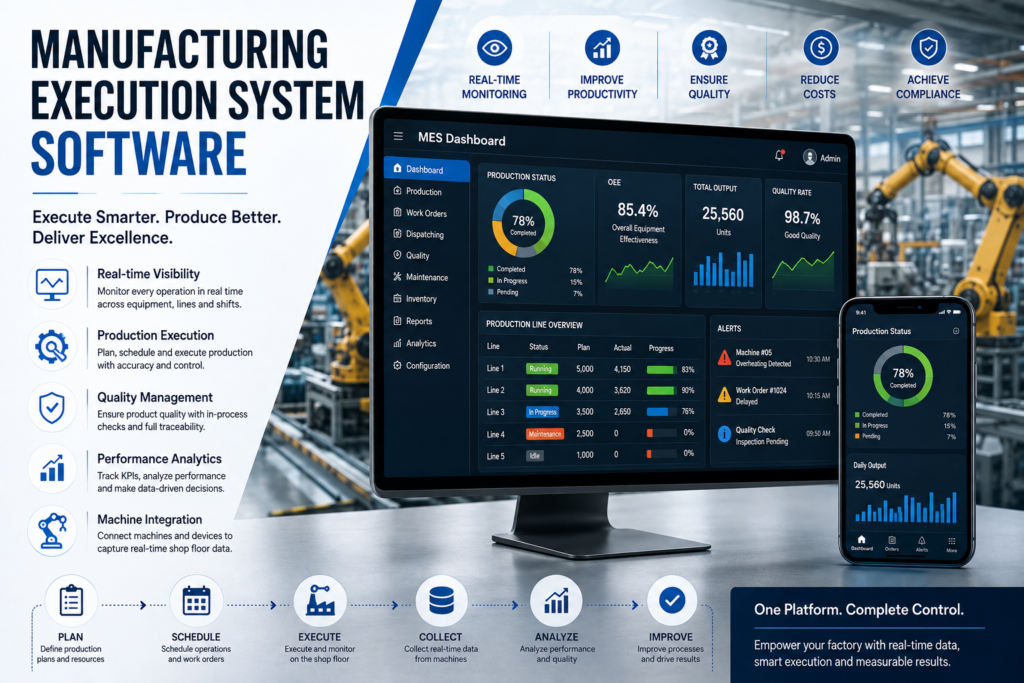
These systems sit between ERP and the shop floor, translating business orders into production instructions and turning real time floor activity into usable data.
The strongest systems cover the core functions defined by the MESA framework, including scheduling, dispatching, quality management, and traceability, rather than offering a narrow slice of functionality.
Choosing the right platform depends on mapping actual pain points first, then evaluating configurability, integration strength, and total cost of ownership rather than license price alone.
Implementation success depends far more on training, data quality, and operator adoption than on the software itself, which is why a pilot line approach consistently outperforms a plant wide rollout on day one.
The future of manufacturing execution system software is increasingly shaped by artificial intelligence driven scheduling, predictive maintenance, and deeper industrial internet of things connectivity.