Discover proven Product Hunt launch strategies for SaaS teams covering pre launch prep timing hunter selection and post launch growth tactics
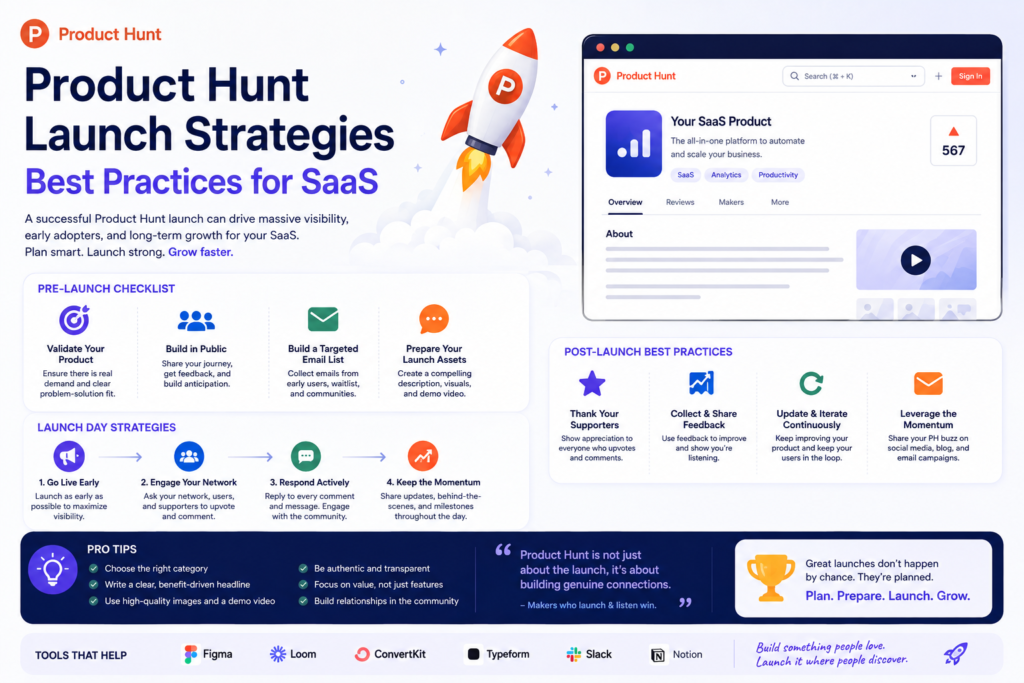
Table of Contents
Product Hunt Launch Strategies Best Practices for SaaS Companies
Launching on Product Hunt can feel like rolling the dice, but the SaaS companies that consistently land in the top five products of the day are not relying on luck. They are following a structured process built around community trust, timing, and momentum.
A strong Product Hunt launch can send a meaningful spike of qualified traffic to a SaaS product, generate early user signups, produce valuable feedback, and create backlinks and social proof that compound for months afterward.
A weak or rushed launch, on the other hand, often results in a handful of upvotes, a few comments, and no lasting impact on growth.
This guide walks through the product hunt launch strategies that experienced SaaS teams use on Product Hunt, the best practices that separate a top ranked launch from a forgettable one, and the common mistakes that quietly sabotage otherwise promising Product Hunt listings.
Whether this is a first launch or a relaunch after lessons learned, the goal here is to give founders and marketers a complete, actionable framework they can execute with confidence.
What a Successful Product Hunt Launch Actually Looks Like
Before diving into tactics, it helps to define what success on Product Hunt actually means for a SaaS business, because the definition shapes every decision made throughout the Product Hunt launch process. Some teams treat a top three finish as the only acceptable outcome, while others care more about the quality of signups and the conversations generated in the comments. For most SaaS companies, a genuinely successful launch produces three outcomes at once: a meaningful volume of targeted traffic that converts into trial signups or demo requests, direct qualitative feedback from real users who are willing to publicly engage with a new product, and a durable content and backlink asset that continues to drive discovery long after launch day ends. Chasing the badge alone, without thinking about what happens to the visitors who land on the page, is one of the most common reasons a launch looks good on the surface but fails to move the business forward.
Building a Pre Launch Strategy That Sets Up Momentum
Momentum on Product Hunt is earned in the weeks before launch day, not created on the day itself. The most effective pre launch strategy starts by building an audience that already knows the product exists and is emotionally invested in seeing it do well. This typically involves teasing the launch on relevant SaaS communities, personal social profiles, and existing customer channels, without asking for upvotes directly, since Product Hunt’s guidelines and community norms discourage explicit vote solicitation. Instead, successful teams focus on storytelling: sharing the problem the product solves, behind the scenes development stories, and early access previews that make people curious enough to want to be there on launch morning. Building a dedicated waitlist or beta group in the four to six weeks before launch gives a founder a warm audience of people who are genuinely excited rather than people who feel obligated to click a button.
Another critical piece of pre launch preparation is studying how Product Hunt’s algorithm and community actually reward products. Upvotes matter, but so does the velocity and diversity of engagement, meaning comments from a wide range of accounts, the quality of the discussion in the thread, and how quickly early momentum builds after the product goes live. Teams that understand this design their pre launch outreach around getting a diverse group of genuinely interested people ready to visit, comment, and engage authentically the moment the listing goes live, rather than a single burst of votes from one narrow network.
Choosing the Right Launch Date and Time
Timing decisions are among the most underestimated product hunt launch strategies for SaaS companies, and they can determine how much visibility a Product Hunt listing receives before it even goes live. Product Hunt runs on a daily cycle that resets at midnight Pacific time, and competition for attention varies significantly by day of the week. Tuesday, Wednesday, and Thursday are generally considered the strongest days because user activity is high and there is enough competitive density to gain visibility without going head to head against the heaviest hitting launches that often cluster around Monday. Launching too early in the day maximizes the amount of time available to accumulate votes and comments, since the ranking is cumulative across the full day, while a late launch can permanently limit a product’s visibility no matter how strong the product itself is.
Seasonality also matters more than many SaaS teams expect. Launching during major industry conferences, holiday weeks, or immediately after a widely publicized launch from a much larger company can dilute attention. Reviewing the upcoming Product Hunt calendar for competing launches in a similar category, and avoiding a direct collision with another well resourced SaaS product, is a simple step that meaningfully improves the odds of a strong finish.
Crafting a Product Page That Converts Visitors Into Users
The product page itself is where curiosity turns into action, and it deserves the same level of craft as a landing page built for paid acquisition. The tagline needs to communicate the core value proposition in a handful of words, avoiding vague marketing language in favor of a specific, benefit driven statement that tells a visitor exactly what problem the SaaS product solves. The first image or gallery item carries enormous weight, since it is often the only visual a scrolling user sees before deciding whether to click through, so it should show the actual product interface in action rather than an abstract illustration or stock photo.
A short, well produced demo video consistently outperforms a wall of screenshots, because it lets visitors experience the product’s core workflow in under a minute without requiring them to imagine how the pieces fit together. The written description should focus on outcomes rather than features, explaining what changes for a user once they adopt the product, while still including enough specificity about functionality that a technical audience can quickly assess fit. Maker comments, the first post from the founder underneath the listing, set the tone for the entire discussion thread, so using that space to share the origin story, the specific problem being solved, and an invitation for feedback tends to generate far richer engagement than a generic thank you message.
Selecting a Hunter and Building Early Advocates
Many SaaS founders overestimate how much a well known hunter changes the outcome of a launch, but there is still real value in having an early advocate with an established Product Hunt reputation post the product, since their existing followers receive a notification and their credibility can lend the listing an initial trust signal. That said, self hunting has become increasingly common and works well when the founder already has some presence in the Product Hunt community and a genuine personal network willing to engage. What matters more than the hunter’s follower count is whether they, or the founder, can speak authentically about the product in the comments throughout the day, since generic or absent engagement is easy for the community to spot and tends to suppress momentum.
Beyond the hunter, cultivating a small group of early advocates who are willing to try the product before launch day, leave a thoughtful first comment, and answer questions from other visitors adds credibility that a founder alone cannot generate. These advocates should genuinely understand the product, not just be asked to leave a positive comment, because vague or clearly coordinated praise is easy to identify and can undermine trust in the thread.
Executing Launch Day Without Losing Momentum
Launch day itself is less about broadcasting and more about sustained, responsive engagement. The founder or core team should be present in the comments from the first minute, responding to every question and piece of feedback with genuine detail rather than short acknowledgments, since active back and forth conversation is one of the strongest signals of a healthy, organic launch. Spacing out outreach to different audience segments throughout the day, rather than sending every notification at once, helps sustain a steady stream of new visitors and comments instead of one spike followed by silence.
It also helps to have a lightweight real time dashboard or simple tracking sheet to monitor ranking position, traffic sources, and signup conversion throughout the day, so the team can identify which channels are actually driving qualified visitors and double down on those rather than continuing to push channels that generate clicks but no meaningful engagement. Teams that treat launch day as a single event to survive, rather than an ongoing conversation to actively manage, consistently underperform their potential.
Common Mistakes SaaS Teams Make on Product Hunt
The most damaging mistake is treating Product Hunt as a traffic stunt disconnected from the rest of the growth strategy, launching without a clear plan for what happens to visitors after they land on the page, whether that is a trial signup flow, an onboarding sequence, or a dedicated landing page built specifically for the audience arriving from the listing. A second common mistake is explicit or implicit vote begging, which the Product Hunt community notices quickly and which can trigger removal of votes or, in serious cases, suspension of the listing. Weak visual assets are another frequent issue, since a blurry screenshot or a generic stock graphic signals low effort and reduces the click through rate from the homepage feed regardless of how strong the underlying product actually is.
Many SaaS teams also underestimate the importance of responding to negative or skeptical comments with patience and specificity rather than defensiveness, since how a founder handles pushback in public is itself a trust signal that influences undecided visitors reading the thread. Finally, some teams disappear entirely once launch day ends, missing the opportunity to convert the traffic spike into a lasting content asset by following up with new users, publishing a retrospective, and continuing to reference the launch in later marketing.
Turning a Launch Into Long Term Growth
The value of a Product Hunt launch should not be measured only by the ranking achieved on launch day within the Product Hunt homepage feed. The backlink from the Product Hunt listing itself carries authority that benefits organic search visibility over time, and the comments thread often becomes a searchable, indexed source of genuine user feedback that future prospects discover independently. SaaS teams that get the most long term value from their launch treat it as the beginning of a broader campaign, repurposing the demo video for other channels, turning maker comments into blog content, and reaching out individually to the most engaged commenters to invite them into a more structured feedback loop or early customer program.
Analyzing signup data from the launch, including which acquisition channel drove the highest quality trials, provides insight that can inform paid acquisition and content strategy for months afterward. In this sense, the most effective product hunt launch strategies are not designed purely to win a single day, but to generate an asset and a dataset that a SaaS marketing team can continue to draw on well after the initial spike in traffic fades.
Key Takeaways
- A successful Product Hunt launch depends far more on preparation in the weeks before launch day than on tactics executed during the day itself.
- Building a genuinely interested audience ahead of time, rather than asking for votes directly, produces stronger and more durable engagement.
- Tuesday through Thursday, launched early in the day, generally offers the best balance of visibility and manageable competition.
- The product page, including the tagline, first image, and demo video, deserves the same craft as a dedicated landing page.
- Active, detailed engagement in the comments throughout launch day is one of the strongest signals of a healthy, organic listing.
- The most common mistakes are treating the launch as disconnected from the broader funnel, vote begging, and disappearing after launch day ends.
- Long term value comes from treating the launch as the start of a campaign, not a single day event.
Frequently Asked Questions
What is the best day to launch a SaaS product on Product Hunt?
Tuesday, Wednesday, and Thursday tend to offer the strongest combination of high user activity and manageable competition, since Monday often attracts the most heavily resourced launches. Launching as early as possible after the daily reset at midnight Pacific time gives a product the maximum window to accumulate votes and comments.
Do I need a well known hunter to succeed on Product Hunt?
No. Self hunting has become common and works well as long as the founder has some existing presence in the community and a genuine network willing to engage authentically. What matters most is active, detailed participation in the comments rather than the follower count of whoever posts the listing.
How early should a SaaS team start preparing for a Product Hunt launch?
Most successful teams begin building awareness and a warm audience four to six weeks before launch day, using teasers, behind the scenes content, and a waitlist to create genuine interest rather than relying solely on last minute outreach.
Is it against the rules to ask people to upvote a Product Hunt listing?
Explicitly asking for upvotes goes against community norms and Product Hunt’s guidelines, and can result in votes being removed or the listing being penalized. The more effective and compliant approach is to share the story and invite genuine feedback rather than requesting a specific action.
What makes a Product Hunt product page convert well?
A specific, benefit driven tagline, a first image or gallery item that shows the real product interface, and a short demo video that lets visitors experience the core workflow all significantly improve conversion from the Product Hunt homepage feed into the product’s own signup flow.
How important are comments during launch day?
Comments are one of the strongest signals of a healthy, organic launch. Founders who respond quickly and in detail throughout the day tend to sustain momentum far better than those who post the listing and go quiet.
Can a Product Hunt launch help with long term SEO for a SaaS company?
Yes. The backlink from the listing itself carries authority, and the comments thread is typically indexed and searchable, meaning it can continue to surface in search results and influence prospects long after the launch day traffic spike has passed.
What should happen immediately after a Product Hunt launch ends?
Effective teams follow up individually with the most engaged commenters, analyze which channels produced the highest quality signups, and repurpose launch assets like the demo video and maker comments into other marketing content rather than moving on immediately.
Should a SaaS company launch on Product Hunt more than once?
A relaunch, often tied to a major new feature or version, can work well if the original launch underperformed or if enough time and product change has occurred to justify fresh community attention, but repeated launches without meaningful updates tend to see diminishing engagement.
What is the single biggest mistake SaaS founders make on Product Hunt?
Treating the launch as an isolated event disconnected from the rest of the growth funnel, without a clear plan for what happens to visitors once they arrive, is the mistake that most consistently turns a promising launch into a missed opportunity.
Conclusion
A strong Product Hunt launch is never the result of a single clever trick executed on launch morning. It is the outcome of weeks of deliberate preparation, a product page crafted with the same care as a paid landing page, and a founder or team genuinely present in the conversation throughout the day. The SaaS companies that consistently benefit from Product Hunt are the ones that treat the platform as one part of a larger growth strategy rather than a one time event, using the momentum, feedback, and backlink authority generated by the launch to fuel growth long after the badge has been earned. By following the product hunt launch strategies and best practices outlined here, from pre launch audience building through post launch follow up, any SaaS team can approach their next launch with a clear, repeatable process instead of hoping for the best.