Explore real examples of crm software used by small businesses and enterprises to understand which crm fits your sales workflow best.
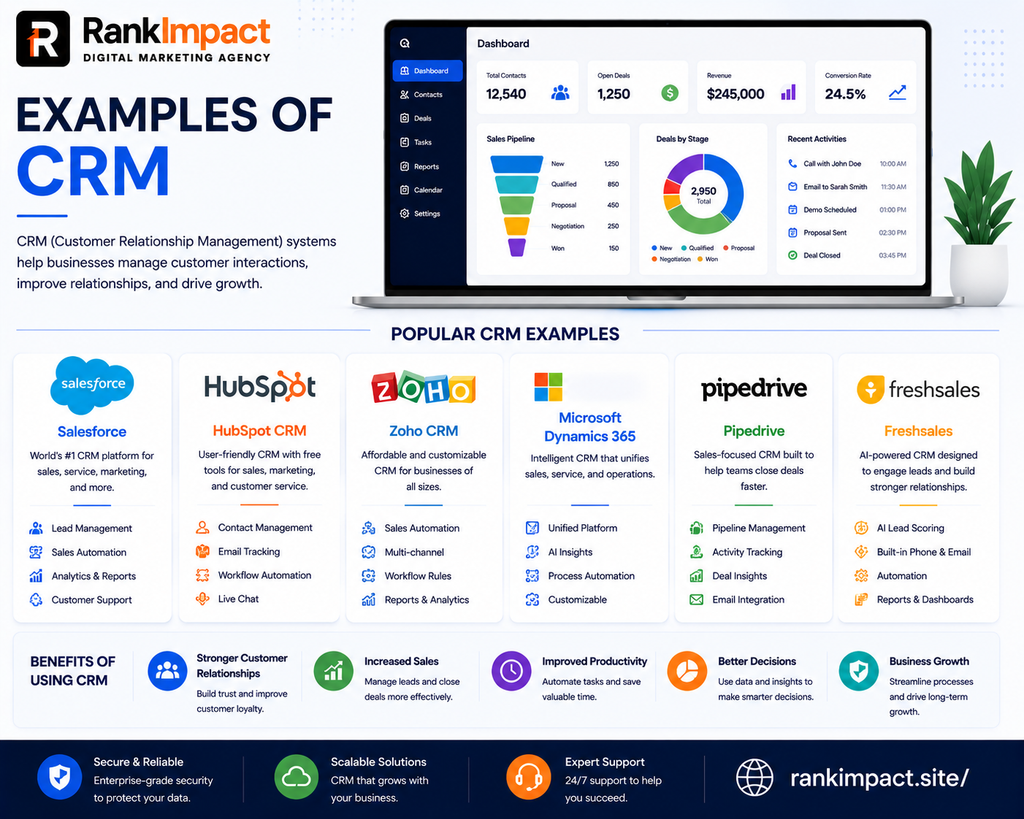
Table of Contents
What Is a CRM and Why Examples Matter More Than Definitions
A customer relationship management system is software that stores every interaction a business has with a lead or a customer in one place. That includes emails, phone calls, meeting notes, deal stages, support tickets, and purchase history. Instead of a sales rep digging through a personal inbox to remember what was discussed three weeks ago, everything sits inside one shared record.
Definitions only go so far though. Reading that a CRM tracks customer data does not tell you what that looks like inside a real sales team or a real support department. That is why looking at concrete CRM examples is more useful than reading another dictionary style explanation. When you see how a 5 person agency uses a CRM differently than a 500 person enterprise, the value of the software becomes obvious in a way no definition can capture.
Throughout this guide you will see specific platforms, specific industries, and specific workflows so you can map the examples to your own situation rather than guessing which features actually matter.
Popular CRM Software Examples Worth Knowing
Salesforce
Salesforce is often the first name people think of when they hear the word CRM, and for good reason. It is used by large enterprises across banking, healthcare, retail, and technology because it can be customized almost endlessly. A sales director at a mid size manufacturing company might use Salesforce to build a custom pipeline with 12 deal stages, automated approval workflows for discounts, and dashboards that update in real time for the executive team. The tradeoff is cost and complexity, since smaller teams often find Salesforce more powerful than they actually need.
HubSpot CRM
HubSpot built its reputation on offering a genuinely useful free CRM tier, which made it the default starting point for startups and small marketing teams. A 3 person marketing agency might use HubSpot to track every lead that comes through a contact form, automatically tag them based on which service page they visited, and trigger a follow up email sequence without writing a single line of code. HubSpot pairs especially well with content marketing and inbound lead generation because its CRM, email tool, and landing page builder all live under one roof.
Zoho CRM
Zoho is a strong example for cost conscious businesses that still want a wide feature set. An ecommerce brand selling through multiple channels might use Zoho to unify orders from a website, a marketplace, and social commerce into a single customer timeline, then use built in AI scoring to flag which leads are most likely to convert. Zoho tends to attract businesses in Asia, the Middle East, and small to mid size operations globally because of its pricing and its bundled suite of business apps beyond just the CRM.
Pipedrive
Pipedrive was designed by salespeople for salespeople, and it shows in how visual and pipeline focused the interface is. A real estate agency might use Pipedrive to move a buyer through stages like inquiry, property viewing, offer submitted, and closed, with reminders automatically set for follow up calls at each stage. Teams that value simplicity over deep customization often prefer Pipedrive because there is very little setup friction before a rep can start using it productively.
Freshsales by Freshworks
Freshsales is a common example for support heavy businesses that already use Freshdesk, since the two products share data seamlessly. A SaaS company offering a subscription product might use Freshsales to see a customer’s support ticket history right next to their renewal date, which helps the account manager decide whether to offer a discount before a churn risk becomes a lost customer.
Zendesk Sell
Zendesk Sell is a strong example of a CRM built with customer service teams in mind. A software company running both sales and support through Zendesk might use Sell to hand off a closed deal directly into the support queue with full context already attached, so the new customer never has to repeat their story to a different department.
Monday CRM
Monday CRM is popular among teams that already use Monday for project management and want their sales pipeline to live in the same visual, color coded boards. A digital marketing agency managing both client projects and new business leads might run both functions inside Monday so account managers and sales reps are working from the same dashboard language.
Copper CRM
Copper is built specifically to integrate with Google Workspace, which makes it a favorite among businesses that live inside Gmail and Google Calendar all day. A consulting firm might use Copper so that every email sent from Gmail is automatically logged against the right client record without any manual data entry, saving hours of admin work every week.
Insightly
Insightly is often cited as a strong CRM example for businesses that need project management bundled with sales tracking. A creative studio taking on client work might use Insightly to move a lead from proposal to signed contract, then automatically convert that record into a project with tasks and milestones, keeping sales and delivery connected instead of siloed.
Nimble
Nimble stands out as a social selling focused CRM example, pulling in social media profile data automatically when a new contact is added. A freelance consultant or solo founder might use Nimble to keep a lightweight but socially informed view of prospects without needing an enterprise grade tool.
CRM Examples by Business Type
CRM Examples in Small Business
Small businesses usually need speed of setup over depth of customization. A local dental clinic might use a simple CRM purely to track appointment reminders and patient follow ups, while a boutique retail shop might use one mainly to remember customer preferences for personalized recommendations. In both cases, the CRM is less about complex pipelines and more about not letting a repeat customer fall through the cracks.
CRM Examples in Enterprise Companies
Large enterprises tend to run CRM systems that connect to dozens of other tools, from ERP systems to marketing automation platforms to custom internal databases. A national insurance provider might use a CRM to manage millions of policyholder records, route claims to the right regional office automatically, and maintain compliance logs for every customer interaction, since regulatory requirements make audit trails essential.
CRM Examples in B2B Sales
B2B sales cycles are often long and involve multiple decision makers, so CRM examples in this space usually center around deal tracking across weeks or months. A software vendor selling to other businesses might use a CRM to track every stakeholder involved in a single deal, log every demo call, and set automated reminders so no prospect goes quiet without a nudge.
CRM Examples in B2C and Retail
B2C businesses tend to use CRM data for personalization at scale rather than one to one relationship management. An online fashion retailer might use CRM data to segment customers by purchase frequency and send targeted promotions to those who have not bought in 60 days, turning customer data directly into revenue recovery.
CRM Examples by Function and Type
Operational CRM Examples
Operational CRMs focus on automating day to day processes like lead capture, follow ups, and service tickets. A call center might use an operational CRM to automatically log every inbound call, assign it to the right agent, and trigger a satisfaction survey once the call ends.
Analytical CRM Examples
Analytical CRMs are built around turning customer data into insight. A subscription box company might use analytical CRM reporting to identify which customer segment has the highest lifetime value, then shift marketing spend toward acquiring more customers who match that profile.
Collaborative CRM Examples
Collaborative CRMs focus on sharing customer information across departments. A telecom provider might use a collaborative CRM so that sales, billing, and technical support all see the same customer record, preventing the frustrating experience of a customer repeating their issue to three different teams.
Real World CRM Use Case Examples
A growing SaaS startup might use its CRM to track free trial signups, automatically flag accounts that have not logged in for 5 days, and trigger a personalized email from customer success before that trial silently expires. A wedding photography business might use a CRM to manage every inquiry from initial contact to signed contract to final gallery delivery, ensuring no bride or groom feels forgotten during a stressful planning season. A B2B logistics company might use its CRM to track every shipment related conversation with a client, so account managers can spot patterns like repeated delivery delays before the client brings it up themselves.
These examples matter because they show the CRM is rarely just a sales tool. It becomes the operational memory of the entire customer relationship, used by marketing, sales, support, and even finance teams depending on how it is configured.
Best Practices When Learning From CRM Examples
Choosing a CRM based on examples alone is not enough. The businesses in the examples above succeeded because they followed a few consistent practices. They kept their data clean by removing duplicate contacts regularly. They trained their entire team on the same workflow instead of letting each rep build their own system. They connected the CRM to other tools like email and calendars so data entry happened automatically instead of manually. And they revisited their CRM setup every few months to remove unused fields and stages that had accumulated clutter over time.
Common Mistakes Businesses Make With CRM Systems
The most common mistake is picking a CRM based on brand recognition rather than actual team workflow. A small team choosing an enterprise grade tool like Salesforce often ends up paying for features nobody uses. Another frequent mistake is treating the CRM as optional, where some reps log their activity and others do not, which destroys the reliability of the data for everyone. Businesses also commonly fail to customize deal stages to match their actual sales process, instead using generic default stages that do not reflect reality. Finally, many companies never review their CRM data for accuracy, letting outdated contact information and duplicate records pile up until the system becomes more of a liability than an asset.
How to Choose the Right CRM Based on These Examples
Start by identifying which example above most closely matches your business size and sales complexity. A solo founder or very small team should lean toward simple, fast to set up tools rather than enterprise platforms. A business with a long, multi stakeholder sales cycle should prioritize deal tracking depth over flashy extras. A support heavy business should weight integration with existing helpdesk tools more heavily than pipeline visuals. Matching the CRM to your actual daily workflow, rather than to the most popular name in the market, is what separates a tool that gets used from one that gets abandoned within 3 months.
Frequently Asked Questions
What are some real examples of CRM software?
Some of the most widely used CRM examples include Salesforce, HubSpot CRM, Zoho CRM, Pipedrive, Freshsales, Zendesk Sell, Monday CRM, Copper, Insightly, and Nimble. Each one serves a slightly different type of business, from small startups to large enterprises.
What is the simplest example of a CRM for a small business?
HubSpot CRM and Pipedrive are commonly recommended examples for small businesses because they require minimal setup time and offer straightforward pipeline tracking without overwhelming complexity.
Can you give an example of how a CRM is used in daily business operations?
A common example is a sales rep logging a call directly into the CRM after speaking with a lead, setting an automatic reminder for a follow up in 3 days, and the system notifying a manager if that follow up does not happen on time.
What industries commonly use CRM software?
Real estate, healthcare, retail, financial services, software companies, logistics, and hospitality are among the industries with the highest CRM adoption, since all of them depend heavily on tracking ongoing customer relationships.
Is a CRM only useful for sales teams?
No, modern CRM examples show usage across marketing, customer support, and even finance departments, since all of these teams benefit from a shared view of customer history and communication.
What is the difference between operational and analytical CRM examples?
Operational CRM examples focus on automating everyday tasks like follow ups and ticket routing, while analytical CRM examples focus on turning stored customer data into reports and insights that guide strategic decisions.
How do I know which CRM example fits my business?
Match the example to your team size, sales cycle length, and existing tools. A short sales cycle with a small team benefits from simple tools, while a long enterprise sales cycle benefits from deeper customization and reporting.
What is a common mistake businesses make when adopting a CRM?
A frequent mistake is choosing a CRM based on its popularity rather than its fit for the actual sales process, which often leads to low adoption rates among the sales team.
Are free CRM examples worth using?
Yes, free tiers like the one offered by HubSpot CRM are genuinely usable for small teams and are a common starting point before a business decides it needs more advanced features.
Do CRM examples differ between B2B and B2C companies?
Yes, B2B CRM examples usually emphasize long deal tracking across multiple stakeholders, while B2C CRM examples usually emphasize customer segmentation and personalized marketing at scale.
Conclusion
Looking at real examples of CRM software makes the entire category easier to understand than any dictionary style definition ever could. From Salesforce serving large enterprises to Pipedrive serving lean sales teams, the right choice depends entirely on your business size, your sales complexity, and the daily workflow your team already follows. The businesses that get the most value are the ones that pick a tool matching their actual process, keep their data clean, and treat the CRM as a shared source of truth rather than an optional add on. Use the examples in this guide as a starting point, then test the 2 or 3 platforms that most closely resemble your own situation before making a final decision.
Key Takeaways
Salesforce, HubSpot, Zoho, Pipedrive, Freshsales, Zendesk Sell, Monday CRM, Copper, Insightly, and Nimble are among the most recognized CRM examples across different business sizes.
Small businesses generally benefit from simpler tools while enterprises benefit from deeper customization and integration.
CRM usage spans far beyond sales, touching marketing, support, and even finance teams.
Operational, analytical, and collaborative CRM types serve different core purposes inside a business.
The most common CRM mistakes involve poor adoption, dirty data, and choosing a tool based on popularity instead of fit.
Matching a CRM example to your specific sales cycle and team size matters more than choosing the most well known brand.