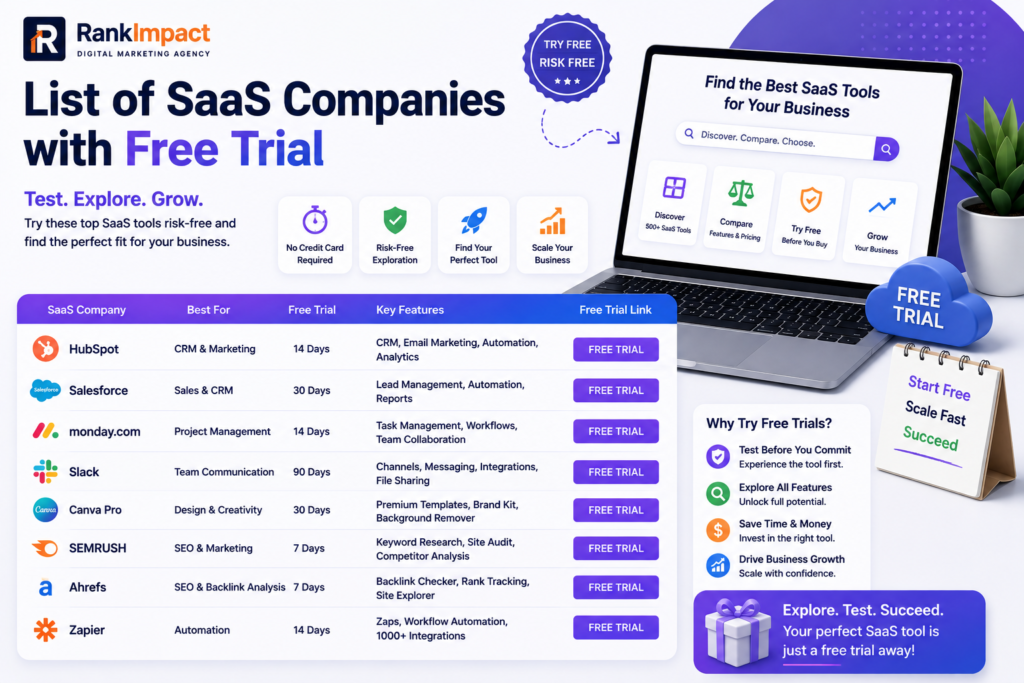
Explore a smart list of SaaS companies with free trial options by category, plus tips to test tools right and avoid surprise charges.
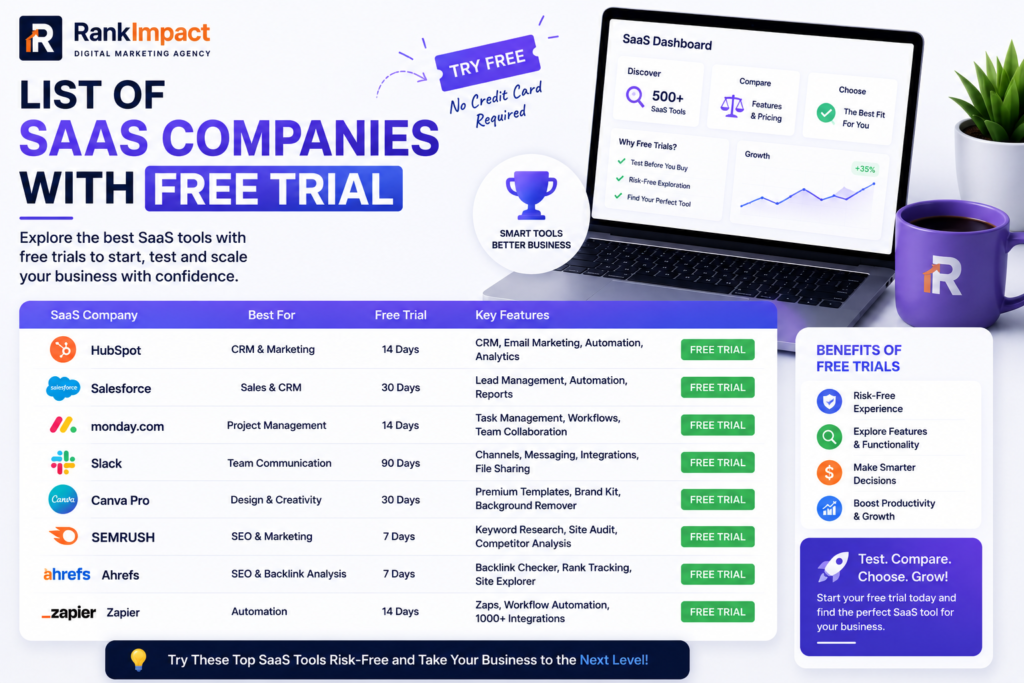
Table of Contents
Why a Free Trial-First Approach Saves You Time and Money
Choosing new software for your business is always a bit of a gamble, and that’s exactly why smart teams lean on trial periods before they commit a single rupee or dollar to a subscription. If you’ve been hunting for a reliable list of SaaS companies with free trial options, you already know the real challenge isn’t finding one or two tools it’s finding the right ones for your specific workflow, budget, and team size, without wasting weeks testing software that was never going to fit in the first place.
This guide breaks down exactly how to evaluate free trials, which categories of SaaS tools are worth testing first, and how to build your own shortlist of SaaS platforms so you never sign a contract you regret.
What Free Trial Actually Means in the SaaS World
Not every free trial is created equal, and this is the first thing most buyers overlook. Some SaaS companies offer a genuine no credit card required trial, letting you explore the full product for a set number of days without any financial commitment. Others require billing details upfront and quietly convert you into a paying customer the moment the trial window closes, unless you cancel manually.
There’s also a growing category of freemium plans, which aren’t technically trials at all they’re permanently free tiers with limited features, designed to hook you before nudging you toward an upgrade. When you’re comparing a list of SaaS companies with free trial offers, it helps to sort them into these three buckets credit card free trials, credit card required trials, and freemium plans. Each one carries a different level of risk and a different buying psychology behind it, and understanding which bucket a tool falls into will save you from surprise charges and awkward cancellation emails later.
Why Free Trials Matter More Than Ever for SaaS Buyers
The SaaS market has become so crowded that nearly every category CRM, project management, email marketing, accounting now has dozens of credible competitors. A polished landing page or a slick demo video can’t tell you whether a tool actually fits your team’s daily rhythm. Only hands-on usage can. This is why free trials have become the deciding factor for most B2B software purchases, especially among small businesses and solo founders who don’t have the budget for a failed six-month contract.
Free trials also reveal things that sales calls conveniently gloss over: how steep the learning curve really is, whether customer support responds quickly, how the tool performs with your actual data volume, and whether your team will genuinely adopt it or quietly go back to spreadsheets. A well-structured trial period is, in many ways, the closest thing to a test drive that software buying offers.
Top Categories of SaaS Companies Offering Free Trials
CRM and Sales Tools
Customer relationship management platforms are almost always trial-friendly because vendors know sales teams need to see their own pipeline data inside the tool before they’ll trust it. Popular options in this space typically offer 14 to 30 day trials with full feature access, since the goal is to get your sales reps hooked on the workflow before the invoice arrives.
Project Management and Collaboration
Tools built for task tracking, sprint planning, and team collaboration usually combine a permanent free tier with a time limited trial of premium features. This hybrid model works well for teams that want to test advanced reporting or automation without losing access to basic functionality once the trial ends.
Email Marketing and Automation
Because email marketing platforms are billed based on subscriber count, most offer trials that cap the number of contacts or emails you can send rather than limiting the number of days. This lets you evaluate deliverability, template design, and automation workflows before your list grows large enough to trigger a paid tier.
Accounting and Finance Software
Financial software vendors tend to be more cautious with trials, often requiring a business email and sometimes a card on file, since these platforms handle sensitive data. Still, most reputable accounting SaaS companies offer at least a two-week window to test invoicing, reconciliation, and reporting features before asking for payment.
Design and Creative Tools
Design platforms frequently use freemium models rather than strict trials, allowing unlimited use of core features while gating advanced export options, brand kits, or collaboration seats behind a paywall. This approach suits freelancers and small studios who may only need the basics.
Communication and Customer Support
Live chat, helpdesk, and communication SaaS tools typically offer generous trials often 14 days or more because support software adoption depends heavily on how well it integrates into an existing team’s daily habits.
AI and Automation Platforms
The newest wave of SaaS products, built around AI writing, image generation, and workflow automation, often bundles a limited number of free credits rather than a fixed trial period. This usage based approach lets you judge output quality directly instead of racing against a countdown clock.
How to Build Your Own List of SaaS Companies With Free Trial Offers
Rather than relying on a single roundup article, the smartest approach is to build a shortlist tailored to your actual needs. Start by listing the three or four core problems your business needs software to solve this quarter not next year, not eventually, but right now. From there, search for category leaders and challengers separately, since newer SaaS companies often offer longer or more generous trials to compete with established players.
Cross-check each candidate’s trial terms directly on their pricing page rather than trusting third party summaries, because trial lengths and conditions change frequently as companies experiment with their funnels. Keep a simple spreadsheet with columns for trial length, card requirement, key features unlocked during the trial, and your own notes after testing. This turns a vague roundup of SaaS companies offering free trials into a structured evaluation you can actually act on.
It also pays to look beyond the obvious market leaders. The most-recommended tool in any category isn’t automatically the best fit for your specific team size, budget, or technical comfort level it’s simply the one with the biggest marketing budget. Smaller or newer SaaS vendors often compete on generosity, offering longer trial windows, more responsive onboarding calls, and fewer feature restrictions during the test period precisely because they need to win your trust without an established brand name to lean on. Give at least one lesser-known challenger a fair shot alongside the household names on your shortlist.
Common Mistakes Businesses Make When Evaluating Free Trials
One of the most frequent mistakes is starting the trial clock before the team is actually ready to test the product seriously. A 14 day trial that begins during a busy launch week is functionally useless, because nobody has time to explore it properly. Always start a trial only when you can dedicate real hours to testing within the first few days.
Another common error is testing tools in isolation rather than against your real workflow. Uploading sample data or using a demo account rarely reveals the friction points that show up once your actual files, contacts, or projects are involved. Whenever possible, import real non sensitive data during the trial so you can judge performance honestly.
Many buyers also forget to test customer support during the trial itself. Sending a genuine support question in the first week tells you far more about response time and service quality than any marketing page ever will. Finally, a surprising number of businesses simply forget to cancel trials that required a card upfront, leading to charges for software nobody ended up using a mistake that’s entirely avoidable with a calendar reminder set on day one.
Best Practices for Getting the Most Out of a SaaS Free Trial
Treat every trial like a short, structured project rather than casual browsing. Assign a specific person on your team to lead the evaluation, set clear success criteria before you start, and involve at least one end user who will actually work inside the tool daily, not just a manager reviewing dashboards. Document your findings as you go instead of relying on memory once the trial period ends.
It also helps to test the tool under realistic conditions rather than best case scenarios. If you’re evaluating email marketing software, send a real campaign to a segment of your list. If you’re testing project management software, run one actual sprint through it rather than creating a handful of sample tasks. This kind of real-world stress testing is the single best predictor of whether a tool will still be useful six months after purchase.
How to Compare Multiple SaaS Trials Without Losing Track
When you’re testing several SaaS tools with free trial access at the same time, organization becomes just as important as the evaluation itself. Set a shared calendar with clear start and end dates for each trial, and block time specifically for hands on testing rather than letting trials expire in the background. Score each tool against the same criteria ease of use, feature depth, pricing transparency, support quality, and integration options so your comparisons stay objective rather than based on which interface simply felt nicer on a given day.
It’s also worth involving more than one stakeholder in the decision, especially for tools that will be used company wide. A finance lead and a sales rep may weigh the same CRM very differently, and catching that disagreement during the trial phase is far cheaper than discovering it after a year-long contract is signed.
A simple scoring sheet, even a basic one with five or six weighted criteria, removes a surprising amount of bias from the final decision. Assign each stakeholder a score out of ten for every tool on every criterion, then average the results at the end of the trial window. This small amount of structure prevents the loudest voice in the room from quietly deciding the outcome, and it gives you a paper trail to refer back to if the chosen tool underperforms a few months later and you need to revisit why it was picked in the first place.
Key Signals That a SaaS Company’s Free Trial Is Trustworthy
Not every trial offer is designed with the customer’s best interest in mind, so it helps to know what a genuinely trustworthy trial looks like. Transparent pricing pages that clearly state whether a card is required, straightforward cancellation processes that don’t hide the option behind multiple menus, and responsive support during the trial period itself are all strong positive signals. On the other hand, trials that require extensive personal information upfront, bury cancellation instructions, or pressure you with countdown timers and urgency messaging are worth approaching with extra caution.
Reading recent user reviews on independent platforms, rather than testimonials on the company’s own site, can also reveal whether other buyers have had trouble canceling or been surprised by charges after their trial ended.
Is It Ever Worth Skipping the Free Trial Entirely?
Not every SaaS purchase needs a full trial cycle before you commit, and knowing when to skip one can actually save time. If the tool is inexpensive, month to month with no lock in contract, and easy to cancel within minutes, the cost of getting it slightly wrong is low enough that a trial adds more friction than value. In these cases, reading a handful of recent, detailed user reviews and simply signing up for the paid plan directly can be faster than running a formal two-week evaluation.
The calculation changes sharply, though, once a tool touches core business operations accounting, customer data, or anything your team will depend on daily. For these higher stakes categories, skipping the trial almost always costs more in the long run than the few days it takes to test properly, because migrating away from an entrenched, poorly fitting tool later is far more disruptive than a short delay upfront. As a rule of thumb, the more integrated a tool will become with your existing systems and daily workflow, the more a hands on trial period is worth insisting on before you sign anything long term.
How Free Trials Fit Into a Smarter SaaS Buying Process Overall
Free trials work best as one part of a broader evaluation process, not the entire process on their own. Before you even open a signup form, it helps to define your must-have features versus nice-to-have features, set a realistic budget ceiling, and identify which existing tools the new software needs to integrate with. Walking into a trial with this groundwork already done means you’re testing whether a specific tool solves a well defined problem, rather than wandering through a dashboard hoping something useful jumps out.
Once the trial period wraps up, resist the urge to make a snap decision purely based on which tool felt the smoothest to click through. Revisit your original requirements list, compare each contender against it honestly, and factor in longer term considerations like pricing tiers at scale, the vendor’s update history, and how responsive their team was throughout the trial. A tool that feels slightly less polished on day one but has transparent pricing and genuinely helpful support often outperforms a flashier competitor once you’re a paying customer for the long haul.
FAQ: List of SaaS Companies With Free Trial Option
1. What is the best way to find a list of SaaS companies with free trial offers in a specific category?
Search directly within your category for example CRM free trial or email marketing free trial and cross reference results with independent review sites, since pricing pages change often and third party roundups can go stale quickly.
2. Do all SaaS companies require a credit card for their free trial?
No. Many companies offer no card required trials specifically to reduce signup friction, while others require billing details upfront to auto-convert trial users into paying customers. Always check the pricing page before signing up.
3. How long do most SaaS free trials typically last?
Most trials run between 7 and 30 days, with 14 days being the most common window across CRM, project management, and communication tools.
4. Can I extend a SaaS free trial if I need more time?
Sometimes. Many SaaS companies will extend a trial if you contact their sales or support team directly and explain that you need more time to properly evaluate the product, especially for higher tier plans.
5. What’s the difference between a free trial and a freemium plan?
A free trial is time limited and usually converts to a paid plan automatically or expires entirely, while a freemium plan is permanently free but restricted in features, storage, or usage volume.
6. Is it safe to use a business free trial for testing with real customer data?
Generally yes for reputable vendors, but always check their data security certifications and privacy policy first, particularly for finance, HR, or healthcare related SaaS tools handling sensitive information.
7. How many SaaS trials should I test before making a decision?
Two to four serious contenders is usually the sweet spot enough to compare meaningfully without spreading your evaluation time so thin that none of them get a fair test.
8. What happens if I forget to cancel a SaaS free trial?
If the trial required a card upfront, you’ll typically be billed automatically once it ends, so setting a calendar reminder a day or two before expiration is the safest habit to build.
9. Are free trials different for enterprise-level SaaS companies?
Yes, enterprise SaaS vendors often replace open self serve trials with guided demos or sandboxed pilot programs run alongside a sales representative, rather than a simple signup and explore model.
10. Where can I keep track of multiple SaaS free trials at once?
A simple shared spreadsheet with trial start dates, end dates, card requirements, and evaluation notes works well, though some teams use dedicated subscription tracking tools once they’re managing several trials regularly.
Conclusion
Building a dependable list of SaaS companies with free trial access isn’t about collecting as many names as possible it’s about matching the right tools to the problems your business actually has, testing them under real conditions, and staying organized enough to make a confident decision before any trial quietly turns into a bill. The businesses that get the most value out of trial periods are the ones that treat them as a structured evaluation process, not a casual browse. Do that consistently, and you’ll spend far less time switching software and far more time actually using it to grow.
Key Takeaways
- Free trials fall into three categories no card required, card-required, and freemium and each carries different risk levels.
- Test tools using real workflows and real data, not sample accounts, to get an honest sense of fit.
- Involve the actual end users of the software in the evaluation, not just decision makers.
- Track trial start and end dates carefully to avoid unexpected charges.
- Compare a shortlist of two to four serious contenders rather than testing too many tools at once.
- Contact support during the trial itself as a real test of service quality.
- A trustworthy SaaS company will always make cancellation simple and pricing transparent.