+92 318 3068833 Get Free Audit

SaaS Content Marketing 11 Strategies That Drive Signups

Learn how SaaS content marketing turns organic traffic into trial signups and revenue, with strategies, formats, and mistakes to avoid in 2026.
SaaS content marketing

Why SaaS Content Marketing Decides Who Wins the Category

Every SaaS category eventually reaches a point where the product features start to look the same across vendors. When that happens, the company that wins is usually the one that has built the most trust with buyers before they ever request a demo. That trust is built almost entirely through content.

SaaS content marketing is the practice of creating and distributing educational, product aware, and decision stage content that moves software buyers from first discovering a problem to signing up for a trial and eventually becoming a paying customer. Unlike traditional content marketing, it has to serve a longer, more research heavy buying journey, support both marketing and product teams, and speak to technical and non technical stakeholders at the same time.

Research from First Page Sage’s 2026 benchmarking study found that cite index=59-3 B2B SaaS SEO produces an average return of 702 percent with a break even period of roughly seven months when measured over a three year window cite. Few other marketing channels for software companies come close to that kind of long term payoff, which is exactly why so many SaaS founders and marketing leaders treat content as a core growth lever rather than a side project.

This guide breaks down what SaaS content marketing actually involves, how it differs from generic B2B content, and the specific strategies, formats, and workflows that experienced SaaS marketers rely on to turn blog traffic into trial signups and expansion revenue.

What Makes SaaS Content Marketing Different From Regular Content Marketing

On the surface, SaaS content marketing looks like any other form of content marketing. There is still keyword research, blog writing, distribution, and measurement. The differences show up in the details, and they matter enormously if you want your content to actually move the needle.

First, SaaS products are usually intangible and often hard to explain in a single sentence, which means content has to do more educational heavy lifting before a prospect understands why the product matters. Second, the buying committee for most B2B software purchases includes several people with different priorities, so a single blog post rarely closes a deal on its own. Third, SaaS is a subscription business, so content does not stop mattering after the sale. Onboarding guides, feature announcements, and best practice articles all influence whether a customer renews or churns.

Finally, SaaS competes in some of the most saturated search results on the internet. Review sites like G2 and Capterra, along with a handful of large incumbent brands, dominate the top rankings for many high intent software queries. Winning visibility requires content that is more specific, more technically credible, and better structured than what a generic content marketing playbook produces.

Understanding Buyer Intent Across the SaaS Funnel

The single biggest mistake in SaaS content marketing is treating every piece of content the same way. Buyers at different stages of the funnel need fundamentally different information, and mapping content to each stage is what separates a strategy that generates leads from one that just generates traffic.

Top of funnel content targets people who are aware of a problem but not yet aware that software can solve it. These readers respond well to broad educational guides, industry trend pieces, and original research. Middle of funnel content targets people actively comparing approaches or evaluating categories of tools, so templates, calculators, and how to guides tend to perform best here. Bottom of funnel content targets people who already know they need a solution and are deciding between specific vendors, which is where comparison pages, alternative pages, and detailed case studies do the heavy lifting.

A useful rule of thumb shared by several experienced SaaS content strategists is that alternative and versus pages, while lower in search volume than broad educational terms, convert at dramatically higher rates because the searcher is closer to a buying decision. Mapping your keyword list to funnel stage before you write a single article prevents the common trap of producing dozens of top of funnel posts that generate traffic but never move anyone toward a purchase.

Building a SaaS Content Marketing Strategy That Aligns With Product Led Growth

Many SaaS companies now rely on product led growth, where the product itself, often through a free trial or freemium tier, does much of the selling. This changes what a content strategy needs to accomplish. It is no longer enough to generate a lead for a sales team to call. Content also needs to drive self serve signups and help users discover value inside the product quickly.

A strong SaaS content marketing strategy for a product led company typically includes use case pages that show specific job to be done scenarios, in app content and empty states that guide new users, and comparison content that helps prospects self select the right plan or feature set without a sales conversation. It also means writing content with clear, low friction calls to action, since a reader who is ready to act should be able to start a trial in one click rather than fill out a lengthy contact form.

The strategy also needs a clear point of view on what the company stands for. Buyers increasingly choose vendors that demonstrate real expertise rather than generic best practices they could find anywhere. Original research, proprietary benchmarks, and opinionated frameworks consistently outperform recycled listicle content because they cannot be easily replicated by competitors or summarized away by an AI answer engine.

Keyword Research and Topical Authority for SaaS Companies

Keyword research for SaaS content marketing works best when it starts from the product rather than from a generic keyword tool. Begin by listing every job your product helps a user accomplish, every problem it solves, and every alternative approach a buyer might currently be using instead of your software. From there, expand into adjacent topics your audience cares about, even if those topics are not directly about your product category.

Topical authority is built by covering a subject area exhaustively rather than publishing isolated posts. A useful structure is the pillar and cluster model, where a broad pillar page targets a competitive head term and a set of supporting articles targets the specific long tail questions related to that topic, all linked back to the pillar. This structure signals to search engines that your site has depth on the subject, and it also gives readers a clear path to explore related content, which improves engagement metrics.

Keyword difficulty matters more for newer SaaS sites than for established ones. A site with limited domain authority should prioritize lower competition, high commercial intent terms first to build early wins, then gradually move into more competitive head terms as authority grows. Chasing the highest volume keyword in a category before your site has earned enough authority is one of the most common ways early stage SaaS content programs waste months of effort.

Content Formats That Work Best for SaaS Companies

Blog posts remain the backbone of most SaaS content marketing programs, but the format mix matters. Comparison and alternative pages convert exceptionally well because they meet buyers at the exact moment they are deciding between vendors. Customer case studies build the kind of social proof that no amount of self authored content can replicate, especially when they include specific, measurable outcomes.

Webinars deserve more attention than many SaaS marketers give them. Industry data shows that cite index 58 4 a majority of marketers report webinars generate higher quality leads than any other content format cite, largely because live formats create a level of engagement and trust that static content cannot match. Templates, calculators, and other interactive tools also perform well because they let prospects experience the value of your thinking, and often your product, before they ever sign up.

Changelogs and product update posts are frequently overlooked, but they matter for retention. Existing customers who understand what is new and why it matters are less likely to churn, and public changelogs also give your sales and customer success teams fresh material to share with prospects and accounts. A well rounded SaaS content marketing plan blends acquisition focused formats with retention focused formats rather than treating content purely as a top of funnel activity.

Structuring a SaaS Content Team and Workflow

Small SaaS companies often start with a single content marketer wearing several hats, while larger organizations build dedicated teams that include a content strategist, writers or freelancers, an SEO specialist, and a designer or video producer. Regardless of team size, the workflow that separates high performing programs from stagnant ones is consistency paired with a documented editorial process.

Every piece of content should move through a clear pipeline that includes topic research and validation, an outline or brief that captures search intent and key points to cover, a draft reviewed by someone with subject matter expertise, and a publishing checklist that covers onpage SEO, internal linking, and calls to action. Subject matter review is especially important in SaaS, where technical inaccuracies or outdated feature claims damage credibility with the exact audience you are trying to win over.

Publishing frequency matters less than most marketers assume, but consistency does not. Research on SaaS blogging performance found that cite index=56 2 roughly 98 percent of top performing SaaS companies maintain an active blog, and those publishing eleven or more posts per month see over three times more traffic than less frequent publishers cite. The takeaway is not that every company needs to publish daily, but that a realistic, sustainable cadence beats sporadic bursts of content followed by long gaps.

SEO Best Practices for SaaS Content Marketing

Technical SEO issues quietly undermine a surprising number of otherwise strong SaaS content programs. Product subdomains that are not properly blocked from crawling can waste crawl budget on thin, session specific pages instead of your marketing content. Duplicate pricing pages, parameter heavy URLs, and slow loading, JavaScript heavy marketing sites all suppress rankings that good content should otherwise earn.

On page optimization for SaaS content should focus on matching search intent precisely, using clear heading structure, and answering the core question a reader is searching for within the first few sentences of the page. This approach also happens to align well with how featured snippets and AI generated answer summaries pull information, since both favor content that states a direct answer early and supports it with detail afterward.

Backlinks remain one of the strongest ranking factors for competitive SaaS keywords. Analysis from uSERP found that <cite index=”65 6″>pages ranking in the top position have nearly four times as many backlinks as lower ranked pages on the same results page</cite>. For SaaS companies, earning links through original research, tool based content, and genuine expert commentary tends to outperform outreach campaigns built around generic guest posts.

Using SaaS Content Marketing to Reduce Churn and Grow Existing Accounts

Most conversations about SaaS content marketing focus entirely on acquisition, but some of the highest-leverage content a SaaS company can produce is aimed at existing customers. Onboarding guides, feature deep dives, and workflow-specific tutorials directly influence whether a new customer reaches the point of realizing value, often called the activation moment, before their trial ends or their first invoice arrives.

For customers already using the product, ongoing educational content helps drive feature adoption, which is one of the strongest predictors of renewal. A customer who only uses a fraction of what your software offers is far more likely to churn than one who has adopted several core workflows. Content that proactively teaches underused features, shares customer success patterns, and explains new releases keeps the product relevant in the customer’s daily work.

This retention focused content also supports expansion revenue. Case studies and use case content that show what is possible at a higher tier or with an add on feature give customer success and sales teams natural material for upsell conversations, without content ever feeling like a hard sell.

Common SaaS Content Marketing Mistakes to Avoid

The most common mistake is writing generic, surface level content that could have been published by any company in any industry. Buyers evaluating software are usually more sophisticated than the average reader, and shallow content erodes trust rather than building it. The second most common mistake is ignoring bottom of funnel content in favor of broad, high volume topics that look impressive in traffic reports but rarely convert.

Many SaaS teams also underestimate how much technical SEO and site structure affect content performance, publishing excellent articles on a site that search engines struggle to crawl efficiently. Others treat content as a one time project rather than a compounding asset, failing to update older posts as the product evolves, which leaves outdated screenshots, pricing, and feature claims live on the site for years.

A final and increasingly important mistake is failing to differentiate content from what a search engine or AI assistant can already summarize. As more informational queries get resolved directly within search results and AI tools, purely explanatory content loses value over time. The content that continues to earn attention going forward is content built on original data, direct product expertise, and a clear point of view that cannot be easily reproduced by a machine summarizing publicly available information.

Measuring the ROI of SaaS Content Marketing

Traffic is the easiest metric to track and the least useful one on its own. A mature SaaS content marketing program measures performance against business outcomes, including trial signups attributed to organic content, content influenced pipeline, and the eventual conversion of content sourced leads into paying customers. Tools like Google Search Console and product analytics platforms can be connected to track a reader’s path from first blog visit to signup.

Assisted conversions matter as much as last click conversions in SaaS, since the buying journey often spans weeks or months and touches multiple pieces of content before a decision is made. Attribution models that only credit the final touchpoint will consistently undervalue top and middle of funnel content, leading teams to defund the very content that built initial awareness and trust.

For retention focused content, the relevant metrics shift to feature adoption rate, time to activation, and support ticket deflection. A knowledge base article that reduces support volume for a common question delivers measurable value even though it will never appear in a traditional marketing attribution report, which is why SaaS content ROI should be evaluated holistically across acquisition, activation, and retention rather than through a single funnel top metric.

Real World SaaS Content Marketing Examples

Several well known SaaS companies illustrate what disciplined content marketing looks like in practice. Ahrefs built its blog around detailed, data backed guides written by practitioners who use the product daily, which reinforces product credibility while ranking for competitive SEO terms. HubSpot has long relied on a massive library of educational content across every stage of the funnel, supported by tools and templates that generate leads independent of the blog itself.

Smaller, more focused companies show that scale is not a prerequisite for strong results. Niche SaaS products have grown organic traffic significantly by publishing narrowly focused, highly specific content that speaks directly to a well defined audience rather than trying to compete for broad, generic terms. The common thread across every successful example is specificity. Companies that describe exactly who a piece of content is for, and exactly what problem it solves, consistently outperform companies producing broader, less targeted material aimed at everyone and no one in particular.

Frequently Asked Questions

What is SaaS content marketing?

SaaS content marketing is the process of creating and distributing content, such as blog posts, comparison pages, case studies, and guides, to attract, convert, and retain customers for a software as a service business. It differs from general content marketing because it must support a longer buying cycle, multiple stakeholders, and both new customer acquisition and existing customer retention.

How is SaaS content marketing different from B2B content marketing in general?

SaaS content marketing shares many principles with broader B2B content marketing but places heavier emphasis on product education, comparison content, and post sale retention material, since SaaS revenue depends on ongoing subscriptions rather than one time purchases.

How long does it take to see results from SaaS content marketing?

Most SaaS companies begin seeing measurable organic traffic and lead generation within three to six months, though competitive terms and newer domains often take longer. Results tend to compound over time as topical authority and backlink profiles grow.

What type of content converts best for SaaS companies?

Bottom of funnel content such as comparison pages, alternative pages, and detailed case studies typically converts at the highest rate, since it targets readers who are actively evaluating vendors and close to a purchase decision.

How often should a SaaS company publish blog content?

Consistency matters more than raw frequency. A sustainable cadence that a team can maintain long term, whether that is weekly or a few times a month, generally outperforms sporadic bursts of publishing followed by long gaps.

Should SaaS companies create content for existing customers, not just prospects?

Yes. Onboarding guides, feature updates, and educational content for current users directly influence activation, feature adoption, and renewal rates, making retention focused content one of the highest leverage areas of a content program.

How does SEO fit into a SaaS content marketing strategy?

SEO and content marketing are deeply intertwined for SaaS companies, since organic search is typically the largest source of long term, low cost traffic. Keyword research, technical site health, and backlink acquisition all directly affect how much value a content program generates.

What are the biggest mistakes SaaS companies make with content marketing?

Common mistakes include publishing generic content that lacks real expertise, over indexing on top of funnel topics while neglecting bottom of funnel conversion content, ignoring technical SEO issues, and treating content as a one time project instead of an asset that requires ongoing updates.

How should a SaaS company measure content marketing ROI?

ROI should be measured across the full customer lifecycle, including organic traffic, trial signups, content influenced pipeline, and retention metrics like feature adoption and support ticket deflection, rather than relying on a single top of funnel metric like page views.

Do small SaaS startups need a large content team to succeed with content marketing?

No. Many successful SaaS content marketing programs start with a single dedicated marketer or a small team, focused on a narrow set of high intent topics, before scaling up as the strategy proves itself and budget allows.

Conclusion

SaaS content marketing is no longer optional for software companies competing in crowded categories. It is the mechanism through which buyers build trust, evaluate alternatives, and ultimately decide who deserves their business, and it continues working long after the sale by driving activation and reducing churn. The companies that treat content as a disciplined, funnel aware program, backed by real subject matter expertise and sound technical execution, consistently outperform those treating it as an occasional blogging exercise. Whether you are a founder writing your first ten articles or a marketing leader scaling a mature program, the fundamentals stay the same: understand exactly who you are writing for, map content to where they are in their decision, and never stop refining what you publish as your product and market evolve.
Conclusion

SaaS content marketing is no longer optional for software companies competing in crowded categories. It is the mechanism through which buyers build trust, evaluate alternatives, and ultimately decide who deserves their business, and it continues working long after the sale by driving activation and reducing churn. The companies that treat content as a disciplined, funnel aware program, backed by real subject matter expertise and sound technical execution, consistently outperform those treating it as an occasional blogging exercise. Whether you are a founder writing your first ten articles or a marketing leader scaling a mature program, the fundamentals stay the same: understand exactly who you are writing for, map content to where they are in their decision, and never stop refining what you publish as your product and market evolve.

Key Takeaways

Effective SaaS content marketing requires mapping content to every stage of the buyer journey rather than producing generic educational posts alone. Bottom of funnel formats like comparison pages and case studies typically deliver the strongest conversion rates. Topical authority, built through a structured pillar and cluster approach, outperforms isolated, disconnected blog posts. Technical SEO health directly affects whether strong content can actually rank. Retention focused content for existing customers is often undervalued despite its direct impact on renewal and expansion revenue. Original research, proprietary data, and genuine product expertise increasingly separate content that earns lasting attention from content that gets summarized away by search engines and AI tools. Finally, ROI should be tracked holistically across acquisition, activation, and retention, not through traffic alone.
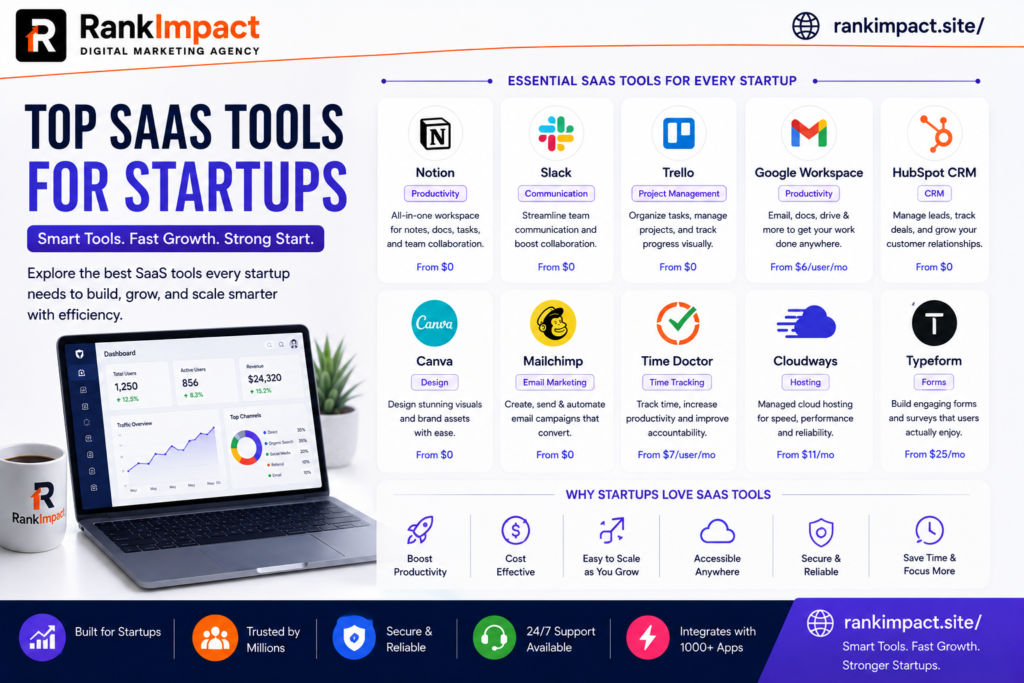
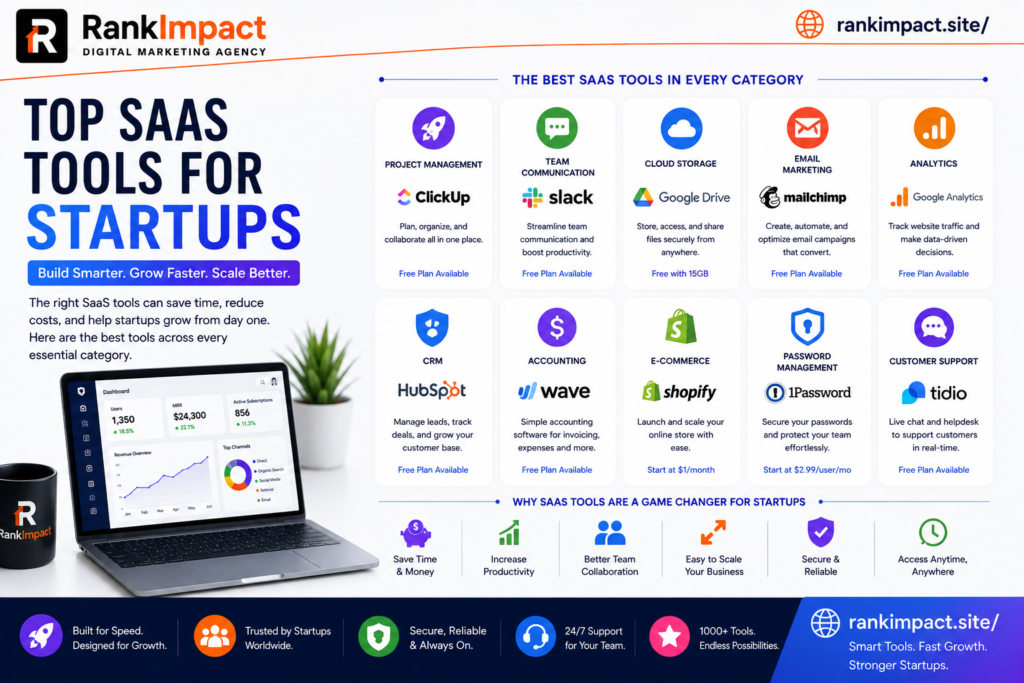
Top SaaS Tools for Startups 15 Best Picks for 2026

Discover the top SaaS tools for startups in 2026, covering CRM, finance, marketing, support, and hosting, with real free tier options for every growth stage.

top saas tools for startups

15 Top SaaS Tools for Startups to Scale Faster in 2026

Every early stage founder eventually hits the same wall. The product is live, the first customers are signing up, and suddenly there is no time left to run finance, support, marketing, and operations by hand. This is exactly where the right software stack starts to matter. Choosing the top SaaS tools for startups is not about collecting as many apps as possible. It is about picking a lean set of platforms that remove friction, save hours every week, and grow with the business instead of holding it back.

This guide walks through the categories every startup needs to cover, names specific platforms worth testing in each one, and explains how to evaluate a tool before you commit your card details to another monthly subscription. The goal is not a random directory of software. It is a practical shortlist of the top SaaS tools for startups, built around what actually moves the needle for a small team trying to reach product market fit without burning through runway on tools nobody uses after month two.

Whether you are a solo founder validating an idea or a five person team preparing for your first funding round, the categories below cover the operational backbone almost every SaaS or product led startup eventually needs. Rather than listing every possible option, this article focuses on tools with a track record of actually being adopted by small teams, not just tools that look impressive in a sales demo.

Why the Right SaaS Stack Matters More Than People Think

Founders often underestimate how much a messy tool stack costs them. Spreadsheets scattered across Google Drive, five different chat apps because nobody agreed on one, and a CRM that only half the sales team updates are not just annoying. They slow down decisions, create blind spots around cash flow, and make onboarding a new hire painful because nothing lives in one place.

A well chosen set of SaaS tools for startups solves three problems at once. First, it centralizes information so founders and managers can see what is actually happening in the business without chasing five people for updates. Second, it automates repetitive work like invoicing, lead follow up, and reporting, which frees up hours that a small team simply does not have to spare. Third, it creates a foundation that can scale. A tool that works for three people and breaks at twenty is a tool you will have to migrate away from later, and migrations are expensive in both time and morale.

The best approach is to think in categories rather than individual products. Every startup, regardless of industry, needs to cover communication, customer relationships, finance, marketing, project management, support, analytics, and hosting. Below is a breakdown of proven options in each category, along with what makes them a strong fit for early stage teams specifically, and why they consistently appear on lists of the top SaaS tools for startups across different industries.

Communication and Team Collaboration Tools

Remote and hybrid teams live or die by how well they communicate asynchronously. The right messaging and video tools keep everyone aligned without turning every question into a 30 minute meeting.

Slack remains one of the most widely adopted options for team messaging because it integrates with almost every other tool a startup already uses, from project trackers to customer support software. Its free tier is generous enough for a small team to run entirely on it before upgrading. You can review current plans directly on the Slack pricing page.

Notion has become a favorite for startups that want a single workspace for documentation, wikis, meeting notes, and lightweight project tracking. Because it replaces several standalone tools, it often ends up saving money rather than adding another line item. Details on its startup friendly pricing are available on the Notion for startups page.

Google Workspace is still the default choice for email, shared calendars, and document collaboration for a reason. It is reliable, familiar to almost every new hire, and scales cleanly from a two person team to a two hundred person company without a painful migration.

Customer Relationship Management Platforms

A CRM is often the first serious software purchase a startup makes once sales conversations move past a handful of manual emails. The mistake many founders make is jumping straight to an enterprise grade CRM before they need one.

HubSpot’s free CRM tier is a strong starting point because it covers contact management, deal tracking, and basic email tools without requiring a credit card. As the sales process matures, teams can move into paid tiers without switching platforms. You can explore what is included on the HubSpot CRM overview.

Zoho CRM is another practical option for budget conscious startups, particularly those already using other Zoho products for finance or support. Its lower entry pricing compared to some competitors makes it appealing for teams that need CRM functionality without a large monthly commitment.

Pipedrive is worth considering for startups with a sales led motion, since its pipeline visualization is built specifically around helping small sales teams move deals forward rather than managing large enterprise account hierarchies.

SaaS Content Marketing and Growth Tools

Marketing software is where many startups either overspend on tools they barely touch or underinvest and fall behind competitors who are consistently visible in search and social. A lean content marketing stack should cover email, SEO research, and social scheduling at minimum.

Mailchimp continues to be a dependable entry point for email marketing, offering automation, audience segmentation, and a free plan suitable for early stage lists. Current plan details are on the Mailchimp pricing page.

Semrush and Ahrefs are the two most established platforms for keyword research, competitor analysis, and technical SEO audits. Startups building an organic acquisition channel through blog content, much like a SaaS content marketing strategy built around search intent, typically rely on one of these two tools to identify keyword opportunities and track ranking progress over time.

Buffer offers a straightforward way to schedule and manage social posts across multiple platforms from a single dashboard, which matters when the same one or two people are handling marketing, support, and half of sales.

Finance, Accounting and Budget Control Tools

Financial visibility is non negotiable, even for a two person startup. Founders who put off proper accounting until year two often discover expensive surprises when it comes time to raise funding or file taxes.

QuickBooks Online remains the most widely used accounting platform for small businesses and startups, offering invoicing, expense tracking, and integrations with most banks and payment processors. Its scalability makes it a safe long term choice rather than something you will outgrow quickly.

Wave is a genuinely free alternative for very early stage startups that need basic invoicing and accounting without a monthly fee, making it a sensible starting point before revenue justifies a paid platform.

Stripe handles payment processing for a large share of SaaS and ecommerce startups worldwide, and its documentation and developer tools make it a practical choice even for non technical founders working with a small engineering team. Pricing and product details are available on the Stripe pricing page.

As spending on software grows, startups should also build a habit of auditing which subscriptions are actually being used each quarter, since unused licenses are one of the most common silent budget leaks in a growing SaaS stack.

Project Management and Productivity Tools

Without a shared system for tracking work, tasks live in someone’s head, in Slack threads, or in a notebook that gets lost. A lightweight project management tool prevents dropped balls as the team grows past a handful of people.

Trello’s board based interface is simple enough for non technical teams to adopt in a single afternoon, which makes it a common first project management tool for startups that are not ready for something more complex.

Asana works well for startups managing multiple projects across departments, offering timelines, dependencies, and reporting that Trello does not provide out of the box, while still remaining approachable for smaller teams.

ClickUp positions itself as an all in one workspace covering tasks, docs, and goals, and its generous free tier makes it attractive for cash conscious founders who want more functionality without an immediate spend commitment.

Customer Support and Success Platforms

How a startup handles its first hundred support tickets often determines whether early customers become advocates or churn quietly. Support tooling does not need to be complex, but it does need to be consistent.

Zendesk is a long established option for structured ticketing, live chat, and a searchable help center, making it a solid choice once support volume grows beyond what a shared inbox can handle. You can review its plans on the Zendesk pricing page.

Intercom combines live chat, help center articles, and product tours in one platform, which appeals to SaaS startups that want support and onboarding to feel connected rather than separate systems.

Help Scout is worth considering for startups that want a shared inbox style experience that still feels personal, rather than a ticket number driven workflow that can feel impersonal to early customers.

Analytics and Product Data Tools

Startups that do not measure usage tend to guess at what to build next, which is one of the most expensive mistakes a small team can make. Product analytics turns assumptions into evidence.

Google Analytics remains the default choice for website traffic analysis and is free for the volume most early stage startups generate, covering acquisition channels, behavior flow, and conversion tracking.

Mixpanel and Amplitude both specialize in product analytics, tracking how users actually move through a SaaS product rather than just website traffic. These tools are particularly useful once a startup needs to understand feature adoption and retention cohorts rather than just top of funnel numbers.

Hotjar adds a visual layer to analytics through heatmaps and session recordings, helping product and marketing teams see exactly where users hesitate or drop off on a page.

Hosting, DevOps and Security Tools

Reliable infrastructure is invisible when it works and catastrophic when it does not. Startups need hosting and security tools that scale automatically rather than requiring manual intervention every time traffic spikes.

DigitalOcean and Vercel are both popular among startups for their straightforward pricing and developer friendly deployment workflows, particularly for teams building modern web applications without a dedicated infrastructure team.

Cloudflare provides content delivery, DNS management, and basic security protection that most startups need from day one, and its free tier covers a meaningful amount of what a small site requires before any paid upgrade becomes necessary.

1Password or a similar credentials manager should be considered mandatory rather than optional, since shared logins passed around in chat messages are one of the most common and easily preventable security failures at early stage companies.

Matching SaaS Tools to Your Startup’s Growth Stage

Not every startup needs the same stack on day one, and one of the most common mistakes founders make is adopting tools built for a stage they have not reached yet. Matching software choices to where the company actually stands saves both money and onboarding time.

Thinking about the top SaaS tools for startups through the lens of company stage, rather than category alone, makes the decision process far less overwhelming. At the idea and pre revenue stage, the priority should be free tools that require no long term commitment. A founder validating a concept does not need a paid CRM or a premium analytics suite. Google Workspace, Trello, Wave, and the free tiers of Slack and Mailchimp are usually more than enough to run the business end to end at this stage.

Once a startup has its first paying customers, it typically needs to add proper accounting through QuickBooks or Stripe for payments, a real CRM like HubSpot to track a growing pipeline, and a support tool such as Help Scout to keep response times consistent as inbound volume increases.

As the team grows past ten or fifteen people, the top SaaS tools for startups at this stage usually shift toward platforms with stronger permissions, reporting, and integration depth, such as Asana for cross department project tracking, Zendesk for structured support ticketing, and dedicated product analytics like Mixpanel or Amplitude to guide roadmap decisions with real usage data instead of guesswork.

How to Choose the Right SaaS Tools for Your Startup

With so many options in every category, the decision process matters more than the specific brand name. A few principles consistently separate startups that build an efficient stack from those that end up with tool sprawl.

Start with the problem, not the product. It is tempting to adopt a tool because a competitor uses it or because it trended on a startup newsletter, but the better question is always what specific bottleneck this tool removes right now.

Favor tools with genuine free tiers over free trials when you are pre revenue. A free trial creates artificial urgency to decide before you have real usage data, while a genuine free tier lets you validate fit over weeks or months without financial pressure.

Check integration compatibility before committing. A tool that does not connect to the rest of your stack through native integrations or something like Zapier will eventually create manual work that defeats the purpose of automating in the first place.

Reassess every quarter rather than assuming a tool chosen at launch is still the right fit a year later. Startups change quickly, and a tool that fit a five person team may be the wrong choice once headcount doubles.

Talk to the team actually using the tool before renewing or expanding a subscription. Founders often make software decisions in isolation based on what looks good in a pitch deck or investor update, while the people entering data every day have the clearest view of whether a platform is genuinely saving time or just adding another login to manage. A quick five minute check in before each renewal date can surface friction points long before they show up as a churned customer or a missed deadline.

Test a tool with real data before rolling it out company wide. A trial run with actual customer records, actual invoices, or actual support tickets reveals limitations that a sales demo never will, and it is far cheaper to discover a dealbreaker during a two week pilot than after a year long contract has already been signed.

Common Mistakes Startups Make When Selecting SaaS Tools

Even experienced founders fall into predictable traps when building out their software stack. Recognizing these patterns early can save real money and time.

Buying enterprise tools too early is one of the most frequent mistakes, since features built for companies with hundreds of employees often add complexity a five person startup does not need yet, along with a price tag that does not match current revenue.

Letting different departments choose tools independently, without checking whether something already covers the need, leads to overlapping subscriptions that quietly drain the budget every month without anyone noticing until a financial review flags it.

Ignoring onboarding and training time is another common blind spot. A tool that looks powerful in a demo but takes three weeks for the team to actually adopt is not saving time, it is costing it, at least in the short term.

Skipping the cancellation step when a tool stops being used is a small habit that compounds. Startups that build a quarterly subscription audit into their routine consistently spend less on software than those that only look at their SaaS bill once a year.

Chasing every new tool that appears on a startup newsletter or a Product Hunt launch is another trap worth naming directly. Novelty is not the same as necessity, and the strongest lists of the top SaaS tools for startups tend to favor proven, well supported platforms over the newest entrant promising to disrupt an entire category overnight.

Building a Lean Stack Without Sacrificing Growth

A lean approach to software does not mean avoiding paid tools altogether. It means being deliberate about when a paid upgrade is actually justified by a real bottleneck rather than a nice to have feature. Many of the top SaaS tools for startups mentioned throughout this guide offer a natural upgrade path, which means a founder can start on a free tier, prove the value internally, and only move to a paid plan once the team is genuinely constrained by the free version.

This approach also protects runway during the earliest and most fragile period of a company’s life. Every dollar spent on a tool that sits unused is a dollar that could have extended the runway by another day, and in a startup that difference sometimes matters more than founders realize until they are staring at a shrinking bank balance a year later. Treat every new subscription as a decision that deserves the same scrutiny as a hire, because in a very real sense, a SaaS subscription is buying a small amount of capacity that a human would otherwise have to provide manually.

Frequently Asked Questions

What are the most important SaaS tools for a brand new startup?

At minimum, a new startup should cover communication, a basic CRM, accounting, and a project management tool. These four categories represent the most essential of the top SaaS tools for startups and address the operational basics that almost every early stage company needs regardless of industry.

Are there genuinely free SaaS tools for startups, or are they all trials?

Several tools mentioned in this guide, including Wave for accounting and the free tiers of Slack, Trello, and HubSpot CRM, offer real ongoing free plans rather than limited time trials, making them practical choices for pre revenue startups.

How many SaaS tools should a startup realistically use?

There is no fixed number, but most efficient early stage teams operate with somewhere between eight and fifteen core tools across all departments. Beyond that range, overlapping functionality and unused subscriptions tend to creep in.

What is the best free CRM for an early stage startup?

HubSpot’s free CRM tier is generally considered the strongest free option, since it includes contact management, deal tracking, and basic email tools without a time limit, unlike many trial based alternatives.

Should a startup choose an all in one platform or specialized tools for each function?

It depends on team size. Very small teams often benefit from all in one platforms like ClickUp or Notion that reduce the number of logins, while growing teams with specialized needs tend to get more value from best in class tools per category.

How often should a startup review its SaaS subscriptions?

A quarterly review is generally sufficient for most early stage companies. This cadence catches unused licenses and overlapping tools before they accumulate into a significant unnecessary expense.

What SaaS tools help startups with limited marketing budgets specifically?

Mailchimp’s free email tier, Buffer’s social scheduling, and Google Analytics all offer meaningful functionality at no cost, making them a sensible starting point before investing in paid SEO or advertising platforms.

Is it worth paying for premium SaaS tools before reaching product market fit?

Generally no, with the exception of tools directly tied to revenue generation like payment processing or core infrastructure. Most other categories have capable free or low cost options that are sufficient before product market fit is confirmed.

How do startups avoid overspending on SaaS tools as they scale?

Regular subscription audits, centralizing purchasing decisions rather than letting every department buy independently, and negotiating annual plans once usage is proven are the three most effective ways startups keep SaaS spend under control.

What is the biggest risk of choosing the wrong SaaS tools early on?

The biggest risk is not the monthly cost itself but the migration cost later. Moving customer data, retraining a team, and rebuilding workflows around a new platform is far more expensive in time and disruption than the subscription fee ever was.

Conclusion

There is no single correct answer to which software a startup should run on, and treating this list as a rigid checklist would miss the point. The real value in identifying the top SaaS tools for startups lies in matching each category to an actual operational need rather than chasing trends or copying a competitor’s stack without understanding why it works for them. Start small, favor tools with real free tiers while validating fit, and build the habit of reviewing subscriptions regularly as the team grows. A startup that gets its software stack right early spends less time fighting its own tools and more time building the product and relationships that actually drive growth.

Key Takeaways

Choosing the top SaaS tools for startups comes down to solving real bottlenecks with tools that have genuine free tiers, integrate cleanly with the rest of the stack, and can scale without forcing a painful migration later. Communication, CRM, finance, marketing, project management, support, analytics, and hosting are the eight categories every startup needs to cover, though the specific product within each category should match the team’s size, budget, and technical comfort level rather than simply following what a competitor uses. Reviewing the stack every quarter, favoring free tiers over trials while pre revenue, and checking integration compatibility before committing are the habits that consistently separate lean, efficient startups from those buried in unused subscriptions.

SaaS Content Marketing A Complete Guide for 2026

Discover how SaaS content marketing actually drives growth, common mistakes to avoid, and how to measure results in this complete strategy guide.

 SaaS content marketing

SaaS Content Marketing A Complete Guide to Growing Your Software Business

Every SaaS company eventually reaches a point where paid acquisition alone cannot sustain growth at a reasonable cost, and that is usually the moment leadership starts taking content seriously. khttps://www.quoleady.com/best-saas-content-marketing-blogs/

has become one of the most reliable long term growth channels in software because buyers of business software research extensively before ever speaking to a sales representative. A well built content program does not just generate traffic. It builds trust with a technical and often skeptical audience, shortens sales cycles by answering objections before they arise, and compounds in value over time in a way paid channels simply do not.

This guide is written for marketing leaders, founders, and content strategists at SaaS companies who want to understand what actually drives results in this space rather than repeating generic advice that ignores how software buyers actually behave. Readers researching this topic typically include early stage founders trying to build a content function from scratch, marketing managers looking to improve an underperforming existing program, and content specialists who understand writing but need a clearer picture of how content ties to SaaS specific metrics like trial signups and expansion revenue. This article addresses all three by covering strategy, execution, and measurement in depth.

What Makes SaaS Content Marketing Different

SaaS content marketing differs from content marketing in most other industries because the buying process is longer, more research intensive, and often involves multiple stakeholders within the purchasing company. A single piece of content rarely closes a deal. Instead, effective SaaS content works as part of a longer nurture sequence where a potential buyer might read a comparison article, later download a guide, eventually attend a webinar, and only then request a demo weeks or months after the first interaction.

The audience is also typically more technically literate and skeptical of marketing language than consumer audiences, which means content that leans on vague superlatives or unsubstantiated claims tends to underperform compared to content grounded in specifics, data, and genuine product expertise. Buyers researching software solutions can usually detect thin or superficial content quickly, and that impression transfers directly to how they perceive the credibility of the product itself.

Finally, SaaS content marketing operates within a subscription business model where the goal extends beyond initial acquisition into retention and expansion. Content aimed at existing customers, such as onboarding guides and advanced use case articles, plays a meaningful role in reducing churn and increasing account value, which is a dimension largely absent from content strategy in transactional business models.

Building a Content Strategy Rooted in Buyer Intent

Effective SaaS content marketing begins with mapping content directly to the stages of the buyer journey rather than producing content based purely on internal ideas about interesting topics. Top of funnel content addresses broad problems your target audience faces, often without mentioning your product directly, and exists primarily to build awareness and demonstrate expertise. Middle of funnel content narrows toward specific solutions and often includes comparison content, in depth guides, and case studies that help a prospect evaluate options seriously. Bottom of funnel content directly supports the final decision, including detailed product pages, pricing explanations, and customer success stories that reduce remaining hesitation before a purchase.

Keyword research should inform this strategy but should never become the sole driver of topic selection. Understanding what your ideal customer profile actually struggles with, gathered directly from sales calls, support tickets, and customer interviews, consistently produces stronger content ideas than keyword tools alone, since search volume data cannot tell you which problems matter most to the specific segment you are trying to reach.

Competitive content analysis remains valuable but should focus on identifying genuine content gaps rather than simply matching what competitors have already published. If every competitor in your space has written a surface level article on a broad topic, there is a real opportunity in producing something meaningfully deeper that addresses the nuances practitioners actually encounter rather than adding another shallow entry to an already crowded topic.

Content Formats That Perform Well for SaaS Companies

Long form educational guides that thoroughly address a specific problem tend to perform exceptionally well for SaaS companies because they build topical authority while serving genuine reader need, particularly when a topic touches on complex workflows where readers are actively searching for comprehensive answers rather than quick tips.

Comparison and alternative pages address searches from buyers actively evaluating multiple tools, and these pages convert unusually well because the reader is already deep in an active buying process rather than early stage research. Writing these honestly, acknowledging genuine competitor strengths rather than dismissing them, builds far more credibility than one sided comparisons that readers quickly recognize as biased marketing content.

Customer case studies remain one of the most persuasive content formats in SaaS specifically because they provide social proof from a similar type of buyer facing a similar problem, and detailed case studies that include specific metrics and honest discussion of implementation challenges consistently outperform vague success story templates.

Original research and data driven content, such as industry benchmark reports or survey findings, generates strong backlink activity and media attention that few other content formats achieve, since journalists and other content creators actively seek original data to reference rather than recycling existing information.

Product led content, including detailed feature explanations and use case walkthroughs, supports users already in a trial or evaluation period by helping them understand how to actually apply the product to their specific situation, which directly influences trial to paid conversion rates.

Common Mistakes in SaaS Content Marketing

One of the most frequent mistakes is producing content exclusively focused on the product itself rather than the broader problems and workflows the product exists within. Readers researching a problem are rarely ready to read purely promotional content, and articles that pivot too quickly into product pitches tend to lose reader trust and abandon the educational value that initially attracted them.

Inconsistent publishing cadence undermines many otherwise well intentioned content programs. Content marketing compounds over time, and a program that publishes intensively for a few months before going dormant loses the momentum needed to build meaningful search visibility and audience trust. A sustainable, even modest, consistent cadence outperforms sporadic bursts of high volume publishing followed by long gaps.

Many SaaS companies also neglect updating existing content after publication, treating each article as a finished project rather than a living asset that requires periodic refreshing as the product evolves, competitors change, and search intent shifts. Older high performing articles that go stale gradually lose rankings, and a regular content audit identifying pages needing updates often produces faster results than producing entirely new content.

Failing to align content marketing with sales and customer success teams represents another significant gap. Content teams operating in isolation from the frontline teams talking to customers daily miss enormously valuable insight into actual objections, common questions, and language customers use, all of which should directly inform content topics and messaging.

Finally, many companies measure content success using vanity metrics like page views alone rather than metrics tied to actual business outcomes such as trial signups, demo requests, or influenced pipeline, which makes it difficult to demonstrate content’s actual contribution to revenue and can lead to premature program cuts during budget reviews.

Distribution Strategies Beyond Search Engine Optimization

While organic search remains a primary channel for most SaaS content programs, relying exclusively on search traffic creates unnecessary vulnerability to algorithm changes and leaves substantial reach on the table. Email newsletters distributed to an existing subscriber base extend the life of each piece of content well beyond its initial publication and help nurture prospects who are not yet ready to buy.

Community engagement within platforms where your target audience already gathers, whether industry specific forums, professional communities, or relevant social platforms, allows content to reach audiences who may never encounter it through search alone, provided the engagement feels genuinely helpful rather than promotional.

Strategic partnerships with complementary companies serving the same audience, through guest content exchanges or co created resources, expose your content to an already qualified audience that trusts the partner’s recommendation, often producing higher quality traffic than cold organic discovery alone.

Paid promotion of your strongest performing content, even at a modest budget, can accelerate initial traction for pieces that show early organic promise, helping content reach the audience and engagement signals needed to compete for competitive search rankings faster than waiting for organic growth alone.

Measuring the Impact of SaaS Content Marketing

Meaningful measurement requires connecting content performance to metrics that matter to the broader business rather than stopping at surface level traffic numbers. Tracking which content pieces influence trial signups or demo requests, using attribution models appropriate to your typical sales cycle length, provides a much clearer picture of actual business impact than organic traffic alone.

Engagement quality metrics, including average time on page and scroll depth, help distinguish between content that genuinely satisfies reader intent and content that attracts clicks but fails to deliver real value, which search engines increasingly account for when determining long term rankings.

For content specifically targeting existing customers, tracking correlation between content consumption and reduced churn or increased expansion revenue demonstrates a dimension of content value that pure acquisition focused reporting misses entirely, and this data often proves persuasive when advocating for continued content investment during budget discussions.

Search visibility tracking across your core topic areas, rather than monitoring individual keyword rankings in isolation, provides a better indicator of growing topical authority over time, since search engines increasingly reward comprehensive coverage of a subject area rather than isolated optimization around individual search terms.

Building Topical Authority Over Time

Search engines increasingly favor websites that demonstrate comprehensive expertise across an entire topic area rather than isolated high quality individual articles scattered across unrelated subjects. Building genuine topical authority in SaaS content marketing means systematically covering the full breadth of a subject area your audience cares about, with clear internal linking connecting related articles into a coherent resource rather than a disconnected collection of blog posts.

This approach also compounds in effectiveness over time because each new piece of content benefits from the established authority and internal linking structure already built by previous content, making topical clusters increasingly efficient to rank as they grow rather than each new piece starting from zero authority independently.

Frequently Asked Questions

What is SaaS content marketing?

SaaS content marketing is the practice of creating educational and informative content specifically designed to attract, engage, and convert software buyers throughout a typically long and research intensive purchasing process.

How is SaaS content marketing different from ecommerce content marketing?

SaaS content marketing addresses longer sales cycles, multiple stakeholders, and technically sophisticated buyers, and extends beyond acquisition into retention and expansion content for existing customers, unlike the primarily transactional focus common in ecommerce content.

How often should a SaaS company publish new content?

Consistency matters more than raw volume, and most successful programs maintain a sustainable weekly or biweekly cadence rather than publishing intensively in bursts followed by long periods of inactivity.

What content format converts best for SaaS companies?

Comparison and alternative pages typically convert at the highest rate because they capture readers already deep in an active evaluation process, though long form educational guides drive the most overall traffic and topical authority.

Should SaaS companies update old content or only create new content?

Regularly updating existing high performing content often produces faster measurable results than creating new content, since refreshed articles can recover lost rankings and improve conversion without needing to build authority from scratch.

How does content marketing support customer retention in SaaS?

Content aimed at existing customers, including onboarding guides and advanced use case articles, helps users extract more value from the product, which directly correlates with reduced churn and increased account expansion over time.

What metrics matter most for measuring SaaS content marketing success?

Metrics tied to business outcomes, such as content influenced trial signups and pipeline, matter significantly more than surface level traffic numbers alone, since traffic without business impact does not justify continued investment.

How long does it take to see results from SaaS content marketing?

Meaningful organic results typically take six to twelve months to materialize given the time required to build topical authority and rank competitively, though earlier wins are possible through distribution channels beyond search alone.

Does SaaS content marketing still work without a large budget?

Yes, since consistency and genuine subject matter expertise matter more than budget size, and many successful SaaS content programs began with a single dedicated writer producing consistently rather than a large team.

How should content teams work with sales teams in a SaaS company?

Content teams should regularly gather insight from sales calls and customer conversations to inform topic selection and messaging, since frontline teams often understand actual buyer objections and language far better than content teams working in isolation.

Conclusion

SaaS content marketing succeeds when it is built around genuine buyer research rather than internal assumptions about interesting topics, executed with consistency rather than sporadic bursts, and measured against real business outcomes rather than surface level traffic metrics. Companies that treat content as a long term compounding asset, connected across a coherent topical structure and continually refreshed as the market evolves, consistently outperform those chasing short term traffic spikes with disconnected, one off articles.

Key Takeaways

SaaS content marketing requires mapping content to distinct buyer journey stages rather than producing content based purely on internal preference. Comparison pages and case studies tend to convert particularly well because they reach buyers already deep in an active evaluation process. Common mistakes include product focused content that ignores genuine reader problems, inconsistent publishing, and neglecting to update existing content over time. Measuring success against business outcomes like trial signups and pipeline influence matters far more than tracking page views alone. Building genuine topical authority through comprehensive, internally linked coverage of a subject area compounds in effectiveness over time far more than isolated individual articles.

Get Your FREE SEO Audit

Enter your details below. Our team will review your website and email you a comprehensive SEO and speed report within 24 hours.