Discover the top free SaaS tools for startups in 2026 covering communication, CRM, hosting, and analytics, with real limits explained.
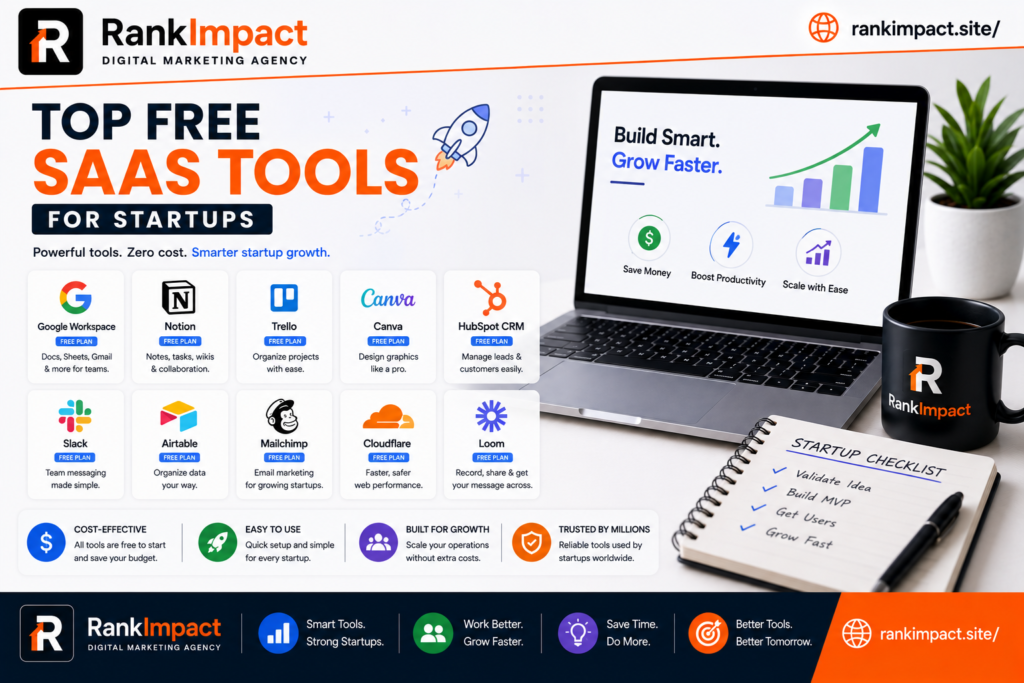
Table of Contents
Top 10 Free SaaS Tools for Startups in 2026
Every founder eventually faces the same early decision point. Runway is limited, the product still needs validating, and yet a startup cannot function without basic infrastructure for communication, project tracking, customer relationships, and payments. This is exactly why finding the best free SaaS tools for startups has become such a heavily searched topic, since the right free tier can genuinely replace what used to require a real monthly budget, while the wrong choice quietly creates a ceiling that blocks growth just when things start working.
This guide is written for solo founders, early stage teams, and anyone building a startup on a genuinely constrained budget who wants a clear, current picture of which free SaaS tools actually deliver real value rather than a stripped down teaser designed purely to force an upgrade. Readers researching this topic typically want three things. Which tools have free tiers generous enough to run a real business rather than a token trial. What the actual limits look like once usage grows. And how to combine these tools into a coherent stack without creating the tool sprawl that quietly drains a startup’s attention and budget later. This article covers all three with specific, current detail.
Understanding What Free Actually Means Before You Choose
Before evaluating specific tools, it helps to understand that the word free covers several genuinely different offers, and confusing them leads to disappointment later. A free plan means the tool remains usable indefinitely at no cost as long as usage stays within defined caps on users, features, or volume. Freemium describes a free tier deliberately built as an on ramp toward a paid plan, where the core is usable but the good stuff is gated behind an upgrade. A free trial offers full access to a paid plan for a limited window, typically seven to thirty days, after which you pay or lose access entirely.
Understanding this distinction upfront prevents a common mistake where a founder builds critical early workflows around a trial, only to face a sudden and disruptive paywall weeks later. The tools highlighted in this guide are true free plans or genuinely generous freemium tiers, not disguised trials.
Slack for Team Communication
Slack remains one of the most reliable starting points for early stage team communication, and its free plan is considerably more generous than many founders initially expect. The free tier offers unlimited users, with the most recent ninety days of messages searchable, meaning small teams lose older message history but rarely hit a genuine blocker in their first year of operation. For developer first or community led startups, Discord serves as a strong alternative, since it remains genuinely free for almost everything, which explains its popularity specifically within technical and community driven early stage companies.
The practical tip here is to resist upgrading purely because a sales prompt suggests it. Most early teams never actually need searchable history beyond ninety days, and paying for that capability before it becomes a genuine operational blocker wastes budget that could extend runway further.
Notion for Documentation and Project Management
Notion has become a near default choice for early stage startups needing a flexible workspace covering documentation, lightweight project tracking, and internal knowledge management within a single tool. Its free tier is genuinely capable enough that many founding teams run their entire operational documentation on it without ever needing to upgrade during their first year, particularly useful given how much early stage work involves constantly evolving processes that benefit from Notion’s flexible, non rigid structure compared to more specialized but less adaptable alternatives.
The common mistake with Notion specifically is over structuring it too early, building elaborate databases and workflows before the team has actually settled into consistent habits, which often means rebuilding the entire structure a few months later once real usage patterns become clear.
HubSpot CRM for Sales and Customer Relationships
HubSpot’s free customer relationship management tool stands out as one of the strongest free offerings available to startups today, providing unlimited users and unlimited contacts with deal pipeline management, email tracking, and meeting scheduling included at no cost. This level of functionality means most startups can run HubSpot free for their entire first year before genuinely needing the automation and advanced reporting features reserved for paid tiers.
A CRM becomes genuinely necessary once a startup is managing more than roughly fifty active leads or once more than one person is involved in selling, since informal tracking through spreadsheets or memory breaks down quickly beyond that point. Adopting HubSpot’s free tier early, even before reaching that threshold, builds good tracking habits before the volume makes disorganization costly.
GitHub for Version Control and Collaboration
For any startup building software, GitHub functions as essential infrastructure rather than an optional convenience, and its free tier covers private repositories, collaboration features, and continuous integration workflows sufficient for most early stage engineering teams. Beyond core version control, GitHub increasingly integrates with broader developer workflows, making it a natural anchor around which other free developer tools connect smoothly.
The mistake many early technical founders make is under using GitHub’s built in project tracking and issue management features, instead adopting a separate paid project management tool for engineering work that GitHub’s own free capabilities could largely handle during the earliest stages.
Vercel for Hosting and Deployment
Vercel’s free Hobby tier has become a popular choice specifically for startups deploying modern web applications, offering meaningful infrastructure capacity without upfront cost during the critical period before a product has proven meaningful traction. This tier suits early stage deployment needs well, though founders should understand its limits around commercial usage and team collaboration before assuming it will scale indefinitely without eventual upgrade.
Combining Vercel with a startup’s broader technical stack tends to work smoothly given how tightly integrated it has become with common modern frontend frameworks, reducing the setup friction that might otherwise consume valuable early engineering time.
PostHog for Product Analytics
Understanding how users actually interact with an early product matters enormously, and PostHog’s free tier provides genuine product analytics capability including event tracking and basic session insight without the cost typically associated with more established enterprise analytics platforms. This kind of visibility into user behavior helps founders make product decisions grounded in actual usage patterns rather than assumption alone during the critical early validation period.
A common mistake here involves collecting extensive analytics data without ever establishing a regular habit of actually reviewing it, which means the tool provides no real value despite technically being implemented correctly within the product.
Figma for Design and Prototyping
Figma’s free tier remains genuinely useful for early stage design work, supporting collaborative interface design and prototyping that founders and early designers can use to iterate quickly on product direction before committing engineering resources to a specific implementation. Its collaborative, browser based nature also means design feedback and iteration can happen quickly across a distributed team without the friction that older, file based design tools historically created.
Stripe for Payments
Stripe operates differently from most tools on this list since it charges per transaction rather than through a traditional subscription model, meaning a startup genuinely pays nothing until it processes actual revenue. This structure makes Stripe effectively free infrastructure during the pre revenue period while remaining the same reliable payment processing layer a startup will continue relying on well into later growth stages, avoiding the disruption of switching payment providers later simply because an initial free option no longer scales.
Zendesk and Freshdesk for Customer Support
Early stage customer support needs are typically modest enough that dedicated free tools handle them well. Tawk.to offers completely free live chat that many early startups begin with when a simple chat widget on the website covers the immediate need. As support volume grows beyond simple live chat, Freshdesk’s free tier for basic email ticketing provides a natural next step without requiring immediate investment in a more expensive dedicated support platform.
Separately, some infrastructure and support vendors offer startup specific programs extending well beyond standard free tiers, including cloud credits, AI API access, and extended free periods specifically designed for early stage companies, which founders should actively research within their specific technical category rather than assuming only standard public free tiers are available.
Zapier for Workflow Automation
Connecting the tools above without manual, repetitive work is where Zapier’s free tier earns its place in an early stage stack, allowing basic automated workflows between apps like Slack, Notion, and HubSpot without requiring custom engineering work to build these connections manually. The free tier’s limits on the number of active automations mean founders should prioritize automating the most repetitive and time consuming manual tasks first rather than attempting to automate everything simultaneously within a constrained free allocation.
How to Build a Coherent Free Stack Without Creating Sprawl
Selecting individual free tools matters less than how deliberately they get combined into a coherent operational stack. Research on this exact challenge notes that the SaaS tools a founder chooses in the first twelve months will either become the startup’s greatest leverage or its quietest budget leak, and the difference typically comes down to intentional selection rather than reactive adoption whenever a new tool seems briefly appealing.
The most common trap founders fall into is accumulating tools that overlap in function, since even early stage startups commonly run dozens of different SaaS tools, with a meaningful portion serving genuinely redundant purposes never noticed until a founder audits actual usage months later. A related and equally damaging pattern is silent cost leakage, where a small forgotten subscription quietly continues billing for months after the team stopped actively using it.
The most effective approach involves choosing a small number of tools per essential function early, resisting the urge to add new tools reactively whenever a minor friction point appears, and only upgrading a specific tool once its free tier limit becomes a genuine, demonstrated blocker rather than a theoretical future concern.
Common Mistakes Startups Make With Free SaaS Tools
Assuming every free tier remains free indefinitely without understanding its specific limits represents the most frequent mistake, since building critical workflows around a tool without knowing exactly where its free ceiling sits creates disruptive surprises precisely when a startup can least afford them, typically during a period of rapid early growth.
Choosing tools purely based on what competitors or other founders use, without genuinely evaluating fit for a startup’s own specific workflow and team size, frequently results in adopting a tool that looks impressive but does not actually match real operational needs. Free tools still cost real time to implement and learn, so genuine fit matters even when the direct financial cost is zero.
Failing to periodically audit an accumulated stack represents another common gap, allowing tools adopted for a since abandoned experiment or a team member no longer with the company to continue quietly consuming attention and, in freemium cases, occasionally converting to paid billing without anyone actively noticing the change.
Frequently Asked Questions
What are the best free SaaS tools for startups in 2026?
The best free SaaS tools for startups in 2026 include Slack for communication, Notion for documentation, HubSpot CRM for sales, GitHub for development, Vercel for hosting, PostHog for analytics, Figma for design, and Stripe for payments.
Can a startup really run entirely on free SaaS tools?
Yes, many early stage startups run entirely on free tools during their first year, since generous free tiers across communication, CRM, hosting, and analytics categories can genuinely cover most operational needs before revenue justifies paid upgrades.
What is the difference between a free plan and a free trial?
A free plan remains usable indefinitely within defined limits on users or features, while a free trial provides full paid plan access for a limited window before requiring payment or losing access entirely.
How many free SaaS tools should a startup use at once?
Most startups should begin with a small, focused set of tools covering essential functions rather than adopting many tools simultaneously, since tool sprawl creates fragmented data and wasted attention even when every individual tool is free.
Is HubSpot CRM really free for startups?
Yes, HubSpot’s free CRM tier offers unlimited users and contacts along with deal pipeline management and email tracking, meaning most startups can run it free for their entire first year before needing paid automation features.
When should a startup upgrade from a free SaaS tool to a paid plan?
A startup should upgrade only once a free tier’s specific limit becomes a genuine, demonstrated blocker to growth or operations, rather than upgrading preemptively based on marketing prompts or assumed future need.
Do free SaaS tools for startups actually have hidden limits?
Yes, free tiers almost always include specific limits such as message history caps, user seat restrictions, or feature gating, and understanding these limits upfront prevents disruptive surprises as usage grows.
What free SaaS tool should a startup adopt first?
Most startups benefit most from starting with a communication tool like Slack and a documentation tool like Notion, since these support nearly every other early stage workflow across the team.
Are there free SaaS tools specifically for startup founders beyond standard free tiers?
Yes, many vendors offer startup specific programs including extended free periods and cloud credits beyond their standard public free tier, and founders should actively research these programs within their specific technical category.
How can a startup avoid wasting money on unused free SaaS tools?
Conducting a periodic audit of the entire tool stack, checking actual usage against every active subscription, helps startups catch abandoned tools before a freemium tier quietly converts to paid billing unnoticed.
Conclusion
The landscape of free SaaS tools for startups in 2026 has genuinely improved to the point where a founder can build real operational infrastructure across communication, documentation, sales, engineering, and analytics without spending meaningful money in the earliest stage of a company. The tools covered in this guide, from Slack and Notion through HubSpot, GitHub, and Stripe, represent free tiers generous enough to support genuine early stage operations rather than token trials designed purely to force an early upgrade. The real skill lies not in finding these individual tools, which have become widely known, but in combining them deliberately into a coherent stack while resisting the sprawl and silent cost leakage that quietly undermines so many early stage teams.
Key Takeaways
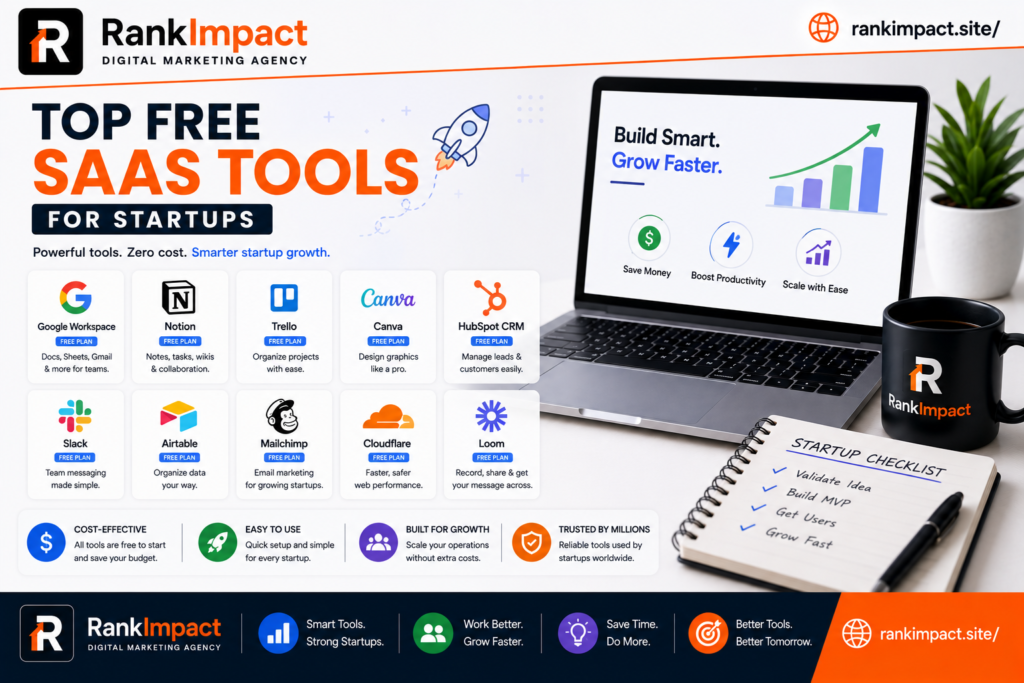
The best free SaaS tools for startups in 2026 span communication, documentation, sales, engineering, hosting, and analytics, with tools like Slack, Notion, and HubSpot offering genuinely generous free tiers. Understanding the difference between a free plan, freemium tier, and free trial prevents disruptive surprises once early usage grows. Tool sprawl and silent cost leakage from forgotten subscriptions represent the most common ways startups waste time and budget even while using nominally free tools. Upgrading should happen only once a specific free tier limit becomes a genuinely demonstrated operational blocker rather than a preemptive decision. Periodically auditing the full tool stack helps startups catch redundant or abandoned tools before they quietly convert to paid billing.