Master software as a service sales with this guide covering 6 proven strategies sales models key metrics and mistakes to avoid before you scale
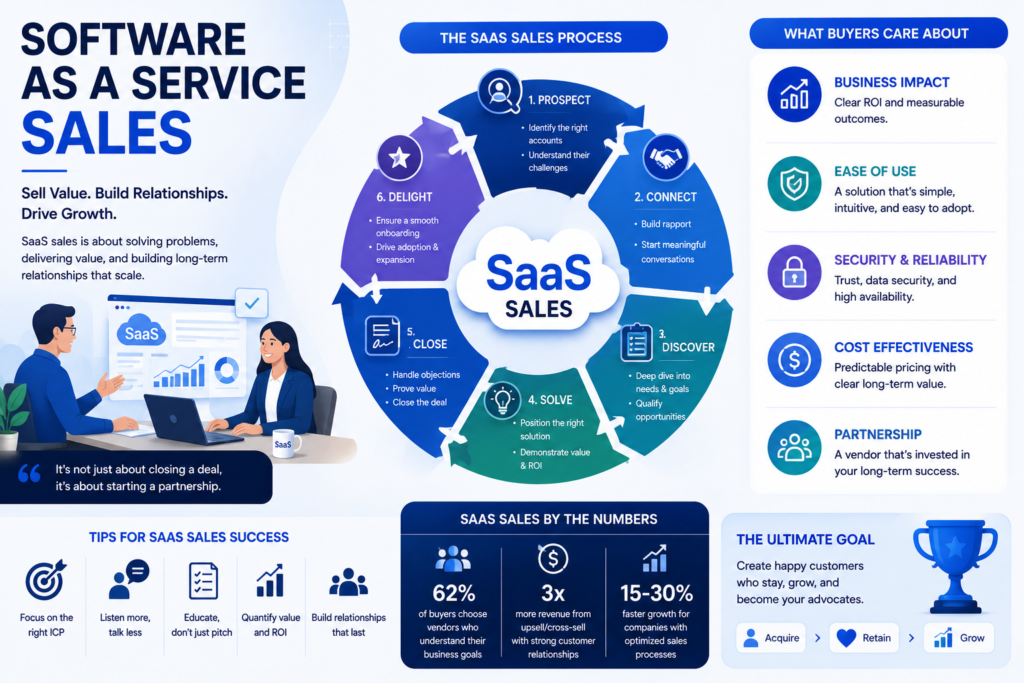
Table of Contents
Software as a Service Sales Models, Process, Metrics, and Best Practices
Selling software as a service is fundamentally different from selling almost any other product because the sale is never really finished the day a contract gets signed. A subscription business only wins when the customer keeps paying month after month or year after year which means every sales conversation carries the weight of a future renewal decision. This single fact changes how deals get structured how sales teams get compensated and how success gets measured across the entire revenue organization. Software as a service sales also moves at a pace and complexity that varies enormously depending on price point since a twenty dollar per month tool might close in a single self service checkout while an enterprise platform can involve a six month cycle with a dozen stakeholders. In this guide we will break down the full landscape of software as a service sales including the major sales models the stages every deal moves through the metrics that actually predict revenue health and the specific mistakes that cause otherwise promising pipelines to stall. Whether you are building a sales motion for the first time or refining one that already exists you will find a practical framework here that reflects how top performing SaaS companies actually operate.
What Makes Software as a Service Sales Different
The core difference between software as a service sales and traditional software sales comes down to the ongoing nature of the relationship. In the old model of selling perpetual software licenses a company earned most of its revenue upfront and support contracts were a secondary consideration. In a subscription business the opposite is true because the initial sale is only the beginning of a much longer revenue relationship that depends on continued product usage and renewed trust. This shifts the entire incentive structure of a sales team since closing a deal that will churn within three months actually hurts the business more than it helps because of the cost required to acquire that customer in the first place. Sales reps in this environment need to think less like closers chasing a single transaction and more like relationship builders who are setting up a customer for long term success from the very first conversation. This is also why software as a service sales teams increasingly share ownership of outcomes with customer success and product teams rather than operating as an isolated function that disappears after the contract is signed.
Core Sales Models Used Across the SaaS Industry
Not every software as a service sales motion looks the same and understanding which model fits your product is one of the most important early decisions a company makes. Self service sales work well for low price point products where customers can sign up start a trial and convert to a paid plan without ever speaking to a human which requires an exceptional onboarding experience since the product itself has to do the selling. Inside sales relies on a team of reps handling inbound leads and outbound outreach through calls video meetings and email typically for mid market deals where some human guidance speeds up the decision but a lengthy field sales process would be overkill. Enterprise sales involves a longer and more consultative cycle often with multiple stakeholders a formal procurement process and custom contract negotiation which is common for platforms serving large organizations with complex requirements. Many successful SaaS companies actually blend these models by offering a self service entry point for smaller customers while maintaining a dedicated enterprise sales team for larger accounts which allows the business to capture revenue across very different customer segments without forcing every buyer through the same journey.
The Stages of a Modern Software as a Service Sales Cycle
A well defined sales cycle gives every rep on a team a shared language and a repeatable structure to follow even when individual deals look different. The cycle typically begins with prospecting and qualification where a rep determines whether a lead has a genuine problem the product solves along with the budget and authority to make a purchase decision. Discovery follows next and this stage deserves far more attention than most reps give it because uncovering the real business pain behind a request determines everything about how the rest of the deal unfolds. After discovery comes the demonstration or trial stage where the product gets shown in a way that directly maps to the specific problems uncovered during discovery rather than a generic feature walkthrough that fails to connect with the buyer’s actual situation. Negotiation and procurement often follow for larger deals and this stage can stretch for weeks as legal and security teams review contracts particularly for enterprise buyers with strict compliance requirements. The cycle technically closes when the contract is signed but in software as a service sales the strongest teams treat closed won as the start of a new relationship rather than the finish line since the real test begins during onboarding and continues through every renewal conversation that follows.
Metrics That Actually Predict SaaS Sales Health
Vanity metrics like total deals closed in a month tell an incomplete story so experienced sales leaders track a broader set of numbers that reveal the true health of their revenue engine. Monthly recurring revenue and annual recurring revenue show the predictable baseline of income the business can count on which becomes the foundation for almost every other calculation in a subscription business. Customer acquisition cost measures how much it costs to win a new customer and this number only becomes meaningful when compared against customer lifetime value since a business spending more to acquire customers than those customers will ever generate in revenue is on an unsustainable path. Sales cycle length reveals how efficiently deals move through the pipeline and a lengthening cycle often signals friction somewhere in the process whether that is unclear pricing weak discovery or an overly complex procurement requirement. Win rate against qualified opportunities shows how effectively a team converts genuine interest into signed contracts while net revenue retention captures how much revenue expands or contracts from existing customers after the initial sale which many experienced operators consider the single most important number in the entire business. Tracking these metrics consistently allows a sales organization to diagnose problems early rather than discovering them only after a quarter has already gone badly.
Proven Techniques That Convert in SaaS Sales Conversations
The techniques that consistently work in software as a service sales share a common thread of putting the customer’s actual business outcomes ahead of product features. Consultative selling asks reps to spend more time listening than talking during early conversations so they can genuinely understand the prospect’s workflow before ever introducing a solution which builds far more trust than a scripted pitch. Tying every product capability directly back to a measurable business outcome such as hours saved per week or revenue protected per quarter makes the value concrete rather than abstract which matters enormously to buyers who need to justify the purchase internally. Multi threading a deal by building relationships with several stakeholders rather than relying on a single champion protects a deal from stalling if that one contact changes roles or loses internal influence during a lengthy sales cycle. Using customer stories and case studies from similar companies in the same industry helps prospects visualize their own success and reduces the perceived risk of trying something new. Finally creating genuine urgency through a clear cost of inaction conversation works far better than artificial discount deadlines because it respects the buyer’s intelligence while still motivating a timely decision.
Common Mistakes That Quietly Kill SaaS Deals
Even experienced sales teams fall into patterns that slowly erode their pipeline without anyone noticing until quarterly numbers come up short. One frequent mistake is rushing past discovery to get to a demo because reps feel pressure to show the product quickly which often results in a generic presentation that fails to connect with what the buyer actually cares about. Another common error is neglecting to identify the true economic buyer early in the process which leads to deals that feel promising for weeks before stalling once they reach someone with real budget authority who was never properly engaged. Overpromising on features or timelines to win a deal creates a serious problem down the line because customer success and product teams inherit expectations they cannot realistically meet which damages the relationship almost immediately after the contract is signed. Many teams also underinvest in handling procurement and security review efficiently which causes deals that were emotionally won weeks earlier to die slowly in legal review simply because nobody proactively prepared the documentation buyers needed. Finally failing to align sales compensation with long term customer health rather than just initial bookings encourages reps to prioritize quick wins over sustainable revenue which eventually shows up as elevated churn that damages the entire business model.
Tools and Technology Supporting Modern SaaS Sales Teams
Technology has become deeply embedded in how software as a service sales teams operate today and choosing the right stack meaningfully affects both rep productivity and forecasting accuracy. A strong customer relationship management platform remains the foundation of any sales operation since it centralizes every interaction and gives leadership visibility into pipeline health across the entire team. Sales engagement platforms help reps manage outbound sequences and follow up consistently without letting promising leads slip through the cracks during a busy week. Conversation intelligence tools that record and analyze sales calls have become increasingly valuable because they allow managers to coach based on actual conversations rather than secondhand summaries which dramatically improves the quality of feedback reps receive. Forecasting and revenue intelligence platforms use historical deal data to flag at risk opportunities before they slip which gives sales leaders time to intervene rather than being surprised at the end of a quarter. None of these tools replace fundamental sales skill but the right combination removes friction from a rep’s day and gives leadership the data needed to coach effectively and forecast with real confidence.
Building and Scaling a High Performing SaaS Sales Team
Growing a software as a service sales team from a handful of early reps into a structured organization requires deliberate planning rather than simply hiring more people and hoping revenue follows. Early stage companies benefit from generalist reps who can handle a full deal cycle from prospecting through close because specialization too early often creates unnecessary handoffs before the process is even proven. As the business matures splitting the function into dedicated roles for prospecting closing and account management typically improves both efficiency and rep specialization once there is enough volume to justify the structure. Investing in a formal onboarding program for new reps pays dividends quickly since ramp time directly affects how fast a growing team reaches full productivity and a disorganized onboarding experience extends that ramp far longer than necessary. Sales leadership should also build a consistent coaching cadence built around real deal reviews and call recordings rather than relying purely on pipeline reports because the qualitative side of coaching often reveals problems that raw numbers alone cannot show. Culture matters just as much as process in this environment since the best software as a service sales teams tend to share information openly across reps rather than treating every deal as a solo competition which ultimately raises performance across the entire team.
Aligning Sales with Customer Success for Sustainable Growth
Because subscription revenue depends entirely on renewals the line between sales and customer success has blurred significantly in modern SaaS organizations. Deals that get handed off to customer success with unclear expectations or an unrealistic implementation timeline create friction that damages the relationship right at the moment it should be strengthening. The strongest companies build a formal handoff process where sales shares detailed context about the customer’s goals stakeholders and success criteria so the customer success team can pick up seamlessly rather than starting from scratch. Some organizations take this further by tying a portion of sales compensation to renewal outcomes which naturally discourages reps from overselling deals that are unlikely to succeed long term. Regular communication between sales and customer success about expansion opportunities within existing accounts also creates a healthier revenue mix since growing an existing customer is typically far less expensive than acquiring a brand new one. Companies that treat sales and customer success as two halves of one connected revenue motion consistently outperform those that let the two functions operate in isolation from each other.
Frequently Asked Questions
What is software as a service sales Software as a service sales refers to the process of selling subscription based software products where revenue depends on ongoing customer retention rather than a single upfront transaction which requires sales teams to focus on long term customer success from the very first conversation.
How is SaaS sales different from traditional software sales SaaS sales differs because the initial sale is only the beginning of a recurring revenue relationship which means sales teams must prioritize product fit and long term value over a single transaction since a churned customer directly hurts the business even after the deal was technically won.
What are the main SaaS sales models The three main models are self service sales for low price point products inside sales for mid market deals handled remotely through calls and video and enterprise sales for large complex deals involving multiple stakeholders and formal procurement processes.
What metrics matter most in SaaS sales The most important metrics include monthly and annual recurring revenue customer acquisition cost customer lifetime value sales cycle length win rate and net revenue retention which together reveal whether the sales motion is generating sustainable long term revenue.
How long does a typical SaaS sales cycle take Sales cycle length varies dramatically by price point with self service products sometimes converting in minutes while enterprise deals often take three to six months or longer depending on the number of stakeholders and the complexity of procurement.
What is the biggest mistake in SaaS sales Rushing past genuine discovery to reach a demo is one of the most damaging mistakes because it leads to generic presentations that fail to connect with the buyer’s actual business problem which lowers both win rates and long term customer satisfaction.
How does customer success relate to SaaS sales Customer success and sales are closely connected in a subscription business because a poorly handed off deal with unrealistic expectations can quickly lead to churn which is why the strongest companies build a formal handoff process between the two teams.
What tools do SaaS sales teams typically use Common tools include a customer relationship management platform for pipeline visibility sales engagement software for consistent outbound follow up conversation intelligence tools for coaching and forecasting platforms that flag at risk deals before they slip.
How should SaaS sales compensation be structured Many companies tie a portion of compensation to renewal or retention outcomes rather than initial bookings alone which discourages reps from overselling deals that are unlikely to succeed and encourages a stronger focus on sustainable long term revenue.
What skills matter most for someone starting a career in SaaS sales Strong listening skills genuine curiosity about a customer’s business problems and the ability to tie product capabilities to measurable outcomes matter far more than aggressive closing tactics for anyone building a long term career in software as a service sales.
Conclusion
Software as a service sales rewards a fundamentally different mindset than traditional transactional selling because every deal is really the beginning of a long term relationship rather than a finish line to cross. Understanding the sales models that fit your product the stages every deal moves through and the metrics that reveal true revenue health gives any sales organization a foundation to build on rather than relying on instinct alone. The techniques that consistently work including genuine discovery multi threaded relationships and outcome focused conversations all share a common thread of putting the customer’s success ahead of a quick close. Avoiding the common mistakes covered in this guide from rushed demos to misaligned compensation protects both near term revenue and long term retention which ultimately determines whether a subscription business thrives. As you refine your own approach to software as a service sales remember that the strongest teams treat sales and customer success as two connected parts of the same journey rather than separate functions working in isolation from each other.
Key Takeaways
Software as a service sales depends on long term retention which means every deal should be approached as the start of an ongoing relationship rather than a single transaction. Choosing the right sales model whether self service inside sales or enterprise sales should match your price point and the complexity of your buyer’s decision process. Tracking metrics like net revenue retention customer acquisition cost and sales cycle length reveals the true health of a revenue engine far better than deal count alone. Genuine discovery multi threading and outcome focused conversations consistently outperform aggressive closing tactics in subscription sales environments. Aligning sales compensation and handoff processes with customer success protects the business from the churn that results from overselling. Building a repeatable sales process and a consistent coaching cadence allows a software as a service sales team to scale without losing quality as headcount grows.