Follow this 7 step SaaS company evaluation criteria checklist to compare vendors on security pricing support and scalability before you buy.
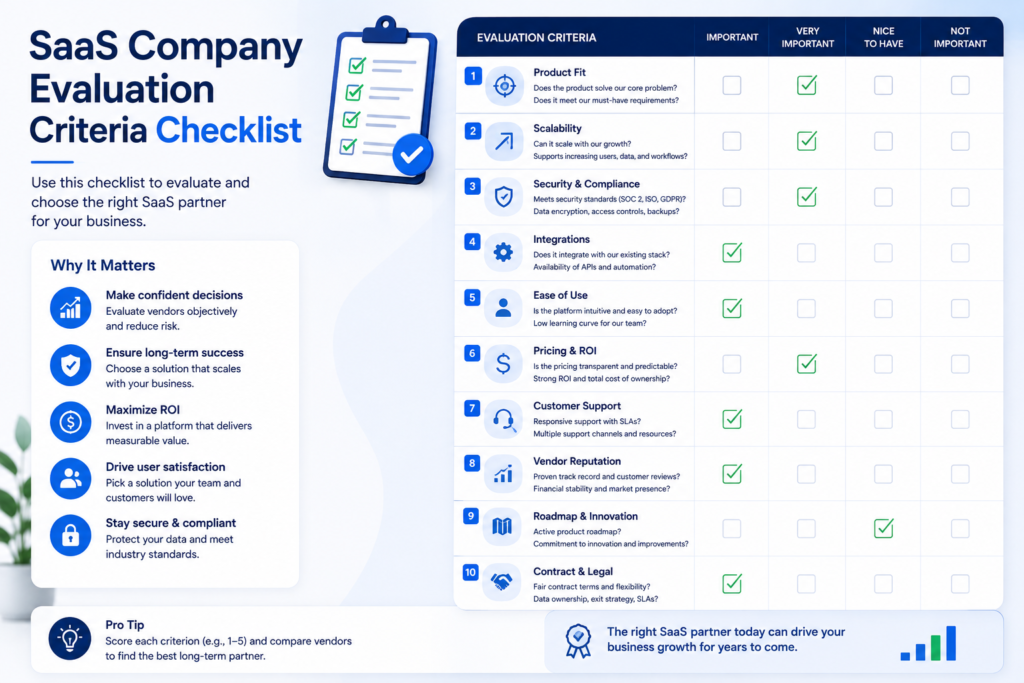
Table of Contents
SaaS Company Evaluation Criteria Checklist A Complete Guide for 2026
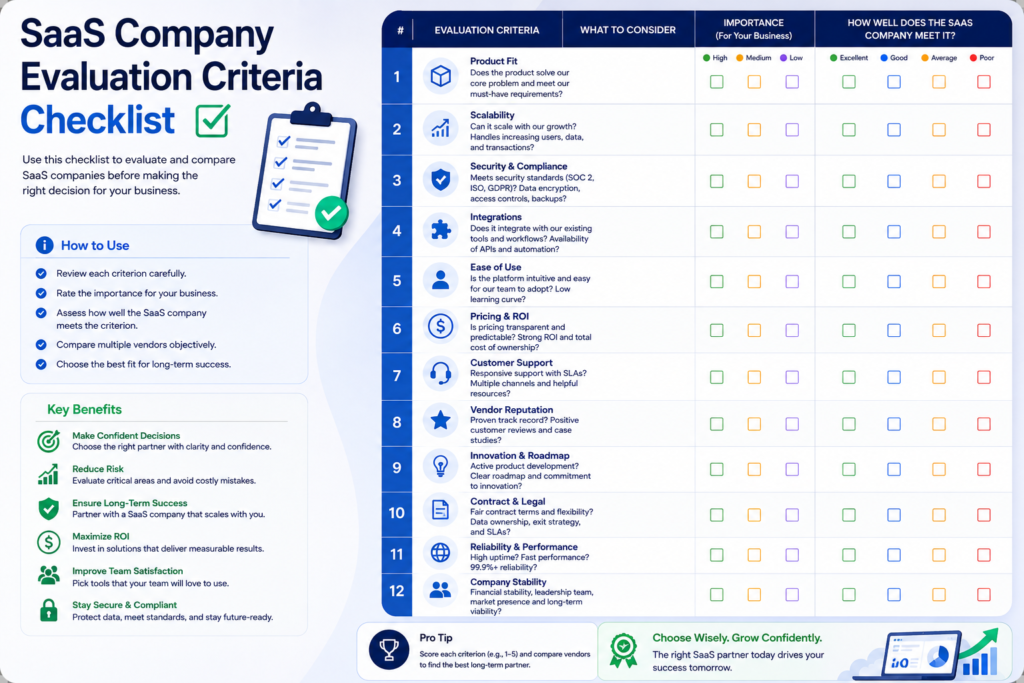
Choosing a software vendor used to be simple because most companies bought a handful of licenses and installed the software once. That world no longer exists. Modern businesses run on dozens of interconnected SaaS platforms that touch finance operations customer data and daily workflows so a poor vendor choice can quietly cost a company months of lost productivity and thousands of dollars in wasted spend. This is exactly why a structured SaaS company evaluation criteria checklist has become essential reading for anyone responsible for software purchasing decisions in 2026. Rather than relying on a sales demo and a gut feeling buyers now need a repeatable framework that examines a vendor from every angle including their financial health their security practices their support quality and their long term product roadmap. In this guide we will walk through every criterion that belongs on a serious SaaS company evaluation criteria checklist explain why each one matters and show you how experienced buyers apply this checklist in real purchasing decisions. By the end you will have a practical framework you can adapt for your own organization whether you are buying your first CRM or renewing an enterprise wide platform.
What a SaaS Company Evaluation Criteria Checklist Actually Covers
A proper SaaS company evaluation criteria checklist is not a single question like does this tool have the features we need. It is a multi dimensional scorecard that looks at the vendor as a business partner rather than just a piece of software. Think of it in four broad buckets: the product itself the company behind the product the commercial terms and the operational fit within your organization. Many buyers make the mistake of spending ninety percent of their evaluation time on features and only ten percent on everything else which is backwards because features can usually be replicated or worked around while a financially unstable vendor or a weak security program can end a partnership overnight. A mature checklist forces you to slow down and score each category independently so that a flashy interface does not overshadow a real weakness in data governance or customer support. When you build your own version of this checklist you should assign a weight to each category based on what matters most to your business because a healthcare company will weight compliance far higher than a small marketing agency would.
Financial Health and Business Stability
One of the most overlooked items on any SaaS company evaluation criteria checklist is the financial stability of the vendor itself. Software as a service is a subscription relationship not a one time purchase so you are effectively betting that this company will still exist and still be investing in the product three or five years from now. Ask vendors about their funding history their customer growth rate and how long they have been profitable or on a clear path to profitability. Publicly traded companies make this easier because their financials are available but private companies especially venture backed startups can be harder to assess. Look for signals like recent funding rounds customer count growth industry analyst reports and how transparent the company is when you ask direct questions about runway. A vendor that dodges financial questions or seems evasive about growth metrics should raise a flag. Vendor lock in becomes a real risk when a company goes out of business or gets acquired and sunsets the product you depend on so treating financial due diligence as a core part of your evaluation protects your business from a painful migration down the road.
Product Architecture and Technical Fit
The technical foundation of a SaaS platform tells you a great deal about how the company builds and maintains its product. When evaluating architecture look at whether the platform is built on modern cloud infrastructure whether it offers a documented API for integrations and whether it has a track record of reliable uptime. Ask vendors to share their uptime history over the past twelve months along with their incident response process because a company that hides this information is usually hiding a problem. Multi tenancy versus single tenancy architecture also matters depending on your data isolation requirements especially in regulated industries. Beyond raw architecture examine how often the company ships updates and whether those updates come with clear release notes because a stagnant product roadmap often signals a company that has stopped investing in innovation. Mobile access offline functionality and how the platform performs under heavy data loads are also worth testing directly rather than trusting a sales deck. A strong SaaS company evaluation criteria checklist always includes a technical trial period where your own engineers or power users stress test the product in conditions that mirror your actual daily workflow.
Security Compliance and Data Governance
Security has moved from a nice to have to an absolute requirement on every serious SaaS company evaluation criteria checklist because a data breach at a vendor becomes your problem the moment your customer data is involved. Start by confirming which compliance certifications the vendor holds such as SOC 2 Type II ISO 27001 or industry specific standards like HIPAA for healthcare or PCI DSS for payment processing. Ask for their most recent audit report rather than accepting a badge on their website at face value. Data encryption both at rest and in transit should be standard along with clear documentation on where customer data is physically stored since data residency rules vary significantly across regions and industries. Review their incident response plan and ask how quickly they notify customers when a breach occurs because response speed often matters more than whether an incident happened at all since even the best companies occasionally face security events. Role based access controls single sign on support and detailed audit logs are additional signals of a mature security program. Any vendor that treats security questions as an inconvenience rather than a normal part of the sales process is telling you something important about their internal culture.
Customer Support and Success Programs
Support quality is one of those criteria that only becomes obvious after you have already signed a contract which is exactly why it needs careful evaluation upfront. During your evaluation ask about support channels response time guarantees and whether dedicated customer success managers are included or sold as an add on. Request to speak with existing customers who are similar in size and industry to your own company because reference calls reveal patterns that a polished demo never will. Pay close attention to how the vendor handles onboarding since a rushed or confusing onboarding process often predicts how the rest of the relationship will feel. Look for evidence of proactive support such as regular check ins usage reviews and health scoring rather than a support team that only responds when something breaks. Community resources like knowledge bases user forums and training academies also indicate whether a company invests in customer enablement beyond the initial sale. A vendor with strong retention numbers usually has strong support behind it so ask directly about their net revenue retention rate since that single metric reflects both product satisfaction and support quality combined.
Pricing Structure and Total Cost of Ownership
Pricing looks simple on a website but becomes complicated once you factor in implementation fees training costs premium support tiers and the cost of add on modules that were not part of the initial quote. A thorough SaaS company evaluation criteria checklist requires you to calculate total cost of ownership over a realistic contract length usually two to three years rather than comparing sticker prices for a single year. Ask vendors directly about annual price increases at renewal since many SaaS contracts include automatic escalators that surprise buyers later. Clarify whether pricing is based on seats usage tiers or a flat organizational license because each model creates different incentives and risks as your company scales. Hidden costs such as data export fees API rate limit overages and charges for additional environments like staging or sandbox instances should all be documented before signing. It also helps to model a worst case growth scenario and ask the vendor how pricing changes if your usage doubles within a year because some platforms become dramatically more expensive at scale in ways that are not obvious from an initial quote. Comparing total cost of ownership rather than headline price is one of the clearest ways experienced buyers separate themselves from first time software purchasers.
Integration Capabilities and Ecosystem Fit
Modern businesses rarely buy a single tool in isolation so integration capability deserves its own dedicated section on any SaaS company evaluation criteria checklist. Start by mapping the tools already in your stack and confirming that the vendor offers native integrations or a well documented API for each one. Native integrations tend to be more reliable than custom built connections because the vendor maintains them directly and updates them when either platform changes. Ask about integration marketplaces such as Zapier or dedicated iPaaS partnerships since these can bridge gaps when native integrations do not exist. Data synchronization frequency also matters because real time sync behaves very differently from a nightly batch update when your teams need current information throughout the day. For companies with existing data warehouses inquire about direct database connections or reverse ETL support so your data team can pull information without relying entirely on the vendor’s dashboards. A platform that fits cleanly into your existing ecosystem reduces both the technical burden on your engineering team and the risk of data silos forming across departments.
Scalability and Long Term Roadmap Alignment
A tool that fits your company today might not fit your company in two years so scalability deserves careful attention during evaluation. Ask vendors directly how their platform performs for companies at your projected future size not just your current size since some SaaS products are built for small teams and struggle once usage or data volume grows significantly. Request their public product roadmap or at minimum a conversation with their product team about upcoming features especially any that align with your growth plans such as international expansion or new business units. Look at how frequently the company acquires other startups and folds those acquisitions into the core product because a pattern of poorly integrated acquisitions often creates a fragmented user experience. Customer advisory boards and public changelogs are good indicators of whether the vendor actively incorporates customer feedback into development priorities. Choosing a platform that can scale alongside your business protects you from a costly migration project just as your company hits its stride.
Common Mistakes Companies Make During SaaS Evaluation
Even experienced buyers fall into predictable traps when evaluating software vendors. One of the most common mistakes is letting a single influential stakeholder fall in love with a flashy demo without involving the actual end users who will use the tool daily. Another frequent error is skipping reference calls entirely because the sales cycle feels time pressured even though reference calls consistently reveal information that a vendor will never volunteer proactively. Many teams also underestimate implementation time and assume a new platform will be live within days when enterprise rollouts often take months especially when data migration and employee training are involved. Ignoring contract terms around data ownership and export rights is another costly oversight because some vendors make it deliberately difficult to extract your own data if you decide to leave. Finally many buyers evaluate price in isolation without weighing it against the total cost of ownership over the full contract length which leads to budget surprises at renewal time. Avoiding these mistakes is often what separates a smooth software rollout from a painful one that damages trust across departments.
Building Your Own SaaS Evaluation Scorecard
Turning everything above into a practical tool means building a simple weighted scorecard that your team can apply consistently across every vendor you evaluate. Start by listing each category discussed in this guide including financial stability product architecture security compliance customer support pricing integrations and scalability. Assign each category a weight based on what matters most to your organization since a company in a regulated industry should weight security and compliance more heavily than a small startup evaluating a marketing tool. Score each vendor on a simple scale from one to five within every category based on documented evidence rather than sales claims and require your team to write a short justification for each score so the reasoning stays transparent. Bring this scorecard into every stakeholder meeting so decisions are grounded in shared criteria instead of individual preference or the loudest voice in the room. Over time this same scorecard becomes a reusable asset that speeds up every future software evaluation your company runs because the framework already exists and only needs minor adjustments for each new use case.
Frequently Asked Questions
What is a SaaS company evaluation criteria checklist used for?
A SaaS company evaluation criteria checklist is used to systematically compare software vendors across categories like financial stability security product architecture customer support and total cost of ownership so that buying decisions are based on documented evidence rather than a single sales demo.
How many criteria should be included in a SaaS evaluation checklist?
Most thorough checklists include between seven and ten major categories such as financial health security compliance product architecture customer support pricing integrations and scalability with several sub questions under each category to guide deeper investigation.
What is the most important criterion when evaluating a SaaS vendor ?
There is no single most important criterion because the right weighting depends on your industry and risk tolerance although security and financial stability are consistently rated among the highest priorities across most industries because both carry long term business continuity risk.
How do you evaluate the financial stability of a SaaS company?
You can evaluate financial stability by reviewing public financial statements when available asking directly about funding rounds and customer growth requesting analyst reports and paying attention to how transparent the company is when answering direct questions about runway and profitability.
Why is total cost of ownership more important than the listed price?
Total cost of ownership captures implementation fees training costs support tiers and renewal price increases over the full contract length which often reveals a very different cost picture than the initial quoted price shown during the sales process.
Should reference calls be part of every SaaS evaluation ?
Yes reference calls with existing customers who are similar in size and industry to your own company consistently reveal information about support quality onboarding experience and product reliability that a sales team will rarely share proactively.
How long should a typical SaaS evaluation process take ?
A thorough evaluation for a mid size business purchase typically takes between four and eight weeks to allow time for technical trials reference calls security review and internal stakeholder alignment although enterprise purchases can take considerably longer.
What security certifications should a SaaS vendor have?
Common certifications to look for include SOC 2 Type II and ISO 27001 along with industry specific standards such as HIPAA for healthcare companies or PCI DSS for any vendor that processes payment data.
How do you compare integration capabilities across vendors?
Compare integration capabilities by mapping your existing technology stack against each vendor’s native integration list checking whether they offer a documented API and asking about data synchronization frequency since real time sync differs significantly from batch updates.
What happens if a company skips a structured evaluation checklist ?
Skipping a structured checklist increases the risk of choosing a vendor based on an appealing demo rather than long term fit which often leads to unexpected costs poor adoption among end users and a difficult migration if the platform later proves unsuitable.
Conclusion
A well built SaaS company evaluation criteria checklist transforms software buying from a rushed guessing game into a disciplined process that protects your budget your data and your team’s productivity for years to come. The categories covered in this guide including financial stability product architecture security compliance customer support pricing structure integration capability and long term scalability each play a distinct role in determining whether a vendor will become a reliable long term partner or a costly mistake. Buyers who take the time to build a weighted scorecard involve real end users in the evaluation and insist on reference calls consistently make better decisions than those who rely solely on a polished sales presentation. As your organization continues to add software tools to its stack revisit this checklist regularly because the criteria that mattered during your last purchase may need to shift as your company grows and your risk profile changes. Treat every SaaS evaluation as an investment in operational stability rather than a simple purchasing task and your future self will thank you when renewal season arrives without any unpleasant surprises.
Key Takeaways
A complete SaaS company evaluation criteria checklist looks beyond features and examines the vendor as a full business partner including their financial health and long term stability. Security compliance certifications like SOC 2 and ISO 27001 should be verified directly rather than assumed from marketing materials. Total cost of ownership over a full contract term gives a far more accurate financial picture than a single year’s listed price. Reference calls with similar customers reveal support quality and onboarding realities that sales demos rarely show. Integration capability and long term product roadmap alignment protect your company from a painful migration as your needs evolve. Building a weighted internal scorecard turns this checklist into a reusable framework that speeds up every future software decision your team makes.