+92 318 3068833 Get Free Audit

Reasons You Need A B2B SaaS Marketing Agency In 2026

Learn what a b2b saas marketing agency does when to hire one how to choose the right partner and common mistakes to avoid before signing a contract.
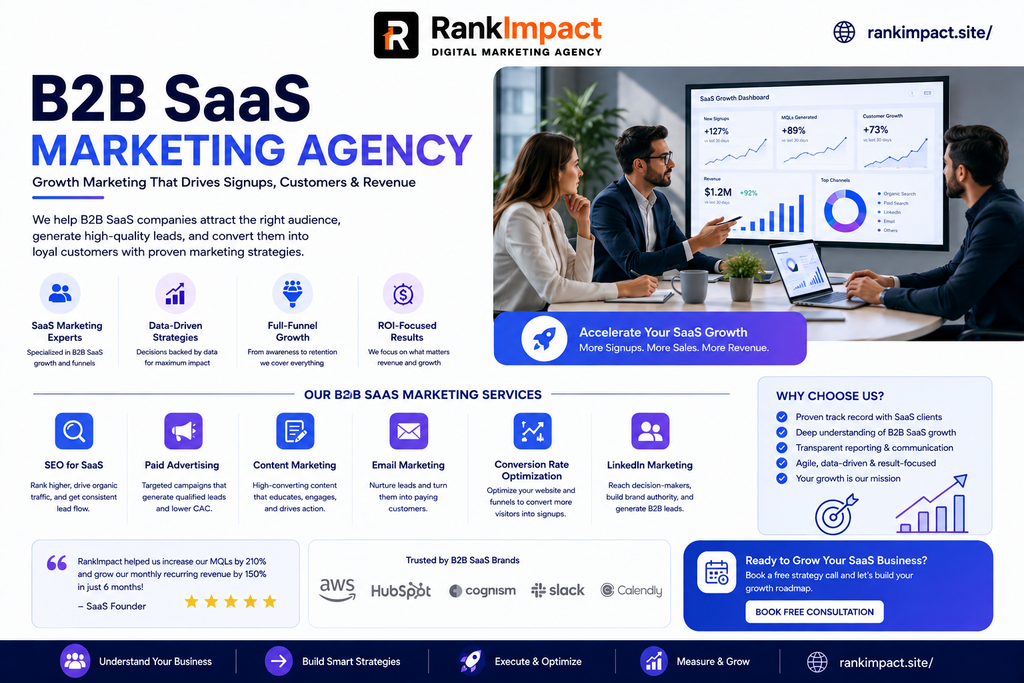
Marketing team at a b2b saas marketing agency reviewing campaign performance data.

What A B2B SaaS Marketing Agency Actually Does

A b2b saas marketing agency is a specialized marketing partner that focuses exclusively or primarily on helping software companies that sell to other businesses grow their pipeline, brand awareness, and revenue. Unlike a general marketing agency that might handle everything from restaurant social media to retail advertising, this type of partner understands the specific dynamics of a subscription business, including longer sales cycles, multiple decision makers, and the importance of metrics like customer acquisition cost and lifetime value rather than simple one time conversion tracking. Services typically include search engine optimization, content marketing, paid advertising across platforms like Google and LinkedIn, marketing automation setup, and increasingly demand generation programs designed to fill a sales pipeline with qualified opportunities rather than just generic website traffic. Because the buyer journey for business software often stretches across months and involves several stakeholders, a strong partner in this space also understands how to build content and campaigns that speak differently to a technical evaluator than to an economic buyer signing off on the budget. This is exactly the kind of nuance a generalist agency rarely brings, and it is a big part of why a b2b saas marketing agency exists as its own distinct category rather than a subset of general marketing services.

Why Software Companies Choose Specialized Marketing Help

Generalist agencies often struggle with the unique rhythm of a subscription business, since their playbooks were built around industries with shorter sales cycles or simpler buyer journeys. A b2b saas marketing agency brings pattern recognition from working across many software companies facing similar challenges, which means they often spot growth opportunities and warning signs faster than an internal team seeing these dynamics for the first time. Specialized partners also tend to understand which metrics actually matter for a subscription business, focusing on pipeline generated, sales qualified leads, and eventual closed revenue rather than vanity metrics like raw traffic or social media followers that do not necessarily translate into paying customers. For smaller software companies without the budget to hire a full internal marketing team covering SEO, paid ads, content, and automation separately, working with a specialized agency often provides access to that full range of expertise at a fraction of the cost of hiring each function internally. This combination of relevant experience and cost efficiency is exactly why so many growing software companies eventually decide that partnering with a b2b saas marketing agency is worth the investment.

Core Services Offered By A B2B SaaS Marketing Agency

Search engine optimization remains a foundational service, helping a software company rank for the terms their ideal customers actually search when evaluating solutions, which requires understanding both technical SEO and the specific keyword patterns common in software buying research. Content marketing goes hand in hand with SEO, producing educational articles, comparison pages, and case studies that build trust with a buyer during a typically long evaluation period rather than pushing for an immediate sale. Paid advertising, particularly on platforms like Google, LinkedIn, and increasingly programmatic display networks, helps generate immediate pipeline while organic efforts like SEO and content build momentum over a longer timeframe. Marketing automation and lifecycle campaigns nurture leads who are not yet ready to buy, keeping a company top of mind through relevant email sequences until a prospect reaches a stage where sales outreach makes sense. Some agencies also offer conversion rate optimization, website design, and even light sales enablement support, recognizing that marketing and sales increasingly need to work as a connected system rather than separate functions handing leads off with little coordination. A strong b2b saas marketing agency treats this connectivity as a core part of the service rather than an afterthought.

Signs Your Company Might Need A B2B SaaS Marketing Agency

A clear signal is a growth plateau, where your company has been generating a similar volume of pipeline for several consecutive quarters despite continued effort from your internal team, suggesting a need for fresh strategy or additional execution capacity that a b2b saas marketing agency can often provide quickly. Another sign is an internal team that is spread too thin across too many channels, attempting SEO, paid ads, content, and automation simultaneously without enough time to execute any single channel well, which often results in mediocre performance everywhere rather than strong results anywhere. Companies preparing for a funding round or aggressive growth target sometimes bring in a specialized partner specifically to accelerate pipeline generation ahead of a critical business milestone that internal capacity alone cannot support fast enough. A lack of specialized expertise is another common trigger, particularly when a company needs technical SEO knowledge, complex marketing automation setup, or paid advertising experience that nobody on the current team has developed. Finally, companies entering a new market segment or launching a new product line sometimes hire outside help specifically for that initiative, since a b2b saas marketing agency can bring relevant experience faster than building that expertise internally from scratch.

How To Evaluate And Choose The Right Agency

Start by reviewing case studies and asking for specific results the agency has achieved for companies similar in size and business model to yours, since generic testimonials without measurable outcomes tell you very little about what to actually expect from a b2b saas marketing agency. Ask detailed questions about how the agency reports on performance, since a partner that only shares vanity metrics like impressions or website visits without connecting that activity to pipeline and revenue is not operating with the right priorities for a subscription business. Understand the team structure you will actually work with, since some agencies pitch senior strategists during the sales process but hand day to day execution to significantly more junior staff once the contract is signed, which can meaningfully affect quality. Pricing models vary considerably, from flat monthly retainers to performance based arrangements, and it is worth understanding exactly what is included at each pricing tier before committing, since scope creep and unclear deliverables are common sources of frustration in agency relationships. Finally, trust your instincts about communication style and cultural fit, since a technically excellent b2b saas marketing agency that is difficult to communicate with or slow to respond will still create significant friction over a long term engagement.

Common Mistakes Companies Make When Hiring An Agency

The most common mistake is choosing a b2b saas marketing agency based purely on price without carefully evaluating actual expertise and fit, which often results in a partner who technically executes the requested tasks but does not understand the strategic nuance needed for a subscription business to actually grow. Another frequent mistake is failing to define clear goals and success metrics before the engagement begins, leaving both the company and the agency without a shared understanding of what a successful partnership actually looks like after several months of work. Many companies also underestimate the importance of internal alignment, bringing on an outside partner without ensuring sales, product, and leadership teams are aligned on messaging and priorities, which creates friction and inconsistent execution regardless of how skilled the agency itself is. Expecting immediate results is another common frustration, since organic channels like SEO and content marketing typically take several months to show meaningful impact, and companies that judge an agency relationship too quickly based on paid channel results alone often miss the compounding value building in the background. Finally, some companies treat the relationship as fully hands off, providing minimal input or feedback, when in reality the strongest partnerships with a b2b saas marketing agency involve active collaboration and regular communication from both sides throughout the engagement.

Questions To Ask Before Signing A Contract

Ask specifically what channels and services are included in the proposed scope, since a proposal from a b2b saas marketing agency that sounds comprehensive on a sales call can sometimes turn out to be narrower once the actual statement of work is reviewed in detail. Clarify how often you will receive reporting and what specific metrics that reporting will include, ensuring pipeline and revenue impact are tracked alongside more general activity metrics rather than instead of them. Ask about contract length and cancellation terms, since a partner confident in their ability to deliver results should be comfortable offering reasonable flexibility rather than locking a client into a long term commitment with difficult exit terms. Request references from current or recent clients, ideally in a similar industry or company size, and actually speak with those references rather than relying solely on written testimonials the agency selected themselves. Finally, ask how the agency handles a situation where results are not meeting expectations, since understanding their process for course correction reveals a great deal about whether they will be a genuine partner during challenging periods rather than someone who disappears when things get difficult.

The Future Of B2B SaaS Marketing Agency Partnerships

Artificial intelligence is reshaping how a b2b saas marketing agency approaches research, content production, and campaign optimization, with many agencies now using AI tools to accelerate keyword research, draft initial content, and analyze campaign performance faster than manual processes ever allowed. Buyers researching software increasingly rely on AI powered search summaries and chatbots before ever visiting a company’s website, which means agencies are adapting content strategy to earn visibility within these AI generated answers rather than optimizing purely for traditional search rankings. Account based marketing continues to gain traction as a specialized service, since targeting specific high value accounts with tailored campaigns often produces stronger results for enterprise focused software companies than broad, general audience marketing efforts. Integration between marketing and revenue operations is also becoming a more standard expectation, with a b2b saas marketing agency increasingly expected to work closely within a client’s existing customer relationship management and marketing automation systems rather than operating as a disconnected outside function. Companies evaluating a partner today should look for agencies actively investing in these emerging capabilities, since a b2b saas marketing agency still relying entirely on outdated playbooks will struggle to keep pace with how quickly software buyer behavior continues to evolve.

Frequently Asked Questions

What does a b2b saas marketing agency actually do?

A b2b saas marketing agency helps software companies that sell to other businesses grow through services like search engine optimization, content marketing, paid advertising, and marketing automation, with a specific focus on subscription business metrics and longer sales cycles.

How much does it cost to hire a b2b saas marketing agency?

Costs vary significantly based on scope and company size, with smaller retainers covering a single channel like SEO or content, while comprehensive engagements spanning multiple services typically involve a considerably higher monthly investment.

How is a b2b saas marketing agency different from a general marketing agency?

The key difference is specialized understanding of subscription business dynamics, including longer sales cycles, multiple decision makers, and metrics like customer acquisition cost and lifetime value that differ from typical retail or consumer marketing approaches.

How long does it take to see results from a b2b saas marketing agency?

Paid advertising can generate leads relatively quickly, often within the first few weeks, while organic channels like SEO and content marketing typically take three to six months to show meaningful impact on pipeline and revenue.

What questions should I ask before hiring a b2b saas marketing agency?

Ask what is included in the proposed scope, how often you will receive reporting tied to pipeline and revenue rather than just activity metrics, and what the contract and cancellation terms actually look like.

Should a small startup hire a b2b saas marketing agency or build an internal team first?

This depends on budget and growth stage, but many early stage companies find that a b2b saas marketing agency provides broader expertise at lower cost than hiring multiple internal specialists before the company has proven sustainable growth.

What is the biggest mistake companies make when hiring a b2b saas marketing agency?

The biggest mistake is choosing based purely on price without evaluating actual expertise and strategic fit, which often results in technically adequate execution that lacks the nuance needed for a subscription business to genuinely grow.

Can a b2b saas marketing agency help with both marketing and sales alignment?

Yes, many agencies now offer light sales enablement support and work closely with a client’s sales team to ensure messaging and lead qualification criteria stay consistent across both functions.

How do I measure the success of a b2b saas marketing agency partnership?

Success should be measured primarily through pipeline generated and closed revenue attributed to marketing efforts, alongside supporting metrics like qualified lead volume and channel specific performance rather than raw traffic alone.

Is it common to switch b2b saas marketing agency partners?

Yes, switching is fairly common when goals, communication, or results do not align well after a reasonable evaluation period, which is why understanding contract flexibility and cancellation terms matters before signing any agreement.

Conclusion

A b2b saas marketing agency can be a genuine growth accelerator for a software company, but only when the partnership is built on clear goals, honest evaluation criteria, and consistent communication from both sides. The companies that get the most value from this type of partnership treat it as a genuine collaboration rather than a fully outsourced function they can ignore, staying involved in strategy while trusting the agency’s specialized expertise on execution. Whether you are evaluating your first outside partner or reconsidering an existing relationship that is not delivering results, focus on proven experience with companies like yours, transparent reporting tied to pipeline and revenue, and a communication style that fits how your team actually works. Approached this way, a b2b saas marketing agency becomes a genuine extension of your team rather than just another vendor relationship to manage.
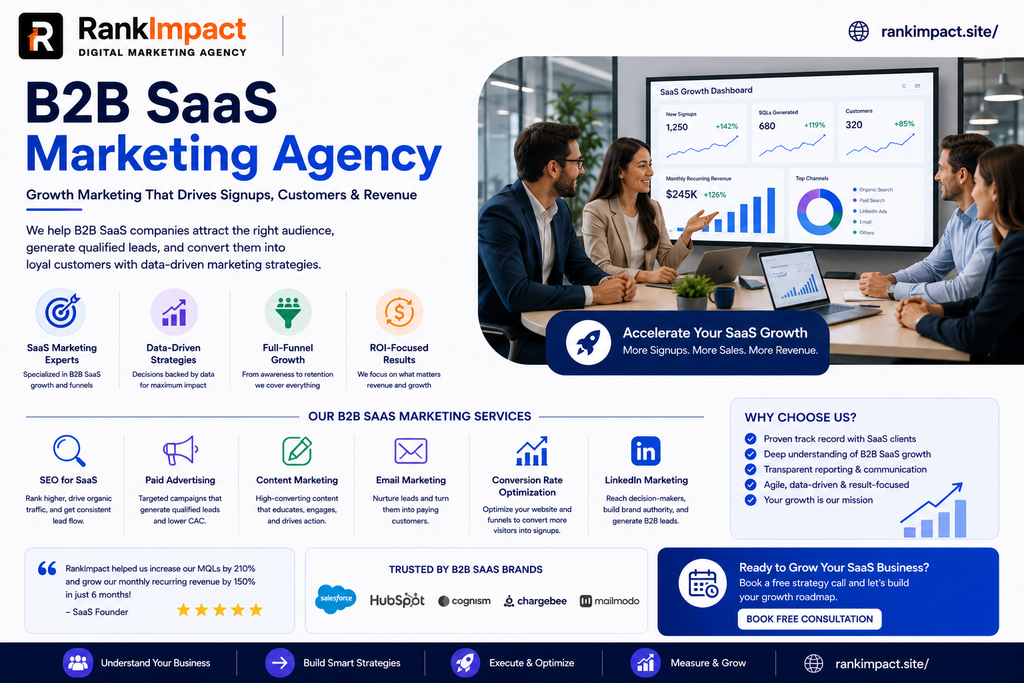
Key Takeaways

A b2b saas marketing agency specializes in the unique dynamics of subscription businesses, including longer sales cycles and multiple decision makers Core services typically include SEO, content marketing, paid advertising, and marketing automation Growth plateaus, limited internal capacity, and upcoming funding milestones are common reasons companies seek specialized help Evaluating a partner requires reviewing real case studies, understanding team structure, and clarifying reporting practices upfront The most common hiring mistake is choosing based on price alone without assessing genuine expertise and strategic fit AI adoption and account based marketing are increasingly shaping how leading agencies operate in 2026
7 Ways A SaaS Cyber Security Platform Protects You

Discover how a saas cyber security platform protects your business in 2026, covering threats, key features, best practices, and how to choose one.

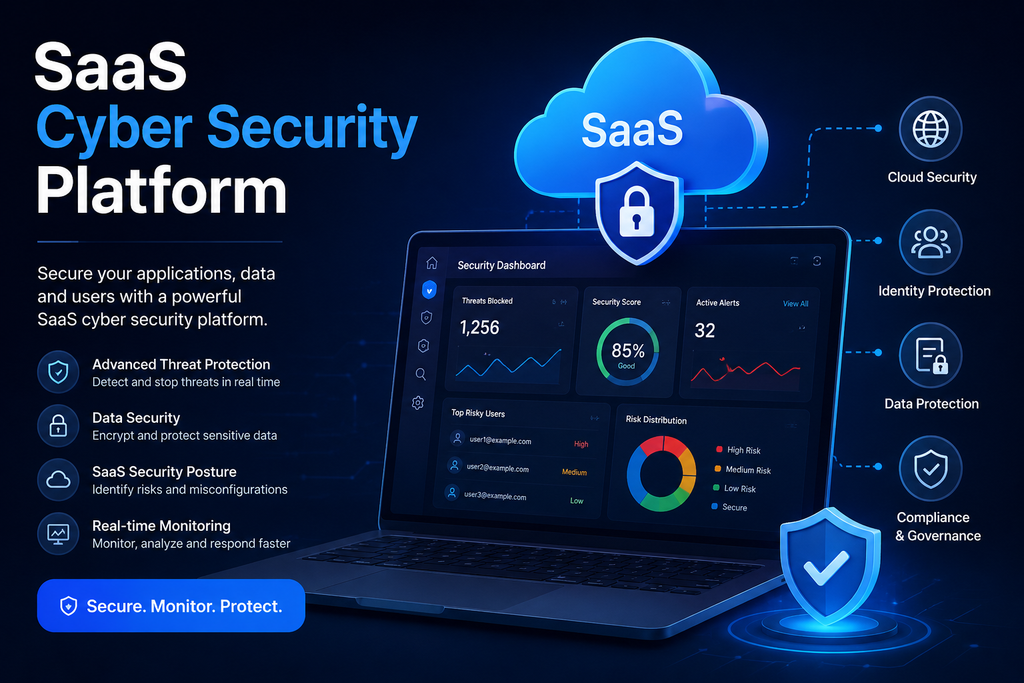
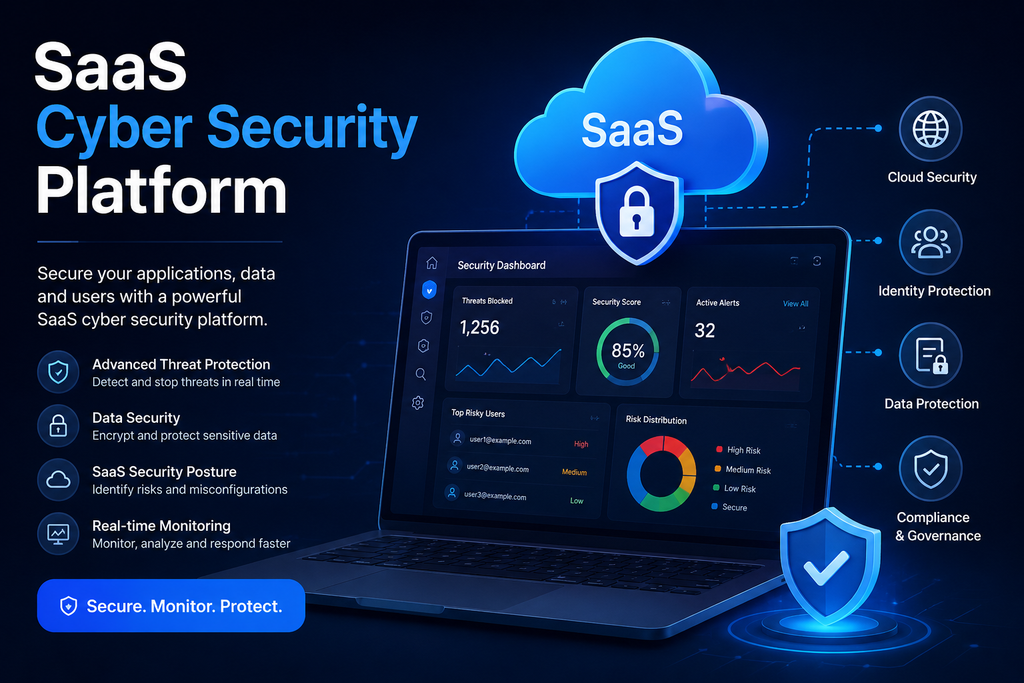
SaaS cyber security platform protecting cloud business data in 2026

What A SaaS Cyber Security Platform Actually Is

A saas cyber security platform is a cloud based security solution built specifically to protect the software as a service applications a business relies on every day, tools like email, file sharing, customer relationship management systems, project management software, and collaboration platforms. Unlike traditional network security tools that focus on protecting a physical perimeter or an on premise server room, a saas cyber security platform focuses on the identity, data, and configuration layer of cloud applications, because that is where most modern attacks actually happen. Every business that stores data in the cloud, runs applications through browser based tools, or relies on subscription software is already living inside a saas environment, whether that was a deliberate strategy or something that happened gradually as teams adopted new tools on their own. In 2026, with hybrid work now the default and the average mid sized company running well over one hundred saas applications, having a dedicated layer of protection for this environment is no longer optional, it is one of the most important investments a company can make to avoid breaches, compliance failures, and reputational damage.

Why Traditional Security Tools Fall Short In A SaaS World

The reason this category has grown so quickly is simple, traditional firewalls and endpoint tools were never designed to see inside a cloud application. They cannot tell you whether an employee shared a sensitive spreadsheet with an external account, whether a former contractor still has admin access to your customer database, or whether a third party integration has permissions far beyond what it actually needs. A saas cyber security platform closes that visibility gap by continuously scanning app configurations, user permissions, and data sharing settings, then flagging anything that deviates from a safe baseline. For a company operating in 2026, where saas sprawl is the norm rather than the exception, this kind of continuous oversight is what separates organizations that catch a problem in minutes from those that discover it months later during a breach investigation, often after real damage has already occurred.

How A SaaS Cyber Security Platform Works Behind The Scenes

Most saas cyber security platforms operate on a similar core model, even though individual vendors differ in depth and specialization. The process generally starts with discovery, where the platform connects to your cloud identity provider and application ecosystem to build a live inventory of every saas tool being used across the organization, including tools that were never formally approved by IT, often referred to as shadow IT. Once the inventory is built, the platform moves into continuous monitoring, checking configurations against security benchmarks, watching for risky permission changes, and tracking how data moves between applications and external parties. Many platforms also monitor user behavior, looking for signs of a compromised account such as impossible travel logins, unusual download volumes, or access attempts outside normal working hours. The third stage is response, where the platform can alert the security team, automatically revoke risky access, or in more advanced setups trigger a predefined workflow that isolates the affected account until it has been reviewed. This combination of discovery, monitoring, and automated response is what allows a lean security team to protect a sprawling saas environment without needing to manually audit every app one at a time.

Top Threats A SaaS Cyber Security Platform Helps You Prevent

Account takeover remains one of the most common entry points for attackers, usually achieved through stolen credentials, phishing, or password reuse, and a saas cyber security platform helps here by enforcing strong authentication policies and flagging login behavior that does not match a user’s normal pattern. Misconfigurations are another major risk, since it is extremely common for a well meaning employee to accidentally set a shared folder to public, or for an admin to leave a legacy integration with broader permissions than necessary, and these platforms continuously scan for exactly this kind of drift before it becomes a public exposure event. Third party app risk has grown significantly as businesses connect dozens of smaller tools into their core saas stack through OAuth permissions, and a saas cyber security platform tracks every connected application and the scope of access it holds, which matters because attackers increasingly target these smaller, less monitored integrations as a backdoor into larger systems. Insider threats and offboarding gaps also cause real damage, since when an employee leaves a company their access across dozens of saas tools needs to be revoked quickly and completely, and without automated tracking it is easy for a departed employee account to remain active in a forgotten corner of the environment for weeks or months. Data leakage through oversharing is a quieter but equally persistent problem, where files shared externally without proper restrictions or public links left active long after they were needed create exposure that a saas cyber security platform is specifically designed to catch.

Key Features Worth Prioritizing In A SaaS Cyber Security Platform

Continuous configuration monitoring should sit at the core of any serious platform, since misconfigurations are the most common cause of saas related incidents, and a strong solution checks settings against recognized security benchmarks while updating that baseline as new threats emerge. Identity and access visibility is equally important, since the platform should show exactly who has access to what across every connected application and make it easy to spot excessive or unused permissions. Shadow IT discovery is a feature that often gets overlooked but delivers enormous value, because a security team cannot protect an application it does not know exists, and a strong platform should automatically surface every saas tool in use, approved or not. Third party app risk scoring helps prioritize which connected integrations deserve the closest attention, since not every OAuth connected app carries the same level of risk to the business. Automated remediation workflows separate basic monitoring tools from truly effective platforms, since being alerted to a problem is useful, but being able to automatically revoke a risky permission or disable a compromised account without waiting for manual intervention is what actually reduces the window of exposure. Compliance mapping is another feature worth prioritizing, particularly for companies that need to demonstrate adherence to frameworks like SOC 2, ISO 27001, or industry specific regulations, since a platform that maps findings directly to these frameworks saves significant time during audits.

Best Practices And Common Mistakes When Adopting A SaaS Cyber Security Platform

Buying the right platform is only half the equation, how a company implements and maintains it determines whether it actually reduces risk. Start by building a complete inventory before configuring policies, since setting security rules before knowing what applications exist in the environment usually leads to gaps. Assign clear ownership for reviewing alerts, integrate the platform with your identity provider so offboarding is reflected automatically, and review third party app permissions on a recurring schedule rather than only at the point of initial connection. On the mistake side, one of the most frequent errors is choosing a platform based purely on the number of integrations it supports without evaluating the depth of monitoring for the applications that matter most. Another common error is treating the platform as a set and forget tool, configuring initial policies and rarely revisiting them even as the company adds new applications and users over time. Companies also frequently underestimate third party app governance, focusing heavily on core applications like email and file storage while ignoring the dozens of smaller connected tools that often carry outsized risk, and some organizations choose a platform without considering how well it maps to their compliance requirements, creating extra manual work later when audit season arrives.

How To Choose The Right SaaS Cyber Security Platform For Your Business

Choosing the right platform starts with understanding your own environment, so take stock of how many saas applications your teams actually use, including tools adopted informally by individual departments, since this shapes how much discovery capability you need from day one. Consider your compliance obligations early in the evaluation process, since a healthcare company, a financial services firm, and an early stage startup will have very different requirements, and the right platform should align closely with the frameworks relevant to your industry. Evaluate how each vendor handles automated remediation, since the speed at which a platform can act on a detected risk often matters more than the speed at which it detects the risk in the first place. Ask for a trial period that reflects your real environment rather than a demo built around a simplified sample account, because saas environments vary enormously and a platform that looks impressive in a demo may behave differently once connected to your actual stack of applications. Finally, weigh the vendor support and onboarding experience heavily, since a saas cyber security platform is only as effective as the team ability to configure it correctly and respond to what it surfaces, so strong onboarding support often determines long term success more than any single feature on a spec sheet.

Frequently Asked Questions

What is a saas cyber security platform in simple terms?

A saas cyber security platform is a cloud based tool that monitors and protects the software as a service applications a business uses, focusing on identity, data sharing, and configuration risks rather than traditional network perimeter defense.

How is a saas cyber security platform different from a traditional firewall?

A traditional firewall protects a network perimeter, while a saas cyber security platform focuses on what happens inside cloud applications themselves, including permissions, data sharing, and user behavior across dozens of connected tools.

Do small businesses need a saas cyber security platform?

Yes, small businesses often rely heavily on cloud tools with limited dedicated security staff, which makes automated monitoring especially valuable for catching misconfigurations and risky access before they become incidents.

Can a saas cyber security platform prevent phishing attacks?

It cannot stop a phishing email from arriving, but it can detect the unusual login behavior that follows a successful phishing attempt, which allows a security team to respond before real damage occurs.

How long does it take to implement a saas cyber security platform?

Initial discovery and connection to core applications typically takes a few days to a few weeks, though building out fully tuned policies and remediation workflows is usually an ongoing process over the following months.

What industries benefit most from a saas cyber security platform?

Any industry handling sensitive customer data benefits significantly, though healthcare, financial services, legal, and technology companies tend to see the fastest return due to strict compliance requirements and high value data.

Is a saas cyber security platform the same as a cloud access security broker?

They overlap in some functions, but a saas cyber security platform typically goes further by including configuration monitoring, third party app risk scoring, and automated remediation across the full saas ecosystem rather than focusing narrowly on access control.

How much does a saas cyber security platform typically cost?

Pricing varies widely based on the number of users and applications monitored, with most vendors using a per user or per application pricing model, so businesses should request a quote based on their actual environment.

Can a saas cyber security platform help with compliance audits?

Yes, many platforms map their findings directly to frameworks like SOC 2 and ISO 27001, which significantly reduces the manual work required to prepare evidence during an audit.

What is the biggest risk of not using a saas cyber security platform?

The biggest risk is losing visibility into your own environment, since without continuous monitoring, misconfigurations, excessive permissions, and risky third party apps can go unnoticed for months before they lead to a breach.

Conclusion

The rise of cloud based work has made every business a saas company in some form, whether that was intentional or not, and the security risks that come with that shift are not going away in 2026. A saas cyber security platform gives organizations the visibility and control needed to manage that risk without overwhelming a security team that is already stretched thin. From catching dangerous misconfigurations to tracking third party app permissions and automating access revocation during offboarding, these platforms address the specific gaps that traditional security tools were never built to cover. Choosing the right one comes down to understanding your own environment, prioritizing depth over feature count, and treating implementation as an ongoing process rather than a one time setup. Businesses that make this investment early put themselves in a far stronger position to prevent the kind of quiet, slow building exposure that eventually turns into a costly breach, and it is worth revisiting your saas cyber security platform strategy regularly as your application stack keeps growing.

Key Takeaways

A saas cyber security platform protects the identity, data, and configuration layer of cloud applications rather than a traditional network perimeter Common threats these platforms defend against include account takeover, misconfigurations, risky third party integrations, insider threats, and data oversharing The most valuable features include continuous configuration monitoring, identity visibility, shadow IT discovery, third party risk scoring, and automated remediation Successful implementation depends on clear ownership of alerts, regular policy review, and integration with your identity provider Choosing the right platform requires understanding your own saas footprint, your compliance obligations, and how quickly each vendor can act on detected risks, not just how many integrations it supports

7 Things To Know About What Is SaaS Sales In 2026

Learn what is saas sales with a complete beginner friendly guide covering the process key roles required skills and how it differs from traditional sales.

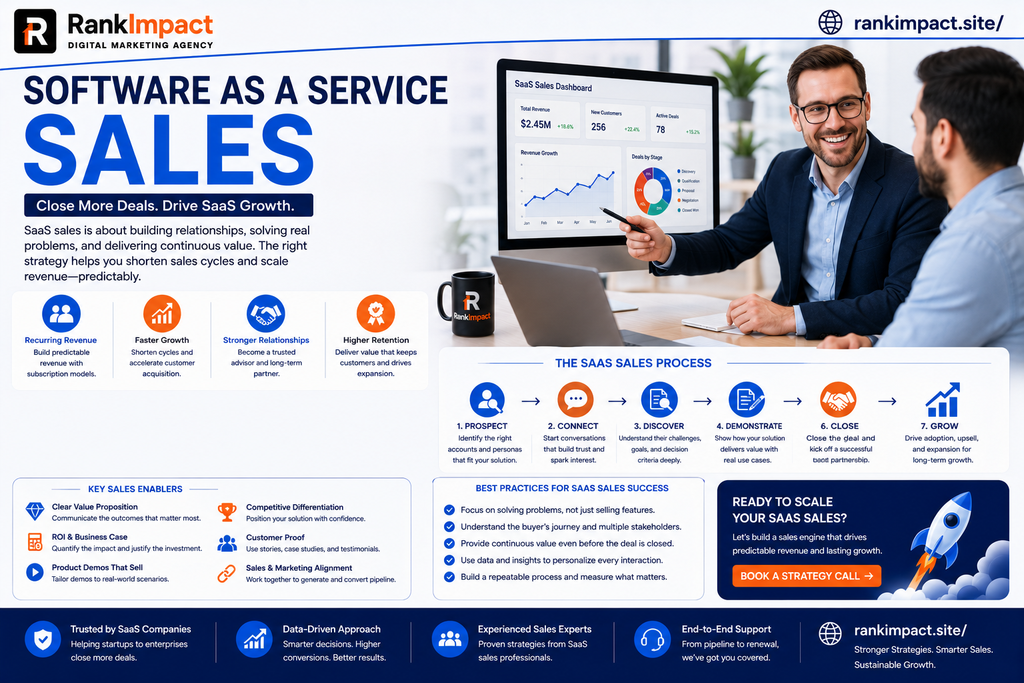
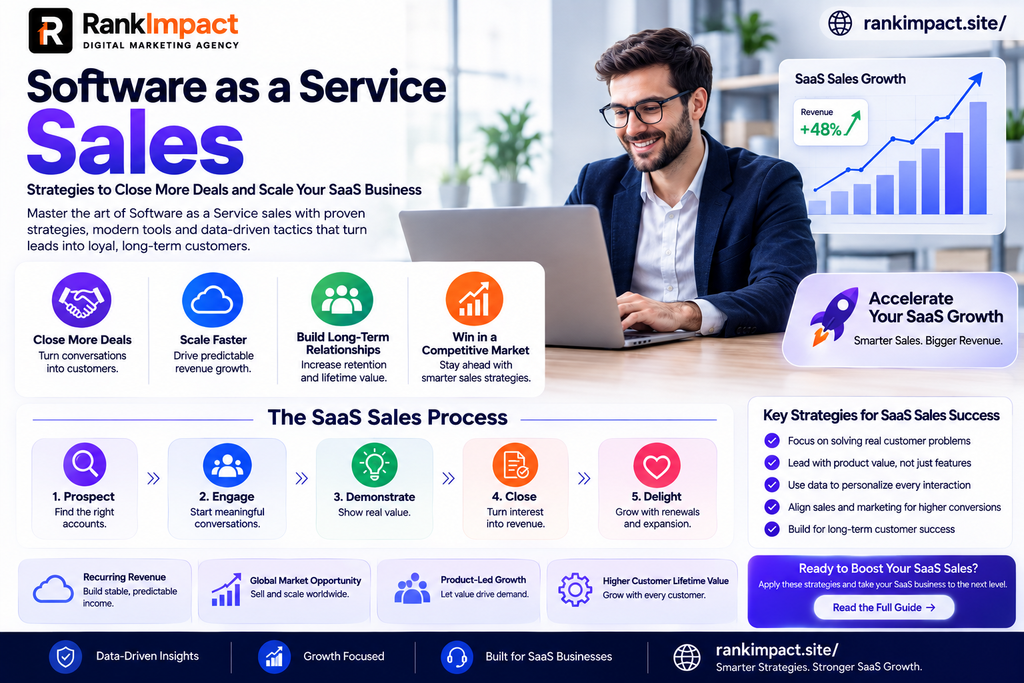
What is SaaS sales with a sales representative demonstrating software.

1 What Is SaaS Sales

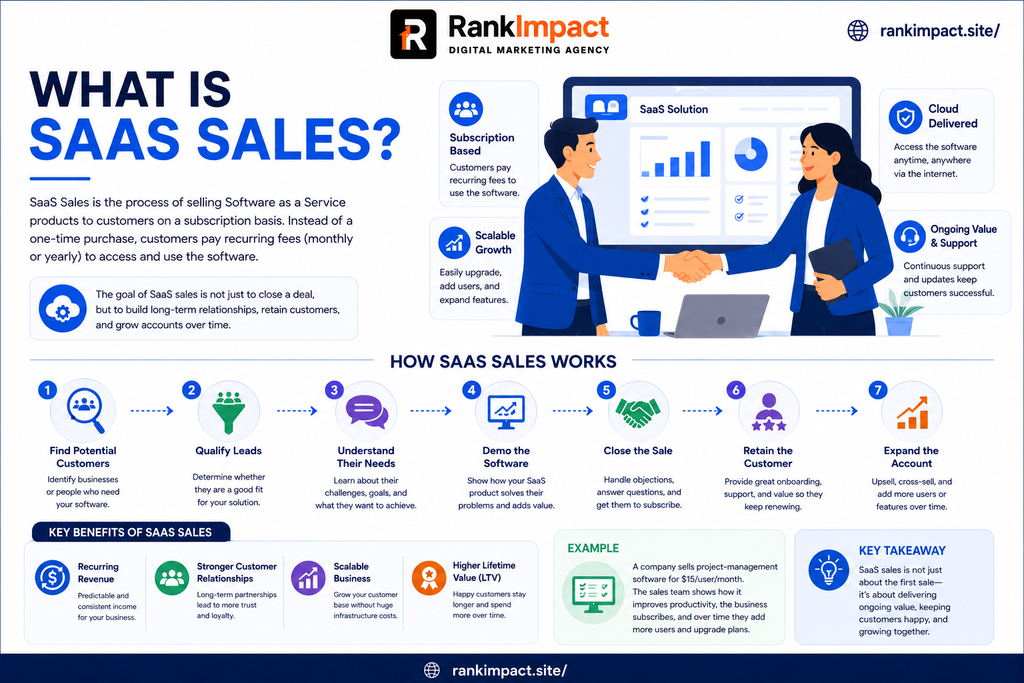
What is saas sales, in the simplest terms, is the process of selling software that customers access through a subscription rather than a product they purchase once and own outright. A saas sales professional guides a prospective customer from first learning about a product through evaluation, negotiation, and finally signing a subscription agreement, and in many companies that same person or team stays involved afterward to support renewal and expansion of the account. Because the software is delivered through the cloud rather than installed on a customer’s own servers, the sales process often includes live product demonstrations, trial periods, and close collaboration with technical evaluators who need to confirm the software actually solves their problem before a purchase decision is made. Unlike selling a physical product or a one time service, the ongoing nature of a subscription means the relationship between buyer and seller does not end at the signature, which shapes almost every part of how this type of selling is structured and measured. Anyone new to the field should start with this basic definition before moving on to specific tactics, since a solid answer to what is saas sales makes every later concept, from qualification to renewal, much easier to understand.

2 Why Understanding SaaS Sales Matters

The software industry has become one of the largest and fastest growing career paths in sales, and Understanding what is saas sales matters whether you are considering a career in the field or building a company that depends on this function to grow. Software companies rely heavily on recurring revenue, which means the sales team is not just responsible for closing new deals but also plays a role in customer retention and expansion, since a poorly qualified deal or an overpromised feature during the sales process often leads directly to churn later on. This retention focused reality is a core part of any honest answer to what is saas sales, since closing the deal is genuinely only half the job. For job seekers, this field offers strong earning potential and clear career progression from entry level roles into more senior positions, and many of the skills learned are transferable across the technology industry more broadly. For founders and business leaders, understanding the fundamentals of this discipline helps in hiring the right people, setting realistic expectations for a new sales team, and recognizing what a healthy versus unhealthy sales process actually looks like as the company scales. Even leaders who will never carry a quota themselves benefit from knowing what is saas sales at a foundational level, since it helps them evaluate whether the process their team follows actually reflects best practice or has quietly drifted into bad habits.

3 How The SaaS Sales Process Typically Works

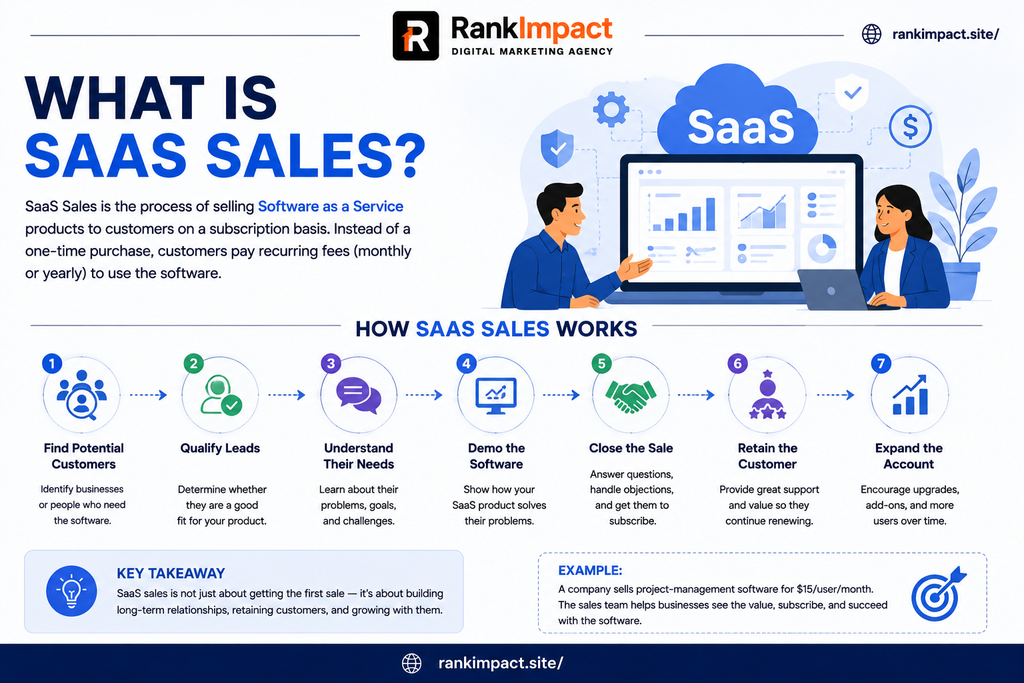
The process generally begins with lead generation, where marketing efforts or outbound prospecting identify potential customers who might benefit from the product. Understanding what is saas sales at this stage mostly means understanding how a name on a spreadsheet becomes a genuine, qualified conversation. Once a lead shows interest, a sales representative typically qualifies the prospect by confirming they have a genuine problem the product solves, the budget and authority to make a purchase decision, and a reasonable timeline for solving that problem. This qualification step is one of the most practical parts of what is saas sales, since skipping it wastes time on both sides of the conversation. Discovery calls follow, where the rep asks detailed questions to understand the prospect’s specific situation rather than immediately pitching features, since understanding the actual problem leads to a far more persuasive and relevant conversation later on. A product demonstration usually comes next, tailored to the specific use case uncovered during discovery rather than a generic walkthrough of every feature the software offers. Skipping straight to a generic demo is one of the fastest ways to undersell what is saas sales actually capable of accomplishing for a specific prospect. From there, the deal typically moves into proposal and negotiation, where pricing, contract terms, and any final questions from stakeholders get resolved before the customer signs. Many companies also include a trial or pilot period at some point in this process, giving the prospect hands on experience with the product before committing to a full contract, which builds confidence and reduces the perceived risk of the purchase decision. This full sequence, from first outreach to signed contract, is really the practical answer to what is saas sales when you see it play out in a real deal rather than described in the abstract.

4 Key Roles Within A SaaS Sales Team

A typical sales organization includes several distinct roles working together rather than one person handling the entire process alone, which is another piece of the puzzle for anyone still working out what is saas sales looks like in practice inside a real company. Sales development representatives focus on the earliest stage of the funnel, researching and reaching out to potential customers to generate qualified conversations for the rest of the team. Understanding this entry point is often the fastest way to grasp what is saas sales from the ground up, since it is where most newcomers to the field actually start. Account executives typically own the deal from qualified conversation through close, running discovery calls, demos, and negotiations to bring the sale across the finish line. This is often the role people picture first when they ask what is saas sales, though it is really only one piece of a larger team effort. Sales engineers or solutions consultants support more technical deals by answering detailed product questions and helping evaluate whether the software will integrate properly with a prospect’s existing systems. This technical layer is a part of what is saas sales that often surprises people coming from a purely relationship driven sales background. Customer success or account management roles often pick up the relationship after the initial sale, focusing on onboarding, ongoing support, and identifying opportunities for the customer to expand their subscription over time. This handoff is a defining piece of what is saas sales that has no real equivalent in most traditional one time sales environments. Sales leadership roles oversee the entire function, setting targets, coaching the team, and ensuring the overall process stays efficient as the company grows, and understanding how these roles connect helps explain why this field offers so many different entry points and career paths. Whichever role you enter through, the underlying answer to what is saas sales stays the same, everyone on the team is ultimately working toward the same recurring revenue outcome from a different angle.

5 Skills That Matter Most In SaaS Sales

Strong communication and active listening consistently rank among the most important skills, since understanding a prospect’s actual problem requires genuinely hearing what they say rather than waiting for a chance to pitch. These skills matter just as much as knowing what is saas sales in theory, since even a perfect definition does not close a single deal without the ability to actually execute a conversation well. Comfort with technology and a willingness to learn the product deeply also matters significantly, since a rep who cannot speak confidently about how the software actually works will struggle to build credibility with technical evaluators. Resilience is essential because rejection is a normal and frequent part of the job, and the reps who succeed long term are typically the ones who can handle a string of no answers without losing motivation or confidence. This resilience factor rarely shows up in a short definition of what is saas sales, but it is one of the biggest predictors of who actually lasts in the field. Organization and time management matter more than many newcomers expect, since a rep juggling dozens of active deals at different stages needs a reliable system to avoid letting opportunities slip through the cracks. This operational discipline is an underrated part of what is saas sales that rarely gets mentioned in beginner focused overviews. Finally, a genuine consultative mindset, meaning a focus on solving the customer’s problem rather than simply pushing toward a signature, tends to separate top performers from reps who close fewer deals and struggle with renewal rates on the accounts they do win.

6 How SaaS Sales Differs From Other Types Of Sales

Traditional retail or one time product sales end the relationship at the point of purchase, while this type of selling treats the sale as the beginning of an ongoing relationship built around renewal and expansion, which is one of the clearest ways to explain what is saas sales to someone coming from a different sales background entirely. Pricing structures also differ meaningfully, since subscription products are often priced per user, by usage, or through tiered plans rather than a single flat price, which requires a rep to understand a prospect’s likely growth trajectory to recommend the right plan. This pricing complexity is a big part of what makes what is saas sales genuinely different from selling something with a single fixed price tag. The sales cycle length varies more widely as well, ranging from same day self serve purchases for low cost products to multi month enterprise deals involving several stakeholders and a formal procurement process. Buying committees also tend to be more complex in this space, often including a technical evaluator, an economic buyer, and an end user champion, each of whom needs to be addressed differently during the sales process, which is quite different from the more straightforward single decision maker dynamic common in many traditional retail transactions. This complexity is one more reason a full answer to what is saas sales needs more than a single sentence to actually make sense.

7 Common Mistakes People Make When Learning SaaS Sales

New reps often make the mistake of pitching product features immediately instead of first understanding the prospect’s actual problem, which makes even a genuinely useful product sound generic and forgettable. This is often the first hard lesson anyone learns after moving past the textbook definition of what is saas sales and into an actual live conversation with a prospect. Another common mistake is neglecting to build relationships with multiple stakeholders on a deal, relying entirely on a single champion who may lose influence or leave the company before the deal closes. Many newcomers also underestimate how much technical product knowledge matters, assuming charisma alone can carry a deal, when in reality prospects increasingly expect a rep to answer detailed questions about how the software actually works. Ignoring the post sale relationship is another frequent mistake, since a rep who disappears the moment a contract is signed misses valuable opportunities for referrals, expansion revenue, and a strong reputation that leads to future deals. Anyone still learning what is saas sales should treat this lesson as essential, since the post sale relationship is where long term earning potential actually comes from. Finally, treating every prospect the same way regardless of their specific situation tends to produce mediocre results, since the most successful reps consistently tailor their approach to each buyer’s actual needs rather than running through a rigid, one size fits all script.

Frequently Asked Questions

What is saas sales in the simplest terms?

What is saas sales comes down to this, it is the process of selling subscription based software, guiding a prospective customer from first interest through a signed agreement and often supporting them afterward to encourage renewal and expansion.

Do I need a technical background to work in saas sales?

No, a technical background is not required, though a genuine willingness to learn the product deeply and understand how it solves customer problems is essential for building credibility during the sales process. Many people asking what is saas sales assume it requires a computer science degree, when in reality curiosity and strong communication skills matter far more.

How long does it typically take to close a saas sales deal?

Deal length varies significantly based on price and complexity, ranging from same day self serve purchases for low cost products to several months for larger enterprise deals involving multiple stakeholders and formal approval.

What entry level roles exist in saas sales?

Sales development representative is the most common entry point, focusing on prospecting and qualifying leads before handing them off to an account executive who manages the deal through to close.

Is saas sales a good career choice?

Yes, this field generally offers strong earning potential, clear career progression, and transferable skills, making it an attractive option for people entering sales or transitioning from another industry, which is often the real reason so many people search what is saas sales in the first place.

What is the difference between saas sales and traditional sales?

The biggest difference is that saas sales focuses on an ongoing subscription relationship built around renewal and expansion, while traditional sales typically ends the relationship at the point of a one time purchase, which is really the heart of what is saas sales as a distinct discipline.

What tools do saas sales teams typically use?

Most teams rely on a customer relationship management platform to track deals, a sales engagement tool for outreach, and often a conversation intelligence tool to analyze calls and improve performance over time, all of which support the day to day mechanics behind what is saas sales in a modern organization.

How is commission structured in saas sales?

Commission structures vary by company, but many pay a base salary plus commission tied to closed deals, and some companies also include a component tied to renewal or expansion revenue to reward long term account health, which reflects how what is saas sales differs meaningfully from a commission model built purely around one time transactions.

What skills should I develop to succeed in saas sales?

Strong communication, active listening, resilience, organization, and a consultative mindset focused on solving customer problems consistently separate top performers from reps who struggle to hit their targets, and developing these skills is really the practical side of learning what is saas sales beyond just memorizing a definition.

Can someone with no sales experience break into saas sales?

Yes, many companies hire entry level sales development representatives with little or no prior experience, since this role focuses on developing foundational skills that build toward more senior sales positions over time, which makes what is saas sales a genuinely practical question for someone considering a first career move rather than just an academic one.

How does saas sales actually feel different day to day compared to what people expect?

Most newcomers expect constant cold calling and pressure tactics, but the reality of what is saas sales in a modern, healthy organization looks more like structured research, thoughtful discovery conversations, and consultative problem solving, with far more listening than talking involved in a typical week. This day to day reality is often the most surprising part of what is saas sales for anyone coming in with outdated assumptions about the field.

Conclusion

What is saas sales ultimately comes down to a straightforward idea, it is the process of guiding a prospective buyer through evaluating and purchasing subscription software, then supporting that relationship well beyond the initial signature. Understanding this field means understanding both the mechanics of the sales process and the mindset that separates top performers from everyone else, a genuine focus on solving the customer’s problem rather than simply pushing toward a close. Whether you are exploring this as a career path or trying to build your first sales process as a founder, the fundamentals stay the same, listen more than you pitch, understand the product deeply, and treat every closed deal as the start of a relationship rather than the end of one. Build on that foundation and the rest of the skills needed in this field become far easier to develop over time, and the next time someone asks you what is saas sales, you will have a genuinely complete answer rather than a one line definition.

Key Takeaways

What is saas sales comes down to selling subscription software and supporting the customer relationship well beyond the initial sale The process typically moves through lead generation, qualification, discovery, demo, proposal, and close Key roles include sales development representatives, account executives, sales engineers, and customer success professionals Communication, resilience, organization, and a consultative mindset consistently separate top performers from the rest This field differs from traditional sales mainly through its focus on renewal and expansion rather than a single transaction Entry level roles like sales development representative make what is saas sales a genuinely accessible career path for newcomers.

9 SaaS Pricing Models Every Company Should Know

Learn how saas pricing works with a complete guide covering pricing models how to choose one common mistakes and how pricing is evolving in 2026.

SaaS pricing page showing tiered subscription plans and feature comparisons.

1 What SaaS Pricing Actually Means

SaaS pricing refers to how a software company charges customers for access to its product, which almost always happens through a recurring subscription rather than a single upfront payment. Unlike a traditional software license that a customer buys once and owns indefinitely, a subscription model means the price a customer pays is tied to an ongoing relationship, which changes how both the buyer and the seller need to think about value. A price that feels fair in month one has to keep feeling fair in month twelve and beyond, since a customer who feels overcharged relative to the value they are receiving will simply cancel at renewal. This is why saas pricing decisions carry more long term weight than a typical one time purchase price, since getting it wrong does not just cost a single sale, it can quietly damage retention and word of mouth growth for years afterward.

2 Why Getting SaaS Pricing Right Matters So Much

Pricing sits at the intersection of revenue, growth, and customer perception in a way few other business decisions do. Set the price too high without matching value and a company loses deals to competitors or scares away smaller customers who could have grown into larger ones over time. Set it too low and the company leaves significant revenue on the table while also sending a subtle signal that the product is not worth much, which can hurt how prospects perceive quality regardless of how good the product actually is. Because subscription pricing directly affects both customer acquisition cost and lifetime value, even a small adjustment to a pricing model can meaningfully change a company’s overall growth trajectory, which is why experienced SaaS operators treat pricing as an ongoing strategic exercise rather than a decision made once at launch and left untouched for years.

3 Common SaaS Pricing Models Explained

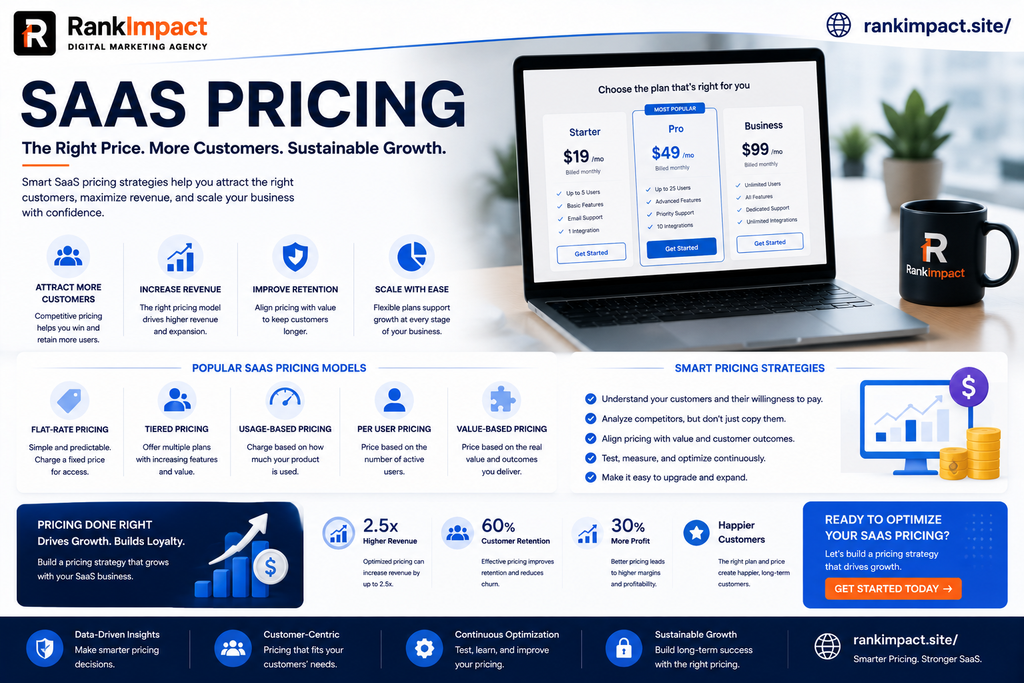
Per user pricing charges a fixed amount for each person who accesses the software, which works well for collaboration and productivity tools where value scales naturally with team size. Tiered pricing groups features into packages such as basic, professional, and enterprise, letting a company serve very different customer segments with one product while capturing more revenue from customers who need advanced capabilities. Usage based pricing charges according to actual consumption, such as the number of API calls, emails sent, or data processed, which aligns cost directly with value delivered and has become increasingly popular for infrastructure and developer focused products. Flat rate pricing offers a single price regardless of usage or team size, which simplifies the buying decision but can leave revenue on the table with larger customers who get disproportionate value from the product. Freemium pricing offers a limited free version alongside paid tiers, which works well for products that benefit from viral or self serve adoption but requires a genuinely compelling reason for free users to eventually upgrade. Many successful companies now blend several of these approaches, for example combining a per user base fee with usage based charges for specific high value features, since a hybrid saas pricing model can capture value more precisely than any single approach used alone.

4 How To Choose The Right SaaS Pricing Model For Your Product

The right saas pricing model depends heavily on how your product delivers value and who is actually using it. If value scales clearly with the number of people using the product, such as a team communication tool, per user pricing usually makes intuitive sense to buyers and is easy to forecast. If value scales with consumption rather than headcount, such as a tool that processes data or sends transactional messages, usage based pricing typically aligns more naturally with what the customer actually experiences as valuable. Products aimed at a wide range of customer sizes, from solo freelancers to large enterprise teams, often benefit from tiered pricing, since a single price point rarely serves both ends of that spectrum well. It also helps to study how your closest competitors price their products, not to copy them directly, but to understand what pricing structure your target buyers are already used to evaluating, since introducing an unfamiliar pricing structure can create unnecessary friction during the sales process even when the underlying price is fair.

5 How To Research And Compare Pricing Across SaaS Companies

When comparing saas pricing across vendors, start by looking past the advertised price on the pricing page and identify exactly what is included at each tier, since two products with similar sticker prices can differ significantly once you account for feature access, usage limits, and support level. Pay close attention to what happens when you exceed a usage limit or need a feature that is only available on a higher tier, since overage charges and forced upgrades can meaningfully change the real cost of a product beyond what the initial quote suggests. It is also worth checking whether a vendor requires an annual commitment to access their advertised price, since many companies show a lower monthly equivalent price that only applies when paying annually upfront, which can be a significant cash flow consideration for a smaller buyer. Finally, request a trial or demo whenever possible before committing, since understanding how quickly you would actually need to upgrade to a higher tier based on real usage patterns is far more useful than any published pricing table alone.

6 Common Mistakes Companies Make With SaaS Pricing

The most common mistake in saas pricing is setting a price based purely on what competitors charge without connecting it to the actual value your product delivers, which can leave meaningful revenue on the table if your product genuinely solves a more valuable problem. Another frequent mistake is making pricing too complicated, stacking so many add ons, usage tiers, and exceptions that prospects struggle to understand what they will actually pay, which slows down the sales process and increases the chance a deal stalls during evaluation. Many companies also wait far too long to revisit pricing after launch, sticking with an initial price set before the product had real market feedback, even as the product and its value proposition evolve significantly over time. Underpricing to win early customers is another costly pattern, since raising prices later on existing customers creates friction and churn risk, while starting closer to fair value from the beginning avoids that difficult conversation altogether. Finally, some companies fail to align pricing with their actual cost to serve, particularly with usage based models, which can result in a pricing structure that technically grows revenue while actually shrinking margin as usage scales.

7 How SaaS Pricing Pages Should Be Structured

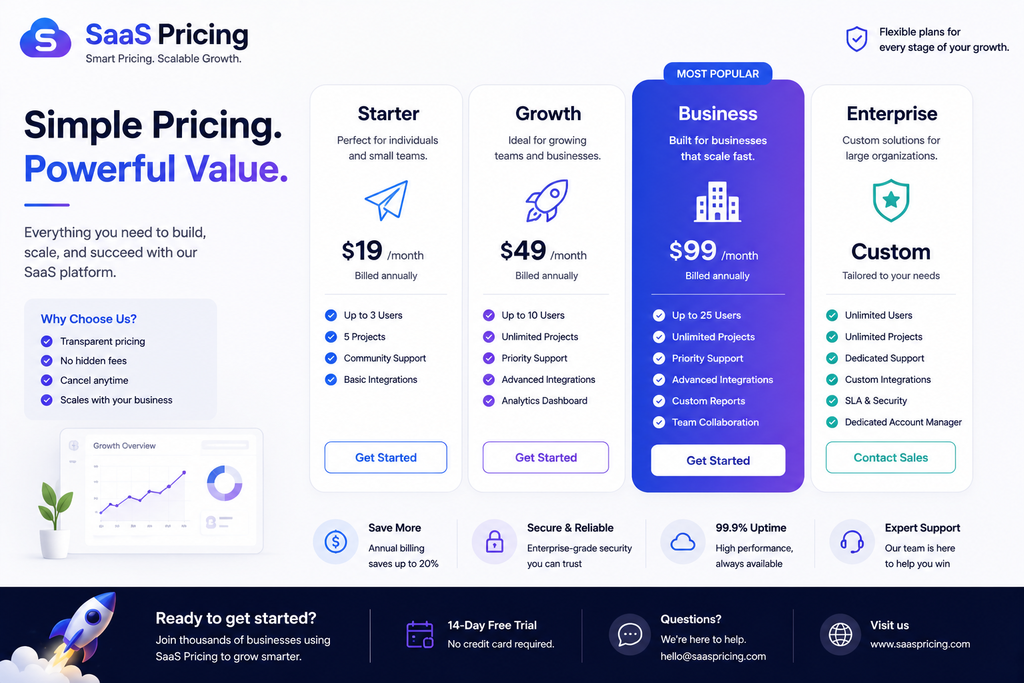
An effective saas pricing page presents options clearly, typically showing three or four tiers side by side so a prospect can compare features and price at a glance without extensive scrolling or clicking through separate pages. Highlighting a recommended or most popular tier helps guide undecided buyers toward the option that fits most customers, reducing decision fatigue during an already complex evaluation process. Clear, specific feature lists matter more than vague marketing language, since a buyer trying to justify a purchase to their own manager needs concrete details they can reference rather than abstract claims about value. Including transparent information about what happens at renewal, whether prices can change, and how easy it is to upgrade or downgrade also builds trust with a cautious buyer who has likely been burned by unclear pricing from another vendor in the past. A frequently asked questions section addressing billing cycles, cancellation policy, and enterprise custom pricing options rounds out a strong pricing page by answering the practical questions a buyer is likely to have before they are ready to commit.

8 How SaaS Pricing Is Evolving In 2026

Usage based and hybrid saas pricing models continue to gain ground as more software companies, particularly in the AI and infrastructure space, look for pricing structures that scale more precisely with the value customers actually receive rather than a flat per seat charge. Buyers have also become significantly more price sensitive and comparison savvy, often researching multiple vendors extensively and negotiating harder than they did just a few years ago, which is pushing companies toward more transparent pricing pages rather than the historical practice of hiding pricing behind a required sales call. Artificial intelligence features are increasingly priced as a separate add on or usage based line item rather than bundled silently into existing tiers, since the underlying compute cost of AI features differs meaningfully from traditional software features and companies need pricing that reflects that reality. Annual contracts remain common for larger deals, but more vendors are offering flexible monthly options at a modest premium to accommodate smaller buyers who value flexibility over the discount that comes with a longer commitment.

9 Best Practices For Communicating SaaS Pricing To Customers

Transparency in saas pricing consistently builds more trust than a hidden or negotiation heavy approach, since buyers increasingly expect to see clear pricing before engaging with a sales team, and companies that hide pricing risk losing self serve prospects who simply move on to a competitor with a visible price. Framing price in terms of the outcome or value delivered, rather than just listing features, helps a buyer understand why the price is justified rather than leaving them to guess whether it represents good value. Being upfront about limitations and what triggers an upgrade, rather than letting a customer discover overage charges after the fact, protects trust and reduces the chance of a frustrated cancellation down the line. Regularly communicating any pricing changes well in advance, along with a clear explanation of what is changing and why, also helps preserve goodwill with existing customers even when a price increase is genuinely necessary for the business.

Frequently Asked Questions

What is saas pricing in simple terms?

Saas pricing refers to how a software company charges customers for ongoing access to its product, typically through a recurring subscription rather than a one time purchase, with the price tied to factors like user count, features, or usage.

What is the most common saas pricing model?

Per user and tiered pricing remain among the most common saas pricing models, though usage based and hybrid approaches have grown significantly as more companies look to align price more closely with actual value delivered.

How do I know if my saas pricing is too low?

Signs that saas pricing is too low include very fast sales cycles with little to no pushback, customers rarely questioning the price, and a company consistently missing revenue targets despite strong customer growth and product adoption.

Should a saas company show pricing publicly or require a sales call?

Showing pricing publicly generally builds more trust and supports self serve buyers, though companies with complex enterprise deals sometimes reserve a custom quote option for larger accounts while still publishing standard tier pricing.

How often should a company review its saas pricing?

Most companies benefit from reviewing pricing at least once a year, and more frequently during periods of significant product change or market shift, since pricing that made sense at launch often no longer reflects the product’s current value.

What is usage based saas pricing?

Usage based saas pricing charges customers according to actual consumption, such as API calls or data processed, aligning cost directly with the value a customer receives rather than a flat fee regardless of how much the product is used.

Is it a mistake to copy a competitor’s saas pricing exactly?

Yes, copying a competitor’s pricing exactly ignores differences in your own product’s value, cost structure, and target customer, and can leave revenue on the table or misalign pricing with what your specific product actually delivers.

How does freemium pricing work for saas companies?

Freemium pricing offers a limited free version of the product alongside paid tiers, which works best when the free tier delivers genuine value while creating a clear and compelling reason for active users to eventually upgrade.

What should be included on a saas pricing page?

A strong saas pricing page includes clearly compared tiers, specific feature lists, transparent renewal and billing information, and a frequently asked questions section addressing common buyer concerns before they commit.

Can raising saas pricing cause customers to churn?

Yes, raising prices on existing customers without clear communication and adequate notice can increase churn risk, which is why most companies grandfather existing customers or provide advance notice and a clear rationale before any increase.

Conclusion

SaaS pricing is far more than a number on a page, it is a strategic decision that shapes how customers perceive value, how predictably a company can grow, and how sustainable that growth actually is over time. The companies that get saas pricing right treat it as an ongoing practice rather than a one time decision, regularly revisiting their model as the product, market, and customer base evolve. Whether you are setting your first price or reevaluating an existing structure, focus on aligning price with the value your product genuinely delivers, keep the structure simple enough for buyers to understand quickly, and communicate any changes with transparency and enough notice to preserve trust. Approached this way, saas pricing becomes a genuine growth lever rather than a source of confusion or lost revenue, and it is worth revisiting your saas pricing regularly as the product and market evolve.

Key Takeaways

SaaS pricing ties directly to an ongoing subscription relationship, not a one time transaction, which raises the stakes of getting it right Per user, tiered, usage based, flat rate, and freemium are the main models, and many companies now blend several together The right model depends on how your product delivers value and who your target customers actually are Common mistakes include copying competitors blindly, overcomplicating pricing, and waiting too long to revisit an outdated model Transparent pricing pages with clear tiers and honest renewal terms build more trust than hidden or negotiation heavy pricing Usage based and hybrid models, along with separately priced AI features, are shaping how saas pricing continues to evolve in 2026.

8 Security As A Service Benefits For Growing Companies

Learn what security as a service includes how it compares to alternatives what it costs common mistakes and how to choose the right provider.

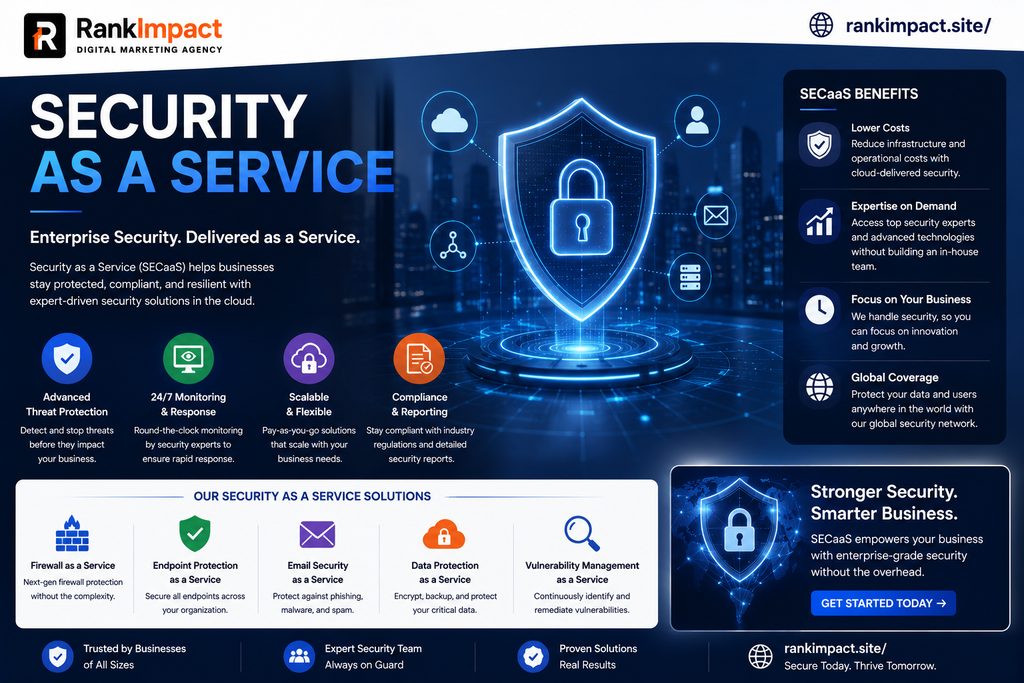
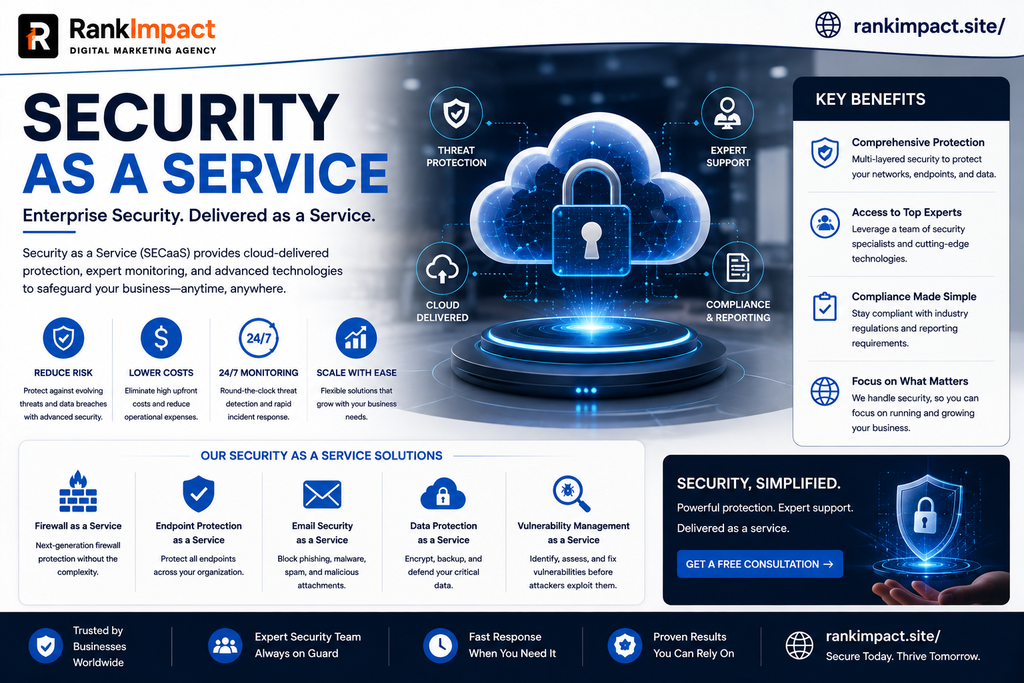
Security as a service dashboard showing real time threat monitoring and protection.

1 What Security As A Service Actually Means

Security as a service is a delivery model where a company pays a subscription fee to access security tools, monitoring, and expertise through the cloud rather than building and maintaining that infrastructure in house. Instead of purchasing hardware appliances, hiring a full time security operations team, and managing software updates internally, a business subscribes to a provider that handles the technology, the monitoring, and often the incident response as part of an ongoing relationship. This model covers a wide range of specific services, including managed firewalls, endpoint detection and response, identity and access management, email security, and continuous vulnerability scanning, all delivered and updated by the provider rather than an internal team. The appeal is straightforward, a growing company gets access to enterprise grade protection and specialized expertise without the capital expense and hiring challenge of building that capability from scratch, which matters enormously for organizations that cannot compete with large enterprises for scarce cybersecurity talent.

2 Why Security As A Service Has Become So Important

Cyber threats have grown more sophisticated and more constant, and small and mid sized businesses are increasingly targeted precisely because attackers know these organizations often lack dedicated security staff. Building an internal security operations center requires round the clock staffing, expensive tooling, and continuous training to keep pace with evolving attack techniques, which is simply out of reach for most companies outside the largest enterprises. Security as a service solves this by pooling expertise and infrastructure across many customers, which lets a provider offer monitoring and response capabilities that would be far too expensive for any single mid sized company to build alone. Regulatory pressure has added another layer of urgency, since industries like healthcare, finance, and retail face compliance requirements around data protection that are difficult to satisfy without dedicated security expertise, and a strong security as a service provider often has compliance frameworks already built into their offering. The result is that security as a service has moved from a nice to have option to something close to a baseline expectation for any company that handles sensitive customer data or operates in a regulated industry. Insurance requirements are reinforcing this shift as well, since many cyber insurance policies now require documented monitoring and response capabilities before they will issue coverage, and demonstrating an active subscription with a reputable provider often satisfies underwriters far more easily than describing an ad hoc internal process.

3 How Security As A Service Differs From Traditional Security Models

Traditional on premise security requires a company to purchase hardware, license software, and staff a team capable of configuring, monitoring, and updating that infrastructure continuously, which creates significant upfront capital expense and ongoing operational burden. Security as a service shifts this to an operating expense model, where a predictable subscription fee replaces large upfront purchases and the provider absorbs the burden of keeping tools updated against the latest threats. This also differs from a managed security service provider model in an important way, since managed security providers typically manage a company’s existing security tools, while a security as a service provider usually delivers the tools themselves as part of the subscription, bundling technology and expertise together rather than separating them. Scalability is another meaningful difference, since a growing company can typically add users, locations, or additional protection layers to a security as a service subscription far more easily than it could scale an internally built security program, which often requires new hardware purchases and additional hiring every time the business grows. Speed to deployment also tends to favor the subscription model, since a provider can typically activate coverage for a new company within days, while building an equivalent internal capability from the ground up can take many months of hiring, procurement, and configuration before it is genuinely operational.

4 Core Components Of A Security As A Service Offering

A comprehensive security as a service package typically includes several distinct layers working together rather than a single standalone tool. Endpoint detection and response protects individual devices like laptops and servers by continuously monitoring for suspicious behavior and automatically containing threats before they spread. Identity and access management controls who can access which systems and data, often including multi factor authentication and single sign on to reduce the risk of compromised credentials leading to a breach. Email security filters phishing attempts and malicious attachments before they reach an employee inbox, which matters enormously since phishing remains one of the most common ways attackers gain initial access to a company’s systems. Continuous vulnerability scanning identifies weaknesses in a company’s systems and applications before attackers can exploit them, while a security operations center staffed by the provider monitors alerts around the clock and responds to genuine incidents rather than leaving that responsibility entirely to an internal team that may only work standard business hours. Data loss prevention is another component worth understanding, since it watches for sensitive information leaving the company through email, file transfers, or cloud storage, catching accidental leaks as well as deliberate exfiltration attempts before they become a reportable incident. Backup and disaster recovery capabilities are sometimes bundled in as well, ensuring that even if an attack succeeds, the company can restore systems and data quickly rather than facing extended downtime. Not every provider bundles all of these components together, which is exactly why understanding what is actually included in a specific offering matters more than comparing price alone.

5 How To Choose The Right Security As A Service Provider

Choosing a security as a service provider starts with understanding your own risk profile, including what type of data you handle, which regulations apply to your industry, and where your current security gaps actually sit, since this shapes which components matter most for your specific business. Smaller companies without a dedicated IT function often benefit most from a provider that offers guided onboarding and plain language reporting, since technical jargon in an alert dashboard is not useful if nobody on staff knows how to act on it. Ask any provider under consideration exactly what is included in the base subscription versus what costs extra, since some providers advertise a low starting price but charge significantly more once you add the monitoring or response capabilities that actually matter during a real incident. Response time commitments deserve careful scrutiny, since a provider that promises monitoring but takes hours to respond to a genuine alert offers far less protection in practice than the marketing material suggests. It is also worth asking for references from customers in a similar industry and company size, since a provider that excels at protecting a small retail business may not have the depth of expertise needed for a healthcare company facing stricter compliance requirements. Finally, review the exit terms carefully before signing, since switching security providers involves transferring sensitive configuration and access details, and a contract that makes this transition difficult can trap a company with a provider that is no longer meeting their needs. It also helps to ask how the provider handles onboarding, since a rushed setup process often leaves gaps in coverage during the first few weeks when a company is most vulnerable to having something fall through the cracks.

6 Common Mistakes Companies Make With Security As A Service

The most common mistake is treating a security as a service subscription as a complete solution that eliminates the need for any internal security awareness, when in reality even the best provider cannot fully protect a company where employees regularly click phishing links or reuse weak passwords. Another frequent mistake is failing to clarify incident response responsibilities before signing a contract, which leads to confusion during an actual breach about who is responsible for containment, communication, and recovery, precious time that should be spent responding to the threat instead of arguing over contract terms. Many companies also underestimate the importance of integration, choosing a provider whose security tools do not connect well with existing business systems, which creates blind spots and makes monitoring less effective than it should be. Some organizations select a provider based purely on price without evaluating actual coverage, only to discover during a real incident that critical protections they assumed were included actually required a more expensive tier. Finally, many companies set up this protection once and never revisit it as the business grows, leaving new employees, new locations, or new cloud applications outside the scope of protection simply because nobody updated the account after the initial setup.

7 What Security As A Service Typically Costs

Pricing for security as a service varies significantly based on company size, industry, and which components are included in the subscription. Small businesses with basic needs, such as endpoint protection and email security for a limited number of users, might pay a modest monthly fee per user, while mid sized companies requiring a full stack including identity management, continuous monitoring, and incident response typically pay considerably more as coverage expands. Enterprise level contracts with dedicated security operations center coverage, custom compliance reporting, and guaranteed response times can run into significant monthly costs, but these are usually justified by the scale of data and systems being protected. It helps to think about cost in the context of what a breach would actually cost the business, including regulatory fines, customer trust, and operational downtime, since this comparison usually makes even a robust subscription look inexpensive relative to the financial damage of a serious incident. When comparing quotes, always confirm whether pricing is per user, per device, or a flat organizational fee, since these structures can produce very different total costs as a company grows.

8 The Future Of Security As A Service

Artificial intelligence is increasingly built into security as a service platforms, helping providers detect unusual behavior patterns and respond to threats faster than manual monitoring alone ever could, since AI models can process far more signal data than a human analyst reviewing alerts one at a time. Zero trust architecture, which assumes no user or device should be automatically trusted regardless of location, is becoming a standard component of leading security as a service offerings rather than an optional add on. As remote and hybrid work remain common, providers are also expanding coverage to protect distributed teams working across personal networks and devices, which traditional perimeter based security models were never designed to handle. Consolidation is another trend worth watching, as more providers bundle previously separate tools into unified platforms, making it easier for a growing company to manage security through a single relationship instead of stitching together multiple point solutions. Companies evaluating security as a service today should look for providers actively investing in these areas, since a provider that is not evolving its capabilities will struggle to keep pace with how quickly the threat landscape continues to change. Asking a prospective provider about their product roadmap and how recently their platform was updated can reveal a lot about whether they are genuinely investing in these emerging capabilities or simply marketing older technology under newer terminology.

Frequently Asked Questions

What is security as a service in simple terms?

Security as a service is a subscription based model where a company accesses security tools, monitoring, and expertise through a cloud provider instead of building and maintaining that infrastructure internally, similar in spirit to how other business software has shifted from owned infrastructure to subscription access.

How is security as a service different from a managed security service provider?

Security as a service typically delivers the security tools themselves as part of the subscription, while a managed security service provider usually manages a company’s existing tools rather than supplying new ones, though the two models increasingly overlap.

Is security as a service suitable for small businesses?

Yes, security as a service is often especially valuable for small businesses since it provides access to enterprise grade protection and expertise without the cost of hiring a dedicated internal security team.

What does a typical security as a service package include?

Most packages include endpoint detection and response, identity and access management, email security, vulnerability scanning, and around the clock monitoring, though the exact components vary significantly by provider.

How much does security as a service typically cost?

Costs vary based on company size and coverage level, ranging from a modest per user monthly fee for basic protection to significantly higher enterprise pricing for full stack coverage with dedicated incident response.

Does security as a service replace the need for an internal IT team?

No, security as a service complements rather than fully replaces internal IT staff, since someone within the company still needs to manage the relationship, enforce security policies, and support employees on day to day issues, and that internal point of contact is often what determines how smoothly the provider relationship actually works in practice.

What questions should I ask a security as a service provider before signing?

Ask exactly what is included in the base subscription, what response time commitments look like during an actual incident, and what the process is for switching providers if the relationship does not work out.

Can security as a service help with regulatory compliance?

Yes, many providers build compliance frameworks for regulations like HIPAA or PCI DSS directly into their offering, which can significantly simplify meeting industry specific data protection requirements.

What is the biggest mistake companies make when adopting security as a service?

The biggest mistake is treating the subscription as a complete solution that removes the need for employee security awareness, when human error remains one of the leading causes of security incidents regardless of what tools are in place.

How is AI changing security as a service?

AI is helping providers detect unusual behavior and respond to threats faster than manual monitoring alone, and it is becoming a core part of how leading security as a service platforms identify and contain incidents in real time.

Conclusion

Security as a service has become one of the most practical ways for growing companies to access serious protection without the cost and complexity of building an internal security program from scratch. The businesses that get the most value from security as a service treat it as one part of a broader security culture, pairing strong provider coverage with employee awareness and clear internal ownership of the relationship, rather than assuming a subscription alone guarantees safety. Whether you are evaluating your first provider or reconsidering an existing one, focus on understanding exactly what is included, how quickly the provider actually responds to real incidents, and whether their offering can grow alongside your business. Approached this way, security as a service stops being just another line item and becomes a genuine foundation for protecting the company as it scales.

Key Takeaways

Security as a service delivers security tools, monitoring, and expertise through a subscription rather than internal infrastructure It differs from managed security providers by typically supplying the tools themselves as part of the offering Core components usually include endpoint protection, identity management, email security, and continuous monitoring Choosing the right provider requires understanding your own risk profile and clarifying incident response responsibilities upfront Pricing varies widely based on company size and coverage level, so always confirm exactly what each tier includes AI and zero trust architecture are becoming standard parts of leading security as a service platforms.

8 Software As A Service Sales Strategies That Convert

Learn how software as a service sales works with a complete guide covering funnel stages sales models common mistakes and the metrics that matter.

Sales team closing a software as a service sales deal in a modern office.

1 What Software As A Service Sales Really Means

Software as a service sales is the process of guiding a prospective customer from first awareness of a problem to a signed subscription agreement, and then continuing to support that relationship so the customer renews and ideally expands their usage over time. Unlike a traditional one time sale, the transaction itself is only the beginning of the relationship rather than the end of it. A rep who closes a deal but ignores onboarding and early usage is setting up the account for churn within the first renewal cycle, which erases the value of the original sale. This is why software as a service sales teams increasingly measure success not just by closed revenue but by net revenue retention, which tracks how much recurring revenue survives and grows after the initial contract. Selling a subscription also means the buyer is evaluating ongoing value, not a one time feature set, so every conversation during the sales process needs to build confidence that the product will keep solving the problem months and years into the future, not just on day one.

2 Why Software As A Service Sales Differs From Traditional Sales

Traditional sales optimizes for a single transaction, while software as a service sales optimizes for a long term relationship built on renewals and expansion. This changes almost everything about how a deal should be structured. A traditional sales rep can walk away the moment a contract is signed, but a subscription sales rep has a strong incentive to make sure the customer actually adopts the product, because a churned customer in month four erases months of recurring revenue and often costs more to replace than it did to acquire in the first place. Pricing structure also differs significantly, since most software as a service deals involve tiered plans, seat based pricing, or usage based pricing rather than a single flat fee, which means a rep needs to understand the buyer’s growth trajectory to recommend the right plan rather than just the biggest one. Buying committees tend to be larger too, especially for mid market and enterprise deals, often including a economic buyer, a technical evaluator, and an end user champion, each of whom cares about a different aspect of the product. A rep who only pitches to one persona in this committee will consistently lose deals to a competitor who addresses all three.

3 Building A Software As A Service Sales Process That Scales

A scalable software as a service sales process starts with a clearly defined and documented set of stages that every deal moves through, typically something like qualification, discovery, demo, proposal, negotiation, and close. Without documented stages, forecasting becomes guesswork and new reps take far longer to ramp because they have no repeatable playbook to follow. Qualification deserves special attention in a subscription business, since chasing a prospect who is not a strong fit wastes not only the sales cycle but also the future support and success resources required to keep that account from churning after signing. A common qualification framework asks whether the prospect has a genuine pain point your product solves, whether they have budget and authority to buy, and whether the timeline for solving the problem aligns with your sales cycle. Discovery calls should focus on understanding the specific outcome the buyer needs to achieve rather than walking through a generic feature list, because buyers remember how well a rep understood their situation far more than they remember a list of product capabilities. As the process matures, layering in clear exit criteria for each stage, meaning specific actions that must happen before a deal can move forward, keeps the pipeline honest and prevents deals from sitting in a stage indefinitely with no real progress.

4 Key Stages Of The Software As A Service Sales Funnel

The top of a software as a service sales funnel usually starts with marketing qualified leads generated through content, paid channels, or referrals, and the job at this stage in software as a service sales is simply to confirm genuine interest and basic fit before investing sales time. The middle of the funnel is where discovery and evaluation happen, and this is typically the longest stage because the buyer is comparing your solution against alternatives, checking references, and often running a trial or pilot to validate that the product delivers on its promises. The bottom of the funnel involves proposal, pricing negotiation, and internal approval on the buyer’s side, which can move quickly for smaller deals but often stretches for weeks or months in mid market and enterprise accounts due to procurement and legal review. A stage that is frequently underestimated is the post sale onboarding period, which some teams treat as a separate customer success function but which strongly influences whether the deal actually pays off, since a customer who never reaches meaningful product usage is a customer who will not renew regardless of how smoothly the initial sale went. Mapping conversion rates at each of these stages lets a sales leader spot exactly where deals are stalling, whether that is a messaging problem at the top of the funnel or a pricing objection at the bottom.

5 Sales Models Used In Software As A Service Sales

Most software as a service sales organizations operate under one of three broad models or a hybrid of them, and choosing correctly among these software as a service sales models shapes almost every other decision a growing company makes. Sales led growth relies on a traditional rep driven process where an account executive owns the relationship from first conversation through close, which tends to work best for higher priced products with longer evaluation cycles and multiple stakeholders. Product led growth flips this structure by letting users try or use the product with minimal friction, often through a free trial or freemium tier, with sales only entering the picture once usage signals indicate a strong likelihood of conversion or expansion, which works well for lower priced or highly self serve products. A growing number of companies now run a hybrid model where product led growth handles smaller accounts and self serve conversion, while a dedicated sales team focuses on larger accounts that need a more consultative approach and custom contract terms. Choosing the right model, or the right mix, depends heavily on price point, deal complexity, and how much value a prospect can experience on their own before needing human guidance, and getting this choice wrong is one of the most expensive strategic mistakes a growing software company can make.

6 Common Mistakes That Kill Software As A Service Sales Deals

The most common mistake in software as a service sales is pitching product features instead of the outcome the buyer actually cares about, which makes even a strong product sound generic and interchangeable with competitors. Another frequent mistake is neglecting the multi threaded nature of larger deals, where a rep who only builds a relationship with a single champion loses the deal the moment that person changes roles or loses internal influence, which happens more often than most reps expect. Underpricing to win a deal quickly is another costly mistake, since a customer who negotiates an unsustainably low price in year one often churns when the price normalizes at renewal, and that churn frequently costs more than the value of winning the deal in the first place. Poor handoffs between sales and customer success also quietly damage renewal rates, since a customer who was promised something during the sales process that the product cannot actually deliver becomes frustrated and disengaged almost immediately after signing. Finally, many teams rely too heavily on discounting as the default response to price objections instead of addressing the underlying value question, which trains buyers to expect a discount on every renewal and steadily erodes margins across the entire customer base.

7 Tools And Metrics That Support Software As A Service Sales Teams

A modern software as a service sales stack typically includes a customer relationship management platform to track pipeline and deal stages, a sales engagement tool to manage outreach cadences, and a conversation intelligence tool that records and analyzes sales calls to identify what top performers in software as a service sales do differently from the rest of the team. Beyond tools, the metrics that matter most in a subscription business go well beyond traditional close rate and deal size. Net revenue retention shows whether existing customers are expanding, staying flat, or shrinking over time, and it is often considered one of the single most important health indicators for a software as a service business. Customer acquisition cost measured against customer lifetime value tells a leadership team whether the sales motion is actually sustainable, since acquiring customers who churn quickly can look fine on a monthly revenue report while quietly destroying long term profitability. Sales velocity, which combines deal count, average deal size, win rate, and sales cycle length into a single formula, helps a sales leader understand how efficiently the team is converting pipeline into closed revenue and where the biggest opportunity for improvement actually sits.

8 How AI Is Changing Software As A Service Sales

Artificial intelligence has started reshaping software as a service sales at almost every stage of the funnel, and teams that ignore this shift in software as a service sales are already falling behind. Lead scoring models now analyze behavioral signals such as product usage, email engagement, and website activity to flag which accounts are most likely to convert, which lets reps prioritize their time far more effectively than manual scoring ever allowed. Conversation intelligence tools use AI to transcribe and analyze sales calls, surfacing objection patterns and coaching opportunities that would take a sales manager weeks to identify manually across a full team. AI powered forecasting is also becoming more common, pulling from historical deal data and current pipeline activity to produce more accurate revenue predictions than the gut feel estimates many teams still rely on. None of this replaces the human relationship building that closes complex deals, but it does mean that reps who use these tools well are consistently outperforming reps who still run their pipeline entirely from memory and instinct, and that gap is likely to keep widening as these tools continue to mature.

Frequently Asked Questions

What is software as a service sales in simple terms?

Software as a service sales is the process of selling a subscription based software product, which involves not only closing the initial deal but also supporting the customer through onboarding and renewal so the recurring revenue relationship actually lasts.

How is software as a service sales different from traditional sales?

The biggest difference is that software as a service sales optimizes for renewal and expansion revenue over time rather than a single transaction, which changes pricing strategy, deal structure, and how success is measured across the entire customer relationship.

What is the typical sales cycle length for software as a service sales?

Sales cycle length varies widely by price point and buyer complexity, ranging from a few days for low cost self serve products to several months for enterprise deals involving multiple stakeholders and a formal procurement process.

Is product led growth replacing traditional software as a service sales?

Product led growth is not fully replacing sales led approaches, but rather complementing them, with many companies now running a hybrid model where self serve handles smaller accounts and a sales team focuses on larger, more complex deals.

What metrics matter most in software as a service sales?

Net revenue retention, customer acquisition cost compared to lifetime value, and sales velocity tend to matter more in software as a service sales than traditional metrics like raw close rate, since they reflect the long term health of the subscription relationship.

How do you qualify a lead in software as a service sales?

A strong qualification framework checks whether the prospect has a genuine pain point the product solves, whether they hold budget and buying authority, and whether their timeline for solving the problem realistically aligns with your sales cycle.

Why do software as a service sales deals fail after closing?

Deals often fail after closing because of a poor handoff to onboarding, unrealistic promises made during the sales process, or low product usage that prevents the customer from experiencing real value before the first renewal decision.

What tools do software as a service sales teams typically use?

Most teams rely on a customer relationship management platform for pipeline tracking, a sales engagement tool for outreach, and increasingly a conversation intelligence tool to analyze sales calls and coach reps at scale.

How important is multi threading in software as a service sales?

Multi threading is critical for larger deals, since relying on a single champion leaves a deal vulnerable to stalling or collapsing entirely if that person changes roles, loses influence, or leaves the company during the evaluation process.

Can a small software company build an effective sales process without a large team?

Yes. A small team can build an effective process by documenting clear deal stages, qualifying leads rigorously, and focusing sales time only on prospects with strong fit, which often outperforms a larger team working without a defined process.

Conclusion

Software as a service sales is fundamentally different from traditional selling because the transaction is only the starting point of a much longer customer relationship built on renewal and expansion. The companies that consistently win at software as a service sales treat qualification, discovery, and onboarding as equally important parts of the same process rather than separate functions that hand off and forget about each other. Whether you are building your first sales process or refining one that already exists, the fundamentals stay the same, understand the buyer’s real outcome, multi thread every meaningful deal, price for long term sustainability rather than short term wins, and measure success through retention and expansion, not just closed revenue. Build the process this way and software as a service sales stops being a series of one off wins and becomes a genuine growth engine for the business, one that compounds with every renewal your software as a service sales team protects.

Key Takeaways

Software as a service sales optimizes for renewal and expansion revenue, not just the initial closed deal Qualification and discovery should focus on the buyer’s real outcome rather than a generic feature pitch Sales led growth, product led growth, and hybrid models each fit different price points and deal complexity Multi threading larger deals protects against losing momentum when a single champion changes roles Net revenue retention and sales velocity matter more than raw close rate in a subscription business AI powered lead scoring, conversation intelligence, and forecasting are becoming standard parts of the sales stack

Get Your FREE SEO Audit

Enter your details below. Our team will review your website and email you a comprehensive SEO and speed report within 24 hours.