Discover the most effective crm tools for b2b companies including Salesforce HubSpot and Pipedrive with real use cases evaluation tips and best practices.
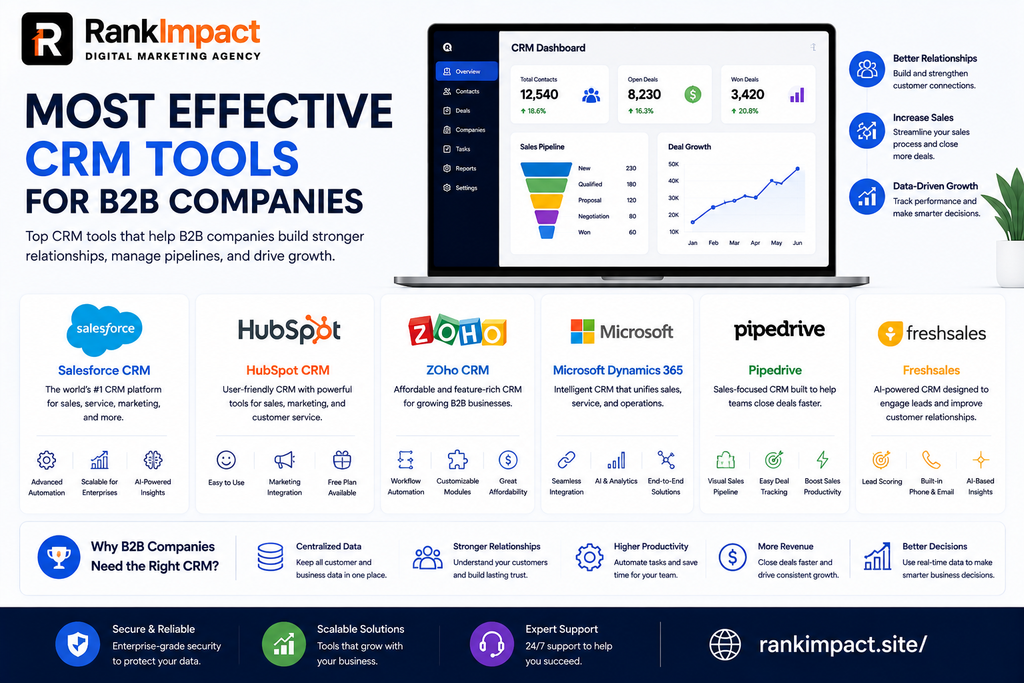
Table of Contents
What Makes a CRM Effective Specifically for B2B Selling
B2b selling involves fundamentally different mechanics than business to consumer selling, and the most effective tools reflect that reality in their core architecture rather than treating it as an afterthought feature. Deal cycles in b2b commonly stretch across weeks or months and involve multiple stakeholders inside the buying organization, which means an effective CRM needs strong support for tracking multiple contacts tied to a single account rather than just individual one off leads. Account based selling has become increasingly central to b2b revenue strategy, so tools that let sales and marketing teams organize their entire pipeline around target accounts, rather than isolated individual contacts, tend to produce far better alignment between the two departments. Forecasting accuracy also matters enormously in b2b, since larger deal sizes and longer cycles mean an inaccurate pipeline forecast can throw off hiring plans, budget decisions, and investor reporting at a company wide level. Finally, tight integration between the CRM and marketing automation tools becomes essential in b2b, since marketing qualified leads typically need to flow seamlessly into sales pipelines with full context preserved rather than losing important engagement history during handoff.
Salesforce Sales Cloud for Complex B2B Pipelines
Salesforce remains one of the most effective crm tools for b2b companies managing complex, multi stakeholder sales cycles, largely because of how deeply it supports account hierarchies and custom deal structures. A b2b software company selling to large enterprise accounts can use Salesforce to map out every contact inside a target account, track which stakeholder influences which part of the buying decision, and build custom approval workflows that mirror their actual internal sales process. Its forecasting and reporting capabilities are particularly strong for b2b organizations with multiple sales teams or territories, allowing revenue leaders to roll up pipeline data across the entire organization while still drilling into individual rep performance when needed. The AppExchange marketplace also gives b2b companies access to specialized tools for contract management, proposal generation, and account based marketing that plug directly into the existing CRM data. The tradeoff remains implementation complexity, since b2b organizations adopting Salesforce typically need a dedicated administrator or outside consultant to configure the system properly for their specific sales motion rather than relying on out of the box defaults.
HubSpot for B2B Companies Prioritizing Sales and Marketing Alignment
HubSpot consistently ranks among the most effective crm tools for b2b companies that need tight coordination between marketing and sales teams throughout a long consideration cycle. A b2b services company running content marketing, email nurture campaigns, and outbound sales simultaneously can use HubSpot to see exactly which content a prospect engaged with before their first sales call, giving reps far more context than a bare contact record would provide. Its lead scoring functionality helps b2b teams prioritize which accounts are showing genuine buying signals, such as repeated visits to pricing pages or downloading multiple pieces of bottom of funnel content, rather than treating every inbound lead with equal urgency. HubSpot also handles account based marketing reasonably well through its more advanced tiers, letting b2b teams organize campaigns and reporting around target account lists rather than individual contacts alone. Companies with smaller sales teams that rely heavily on inbound demand generation tend to see the strongest return from HubSpot, while organizations with extremely complex enterprise sales processes sometimes find its customization ceiling lower than platforms built specifically for that complexity.
Pipedrive for Lean B2B Sales Teams
Pipedrive earns its place among the most effective crm tools for b2b companies that prioritize a clean, visual sales process over extensive customization and marketing automation depth. A b2b consulting firm running a lean sales team with a handful of active deals at any given time benefits from Pipedrive’s simple pipeline visualization, which makes it easy to see exactly which deals need attention without digging through complex reports. Its relatively short learning curve means new sales hires can become productive within their first week, which matters significantly for smaller b2b teams that cannot afford lengthy onboarding periods. Pipedrive also offers solid activity based selling features, prompting reps to schedule and complete specific follow up actions that keep deals moving rather than letting them stall in a pipeline stage. The tool’s marketing automation and account based selling capabilities are noticeably lighter than platforms like HubSpot or Salesforce, making it a better fit for smaller b2b teams with simpler sales processes than for larger organizations managing complex enterprise deals.
Zoho CRM for Budget Conscious B2B Organizations
Zoho CRM stands out among the most effective crm tools for b2b companies watching their software budget closely while still needing genuine depth in sales automation and reporting. A growing b2b manufacturing company can use Zoho to manage multi contact accounts, automate follow up sequences based on deal stage, and generate detailed sales forecasting reports at a fraction of the cost of comparable enterprise platforms. Zoho also integrates naturally with its own suite of connected business applications, which appeals strongly to b2b companies that want unified data across sales, finance, and customer support without managing a dozen separate vendor relationships. Its workflow automation engine, while not quite as flexible as Salesforce, still covers the vast majority of automation needs that mid sized b2b sales teams require on a daily basis. Some larger b2b enterprises eventually find Zoho’s interface and advanced customization options less refined than higher priced competitors, but for cost conscious mid sized organizations it consistently delivers strong value relative to price.
Microsoft Dynamics 365 for Enterprise B2B Operations
Microsoft Dynamics 365 appears frequently among the most effective crm tools for b2b companies already deeply embedded in the Microsoft ecosystem, particularly large enterprises managing complex operational data alongside their sales pipeline. A b2b industrial equipment manufacturer running its entire operation through Microsoft tools can connect Dynamics 365 directly into Outlook, Teams, and existing enterprise resource planning data, giving sales reps full context on account history, order status, and support tickets without switching platforms. Its combination of CRM and ERP functionality makes it particularly effective for b2b companies where sales, finance, and supply chain data need to work together closely, such as manufacturers or distributors managing large recurring account relationships. Implementation projects for Dynamics 365 tend to be significant undertakings though, often requiring months of configuration and specialized consulting support, which makes it a realistic choice mainly for larger b2b enterprises with the internal resources to manage that complexity rather than smaller growing companies.
Freshsales for B2B Teams Wanting Built In Automation
Freshsales has earned a spot among the most effective crm tools for b2b companies that want strong built in automation and artificial intelligence features without needing to purchase and integrate separate add on tools. A b2b software company running an active outbound sales motion can use Freshsales built in lead scoring to identify which accounts are showing the strongest buying signals based on email engagement and website activity, helping reps prioritize their limited outreach time more effectively. The platform also bundles phone and email functionality directly into the CRM, which reduces the need for smaller b2b teams to purchase and manage separate calling software just to run an effective outbound process. Freshsales tends to work particularly well for growing b2b teams that want a modern, straightforward interface without a lengthy setup process, though very large enterprises with highly complex multi department workflows may eventually find some of its customization options more limited compared to platforms like Salesforce.
Key Features B2B Companies Should Prioritize When Evaluating CRM Tools
When narrowing down the most effective crm tools for b2b companies, certain features consistently matter more for b2b selling than others and deserve extra weight during evaluation. Account and contact hierarchy support ranks near the top of this list, since b2b deals almost always involve multiple stakeholders inside a single organization, and a CRM that cannot clearly map relationships between contacts within an account creates blind spots during the sales process. Strong pipeline forecasting and reporting functionality also matters significantly more in b2b than in transactional consumer selling, since accurate revenue forecasting directly informs hiring, budgeting, and investor communication at a company wide level. Integration capabilities with marketing automation platforms deserve careful evaluation too, since b2b revenue teams depend heavily on preserving full engagement history as leads move from marketing qualified to sales qualified status. Customization flexibility matters as well, particularly for b2b companies with unique sales processes that do not fit neatly into a CRM’s default pipeline structure. Finally, evaluating how well a CRM supports team collaboration features like shared notes, internal mentions, and deal handoff workflows helps ensure the tool actually improves coordination rather than just digitizing an already disconnected process.
Common Mistakes B2B Companies Make When Selecting a CRM
One of the most frequent mistakes b2b companies make is choosing a CRM based on brand recognition or a peer recommendation without first mapping the tool against their actual sales process and deal complexity, which often results in paying for enterprise features that never get used or missing critical functionality the business genuinely needs. Another common error involves underestimating the importance of account based data structure during setup, leading teams to configure the CRM around individual contacts rather than properly organized accounts, which quickly creates confusion once multiple stakeholders from the same company enter the pipeline. Many b2b organizations also skip building proper integration between their CRM and marketing automation platform during initial rollout, resulting in disconnected data that forces reps to manually piece together a lead’s full engagement history before every call. Rushing implementation without adequate sales team training is another recurring issue, since reps who do not fully understand how to use pipeline stages, forecasting fields, or activity tracking correctly often revert to personal spreadsheets within a few months, undermining the entire investment. Finally, many b2b companies fail to revisit their CRM configuration as their sales process matures, sticking with an outdated pipeline structure for years even as their actual selling motion evolves significantly.
Best Practices for Getting Maximum Value From a B2B CRM
B2b companies that get the most value from their CRM typically start by mapping their actual sales process in detail before configuring any pipeline stages or automation rules, ensuring the system reflects how deals genuinely move through their organization rather than a generic default template. Building clear data entry standards around account and contact structure from day one prevents the common problem of messy, duplicate records that erode trust in CRM data over time. Establishing a tight integration between sales and marketing data, even if it requires additional setup effort early on, pays significant dividends by ensuring leads carry their full engagement context as they move through the funnel. Reviewing pipeline and forecasting reports together as a revenue team on a regular cadence, rather than only during formal quarterly reviews, helps surface deal risks and process bottlenecks while there is still time to address them. It also helps enormously to designate an internal CRM owner responsible for ongoing configuration, training, and data hygiene, since b2b sales processes evolve constantly and a system that never gets revisited after initial launch inevitably falls out of alignment with how the business actually sells.
How to Match a CRM Tool to Your B2B Sales Motion
Companies running a primarily inbound, content driven b2b sales motion typically get the strongest results from HubSpot, given its deep integration between marketing engagement data and the sales pipeline. B2b organizations managing complex enterprise deals with multiple stakeholders and long approval cycles generally benefit most from Salesforce or Microsoft Dynamics 365, since both offer the deep customization and account hierarchy support that complex deals demand. Smaller b2b teams running a lean, activity focused outbound sales process without heavy marketing automation needs often find Pipedrive delivers the cleanest, fastest to adopt experience. Mid sized b2b companies balancing cost against genuine feature depth frequently land on Zoho CRM as a strong middle ground option that avoids both the complexity of enterprise platforms and the limitations of very basic tools. Matching the tool to your specific sales motion, deal complexity, and internal resources for ongoing administration will consistently produce a better long term outcome than simply choosing whichever platform appears most frequently at the top of general best CRM lists.
Frequently Asked Questions
What are the most effective crm tools for b2b companies?
Salesforce, HubSpot, Pipedrive, Zoho CRM, Microsoft Dynamics 365, and Freshsales are consistently ranked among the most effective crm tools for b2b companies, each serving different needs around deal complexity, budget, and sales and marketing alignment.
What features should a b2b CRM have?
A strong b2b CRM should include account and contact hierarchy support, accurate pipeline forecasting, integration with marketing automation tools, workflow customization, and collaboration features that help sales and marketing teams stay aligned throughout a long deal cycle.
Is Salesforce good for b2b companies?
Yes, Salesforce is widely considered one of the strongest CRM platforms for b2b companies managing complex, multi stakeholder deals, thanks to its deep customization options and strong account hierarchy support.
What is the difference between a b2b CRM and a b2c CRM?
A b2b CRM typically emphasizes account hierarchies, long sales cycles, and multiple stakeholder tracking, while a b2c CRM usually focuses more on high volume transactional data and individual customer purchase history.
Which CRM is best for small b2b sales teams?
Pipedrive and HubSpot are commonly recommended for small b2b sales teams due to their shorter learning curve, clean pipeline visualization, and accessible pricing for growing organizations.
How important is sales and marketing alignment in a b2b CRM?
Sales and marketing alignment is critical in b2b CRM selection, since long consideration cycles mean leads often engage with marketing content extensively before ever speaking with a sales rep, and losing that context during handoff weakens conversion rates significantly.
Can a CRM help with account based marketing in b2b ?
Yes, many modern CRM platforms including HubSpot and Salesforce support account based marketing by allowing teams to organize campaigns, pipelines, and reporting around target account lists rather than individual contacts alone.
How long does it take to implement a CRM for a b2b company?
Implementation timelines vary based on complexity, with smaller b2b teams often becoming fully operational within a few weeks while larger enterprise implementations involving custom workflows can take several months.
What is the average cost of a CRM for b2b companies ?
CRM costs for b2b companies generally range from free entry level plans up to more than one hundred fifty dollars per user per month for advanced enterprise tiers, with most mid sized b2b organizations spending between thirty and eighty dollars per user per month.
Do b2b companies need CRM software with forecasting features?
Yes, forecasting features are particularly important for b2b companies because longer sales cycles and larger deal sizes make accurate revenue prediction essential for hiring, budgeting, and overall business planning decisions.
Conclusion
Finding the most effective crm tools for b2b companies comes down to matching a platform’s core strengths to the specific complexity of your sales motion rather than simply picking whichever tool ranks highest on a generic list. Salesforce and Microsoft Dynamics 365 excel for enterprises managing complex, multi stakeholder deals, HubSpot stands out for organizations prioritizing tight sales and marketing alignment, and tools like Pipedrive and Zoho CRM offer strong value for leaner or budget conscious b2b teams. The businesses that get the most value from their CRM investment take the time to map their actual sales process before configuring any system, prioritize account level data structure over simple contact lists, and commit to ongoing training and data hygiene rather than treating implementation as a one time project. Evaluate your team’s deal complexity, budget, and internal resources honestly, and you will land on a CRM that genuinely supports your b2b revenue growth rather than one that simply looks impressive on a features page.
Key Takeaways
The most effective crm tools for b2b companies are built around account hierarchies, multi stakeholder tracking, and accurate pipeline forecasting rather than simple individual contact management.
Salesforce and Microsoft Dynamics 365 are best suited for enterprises managing complex b2b deals with multiple stakeholders and long approval cycles.
HubSpot delivers the strongest results for b2b companies that depend heavily on tight coordination between marketing content engagement and sales follow up.
Pipedrive and Zoho CRM offer excellent options for leaner or budget conscious b2b sales teams that need a clean process without extensive customization.
Common mistakes include choosing a CRM based on brand recognition alone, neglecting account level data structure, and skipping integration between sales and marketing platforms.
Successful b2b CRM adoption depends heavily on mapping your actual sales process before configuration and designating an internal owner for ongoing data hygiene and training.
Matching a CRM to your specific deal complexity, budget, and sales motion consistently produces better long term results than choosing based on general popularity rankings alone.