+92 318 3068833 Get Free Audit

Software as a Service Sales 6 Proven Strategies

Master software as a service sales with this guide covering 6 proven strategies sales models key metrics and mistakes to avoid before you scale
software as a service sales

Software as a Service Sales Models, Process, Metrics, and Best Practices

Selling software as a service is fundamentally different from selling almost any other product because the sale is never really finished the day a contract gets signed. A subscription business only wins when the customer keeps paying month after month or year after year which means every sales conversation carries the weight of a future renewal decision. This single fact changes how deals get structured how sales teams get compensated and how success gets measured across the entire revenue organization. Software as a service sales also moves at a pace and complexity that varies enormously depending on price point since a twenty dollar per month tool might close in a single self service checkout while an enterprise platform can involve a six month cycle with a dozen stakeholders. In this guide we will break down the full landscape of software as a service sales including the major sales models the stages every deal moves through the metrics that actually predict revenue health and the specific mistakes that cause otherwise promising pipelines to stall. Whether you are building a sales motion for the first time or refining one that already exists you will find a practical framework here that reflects how top performing SaaS companies actually operate.

What Makes Software as a Service Sales Different

The core difference between software as a service sales and traditional software sales comes down to the ongoing nature of the relationship. In the old model of selling perpetual software licenses a company earned most of its revenue upfront and support contracts were a secondary consideration. In a subscription business the opposite is true because the initial sale is only the beginning of a much longer revenue relationship that depends on continued product usage and renewed trust. This shifts the entire incentive structure of a sales team since closing a deal that will churn within three months actually hurts the business more than it helps because of the cost required to acquire that customer in the first place. Sales reps in this environment need to think less like closers chasing a single transaction and more like relationship builders who are setting up a customer for long term success from the very first conversation. This is also why software as a service sales teams increasingly share ownership of outcomes with customer success and product teams rather than operating as an isolated function that disappears after the contract is signed.

Core Sales Models Used Across the SaaS Industry

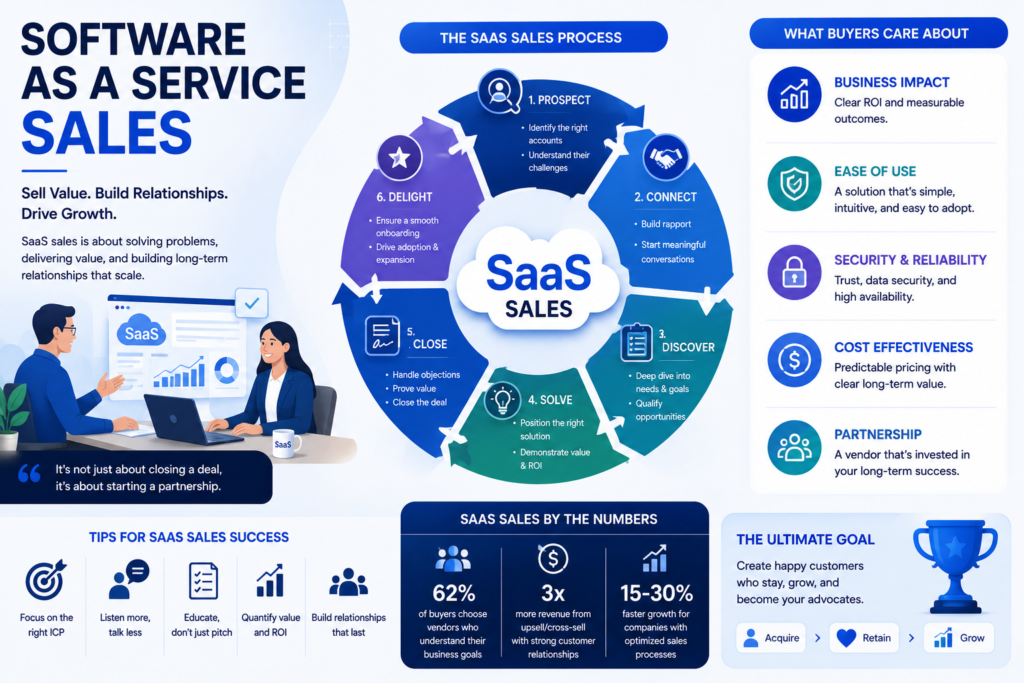
Not every software as a service sales motion looks the same and understanding which model fits your product is one of the most important early decisions a company makes. Self service sales work well for low price point products where customers can sign up start a trial and convert to a paid plan without ever speaking to a human which requires an exceptional onboarding experience since the product itself has to do the selling. Inside sales relies on a team of reps handling inbound leads and outbound outreach through calls video meetings and email typically for mid market deals where some human guidance speeds up the decision but a lengthy field sales process would be overkill. Enterprise sales involves a longer and more consultative cycle often with multiple stakeholders a formal procurement process and custom contract negotiation which is common for platforms serving large organizations with complex requirements. Many successful SaaS companies actually blend these models by offering a self service entry point for smaller customers while maintaining a dedicated enterprise sales team for larger accounts which allows the business to capture revenue across very different customer segments without forcing every buyer through the same journey.

The Stages of a Modern Software as a Service Sales Cycle

A well defined sales cycle gives every rep on a team a shared language and a repeatable structure to follow even when individual deals look different. The cycle typically begins with prospecting and qualification where a rep determines whether a lead has a genuine problem the product solves along with the budget and authority to make a purchase decision. Discovery follows next and this stage deserves far more attention than most reps give it because uncovering the real business pain behind a request determines everything about how the rest of the deal unfolds. After discovery comes the demonstration or trial stage where the product gets shown in a way that directly maps to the specific problems uncovered during discovery rather than a generic feature walkthrough that fails to connect with the buyer’s actual situation. Negotiation and procurement often follow for larger deals and this stage can stretch for weeks as legal and security teams review contracts particularly for enterprise buyers with strict compliance requirements. The cycle technically closes when the contract is signed but in software as a service sales the strongest teams treat closed won as the start of a new relationship rather than the finish line since the real test begins during onboarding and continues through every renewal conversation that follows.

Metrics That Actually Predict SaaS Sales Health

Vanity metrics like total deals closed in a month tell an incomplete story so experienced sales leaders track a broader set of numbers that reveal the true health of their revenue engine. Monthly recurring revenue and annual recurring revenue show the predictable baseline of income the business can count on which becomes the foundation for almost every other calculation in a subscription business. Customer acquisition cost measures how much it costs to win a new customer and this number only becomes meaningful when compared against customer lifetime value since a business spending more to acquire customers than those customers will ever generate in revenue is on an unsustainable path. Sales cycle length reveals how efficiently deals move through the pipeline and a lengthening cycle often signals friction somewhere in the process whether that is unclear pricing weak discovery or an overly complex procurement requirement. Win rate against qualified opportunities shows how effectively a team converts genuine interest into signed contracts while net revenue retention captures how much revenue expands or contracts from existing customers after the initial sale which many experienced operators consider the single most important number in the entire business. Tracking these metrics consistently allows a sales organization to diagnose problems early rather than discovering them only after a quarter has already gone badly.

Proven Techniques That Convert in SaaS Sales Conversations

The techniques that consistently work in software as a service sales share a common thread of putting the customer’s actual business outcomes ahead of product features. Consultative selling asks reps to spend more time listening than talking during early conversations so they can genuinely understand the prospect’s workflow before ever introducing a solution which builds far more trust than a scripted pitch. Tying every product capability directly back to a measurable business outcome such as hours saved per week or revenue protected per quarter makes the value concrete rather than abstract which matters enormously to buyers who need to justify the purchase internally. Multi threading a deal by building relationships with several stakeholders rather than relying on a single champion protects a deal from stalling if that one contact changes roles or loses internal influence during a lengthy sales cycle. Using customer stories and case studies from similar companies in the same industry helps prospects visualize their own success and reduces the perceived risk of trying something new. Finally creating genuine urgency through a clear cost of inaction conversation works far better than artificial discount deadlines because it respects the buyer’s intelligence while still motivating a timely decision.

Common Mistakes That Quietly Kill SaaS Deals

Even experienced sales teams fall into patterns that slowly erode their pipeline without anyone noticing until quarterly numbers come up short. One frequent mistake is rushing past discovery to get to a demo because reps feel pressure to show the product quickly which often results in a generic presentation that fails to connect with what the buyer actually cares about. Another common error is neglecting to identify the true economic buyer early in the process which leads to deals that feel promising for weeks before stalling once they reach someone with real budget authority who was never properly engaged. Overpromising on features or timelines to win a deal creates a serious problem down the line because customer success and product teams inherit expectations they cannot realistically meet which damages the relationship almost immediately after the contract is signed. Many teams also underinvest in handling procurement and security review efficiently which causes deals that were emotionally won weeks earlier to die slowly in legal review simply because nobody proactively prepared the documentation buyers needed. Finally failing to align sales compensation with long term customer health rather than just initial bookings encourages reps to prioritize quick wins over sustainable revenue which eventually shows up as elevated churn that damages the entire business model.

Tools and Technology Supporting Modern SaaS Sales Teams

Technology has become deeply embedded in how software as a service sales teams operate today and choosing the right stack meaningfully affects both rep productivity and forecasting accuracy. A strong customer relationship management platform remains the foundation of any sales operation since it centralizes every interaction and gives leadership visibility into pipeline health across the entire team. Sales engagement platforms help reps manage outbound sequences and follow up consistently without letting promising leads slip through the cracks during a busy week. Conversation intelligence tools that record and analyze sales calls have become increasingly valuable because they allow managers to coach based on actual conversations rather than secondhand summaries which dramatically improves the quality of feedback reps receive. Forecasting and revenue intelligence platforms use historical deal data to flag at risk opportunities before they slip which gives sales leaders time to intervene rather than being surprised at the end of a quarter. None of these tools replace fundamental sales skill but the right combination removes friction from a rep’s day and gives leadership the data needed to coach effectively and forecast with real confidence.

Building and Scaling a High Performing SaaS Sales Team

Growing a software as a service sales team from a handful of early reps into a structured organization requires deliberate planning rather than simply hiring more people and hoping revenue follows. Early stage companies benefit from generalist reps who can handle a full deal cycle from prospecting through close because specialization too early often creates unnecessary handoffs before the process is even proven. As the business matures splitting the function into dedicated roles for prospecting closing and account management typically improves both efficiency and rep specialization once there is enough volume to justify the structure. Investing in a formal onboarding program for new reps pays dividends quickly since ramp time directly affects how fast a growing team reaches full productivity and a disorganized onboarding experience extends that ramp far longer than necessary. Sales leadership should also build a consistent coaching cadence built around real deal reviews and call recordings rather than relying purely on pipeline reports because the qualitative side of coaching often reveals problems that raw numbers alone cannot show. Culture matters just as much as process in this environment since the best software as a service sales teams tend to share information openly across reps rather than treating every deal as a solo competition which ultimately raises performance across the entire team.

Aligning Sales with Customer Success for Sustainable Growth

Because subscription revenue depends entirely on renewals the line between sales and customer success has blurred significantly in modern SaaS organizations. Deals that get handed off to customer success with unclear expectations or an unrealistic implementation timeline create friction that damages the relationship right at the moment it should be strengthening. The strongest companies build a formal handoff process where sales shares detailed context about the customer’s goals stakeholders and success criteria so the customer success team can pick up seamlessly rather than starting from scratch. Some organizations take this further by tying a portion of sales compensation to renewal outcomes which naturally discourages reps from overselling deals that are unlikely to succeed long term. Regular communication between sales and customer success about expansion opportunities within existing accounts also creates a healthier revenue mix since growing an existing customer is typically far less expensive than acquiring a brand new one. Companies that treat sales and customer success as two halves of one connected revenue motion consistently outperform those that let the two functions operate in isolation from each other.

Frequently Asked Questions

What is software as a service sales Software as a service sales refers to the process of selling subscription based software products where revenue depends on ongoing customer retention rather than a single upfront transaction which requires sales teams to focus on long term customer success from the very first conversation.

How is SaaS sales different from traditional software sales SaaS sales differs because the initial sale is only the beginning of a recurring revenue relationship which means sales teams must prioritize product fit and long term value over a single transaction since a churned customer directly hurts the business even after the deal was technically won.

What are the main SaaS sales models The three main models are self service sales for low price point products inside sales for mid market deals handled remotely through calls and video and enterprise sales for large complex deals involving multiple stakeholders and formal procurement processes.

What metrics matter most in SaaS sales The most important metrics include monthly and annual recurring revenue customer acquisition cost customer lifetime value sales cycle length win rate and net revenue retention which together reveal whether the sales motion is generating sustainable long term revenue.

How long does a typical SaaS sales cycle take Sales cycle length varies dramatically by price point with self service products sometimes converting in minutes while enterprise deals often take three to six months or longer depending on the number of stakeholders and the complexity of procurement.

What is the biggest mistake in SaaS sales Rushing past genuine discovery to reach a demo is one of the most damaging mistakes because it leads to generic presentations that fail to connect with the buyer’s actual business problem which lowers both win rates and long term customer satisfaction.

How does customer success relate to SaaS sales Customer success and sales are closely connected in a subscription business because a poorly handed off deal with unrealistic expectations can quickly lead to churn which is why the strongest companies build a formal handoff process between the two teams.

What tools do SaaS sales teams typically use Common tools include a customer relationship management platform for pipeline visibility sales engagement software for consistent outbound follow up conversation intelligence tools for coaching and forecasting platforms that flag at risk deals before they slip.

How should SaaS sales compensation be structured Many companies tie a portion of compensation to renewal or retention outcomes rather than initial bookings alone which discourages reps from overselling deals that are unlikely to succeed and encourages a stronger focus on sustainable long term revenue.

What skills matter most for someone starting a career in SaaS sales Strong listening skills genuine curiosity about a customer’s business problems and the ability to tie product capabilities to measurable outcomes matter far more than aggressive closing tactics for anyone building a long term career in software as a service sales.

Conclusion

Software as a service sales rewards a fundamentally different mindset than traditional transactional selling because every deal is really the beginning of a long term relationship rather than a finish line to cross. Understanding the sales models that fit your product the stages every deal moves through and the metrics that reveal true revenue health gives any sales organization a foundation to build on rather than relying on instinct alone. The techniques that consistently work including genuine discovery multi threaded relationships and outcome focused conversations all share a common thread of putting the customer’s success ahead of a quick close. Avoiding the common mistakes covered in this guide from rushed demos to misaligned compensation protects both near term revenue and long term retention which ultimately determines whether a subscription business thrives. As you refine your own approach to software as a service sales remember that the strongest teams treat sales and customer success as two connected parts of the same journey rather than separate functions working in isolation from each other.

Key Takeaways

Software as a service sales depends on long term retention which means every deal should be approached as the start of an ongoing relationship rather than a single transaction. Choosing the right sales model whether self service inside sales or enterprise sales should match your price point and the complexity of your buyer’s decision process. Tracking metrics like net revenue retention customer acquisition cost and sales cycle length reveals the true health of a revenue engine far better than deal count alone. Genuine discovery multi threading and outcome focused conversations consistently outperform aggressive closing tactics in subscription sales environments. Aligning sales compensation and handoff processes with customer success protects the business from the churn that results from overselling. Building a repeatable sales process and a consistent coaching cadence allows a software as a service sales team to scale without losing quality as headcount grows.
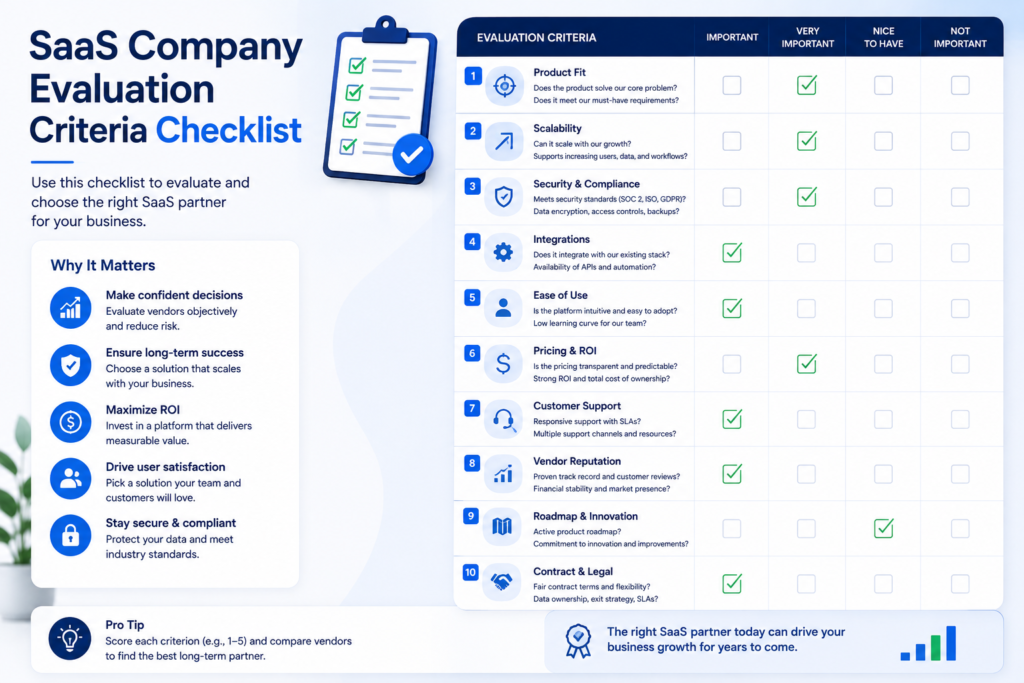
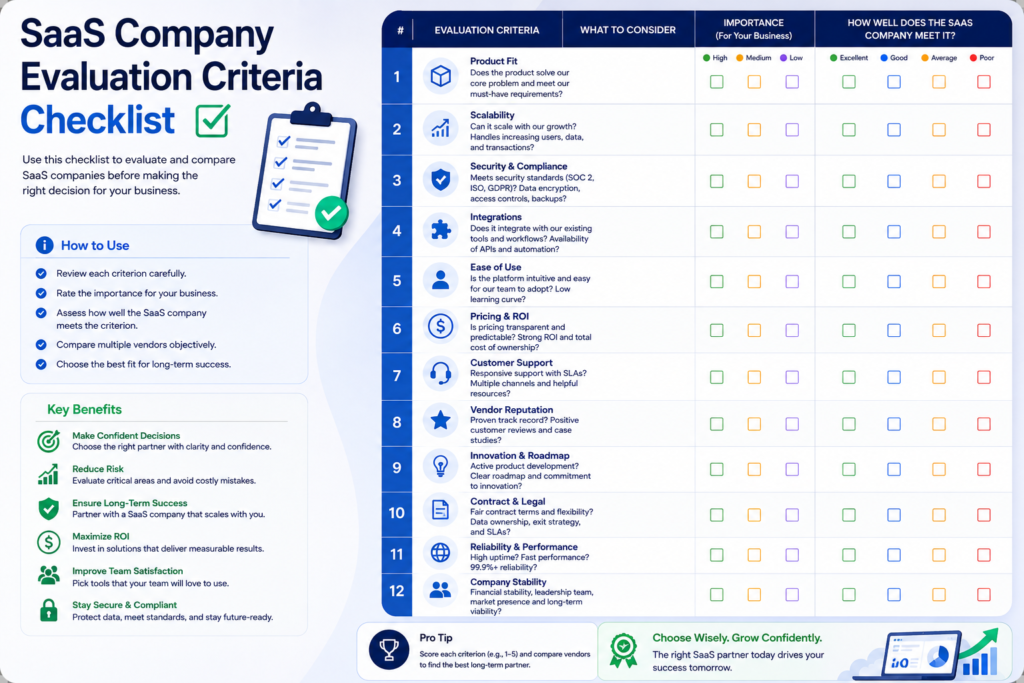
SaaS Company Evaluation Criteria Checklist 7 Steps

Follow this 7 step SaaS company evaluation criteria checklist to compare vendors on security pricing support and scalability before you buy.

SaaS company evaluation criteria checklist

SaaS Company Evaluation Criteria Checklist A Complete Guide for 2026

Choosing a software vendor used to be simple because most companies bought a handful of licenses and installed the software once. That world no longer exists. Modern businesses run on dozens of interconnected SaaS platforms that touch finance operations customer data and daily workflows so a poor vendor choice can quietly cost a company months of lost productivity and thousands of dollars in wasted spend. This is exactly why a structured SaaS company evaluation criteria checklist has become essential reading for anyone responsible for software purchasing decisions in 2026. Rather than relying on a sales demo and a gut feeling buyers now need a repeatable framework that examines a vendor from every angle including their financial health their security practices their support quality and their long term product roadmap. In this guide we will walk through every criterion that belongs on a serious SaaS company evaluation criteria checklist explain why each one matters and show you how experienced buyers apply this checklist in real purchasing decisions. By the end you will have a practical framework you can adapt for your own organization whether you are buying your first CRM or renewing an enterprise wide platform.

What a SaaS Company Evaluation Criteria Checklist Actually Covers

A proper SaaS company evaluation criteria checklist is not a single question like does this tool have the features we need. It is a multi dimensional scorecard that looks at the vendor as a business partner rather than just a piece of software. Think of it in four broad buckets: the product itself the company behind the product the commercial terms and the operational fit within your organization. Many buyers make the mistake of spending ninety percent of their evaluation time on features and only ten percent on everything else which is backwards because features can usually be replicated or worked around while a financially unstable vendor or a weak security program can end a partnership overnight. A mature checklist forces you to slow down and score each category independently so that a flashy interface does not overshadow a real weakness in data governance or customer support. When you build your own version of this checklist you should assign a weight to each category based on what matters most to your business because a healthcare company will weight compliance far higher than a small marketing agency would.

Financial Health and Business Stability

One of the most overlooked items on any SaaS company evaluation criteria checklist is the financial stability of the vendor itself. Software as a service is a subscription relationship not a one time purchase so you are effectively betting that this company will still exist and still be investing in the product three or five years from now. Ask vendors about their funding history their customer growth rate and how long they have been profitable or on a clear path to profitability. Publicly traded companies make this easier because their financials are available but private companies especially venture backed startups can be harder to assess. Look for signals like recent funding rounds customer count growth industry analyst reports and how transparent the company is when you ask direct questions about runway. A vendor that dodges financial questions or seems evasive about growth metrics should raise a flag. Vendor lock in becomes a real risk when a company goes out of business or gets acquired and sunsets the product you depend on so treating financial due diligence as a core part of your evaluation protects your business from a painful migration down the road.

Product Architecture and Technical Fit

The technical foundation of a SaaS platform tells you a great deal about how the company builds and maintains its product. When evaluating architecture look at whether the platform is built on modern cloud infrastructure whether it offers a documented API for integrations and whether it has a track record of reliable uptime. Ask vendors to share their uptime history over the past twelve months along with their incident response process because a company that hides this information is usually hiding a problem. Multi tenancy versus single tenancy architecture also matters depending on your data isolation requirements especially in regulated industries. Beyond raw architecture examine how often the company ships updates and whether those updates come with clear release notes because a stagnant product roadmap often signals a company that has stopped investing in innovation. Mobile access offline functionality and how the platform performs under heavy data loads are also worth testing directly rather than trusting a sales deck. A strong SaaS company evaluation criteria checklist always includes a technical trial period where your own engineers or power users stress test the product in conditions that mirror your actual daily workflow.

Security Compliance and Data Governance

Security has moved from a nice to have to an absolute requirement on every serious SaaS company evaluation criteria checklist because a data breach at a vendor becomes your problem the moment your customer data is involved. Start by confirming which compliance certifications the vendor holds such as SOC 2 Type II ISO 27001 or industry specific standards like HIPAA for healthcare or PCI DSS for payment processing. Ask for their most recent audit report rather than accepting a badge on their website at face value. Data encryption both at rest and in transit should be standard along with clear documentation on where customer data is physically stored since data residency rules vary significantly across regions and industries. Review their incident response plan and ask how quickly they notify customers when a breach occurs because response speed often matters more than whether an incident happened at all since even the best companies occasionally face security events. Role based access controls single sign on support and detailed audit logs are additional signals of a mature security program. Any vendor that treats security questions as an inconvenience rather than a normal part of the sales process is telling you something important about their internal culture.

Customer Support and Success Programs

Support quality is one of those criteria that only becomes obvious after you have already signed a contract which is exactly why it needs careful evaluation upfront. During your evaluation ask about support channels response time guarantees and whether dedicated customer success managers are included or sold as an add on. Request to speak with existing customers who are similar in size and industry to your own company because reference calls reveal patterns that a polished demo never will. Pay close attention to how the vendor handles onboarding since a rushed or confusing onboarding process often predicts how the rest of the relationship will feel. Look for evidence of proactive support such as regular check ins usage reviews and health scoring rather than a support team that only responds when something breaks. Community resources like knowledge bases user forums and training academies also indicate whether a company invests in customer enablement beyond the initial sale. A vendor with strong retention numbers usually has strong support behind it so ask directly about their net revenue retention rate since that single metric reflects both product satisfaction and support quality combined.

Pricing Structure and Total Cost of Ownership

Pricing looks simple on a website but becomes complicated once you factor in implementation fees training costs premium support tiers and the cost of add on modules that were not part of the initial quote. A thorough SaaS company evaluation criteria checklist requires you to calculate total cost of ownership over a realistic contract length usually two to three years rather than comparing sticker prices for a single year. Ask vendors directly about annual price increases at renewal since many SaaS contracts include automatic escalators that surprise buyers later. Clarify whether pricing is based on seats usage tiers or a flat organizational license because each model creates different incentives and risks as your company scales. Hidden costs such as data export fees API rate limit overages and charges for additional environments like staging or sandbox instances should all be documented before signing. It also helps to model a worst case growth scenario and ask the vendor how pricing changes if your usage doubles within a year because some platforms become dramatically more expensive at scale in ways that are not obvious from an initial quote. Comparing total cost of ownership rather than headline price is one of the clearest ways experienced buyers separate themselves from first time software purchasers.

Integration Capabilities and Ecosystem Fit

Modern businesses rarely buy a single tool in isolation so integration capability deserves its own dedicated section on any SaaS company evaluation criteria checklist. Start by mapping the tools already in your stack and confirming that the vendor offers native integrations or a well documented API for each one. Native integrations tend to be more reliable than custom built connections because the vendor maintains them directly and updates them when either platform changes. Ask about integration marketplaces such as Zapier or dedicated iPaaS partnerships since these can bridge gaps when native integrations do not exist. Data synchronization frequency also matters because real time sync behaves very differently from a nightly batch update when your teams need current information throughout the day. For companies with existing data warehouses inquire about direct database connections or reverse ETL support so your data team can pull information without relying entirely on the vendor’s dashboards. A platform that fits cleanly into your existing ecosystem reduces both the technical burden on your engineering team and the risk of data silos forming across departments.

Scalability and Long Term Roadmap Alignment

A tool that fits your company today might not fit your company in two years so scalability deserves careful attention during evaluation. Ask vendors directly how their platform performs for companies at your projected future size not just your current size since some SaaS products are built for small teams and struggle once usage or data volume grows significantly. Request their public product roadmap or at minimum a conversation with their product team about upcoming features especially any that align with your growth plans such as international expansion or new business units. Look at how frequently the company acquires other startups and folds those acquisitions into the core product because a pattern of poorly integrated acquisitions often creates a fragmented user experience. Customer advisory boards and public changelogs are good indicators of whether the vendor actively incorporates customer feedback into development priorities. Choosing a platform that can scale alongside your business protects you from a costly migration project just as your company hits its stride.

Common Mistakes Companies Make During SaaS Evaluation

Even experienced buyers fall into predictable traps when evaluating software vendors. One of the most common mistakes is letting a single influential stakeholder fall in love with a flashy demo without involving the actual end users who will use the tool daily. Another frequent error is skipping reference calls entirely because the sales cycle feels time pressured even though reference calls consistently reveal information that a vendor will never volunteer proactively. Many teams also underestimate implementation time and assume a new platform will be live within days when enterprise rollouts often take months especially when data migration and employee training are involved. Ignoring contract terms around data ownership and export rights is another costly oversight because some vendors make it deliberately difficult to extract your own data if you decide to leave. Finally many buyers evaluate price in isolation without weighing it against the total cost of ownership over the full contract length which leads to budget surprises at renewal time. Avoiding these mistakes is often what separates a smooth software rollout from a painful one that damages trust across departments.

Building Your Own SaaS Evaluation Scorecard

Turning everything above into a practical tool means building a simple weighted scorecard that your team can apply consistently across every vendor you evaluate. Start by listing each category discussed in this guide including financial stability product architecture security compliance customer support pricing integrations and scalability. Assign each category a weight based on what matters most to your organization since a company in a regulated industry should weight security and compliance more heavily than a small startup evaluating a marketing tool. Score each vendor on a simple scale from one to five within every category based on documented evidence rather than sales claims and require your team to write a short justification for each score so the reasoning stays transparent. Bring this scorecard into every stakeholder meeting so decisions are grounded in shared criteria instead of individual preference or the loudest voice in the room. Over time this same scorecard becomes a reusable asset that speeds up every future software evaluation your company runs because the framework already exists and only needs minor adjustments for each new use case.

Frequently Asked Questions

What is a SaaS company evaluation criteria checklist used for?

A SaaS company evaluation criteria checklist is used to systematically compare software vendors across categories like financial stability security product architecture customer support and total cost of ownership so that buying decisions are based on documented evidence rather than a single sales demo.

How many criteria should be included in a SaaS evaluation checklist?

Most thorough checklists include between seven and ten major categories such as financial health security compliance product architecture customer support pricing integrations and scalability with several sub questions under each category to guide deeper investigation.

What is the most important criterion when evaluating a SaaS vendor ?

There is no single most important criterion because the right weighting depends on your industry and risk tolerance although security and financial stability are consistently rated among the highest priorities across most industries because both carry long term business continuity risk.

How do you evaluate the financial stability of a SaaS company?

You can evaluate financial stability by reviewing public financial statements when available asking directly about funding rounds and customer growth requesting analyst reports and paying attention to how transparent the company is when answering direct questions about runway and profitability.

Why is total cost of ownership more important than the listed price?

Total cost of ownership captures implementation fees training costs support tiers and renewal price increases over the full contract length which often reveals a very different cost picture than the initial quoted price shown during the sales process.

Should reference calls be part of every SaaS evaluation ?

Yes reference calls with existing customers who are similar in size and industry to your own company consistently reveal information about support quality onboarding experience and product reliability that a sales team will rarely share proactively.

How long should a typical SaaS evaluation process take ?

A thorough evaluation for a mid size business purchase typically takes between four and eight weeks to allow time for technical trials reference calls security review and internal stakeholder alignment although enterprise purchases can take considerably longer.

What security certifications should a SaaS vendor have?

Common certifications to look for include SOC 2 Type II and ISO 27001 along with industry specific standards such as HIPAA for healthcare companies or PCI DSS for any vendor that processes payment data.

How do you compare integration capabilities across vendors?

Compare integration capabilities by mapping your existing technology stack against each vendor’s native integration list checking whether they offer a documented API and asking about data synchronization frequency since real time sync differs significantly from batch updates.

What happens if a company skips a structured evaluation checklist ?

Skipping a structured checklist increases the risk of choosing a vendor based on an appealing demo rather than long term fit which often leads to unexpected costs poor adoption among end users and a difficult migration if the platform later proves unsuitable.

Conclusion

A well built SaaS company evaluation criteria checklist transforms software buying from a rushed guessing game into a disciplined process that protects your budget your data and your team’s productivity for years to come. The categories covered in this guide including financial stability product architecture security compliance customer support pricing structure integration capability and long term scalability each play a distinct role in determining whether a vendor will become a reliable long term partner or a costly mistake. Buyers who take the time to build a weighted scorecard involve real end users in the evaluation and insist on reference calls consistently make better decisions than those who rely solely on a polished sales presentation. As your organization continues to add software tools to its stack revisit this checklist regularly because the criteria that mattered during your last purchase may need to shift as your company grows and your risk profile changes. Treat every SaaS evaluation as an investment in operational stability rather than a simple purchasing task and your future self will thank you when renewal season arrives without any unpleasant surprises.

SaaS company evaluation criteria checklist

Key Takeaways

A complete SaaS company evaluation criteria checklist looks beyond features and examines the vendor as a full business partner including their financial health and long term stability. Security compliance certifications like SOC 2 and ISO 27001 should be verified directly rather than assumed from marketing materials. Total cost of ownership over a full contract term gives a far more accurate financial picture than a single year’s listed price. Reference calls with similar customers reveal support quality and onboarding realities that sales demos rarely show. Integration capability and long term product roadmap alignment protect your company from a painful migration as your needs evolve. Building a weighted internal scorecard turns this checklist into a reusable framework that speeds up every future software decision your team makes.

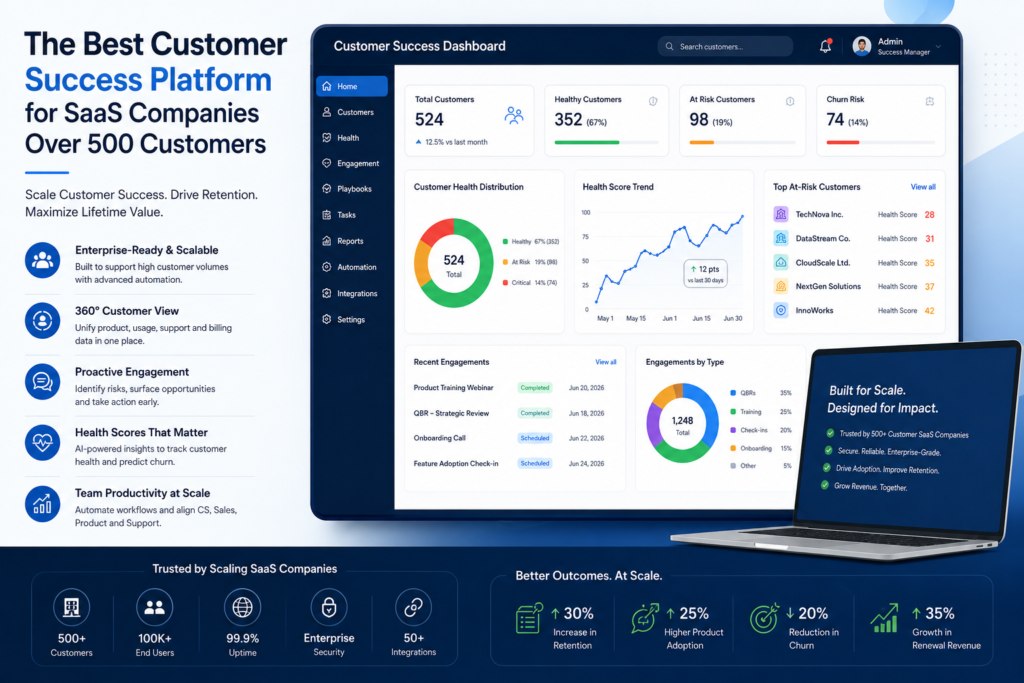
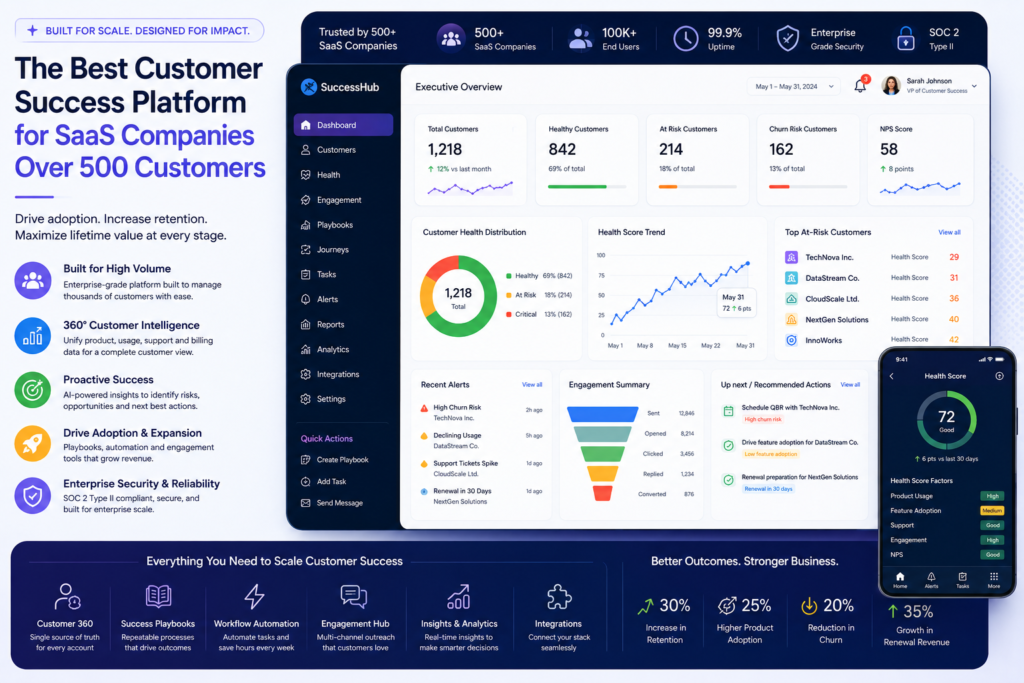
Best Customer Success Platform for SaaS Over 500 Customers

Compare the best customer success platform options for SaaS companies over 500 customers, with real vendors, pricing shape, and a framework to choose.

best customer success platform for saas companies over 500 customers

Best Customer Success Platform for SaaS Companies Over 500 Customers

Somewhere between one hundred and five hundred customers, most SaaS companies feel the first cracks in their customer success process. Somewhere past five hundred, those cracks turn into real revenue risk. Manual health checks stop scaling. A single spreadsheet cannot represent hundreds of active accounts with any accuracy. Renewal dates slip through the gaps between tools, and churn signals that used to be obvious in a founder’s gut feeling now hide inside product usage data that nobody has time to read manually. Finding the best customer success platform for SaaS companies over 500 customers is less about buying more software and more about buying the right operating layer for a team that can no longer manage growth by memory. This guide walks through what changes at this stage, the capabilities worth paying for, how the leading platforms actually compare, and the mistakes that turn a promising rollout into another underused tool.

What Changes When a SaaS Company Passes 500 Customers

The jump past five hundred customers is not just a bigger number, it is a structural shift in how customer success has to operate. Below that line, a small team can often get away with manual check ins, shared spreadsheets, and a CSM who simply knows most of the accounts by name. Above that line, the math stops working. A CSM covering eighty accounts with weekly manual reviews physically cannot repeat that process across a base that has quadrupled, so either headcount grows in a way finance will not support, or the process has to become software driven.

This is also the point where segmentation becomes essential rather than optional. Not every account past the five hundred mark deserves the same level of attention. High touch accounts still need a human relationship, mid tier accounts need automated playbooks with human oversight, and long tail accounts often need a fully automated digital motion built on in app messaging and usage triggers. A platform that cannot support this kind of tiered coverage forces every account into the same generic workflow, which wastes CSM time on accounts that do not need it and starves the accounts that do.

Data volume is the third shift. At five hundred customers and beyond, product usage events, support tickets, billing data, and NPS responses generate far more signal than any team can review manually. The platform’s job changes from simply storing customer notes to actively surfacing which accounts need attention today, based on real behavioral signals rather than a CSM’s memory of the last call.

Core Capabilities to Look For in a Customer Success Platform at This Scale

Feature lists across vendors look remarkably similar on a sales call, so the real differentiation shows up in depth and in how well the pieces work together rather than as separate bolted on modules.

Health scoring needs to be explainable rather than a black box number. A score of sixty two means very little to a CSM trying to decide what to do next. The strongest platforms break the score down into the underlying drivers, such as declining login frequency, a support ticket spike, or a feature adoption gap, so the CSM knows exactly what conversation to have and when to have it.

Automated playbooks and journey orchestration matter enormously once manual coverage becomes impossible. A good platform triggers a specific outreach sequence the moment a risk signal appears, rather than waiting for a CSM to notice a dashboard change during a quarterly review.

Native integrations with your CRM, billing system, product analytics, and support desk determine whether the platform becomes a true system of record or just another disconnected tab. At this scale, manually reconciling data between five different tools is not sustainable, and any gap in integration becomes a blind spot in your churn risk visibility.

Segmentation and tiering functionality should let you build genuinely different workflows for high touch, tech touch, and fully digital accounts within the same platform, rather than forcing every customer through an identical process regardless of contract value or risk profile.

Revenue and expansion tracking is often underweighted in early evaluations but becomes critical once a company depends on net revenue retention to hit growth targets. The platform should surface upsell and cross sell opportunities from usage data, not just churn risk, since retention alone is rarely enough to satisfy a board past this stage of growth.

Reporting built for both CSMs and leadership is the final differentiator. Frontline CSMs need a task focused view of what to do today, while leadership needs portfolio level visibility into net revenue retention, churn by segment, and CSM capacity, and the strongest platforms serve both audiences without forcing a choice.

How to Choose the Best Customer Success Platform for SaaS Companies Over 500 Customers

Choosing well at this stage starts with an honest read of your current bottleneck rather than a generic feature comparison. A company drowning in manual health checks needs automation first. A company with plenty of automation but poor visibility into revenue risk needs stronger reporting first. Naming the actual bottleneck before evaluating vendors keeps demos honest instead of letting a slick presentation set the agenda.

Match implementation complexity to your team’s capacity. Some platforms are genuinely powerful but require a dedicated CS operations person to configure and maintain, while others are built to go live within weeks with a leaner setup. A five hundred plus customer base does not automatically mean you need the most complex enterprise platform on the market, and choosing more sophistication than your team can operate often produces worse outcomes than choosing something simpler and using it consistently.

Evaluate pricing structure carefully, since costs at this customer volume can scale in very different ways depending on the vendor. Per seat pricing can become expensive quickly as your CS team grows, while usage based or tiered pricing by account count may better match how your business actually scales.

Ask for reference customers at a similar stage rather than trusting general case studies. A platform built primarily for companies with tens of thousands of customers may be overkill for a team just past the five hundred mark, while a platform built for early stage startups may not hold up once your account volume and data complexity increase.

Test the actual CSM experience during a trial or sandbox, not just the leadership dashboard shown in a sales demo. Adoption ultimately determines whether the platform delivers value, and a system your team finds clunky to use daily will quietly get abandoned no matter how impressive its reporting looks in a boardroom.

Comparing Leading Customer Success Platforms for Growing SaaS Teams

A handful of platforms consistently show up on shortlists once a SaaS company passes the five hundred customer mark, each with a different strength worth understanding before you commit to a demo cycle.

Gainsight is the most established enterprise option, built for large, complex customer portfolios with deep health scoring, journey orchestration, and revenue forecasting capabilities. It suits companies with dedicated CS operations resources who need maximum configurability and are prepared for a longer implementation timeline in exchange for that depth.

Totango offers strong account management and AI driven insights aimed at identifying growth opportunities alongside churn risk, and it is often shortlisted by enterprises that want scalable personalized engagement without building every workflow from scratch.

ChurnZero focuses heavily on real time churn detection and intuitive segmentation, and teams frequently describe its interface as more approachable than traditional enterprise platforms, making it a common choice for mid market SaaS companies that want strong automation without a steep learning curve.

Vitally has become a popular choice for teams that have outgrown spreadsheets but find the largest enterprise platforms to be overkill, pairing solid automation with an interface CSMs tend to actually enjoy using, and it typically reaches go live faster than heavier enterprise systems.

Planhat and Catalyst round out the group frequently evaluated by companies scaling past five hundred customers, each offering strong customization and reporting depth suited to teams that want flexibility in how workflows and dashboards are built without committing to the heaviest enterprise footprint.

The right answer among these depends far less on brand recognition and far more on which platform matches your actual bottleneck, your team’s implementation capacity, and the pricing shape that fits your growth stage.

Common Mistakes Companies Make When Scaling Customer Success Software

Even a genuinely strong platform can underdeliver when a handful of avoidable mistakes creep into the buying and rollout process.

Buying based on feature count rather than actual workflow fit leaves teams paying for enterprise depth they never configure or use, while the specific automation and reporting their team actually needs sits underutilized because it was never prioritized during setup.

Skipping proper data cleanup before go live means importing inconsistent account records, outdated contact information, and incomplete usage history directly into the new platform, which produces unreliable health scores and erodes trust in the system before it has a fair chance to prove itself.

Treating the rollout as purely a tooling change rather than a process change leaves CSMs unclear on how their daily workflow is supposed to shift, and without that clarity, teams tend to keep working the old way alongside the new software rather than fully adopting it.

Underinvesting in segmentation strategy forces every account through the same workflow regardless of value or risk, wasting CSM attention on low risk accounts while high value accounts do not get the proactive outreach they actually need.

Ignoring the CSM experience in favor of leadership reporting produces a platform that looks impressive in board meetings but that frontline teams find frustrating to use daily, and low daily adoption quietly undermines the accuracy of every dashboard built on top of it.

Implementation Best Practices for Customer Success Platforms at Scale

A strong platform choice still needs a disciplined rollout to deliver real value once the account base is past five hundred customers.

Start with a defined segment rather than the entire customer base at once. Rolling out new health scoring and playbooks to one tier first lets the team refine configuration and build confidence in the data before extending the same model across the full portfolio.

Involve frontline CSMs in configuring health score weightings and playbook triggers rather than designing the model in isolation. The people managing accounts daily often understand which signals genuinely predict churn far better than a generic default configuration provided by the vendor.

Clean and standardize your account data before migration, including consistent naming conventions, accurate contract dates, and complete usage history wherever possible, since even a powerful platform can only be as reliable as the data feeding its scoring model.

Define clear success metrics before launch, typically including net revenue retention, gross churn rate, time to value for new accounts, and CSM capacity utilization, so the organization can measure real impact rather than relying on subjective impressions of whether the tool feels helpful.

Phase in advanced features gradually rather than activating every module simultaneously. Getting core health scoring and playbooks stable first, then layering in revenue forecasting and deeper automation later, produces a far more stable and trusted rollout than an all at once activation.

Measuring ROI and Success After Adoption

Once a customer success platform is live, the real test is whether it measurably changes outcomes rather than simply changing where CSM notes are stored.

Net revenue retention is the clearest headline metric, since a platform genuinely improving proactive engagement should show measurable movement in expansion revenue relative to churn over the following quarters.

Time to detect risk is another strong indicator, comparing how quickly the team now identifies a churn signal against how long that same signal used to sit unnoticed in a spreadsheet or a CSM’s personal notes.

CSM capacity is worth tracking directly, since a well configured platform should allow each CSM to responsibly manage a larger book of accounts through automation, freeing up time for the high touch relationships that genuinely need a human.

Adoption rate among the CS team itself is a quieter but equally important signal, since a platform with low daily logins from the people meant to use it will not deliver the outcomes shown in a vendor’s case study, no matter how strong its theoretical capabilities are.

The Future of Customer Success Platforms for Growing SaaS Companies

Customer success platforms built for growing SaaS companies are shifting quickly from passive reporting tools toward systems that actively act on risk and opportunity rather than simply displaying it.

Artificial intelligence is increasingly embedded directly into health scoring and playbook triggers, allowing platforms to recommend or even initiate specific outreach based on patterns identified across thousands of historical accounts rather than static rules configured manually by an admin.

Explainable scoring is becoming a baseline expectation rather than a premium feature, since CSMs and leadership alike have grown skeptical of opaque risk scores that cannot be traced back to a specific underlying driver.

Tighter integration between customer success platforms and product analytics is narrowing the gap between what a customer does inside the product and what the CS team sees, reducing the manual reconciliation that used to slow down risk detection.

Faster time to value is reshaping vendor positioning generally, as more companies past the five hundred customer mark look for platforms that can go live in weeks rather than committing to lengthy enterprise implementations before seeing any measurable benefit.

Frequently Asked Questions

What is the best customer success platform for SaaS companies over 500 customers?

There is no single universal answer, since the right choice depends on your team’s implementation capacity, budget, and specific bottleneck, though Gainsight, Totango, ChurnZero, Vitally, and Planhat are the platforms most commonly shortlisted by SaaS companies at this stage.

How much does a customer success platform cost at this scale?

Pricing varies widely by vendor and account volume, with mid market platforms often starting in the low hundreds of dollars per month and scaling into the low thousands, while enterprise platforms with the deepest feature sets can run into five or six figures annually.

Do we need a dedicated CS operations person to run this software ?

Larger enterprise platforms generally benefit from a dedicated operations resource to manage configuration and reporting, while several mid market platforms are specifically built to be managed by CSM leadership without a separate operations role.

How long does implementation typically take ?

Timelines range from a few weeks for lighter mid market platforms to several months for the most configurable enterprise systems, largely depending on data complexity and how many integrations are required at launch.

Can a customer success platform actually reduce churn?

A platform itself does not reduce churn directly, but it gives teams the visibility and automation needed to intervene earlier and more consistently, which measurably improves retention when paired with a team that actually acts on the signals it surfaces.

Is it worth switching platforms if we already have one?

Switching makes sense when the current tool cannot support your segmentation needs, integration requirements, or reporting depth at your current scale, but a poorly implemented rollout on any platform will underperform regardless of how strong the underlying software is.

What integrations matter most for a customer success platform?

CRM, billing, product analytics, and support desk integrations tend to matter most, since gaps in any of these create blind spots in the health score and force CSMs to manually reconcile data across tools.

How is customer success software different from a CRM ?

A CRM is generally built around sales pipeline and contact management, while customer success software is built around post sale health scoring, playbooks, and retention workflows, and the two are meant to work together rather than replace each other.

What is the biggest reason customer success platform rollouts fail?

Treating the rollout as a purely technical setup rather than a process and adoption change is the most common reason implementations underdeliver, since CSM adoption ultimately determines whether the data and automation are actually used.

How do we know if we have outgrown our current customer success tool?

Common signs include manual health checks that no longer scale, CSMs missing renewal risk until it is too late, and leadership lacking clear visibility into net revenue retention across the account base.

Conclusion

There is no single best customer success platform for SaaS companies over 500 customers that fits every team, since the right choice depends heavily on your bottleneck, your implementation capacity, and how your pricing needs to scale with account volume. What separates the companies that get real value from their investment is not the brand name on the contract, but a clear read of what is actually breaking today, a platform matched honestly to that need, and a rollout that treats adoption as seriously as configuration. Get those three things right, and the platform becomes the operating layer that lets your CS team scale coverage without scaling headcount at the same rate. Get them wrong, and even the most powerful software on the market becomes another underused tool sitting quietly beside the spreadsheet it was supposed to replace.

Key Takeaways

Crossing five hundred customers is a structural shift that breaks manual health checks and spreadsheet based tracking, not just a bigger number to manage with the same process.

The strongest platforms combine explainable health scoring, automated playbooks, deep integrations, and reporting that serves both CSMs and leadership without forcing a tradeoff between the two audiences.

Gainsight, Totango, ChurnZero, Vitally, Planhat, and Catalyst are the platforms most frequently shortlisted at this stage, each suited to a different balance of implementation complexity and team capacity.

Implementation success depends far more on data cleanup, CSM involvement, and phased rollout than on the platform itself, which is why segment first launches consistently outperform full portfolio rollouts on day one.

Measuring real ROI means tracking net revenue retention, time to detect risk, and CSM capacity, not just counting logins or assuming the software is working because it was purchased.

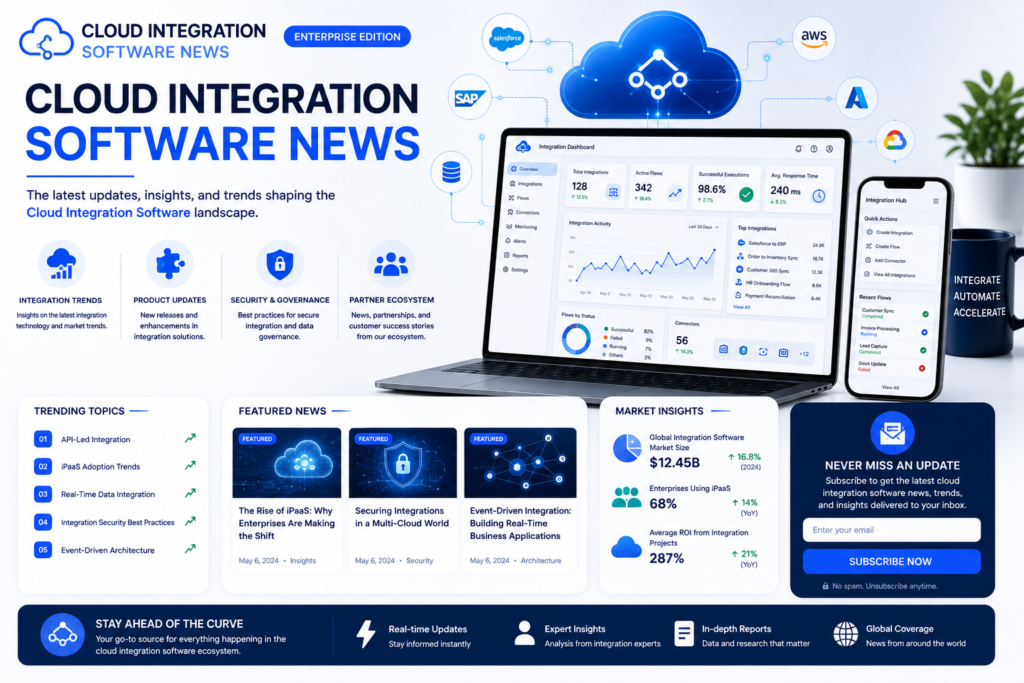
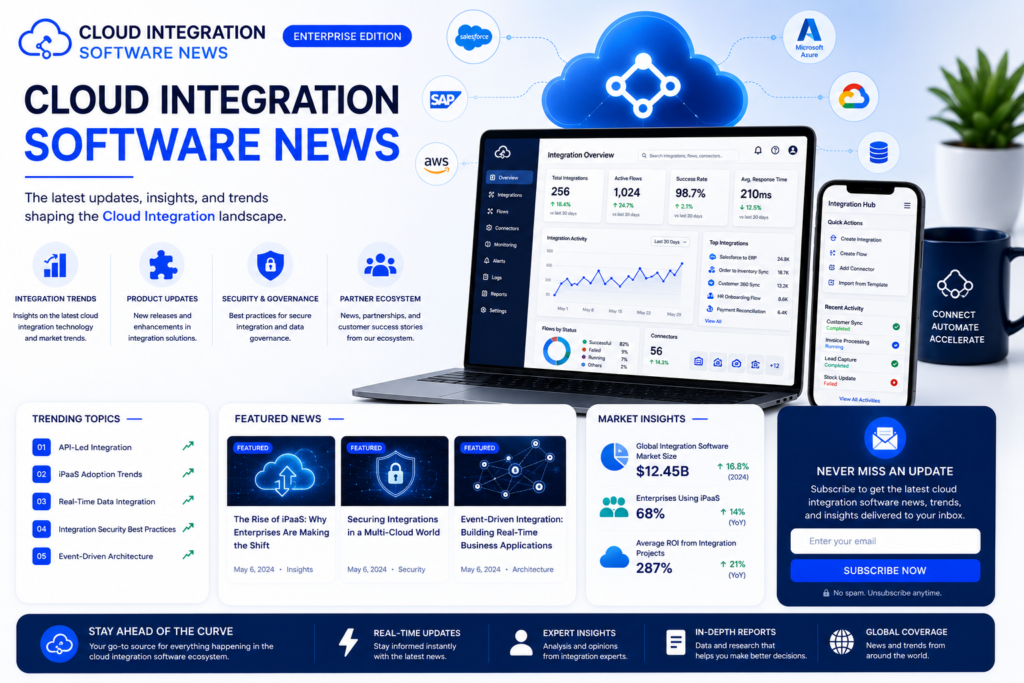
Cloud Integration Software The Complete Guide 2026

Discover how cloud integration software connects your apps automates workflows and eliminates manual data entry Learn features types and best practices

cloud integration software

What Is Cloud Integration Software and Why Is It Essential for Growing Companies?

Every growing company eventually hits the same wall. Data lives in one tool sales activity lives in another customer support tickets sit somewhere else entirely and finance is stuck exporting spreadsheets just to close the books each month. This is the exact problem that this type of software was built to solve. Instead of forcing teams to manually move information between systems cloud integration software connects applications databases and services so data flows automatically in real time. For SaaS companies in particular this is not a nice to have feature anymore it is the backbone of how modern operations actually function.

In this guide we will break down what cloud integration software really is how it works the different types available on the market today the business value it creates the common mistakes companies make when adopting it and the practical steps required to choose and implement the right solution. Whether you are a technical founder trying to reduce engineering overhead or an operations leader trying to eliminate manual data entry this article will give you a complete and honest picture of cloud integration software so you can make a confident decision.

What Is this technology

Cloud integration software is a category of technology that connects two or more applications databases or systems that are hosted in the cloud so they can share data and work together automatically. Rather than relying on developers to build and maintain custom point to point connections between every tool a company uses such platforms provides pre built connectors workflow automation and data mapping tools that make it possible to link systems in hours instead of weeks.

At its core cloud integration software solves a very old problem in a new environment. Companies have always needed their software systems to talk to each other but as businesses moved from on premise servers to cloud based applications the old integration methods stopped scaling. A typical SaaS company today might use a customer relationship management platform a billing system a support desk a marketing automation tool a data warehouse and dozens of smaller apps for specific tasks. these tools exists to stitch all of these together into one connected ecosystem instead of a patchwork of disconnected silos.

How Cloud Integration Software Works

Most this category of software operates on a few core mechanisms that are worth understanding before you evaluate any platform. The first is application programming interfaces which are the standardized ways that software systems expose their data and functionality to the outside world. Cloud integration software uses these interfaces to pull data from one system and push it into another.

The second mechanism is data transformation and mapping. Different systems often store the same type of information in different formats. One tool might label a customer record as full name while another splits it into first name and last name. Good the platform automatically maps and transforms these fields so information stays accurate and usable no matter where it lands.

The third mechanism is workflow orchestration. This is what allows cloud integration software to move beyond simple data syncing into true automation. For example when a new customer signs up in a billing platform an orchestrated workflow inside the integration software can automatically create a record in the customer relationship management tool send a welcome email through the marketing platform and open an onboarding task in the project management tool all without a single person touching a keyboard.

Finally most modern these systems includes monitoring and error handling. Integrations fail from time to time because of rate limits authentication issues or unexpected data formats. Reliable cloud integration software detects these failures logs them clearly and in many cases retries automatically so teams are not left guessing why data stopped flowing.

Types Of this type of software

Not all cloud integration software is built the same way and understanding the categories will help you choose the right fit for your organization.

Integration platform as a service solutions are the most common type for growing SaaS companies. These platforms provide a visual interface where non developers can build and manage integrations using pre built connectors and simple logic. They are ideal for operations and marketing teams that need to connect popular tools quickly without waiting on engineering resources.

Enterprise service bus solutions are older and more traditional forms of cloud integration software that focus on large scale complex integrations across many internal and external systems. These tend to require significant technical expertise and are more common in large enterprises with dedicated integration teams.

Application programming interface management platforms focus specifically on building securing and monitoring custom application programming interfaces. These are typically used by engineering teams that need full control over how data is exposed and consumed rather than relying on pre built connectors.

Data integration and extract transform load tools specialize in moving large volumes of data into data warehouses and analytics platforms. These are essential for companies that rely heavily on business intelligence and need clean centralized data for reporting.

Embedded integration platforms are a newer category built specifically for SaaS companies that want to offer native integrations inside their own product. Instead of building and maintaining dozens of custom integrations in house these companies use embedded cloud integration software to let their customers connect third party tools directly within the product itself.

Why this technology Matters For SaaS Companies

The value of cloud integration software becomes obvious once you look at what happens without it. Teams end up duplicating data entry across multiple systems which introduces errors and wastes hours every week. Customer information becomes inconsistent because one team updates a record in one tool while another team is working from outdated information in a different tool. Reporting becomes unreliable because data is scattered and no one is confident the numbers are accurate.

such platforms eliminates these problems by creating a single source of truth that flows automatically across the entire tech stack. This has a direct impact on customer experience because support teams have full context the moment a customer reaches out. It has a direct impact on revenue because sales and marketing teams can act on real time data instead of stale reports. And it has a direct impact on operational efficiency because employees spend their time on meaningful work instead of copying and pasting information between tabs.

For SaaS companies specifically cloud integration software also plays a strategic role in the product itself. Customers increasingly expect the software they buy to connect seamlessly with the other tools they already use. A SaaS product that offers strong native integrations through embedded these tools becomes stickier reduces churn and becomes easier to sell because it fits naturally into a customer existing workflow rather than forcing them to change how they work.

Key Features To Look For In Cloud Integration Software

Choosing the right this category of software requires looking past marketing claims and focusing on features that actually determine long term success.

Pre built connectors matter because they reduce implementation time dramatically. The best cloud integration software offers hundreds of ready made connectors for popular business applications so teams are not starting from scratch every time they need a new integration.

Scalability is another critical factor. As a company grows the volume of data flowing through integrations grows with it. the platform needs to handle increasing data loads without slowing down or breaking, which means evaluating rate limits processing speed and infrastructure reliability before committing to a platform.

Security and compliance capabilities are non negotiable for any serious evaluation. Since cloud integration software often handles sensitive customer and financial data it should offer encryption in transit and at rest role based access controls and compliance certifications relevant to your industry.

Error handling and observability determine how much trust a team can place in an integration running quietly in the background. Strong these systems provides clear logs real time alerts and automatic retry logic so issues are caught and resolved before they cause bigger problems downstream.

Ease of use is especially important for teams without dedicated engineering resources. A visual workflow builder clear documentation and responsive customer support all make a significant difference in how quickly a team can get real value out of cloud integration software.

Flexibility for custom logic is the final piece. Even the best pre built connectors cannot anticipate every business rule so the ability to add custom code transformations or conditional logic ensures the this type of software can adapt to your specific needs rather than forcing your business to adapt to it.

Common Mistakes Companies Make With Cloud Integration Software

Even with the right tool in place many companies run into avoidable problems when adopting cloud integration software.

One common mistake is treating integration as a one time project rather than an ongoing responsibility. Systems change application programming interfaces get updated and business processes evolve. Cloud integration software needs regular monitoring and maintenance or integrations quietly break and no one notices until customer data starts looking wrong.

Another frequent mistake is choosing a platform based purely on price without evaluating whether it can actually scale with the business. A cheap solution that cannot handle growing data volumes ends up costing far more in lost productivity and emergency fixes than a slightly more expensive platform built for scale.

Many teams also underestimate the importance of data governance. Without clear ownership of which team is responsible for which integration and without documented data mapping rules this technology can create more confusion than it solves, especially as more integrations get added over time.

A final common mistake is ignoring the end user experience when integrations are customer facing. If a SaaS company embeds cloud integration software into its product but the setup process is confusing or unreliable customers will abandon the integration entirely, which defeats the purpose of offering it in the first place.

Best Practices For Implementing such platforms

Successful implementation of cloud integration software starts with mapping out exactly which systems need to be connected and why. Rather than integrating everything at once it is far more effective to start with the highest impact workflows such as syncing customer data between a customer relationship management platform and a support tool, then expanding from there once the foundation is proven stable.

Documentation should be treated as a core part of the process rather than an afterthought. Every integration built with these tools should have clear documentation covering what data flows where how errors are handled and who owns the integration going forward.

Testing in a staging environment before pushing integrations live is essential, particularly for workflows that touch billing or customer facing data. A small mapping error in cloud integration software can cause significant downstream problems if it is not caught before deployment.

Setting up proactive monitoring and alerts ensures that any failures are caught within minutes rather than being discovered days later when a customer complains or a report looks wrong. Most modern this category of software includes built in alerting but it needs to be actively configured rather than left on default settings.

Finally reviewing integrations on a regular schedule helps catch issues before they become expensive. As business processes evolve the logic inside cloud integration software should evolve with them rather than being built once and forgotten.

How To Choose The Right the platform For Your Business

Choosing cloud integration software should start with a clear inventory of the systems that need to be connected and the specific outcomes the business is trying to achieve. A company focused on syncing marketing and sales data has very different needs than a company trying to build a data warehouse for advanced analytics.

Next it is worth evaluating whether the team implementing the integrations is technical or non technical. Some these systems is built for developers with full coding flexibility while other platforms are designed specifically for business users who need a visual no code experience.

Budget matters but should be evaluated in terms of total cost of ownership rather than sticker price alone. This includes implementation time ongoing maintenance and the cost of switching platforms later if the chosen solution cannot scale with the business.

It is also worth testing customer support responsiveness before committing to a long term contract. Since cloud integration software often becomes a critical part of daily operations, slow or unhelpful support during an outage can create serious business risk.

Finally requesting a trial or proof of concept with your actual systems rather than relying solely on demos gives a far more accurate picture of how well a given this type of software will perform in your specific environment.

The Future Of Cloud Integration Software

these platforms continues to evolve rapidly as businesses adopt more specialized applications and generate larger volumes of data. Artificial intelligence is increasingly being built into these platforms to automatically suggest data mappings detect anomalies in data flow and even predict integration failures before they happen. This shift is making cloud integration software more proactive rather than purely reactive.

There is also a clear trend toward embedded integration becoming a standard expectation rather than a competitive advantage. SaaS buyers increasingly assume that the tools they purchase will connect natively with their existing stack, which means more companies will rely on embedded this technology to meet customer expectations without building every integration from scratch internally.

Real time data processing is also becoming the standard rather than the exception. Batch syncing that updates data every few hours is being replaced by event driven cloud integration software that reflects changes the instant they happen, giving businesses a genuinely live view of their operations.

Frequently Asked Questions

What is cloud integration software used for?

Cloud integration software is used to connect different cloud based applications so data and processes flow automatically between them. It eliminates manual data entry keeps information consistent across systems and enables automated workflows that save time and reduce errors.

Is such platforms the same as an application programming interface?

No. An application programming interface is the technical method a system uses to expose its data and functionality. Cloud integration software is the platform that uses these interfaces along with additional tools like data mapping and workflow automation to actually connect multiple systems together.

How much does these tools cost ?

Pricing varies widely depending on the platform the number of integrations and the volume of data processed. Smaller platforms aimed at startups may cost a modest monthly fee while enterprise grade cloud integration software with advanced features and dedicated support can cost significantly more based on usage and scale.

Can small businesses benefit from this category of software?

Yes. Small businesses often benefit the most from cloud integration software because they typically have limited staff and cannot afford the time lost to manual data entry. Automating even a few key workflows can free up significant time for a small team.

What is the difference between the platform and traditional middleware ?

Traditional middleware was typically built for on premise systems and required significant custom development. Cloud integration software is designed specifically for cloud based applications and generally offers pre built connectors and visual tools that make implementation much faster and more accessible.

Do I need a developer to use these systems?

It depends on the platform. Many modern cloud integration software solutions are designed with visual no code interfaces so business users can build integrations without writing code. More complex or highly customized integrations may still benefit from developer involvement.

How long does it take to implement this type of software?

Simple integrations using pre built connectors can often be set up within hours. More complex integrations involving custom data mapping or multiple systems can take days or weeks depending on the complexity of the business requirements.

Is cloud integration software secure ?

Reputable these platforms providers implement strong security measures including encryption access controls and compliance certifications. That said security also depends on how well the integrations are configured internally, so following best practices during implementation matters just as much as the platform itself.

What industries rely most heavily on cloud integration software?

this technology is widely used across SaaS companies e commerce businesses financial services healthcare and any industry that relies on multiple digital systems working together in real time.

Can cloud integration software help with data analytics ?

Yes. Many companies use such platforms to move data from multiple sources into a central data warehouse where it can be cleaned organized and analyzed, giving leadership teams a more accurate and complete view of business performance.

Conclusion

Cloud integration software has moved from being a technical nice to have into a foundational part of how modern SaaS businesses operate. It eliminates the friction of disconnected systems reduces manual work and gives teams the real time accurate data they need to make confident decisions. Choosing the right platform requires looking beyond flashy features and evaluating scalability security ease of use and long term reliability. Companies that treat cloud integration software as an ongoing strategic investment rather than a one time setup task consistently see stronger operational efficiency happier customers and a tech stack that grows smoothly alongside the business.

Key Takeaways

Cloud integration software connects cloud based applications so data flows automatically without manual effort. It works through application programming interfaces data mapping and workflow orchestration to keep systems synchronized in real time. Different types of cloud integration software exist for different needs including integration platform as a service solutions enterprise service bus platforms and embedded integration tools built directly into SaaS products. Choosing the right solution requires evaluating scalability security ease of use and total cost of ownership rather than price alone. Companies that avoid common mistakes like neglecting maintenance and documentation get significantly more long term value from their cloud integration software investment.

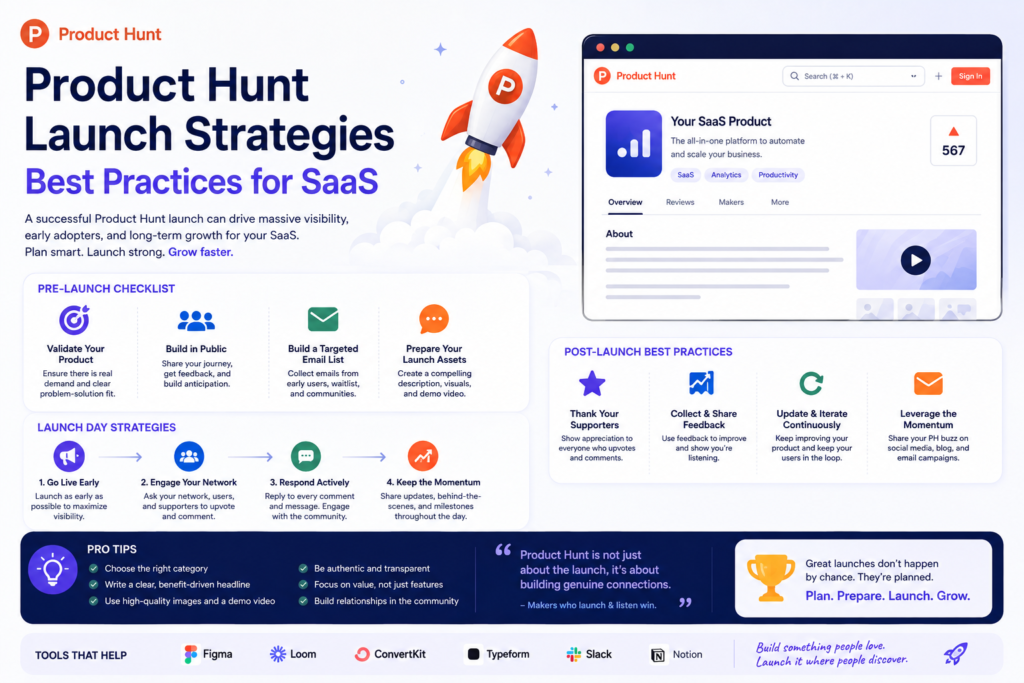
Product Hunt Launch Strategies for SaaS in 2026

Discover proven Product Hunt launch strategies for SaaS teams covering pre launch prep timing hunter selection and post launch growth tactics

Product Hunt launch

Product Hunt Launch Strategies Best Practices for SaaS Companies

Launching on Product Hunt can feel like rolling the dice, but the SaaS companies that consistently land in the top five products of the day are not relying on luck. They are following a structured process built around community trust, timing, and momentum.

A strong Product Hunt launch can send a meaningful spike of qualified traffic to a SaaS product, generate early user signups, produce valuable feedback, and create backlinks and social proof that compound for months afterward.

A weak or rushed launch, on the other hand, often results in a handful of upvotes, a few comments, and no lasting impact on growth.

This guide walks through the product hunt launch strategies that experienced SaaS teams use on Product Hunt, the best practices that separate a top ranked launch from a forgettable one, and the common mistakes that quietly sabotage otherwise promising Product Hunt listings.

Whether this is a first launch or a relaunch after lessons learned, the goal here is to give founders and marketers a complete, actionable framework they can execute with confidence.

What a Successful Product Hunt Launch Actually Looks Like

Before diving into tactics, it helps to define what success on Product Hunt actually means for a SaaS business, because the definition shapes every decision made throughout the Product Hunt launch process. Some teams treat a top three finish as the only acceptable outcome, while others care more about the quality of signups and the conversations generated in the comments. For most SaaS companies, a genuinely successful launch produces three outcomes at once: a meaningful volume of targeted traffic that converts into trial signups or demo requests, direct qualitative feedback from real users who are willing to publicly engage with a new product, and a durable content and backlink asset that continues to drive discovery long after launch day ends. Chasing the badge alone, without thinking about what happens to the visitors who land on the page, is one of the most common reasons a launch looks good on the surface but fails to move the business forward.

Building a Pre Launch Strategy That Sets Up Momentum

Momentum on Product Hunt is earned in the weeks before launch day, not created on the day itself. The most effective pre launch strategy starts by building an audience that already knows the product exists and is emotionally invested in seeing it do well. This typically involves teasing the launch on relevant SaaS communities, personal social profiles, and existing customer channels, without asking for upvotes directly, since Product Hunt’s guidelines and community norms discourage explicit vote solicitation. Instead, successful teams focus on storytelling: sharing the problem the product solves, behind the scenes development stories, and early access previews that make people curious enough to want to be there on launch morning. Building a dedicated waitlist or beta group in the four to six weeks before launch gives a founder a warm audience of people who are genuinely excited rather than people who feel obligated to click a button.

Another critical piece of pre launch preparation is studying how Product Hunt’s algorithm and community actually reward products. Upvotes matter, but so does the velocity and diversity of engagement, meaning comments from a wide range of accounts, the quality of the discussion in the thread, and how quickly early momentum builds after the product goes live. Teams that understand this design their pre launch outreach around getting a diverse group of genuinely interested people ready to visit, comment, and engage authentically the moment the listing goes live, rather than a single burst of votes from one narrow network.

Choosing the Right Launch Date and Time

Timing decisions are among the most underestimated product hunt launch strategies for SaaS companies, and they can determine how much visibility a Product Hunt listing receives before it even goes live. Product Hunt runs on a daily cycle that resets at midnight Pacific time, and competition for attention varies significantly by day of the week. Tuesday, Wednesday, and Thursday are generally considered the strongest days because user activity is high and there is enough competitive density to gain visibility without going head to head against the heaviest hitting launches that often cluster around Monday. Launching too early in the day maximizes the amount of time available to accumulate votes and comments, since the ranking is cumulative across the full day, while a late launch can permanently limit a product’s visibility no matter how strong the product itself is.

Seasonality also matters more than many SaaS teams expect. Launching during major industry conferences, holiday weeks, or immediately after a widely publicized launch from a much larger company can dilute attention. Reviewing the upcoming Product Hunt calendar for competing launches in a similar category, and avoiding a direct collision with another well resourced SaaS product, is a simple step that meaningfully improves the odds of a strong finish.

Crafting a Product Page That Converts Visitors Into Users

The product page itself is where curiosity turns into action, and it deserves the same level of craft as a landing page built for paid acquisition. The tagline needs to communicate the core value proposition in a handful of words, avoiding vague marketing language in favor of a specific, benefit driven statement that tells a visitor exactly what problem the SaaS product solves. The first image or gallery item carries enormous weight, since it is often the only visual a scrolling user sees before deciding whether to click through, so it should show the actual product interface in action rather than an abstract illustration or stock photo.

A short, well produced demo video consistently outperforms a wall of screenshots, because it lets visitors experience the product’s core workflow in under a minute without requiring them to imagine how the pieces fit together. The written description should focus on outcomes rather than features, explaining what changes for a user once they adopt the product, while still including enough specificity about functionality that a technical audience can quickly assess fit. Maker comments, the first post from the founder underneath the listing, set the tone for the entire discussion thread, so using that space to share the origin story, the specific problem being solved, and an invitation for feedback tends to generate far richer engagement than a generic thank you message.

Selecting a Hunter and Building Early Advocates

Many SaaS founders overestimate how much a well known hunter changes the outcome of a launch, but there is still real value in having an early advocate with an established Product Hunt reputation post the product, since their existing followers receive a notification and their credibility can lend the listing an initial trust signal. That said, self hunting has become increasingly common and works well when the founder already has some presence in the Product Hunt community and a genuine personal network willing to engage. What matters more than the hunter’s follower count is whether they, or the founder, can speak authentically about the product in the comments throughout the day, since generic or absent engagement is easy for the community to spot and tends to suppress momentum.

Beyond the hunter, cultivating a small group of early advocates who are willing to try the product before launch day, leave a thoughtful first comment, and answer questions from other visitors adds credibility that a founder alone cannot generate. These advocates should genuinely understand the product, not just be asked to leave a positive comment, because vague or clearly coordinated praise is easy to identify and can undermine trust in the thread.

Executing Launch Day Without Losing Momentum

Launch day itself is less about broadcasting and more about sustained, responsive engagement. The founder or core team should be present in the comments from the first minute, responding to every question and piece of feedback with genuine detail rather than short acknowledgments, since active back and forth conversation is one of the strongest signals of a healthy, organic launch. Spacing out outreach to different audience segments throughout the day, rather than sending every notification at once, helps sustain a steady stream of new visitors and comments instead of one spike followed by silence.

It also helps to have a lightweight real time dashboard or simple tracking sheet to monitor ranking position, traffic sources, and signup conversion throughout the day, so the team can identify which channels are actually driving qualified visitors and double down on those rather than continuing to push channels that generate clicks but no meaningful engagement. Teams that treat launch day as a single event to survive, rather than an ongoing conversation to actively manage, consistently underperform their potential.

Common Mistakes SaaS Teams Make on Product Hunt

The most damaging mistake is treating Product Hunt as a traffic stunt disconnected from the rest of the growth strategy, launching without a clear plan for what happens to visitors after they land on the page, whether that is a trial signup flow, an onboarding sequence, or a dedicated landing page built specifically for the audience arriving from the listing. A second common mistake is explicit or implicit vote begging, which the Product Hunt community notices quickly and which can trigger removal of votes or, in serious cases, suspension of the listing. Weak visual assets are another frequent issue, since a blurry screenshot or a generic stock graphic signals low effort and reduces the click through rate from the homepage feed regardless of how strong the underlying product actually is.

Many SaaS teams also underestimate the importance of responding to negative or skeptical comments with patience and specificity rather than defensiveness, since how a founder handles pushback in public is itself a trust signal that influences undecided visitors reading the thread. Finally, some teams disappear entirely once launch day ends, missing the opportunity to convert the traffic spike into a lasting content asset by following up with new users, publishing a retrospective, and continuing to reference the launch in later marketing.

Turning a Launch Into Long Term Growth

The value of a Product Hunt launch should not be measured only by the ranking achieved on launch day within the Product Hunt homepage feed. The backlink from the Product Hunt listing itself carries authority that benefits organic search visibility over time, and the comments thread often becomes a searchable, indexed source of genuine user feedback that future prospects discover independently. SaaS teams that get the most long term value from their launch treat it as the beginning of a broader campaign, repurposing the demo video for other channels, turning maker comments into blog content, and reaching out individually to the most engaged commenters to invite them into a more structured feedback loop or early customer program.

Analyzing signup data from the launch, including which acquisition channel drove the highest quality trials, provides insight that can inform paid acquisition and content strategy for months afterward. In this sense, the most effective product hunt launch strategies are not designed purely to win a single day, but to generate an asset and a dataset that a SaaS marketing team can continue to draw on well after the initial spike in traffic fades.

Key Takeaways

  • A successful Product Hunt launch depends far more on preparation in the weeks before launch day than on tactics executed during the day itself.
  • Building a genuinely interested audience ahead of time, rather than asking for votes directly, produces stronger and more durable engagement.
  • Tuesday through Thursday, launched early in the day, generally offers the best balance of visibility and manageable competition.
  • The product page, including the tagline, first image, and demo video, deserves the same craft as a dedicated landing page.
  • Active, detailed engagement in the comments throughout launch day is one of the strongest signals of a healthy, organic listing.
  • The most common mistakes are treating the launch as disconnected from the broader funnel, vote begging, and disappearing after launch day ends.
  • Long term value comes from treating the launch as the start of a campaign, not a single day event.

Frequently Asked Questions

What is the best day to launch a SaaS product on Product Hunt?

Tuesday, Wednesday, and Thursday tend to offer the strongest combination of high user activity and manageable competition, since Monday often attracts the most heavily resourced launches. Launching as early as possible after the daily reset at midnight Pacific time gives a product the maximum window to accumulate votes and comments.

Do I need a well known hunter to succeed on Product Hunt?

No. Self hunting has become common and works well as long as the founder has some existing presence in the community and a genuine network willing to engage authentically. What matters most is active, detailed participation in the comments rather than the follower count of whoever posts the listing.

How early should a SaaS team start preparing for a Product Hunt launch?

Most successful teams begin building awareness and a warm audience four to six weeks before launch day, using teasers, behind the scenes content, and a waitlist to create genuine interest rather than relying solely on last minute outreach.

Is it against the rules to ask people to upvote a Product Hunt listing?

Explicitly asking for upvotes goes against community norms and Product Hunt’s guidelines, and can result in votes being removed or the listing being penalized. The more effective and compliant approach is to share the story and invite genuine feedback rather than requesting a specific action.

What makes a Product Hunt product page convert well?

A specific, benefit driven tagline, a first image or gallery item that shows the real product interface, and a short demo video that lets visitors experience the core workflow all significantly improve conversion from the Product Hunt homepage feed into the product’s own signup flow.

How important are comments during launch day?

Comments are one of the strongest signals of a healthy, organic launch. Founders who respond quickly and in detail throughout the day tend to sustain momentum far better than those who post the listing and go quiet.

Can a Product Hunt launch help with long term SEO for a SaaS company?

Yes. The backlink from the listing itself carries authority, and the comments thread is typically indexed and searchable, meaning it can continue to surface in search results and influence prospects long after the launch day traffic spike has passed.

What should happen immediately after a Product Hunt launch ends?

Effective teams follow up individually with the most engaged commenters, analyze which channels produced the highest quality signups, and repurpose launch assets like the demo video and maker comments into other marketing content rather than moving on immediately.

Should a SaaS company launch on Product Hunt more than once?

A relaunch, often tied to a major new feature or version, can work well if the original launch underperformed or if enough time and product change has occurred to justify fresh community attention, but repeated launches without meaningful updates tend to see diminishing engagement.

What is the single biggest mistake SaaS founders make on Product Hunt?

Treating the launch as an isolated event disconnected from the rest of the growth funnel, without a clear plan for what happens to visitors once they arrive, is the mistake that most consistently turns a promising launch into a missed opportunity.

Conclusion

A strong Product Hunt launch is never the result of a single clever trick executed on launch morning. It is the outcome of weeks of deliberate preparation, a product page crafted with the same care as a paid landing page, and a founder or team genuinely present in the conversation throughout the day. The SaaS companies that consistently benefit from Product Hunt are the ones that treat the platform as one part of a larger growth strategy rather than a one time event, using the momentum, feedback, and backlink authority generated by the launch to fuel growth long after the badge has been earned. By following the product hunt launch strategies and best practices outlined here, from pre launch audience building through post launch follow up, any SaaS team can approach their next launch with a clear, repeatable process instead of hoping for the best.

SFDC SaaS Meaning Explained for Business and Tech Teams 2026

Learn what SFDC SaaS means, how Salesforce built the model, core products, career paths, common challenges, and proven best practices for lasting success.

SFDC SaaS

Anyone who has spent time inside the CRM world, whether as a sales rep, an administrator, or a job seeker scrolling through listings, has likely come across the term SFDC. It shows up in job titles like SFDC Administrator, in certification names, and in casual conversation among people who work with Salesforce every day. Understanding SFDC SaaS matters because it connects two ideas that are often discussed separately, the identity of Salesforce as a company and the software delivery model that made it one of the most influential businesses in modern enterprise technology.

SFDC stands for Salesforce dot com, the original legal and stock market name of the company before it shortened its public identity to simply Salesforce. SaaS, short for software as a service, describes cloud hosted software that customers access through a subscription rather than installing it on local servers. Put the two together and SFDC SaaS refers to Salesforce as one of the earliest and most successful examples of the software as a service business model, a company that helped define what modern SaaS looks like for millions of businesses that followed its lead.

What SFDC Actually Stands For

The abbreviation SFDC traces back to Salesforce dot com, the name the company used from its founding in 1999 through its early years as a young cloud software startup challenging traditional, on premise CRM systems. Even after the company rebranded its public facing name to Salesforce, the SFDC abbreviation stuck around inside the industry, largely because it was already baked into job titles, internal documentation, and community terminology on platforms like Trailhead and various Salesforce user groups.

Today, SFDC is used almost interchangeably with Salesforce in casual professional conversation, though it appears most often in three specific contexts. Recruiters and hiring managers use it in job titles such as SFDC Administrator or SFDC Developer, since these shorter terms are easier to scan in a list of postings. Salesforce professionals use it as shorthand among themselves, the same way developers might say JS instead of JavaScript. And documentation or internal wikis at companies that have used Salesforce for a long time often default to SFDC simply because that was the accepted term when the systems were first implemented.

How SFDC Became a Defining Example of SaaS

Salesforce launched at a time when nearly all serious business software was sold as an on premise license, requiring companies to buy servers, install the software internally, and hire IT staff to maintain it. Salesforce challenged that model directly with a simple pitch, access your CRM through a web browser and pay a subscription instead of a massive upfront license fee. This approach was unusual enough at the time that the company built its early marketing around the phrase no software, deliberately positioning itself against the installed software vendors that dominated the enterprise market.

That bet paid off. Salesforce grew from a startup selling a single CRM product into a sprawling platform offering sales tools, customer service tools, marketing automation, analytics, and a full ecosystem of third party applications available through its AppExchange marketplace. Because of how early and how successfully it proved the subscription based, cloud hosted model at enterprise scale, SFDC is frequently cited in business and technology courses as one of the companies that legitimized SaaS as a viable way to sell serious business software, not just simple consumer tools.

Core Products Inside the SFDC SaaS Platform

Understanding SFDC SaaS in practice means understanding what the platform actually includes, since Salesforce today is far broader than a single CRM tool. Sales Cloud remains the original core product, giving sales teams a system to track leads, manage pipelines, and forecast revenue. Service Cloud extends the same underlying platform toward customer support teams, offering case management, knowledge bases, and omnichannel communication tools. Marketing Cloud handles email campaigns, customer journeys, and marketing automation for teams trying to coordinate outreach across multiple channels.

Beyond these flagship products, the SFDC SaaS platform includes Salesforce Platform itself, a set of tools that let developers build custom applications directly on top of the same infrastructure, and Tableau, a data visualization tool Salesforce acquired to strengthen its analytics offering. Slack, another Salesforce acquisition, has since been folded into the broader SFDC SaaS ecosystem as a collaboration layer that sits alongside the core CRM products, giving teams a way to discuss deals, cases, and campaigns without leaving their day to day workflow. Each of these products shares the same underlying multi tenant, cloud hosted architecture that defines the SaaS model, meaning customers across industries run on shared infrastructure while their individual data stays logically separated and secure.

For businesses new to the ecosystem, it helps to think of SFDC SaaS less as a single application and more as a connected suite, where a company might start with just Sales Cloud and gradually layer in Service Cloud or Marketing Cloud as its needs grow, without needing to migrate to a different vendor each time a new department wants cloud software of its own.

SFDC SaaS in the Job Market

One of the most practical reasons people search for SFDC SaaS is career related. Job titles referencing SFDC are common across a wide range of roles, and understanding the terminology helps candidates search more effectively and helps hiring managers write clearer postings. An SFDC Administrator manages user access, builds workflows, customizes objects and fields, and keeps the system running smoothly for the business teams that depend on it daily. An SFDC Developer writes custom code using Apex, the platform’s proprietary programming language, and builds integrations that connect Salesforce to other business systems. Beyond these two common titles, roles like SFDC Business Analyst and SFDC Consultant have also grown steadily, reflecting how deeply this particular SaaS platform has embedded itself into modern business operations.

Certifications play a large role in this career path. The Salesforce Administrator certification, often referred to informally as an SFDC Admin certification, has become a recognized credential that many companies list as a preferred or required qualification. Because Salesforce maintains its own free learning platform through Trailhead, career changers without a traditional computer science background have a realistic path into SFDC focused roles, which has made this corner of the SaaS job market unusually accessible compared to other enterprise software ecosystems. Recruiters searching specifically for SFDC SaaS experience often use the abbreviation as a quick filter, assuming candidates who list it on a resume already understand the platform’s core terminology and workflows without needing it spelled out in full.

Why Businesses Choose SFDC SaaS as Their CRM

Businesses evaluating SFDC SaaS as a CRM option tend to weigh a specific set of advantages against the SFDC SaaS cost and complexity. Customization stands out as one of the strongest selling points, since the platform allows businesses to reshape nearly every object, field, and workflow to match their existing processes rather than forcing teams to adapt to a rigid, out of the box structure. The AppExchange marketplace adds further flexibility, giving businesses access to thousands of pre built integrations and add on applications built by third party developers, which often removes the need for custom development work entirely.

Scalability is another major draw of SFDC SaaS. A five person sales team and a five thousand person enterprise sales organization can both run on the same underlying platform, scaling up through additional licenses and more advanced product tiers rather than migrating to an entirely different system as the business grows. This scalability, combined with the platform’s long track record and large talent pool of trained administrators and developers, makes SFDC a lower risk choice for businesses that plan to grow significantly over the coming years and want a CRM that can grow with them.

Common Challenges Businesses Face With SFDC SaaS

Despite its strengths, businesses adopting SFDC SaaS run into a consistent set of challenges worth understanding before implementation begins. Cost is the most frequently cited concern, since Salesforce pricing scales with both the number of user licenses and the specific product tier a business selects, which can grow substantially as a company adds more users and more advanced features over time.

Implementation complexity catches many businesses off guard when adopting SFDC SaaS, particularly those moving from a simpler CRM or from spreadsheets. Because the platform offers so much configurability, businesses without clear internal ownership of the system often end up with a cluttered, poorly organized setup that confuses users rather than helping them, a problem that typically stems from rushing the implementation phase rather than any flaw in the platform itself. Over customization is a related trap, where well meaning administrators add so many custom fields, workflows, and automations that the system becomes difficult to maintain and slow to adapt when business needs change.

User adoption also remains a genuine hurdle for SFDC SaaS rollouts. A CRM only delivers value when sales and service teams actually use it consistently and enter accurate data, and businesses that skip proper training or fail to demonstrate clear personal value to end users often see poor adoption regardless of how well the system itself is configured.

Best Practices for Getting the Most Out of SFDC SaaS

Companies that succeed with SFDC SaaS implementations tend to follow a consistent set of practices that separate a smooth SFDC SaaS rollout from a frustrating one. Starting with a clean, well planned data structure before heavy customization begins prevents the clutter and confusion that often plague rushed implementations, since it is far easier to build good habits into the system from day one than to untangle a messy setup later.

Investing in proper training for end users, not just administrators, pays off directly in adoption rates and data quality. Teams that understand why they are entering data into the system, not just how, tend to engage with it far more consistently than teams that view it as an administrative burden imposed from above. Regularly auditing custom fields, workflows, and automations helps prevent the over customization trap, keeping the system lean enough that new administrators can understand and maintain it without needing to decode years of accumulated complexity. Finally, leaning on the Trailhead learning platform and the broader Salesforce community, including user groups and forums, gives internal teams access to a huge base of shared knowledge that can solve most implementation questions without expensive outside consulting.

The Future of SFDC as a SaaS Leader

SFDC SaaS continues to evolve well beyond its original CRM roots, and understanding where the platform is heading helps businesses plan for the long term rather than just the immediate implementation. Artificial intelligence has become a central focus, with tools built directly into the platform that can draft customer communications, summarize case histories, and surface predictive insights without requiring separate software. This mirrors a broader trend across the SaaS industry, where vendors are embedding intelligence directly into existing workflows rather than treating it as a bolt on feature.

Industry specific versions of SFDC SaaS, built for sectors like financial services, healthcare, and manufacturing, reflect a broader shift toward vertical specialization across the SaaS world, where generic tools increasingly compete against industry tailored alternatives built to handle sector specific compliance and workflow needs out of the box. As competition in the CRM SaaS space continues to intensify, SFDC’s long head start, large partner ecosystem, and trained talent pool remain significant advantages that newer competitors have struggled to fully replicate.

Frequently Asked Questions

What does SFDC stand for in the SaaS world.

Answer SFDC stands for Salesforce dot com, the original legal name of the company that became one of the earliest and most influential examples of the software as a service business model.

Is SFDC the same thing as Salesforce.

Answer Yes, SFDC and Salesforce refer to the same company. SFDC is simply an older abbreviation that remains common in job titles, certifications, and everyday professional conversation.

Is Salesforce actually a SaaS company.

Answer Yes. Salesforce delivers its products entirely through the cloud on a subscription basis, which places SFDC SaaS firmly within the broader SaaS category and makes it one of the model’s earliest large scale success stories.

What does an SFDC Administrator actually do.

Answer An SFDC Administrator manages user access, customizes objects and workflows, maintains data quality, and keeps the overall system aligned with how the business actually operates day to day.

What is the difference between SFDC SaaS and traditional on premise CRM software.

Answer Traditional on premise CRM software requires companies to install and maintain the system on their own servers, while SFDC SaaS is hosted entirely by Salesforce and accessed through a subscription, removing the need for internal infrastructure.

Do I need a technical background to work in SFDC SaaS roles.

Answer Not necessarily. Many SFDC Administrators come from business or operations backgrounds and build technical skills through Salesforce’s free Trailhead learning platform rather than a traditional computer science degree.

Why is SFDC pricing considered expensive by some businesses.

Answer Salesforce pricing scales with the number of user licenses and the specific product tier selected, which can add up quickly for growing teams, particularly once businesses move beyond the most basic plan.

What is the AppExchange in relation to SFDC SaaS.

Answer The AppExchange is Salesforce’s marketplace of third party applications and integrations, allowing businesses to extend the core SFDC SaaS platform without building custom solutions from scratch.

How long does it typically take to implement SFDC SaaS.

Answer Implementation timelines vary widely depending on business complexity, but a straightforward setup can take a few weeks while a large enterprise rollout with heavy customization can take several months.

Is SFDC SaaS a good long term choice for growing businesses.

Answer For businesses expecting significant growth, SFDC SaaS is often a strong long term choice due to its scalability, large talent pool, and extensive ecosystem, though smaller teams should weigh the cost against simpler CRM alternatives first.

Conclusion

SFDC SaaS is more than an abbreviation borrowed from an old company name, and understanding SFDC SaaS in full context helps professionals speak the language of the industry with confidence. It represents one of the clearest real world examples of how the software as a service model reshaped enterprise technology, turning Salesforce from a small startup with a simple pitch into a company whose products, certifications, and job titles now shape careers across the business world. Whether the goal is understanding a job posting, evaluating a CRM purchase, or simply making sense of industry terminology, grasping what SFDC SaaS actually means gives professionals and businesses alike a clearer picture of both where cloud software came from and where it continues to head.

Key Takeaways

SFDC stands for Salesforce dot com, the original name behind one of the most influential SaaS companies in enterprise software history.

SFDC SaaS refers to Salesforce’s cloud hosted, subscription based CRM platform, which helped legitimize the broader SaaS business model.

Core SFDC products include Sales Cloud, Service Cloud, Marketing Cloud, and the developer focused Salesforce Platform.

SFDC terminology shows up heavily in job titles and certifications, making it especially relevant to career changers and hiring teams.

Common challenges with SFDC SaaS include cost, implementation complexity, over customization, and user adoption struggles.

Clean data structure, proper training, and regular system audits are proven best practices for long term SFDC success.

The future of SFDC as a SaaS leader is being shaped by embedded artificial intelligence and industry specific product versions.

Enterprise SaaS News 9 Essential Updates for 2026

Stay ahead with the latest Enterprise SaaS news. Discover top sources, key trends, and how to turn industry updates into smarter decisions.

Enterprise SaaS News

Enterprise SaaS news

Enterprise SaaS news moves fast, and for anyone responsible for technology decisions inside a growing company, missing an important update can be expensive. A security breach at a vendor you rely on, a sudden pricing change, an acquisition that shifts a product’s roadmap, these are not abstract industry stories. They are events that can directly affect budgets, security posture, and long term planning, sometimes within days of the original announcement.

This guide breaks down everything you need to know about following enterprise SaaS news effectively. You will learn what this category of news actually includes, the best sources worth following, how to judge whether a source is credible, which tools can automate the tracking process, the biggest trends shaping coverage in 2026, and the mistakes that cause even experienced professionals to miss important signals buried in the noise. Whether you are a technology buyer, an investor, or someone working inside a SaaS company, this article will give you a practical framework for staying informed without drowning in irrelevant headlines.

What Enterprise SaaS News Actually Covers

Enterprise SaaS news spans a wide range of topics, and understanding the full scope helps readers know what to actually pay attention to. Product and feature announcements sit at the center of daily coverage, since enterprise vendors regularly ship new capabilities, integrations, and platform changes that can directly affect how a company uses a tool it already depends on. A release note buried on a vendor’s changelog page might seem minor, but for a company relying on a specific workflow, a removed feature or a changed API can require real engineering time to accommodate.

Funding rounds, acquisitions, and IPO activity form another major pillar of enterprise SaaS news. When a vendor raises a large funding round or gets acquired by a larger company, that event often signals where the product roadmap is heading next, and sometimes it signals risk, particularly if a smaller vendor gets absorbed into a larger company with different priorities. History is full of examples where an acquired product was slowly deprecated in favor of the acquiring company’s own competing tool, leaving customers with a difficult, unplanned migration.

Security incidents and data breaches represent some of the most consequential enterprise SaaS news a technology leader can encounter, since a breach at a vendor holding sensitive company data creates immediate risk that needs a fast response. Leadership changes, including new CEOs or major executive departures, often precede larger strategic shifts inside a company, making them worth watching even when they seem like routine corporate news on the surface.

Regulatory and compliance developments also fall inside this category, particularly as governments around the world continue tightening rules around data privacy, AI usage, and cross border data transfers. A new regulation affecting how vendors can store or process customer data can ripple through procurement requirements almost overnight. Finally, broader market analysis, including reports on enterprise software spending trends, AI adoption inside SaaS platforms, and shifts in buyer behavior, rounds out the category, giving readers the bigger picture context behind the individual headlines.

Why Staying Current on Enterprise SaaS News Matters

For IT and procurement teams, staying current on enterprise SaaS news is directly tied to risk management. A company that does not track vendor security incidents may not realize its own data was exposed until well after the damage is done. Vendor pricing changes, feature deprecations, and end of life announcements all require advance planning, and missing that news can lead to scrambling under a tight deadline instead of managing a transition calmly, with the budget and internal buy in already in place.

For investors and analysts, enterprise SaaS news provides the raw signal needed to spot emerging trends before they become obvious to everyone else. A wave of funding into a particular category, such as AI powered customer service tools or vertical specific SaaS platforms, often points toward where enterprise budgets are shifting next, and being early to recognize that shift carries real financial value.

For marketers and founders inside SaaS companies, following industry news closely helps shape sharper positioning. Understanding what competitors are announcing, what analysts are saying about the category, and what buyers are complaining about in public forums gives a real edge when crafting messaging that actually resonates rather than repeating generic industry talking points that every competitor is already using.

There is also a less obvious benefit that applies across all three groups: pattern recognition over time. A single headline rarely tells the full story, but reading enterprise SaaS news consistently over months and years builds an intuitive sense for how the market moves, which vendors tend to follow through on their promises, and which categories are genuinely maturing versus which ones are experiencing a temporary hype cycle that will cool off within a year or two.

Top Categories of Enterprise SaaS News

Breaking enterprise SaaS news down into clear categories makes it easier to build a consistent tracking habit rather than passively scrolling headlines without a real filter. Product updates and platform changes deserve close attention from anyone actively using enterprise software, since new features or removed functionality can directly affect daily workflows across an entire organization.

Security and compliance news, including breach disclosures, new certifications, and regulatory changes, matters enormously for any company handling sensitive customer or financial data. This category has grown significantly in both volume and importance over the past few years, as attackers increasingly target SaaS vendors specifically because a single breach can expose data belonging to hundreds or thousands of downstream customers at once.

Mergers, acquisitions, and funding news help readers understand the competitive landscape and anticipate where consolidation is happening. Watching this category closely can reveal early warning signs about a vendor’s long term stability well before that instability shows up as a service disruption.

Pricing and packaging changes are often underreported but genuinely important, since a vendor shifting from per seat pricing to usage based billing can significantly affect a company’s budget forecasting, sometimes increasing costs substantially without any corresponding increase in actual usage. Leadership and organizational news, including executive departures, layoffs, and restructuring announcements, frequently precedes larger strategic pivots and deserves more attention than it typically receives from buyers focused purely on product features.

Finally, AI and automation coverage has become one of the fastest growing categories inside enterprise SaaS news, as vendors race to embed AI capabilities into existing platforms and buyers try to separate genuine innovation from marketing hype dressed up in AI branding.

Best Sources for Enterprise SaaS News

Not all sources covering enterprise SaaS news offer the same depth or reliability, so building a curated list matters more than casually following whatever appears in a general search feed. Established technology publications with dedicated enterprise software reporters tend to offer the most rigorous, fact checked coverage, particularly for major events like acquisitions or security incidents, since these outlets typically have relationships with company spokespeople and access to verify claims before publishing.

Analyst firms that publish regular research reports provide deeper context than daily news coverage, often identifying trends before they become widely reported in mainstream outlets. These firms typically combine survey data, customer interviews, and financial analysis to produce forecasts that go well beyond what a single news article can offer.

Vendor blogs and official changelogs remain essential for anyone actively using a specific platform, since they are the most direct and reliable source for feature updates and end of life announcements affecting that particular tool. Relying solely on vendor communication has an obvious limitation, however, since vendors rarely publicize their own problems with the same enthusiasm they bring to feature launches.

Industry newsletters curated by experienced practitioners can save significant time by filtering out noise and highlighting only the stories that genuinely matter, often with added commentary explaining why a particular development is significant. Community forums and discussion spaces where real practitioners share firsthand experience with vendors often surface issues, like poor customer support or hidden pricing changes, well before that information reaches formal news coverage, making these communities a valuable supplement to more formal sources.

Podcasts hosted by experienced operators and investors have also become a meaningful source of enterprise SaaS news in recent years, often providing more candid, unscripted discussion of industry dynamics than written coverage allows, since guests speaking on a podcast sometimes share perspectives they would never put in writing.

How to Evaluate the Credibility of a Source

Not every outlet covering enterprise SaaS news deserves equal trust, and learning to evaluate credibility protects readers from acting on inaccurate or biased information. Start by checking whether a publication clearly separates news reporting from sponsored content or paid placements, since outlets that blur this line consistently are more likely to publish favorable coverage in exchange for advertising revenue rather than objective reporting.

Look at whether a source cites primary evidence, such as official filings, direct quotes from named company representatives, or verifiable data, rather than relying entirely on unnamed sources or secondhand claims repeated from another outlet without independent verification. A track record of corrections and updates is actually a positive signal rather than a negative one, since it shows a publication is willing to fix mistakes rather than letting inaccurate information stand uncorrected.

Consider the author’s background and expertise as well. A reporter who has covered enterprise software for years and demonstrates fluency with technical and financial details tends to produce more reliable analysis than a generalist writer covering the beat casually alongside many unrelated topics. Finally, cross reference significant claims across at least two independent sources before treating them as confirmed fact, particularly for high stakes news like a security breach or a major acquisition, since early reporting on breaking stories sometimes contains errors that get corrected as more information becomes available.

Tools and Platforms for Tracking Enterprise SaaS News

Manually checking dozens of websites every day is not a sustainable way to stay informed, which is why most experienced professionals rely on tools that consolidate and filter information automatically. RSS feed readers remain a surprisingly effective, low friction way to aggregate updates from vendor blogs, publications, and analyst firms into a single feed that can be scanned quickly without algorithmic interference deciding what gets shown.

Google Alerts and similar keyword monitoring tools can notify readers automatically when a specific vendor name or topic appears in new coverage, which works especially well for tracking a short list of vendors that matter most to a particular role or company. Social listening platforms, particularly those monitoring professional networks and industry specific forums, can surface firsthand user commentary and breaking news faster than formal publications sometimes manage.

Dedicated news aggregation platforms built specifically for the technology and SaaS industry curate headlines from multiple sources into a single interface, often with filtering by category, saving significant manual effort compared to visiting each source individually. Some enterprise buyers also use vendor risk management platforms that combine news monitoring with security and compliance tracking, giving procurement and security teams a single dashboard for both operational and reputational risk related to their vendor list.

Whichever combination of tools a reader chooses, the goal remains the same: reduce the manual effort required to stay informed so that more time can be spent analyzing what the news actually means rather than simply finding it in the first place.

How to Build a Personal Enterprise SaaS News Routine

Consistency matters more than volume when it comes to staying informed. Rather than trying to read everything published about enterprise SaaS news, successful professionals build a focused routine around a small number of trusted sources and a repeatable weekly rhythm.

Start by identifying the specific vendors and product categories most relevant to your role or company, then set up direct tracking for those, such as subscribing to official changelogs or setting alerts for company names. Layer in two or three broader industry publications for wider context, and check them on a set schedule rather than constantly throughout the day, which helps avoid the distraction of low value breaking news that rarely requires immediate action.

Set aside dedicated time each week, even just twenty or thirty minutes, to review what has happened across your tracked sources and note anything requiring follow up action, such as reviewing a security bulletin or reassessing a vendor relationship after a leadership change. Keeping a simple running log, even something as basic as a shared document noting the date, the vendor, and a short summary of significance, makes it far easier to spot patterns over time and to reference past events when a similar situation arises again months later.

This structured approach turns passive news consumption into an actual input for decision making, rather than background noise that gets skimmed and forgotten within minutes of reading it. Teams that manage multiple vendors often benefit from assigning ownership, where a specific person is responsible for monitoring news related to each critical vendor relationship, ensuring nothing falls through the cracks simply because everyone assumed someone else was watching.

Several clear patterns are shaping enterprise SaaS news coverage this year. AI integration remains the dominant storyline, with nearly every major enterprise vendor announcing new AI powered features, from automated workflow suggestions to AI agents capable of completing multi step tasks inside a platform without direct human input at every stage. Coverage has also begun shifting from simply reporting on new AI features toward more critical analysis of whether these features actually deliver measurable value, reflecting growing buyer skepticism after an initial wave of AI hype that did not always translate into real productivity gains.

Consolidation continues as larger platforms acquire smaller, specialized tools to fill gaps in their product suite, a trend that shows no sign of slowing given how expensive it has become to build certain capabilities from scratch versus acquiring an existing team and product. This consolidation trend has particularly accelerated in categories like sales intelligence, customer support automation, and workflow orchestration, where a handful of dominant platforms are steadily absorbing smaller competitors.

Security coverage has intensified as well, with enterprise buyers increasingly demanding transparency around how vendors protect data, particularly as AI features introduce new categories of risk around data handling and model training on customer information. This has led to growing coverage of vendor security certifications and independent audits as buyers push back against vague assurances that used to satisfy procurement checklists in previous years.

Usage based and hybrid pricing models are appearing more frequently in vendor announcements, reflecting a broader shift away from simple per seat licensing toward pricing tied more closely to actual platform usage, which has generated significant news coverage as enterprise buyers grapple with less predictable monthly costs. Finally, vertical specific SaaS platforms built for narrow industries, such as healthcare, legal, or construction, continue generating significant funding and acquisition news, reflecting investor interest in software built around the specific workflows of a single industry rather than broad horizontal tools trying to serve every market at once.

Enterprise SaaS News Across Different Industries

Coverage of enterprise SaaS news does not land the same way across every industry, and readers benefit from understanding how relevance shifts depending on their sector. In healthcare, news about compliance certifications, data handling practices, and regulatory changes carries outsized weight, since a vendor that cannot demonstrate proper safeguards for patient data is often disqualified from consideration regardless of how strong its feature set might be.

Financial services buyers tend to weight security incidents and regulatory news even more heavily than most industries, given the strict compliance requirements and reputational risk associated with any vendor related security failure. News about audit certifications, encryption standards, and incident response history carries direct procurement implications in this sector.

Retail and ecommerce companies often pay closer attention to news about integration capabilities and seasonal reliability, since a platform outage during a major shopping period can cause significant, immediate revenue loss in a way that other industries may not experience as acutely. Manufacturing and logistics companies increasingly follow news related to supply chain visibility tools and industrial automation platforms, categories that have seen a notable rise in enterprise SaaS coverage as physical operations become more deeply integrated with cloud software.

Understanding these industry specific patterns helps readers prioritize which categories of enterprise SaaS news deserve the most attention for their particular context, rather than treating all coverage as equally relevant regardless of sector.

The Role of Enterprise SaaS News in Competitive Intelligence

Beyond direct vendor management, enterprise SaaS news serves as a valuable input for competitive intelligence, particularly for professionals working inside SaaS companies themselves. Tracking funding announcements and product launches from direct competitors helps product and marketing teams understand where the competitive landscape is shifting and where gaps might exist for differentiation.

Analyst commentary and market research reports often reveal how a particular category is being framed by outside observers, which can be valuable input when refining a company’s own positioning to align with, or deliberately counter, prevailing industry narratives. Watching leadership changes at competing companies can also offer early signals about strategic shifts, since a new head of product or a departing head of sales sometimes precedes a broader change in company direction.

Even customer complaints and public discussions surfaced through community forums can function as a form of competitive intelligence, revealing pain points that a competitor’s product has not solved, which represents a potential opportunity worth exploring further. Companies that build a genuine habit of monitoring this information systematically, rather than occasionally skimming headlines when something dramatic happens, tend to make sharper strategic decisions grounded in what is actually happening in the market rather than assumptions formed months or years earlier.

Common Mistakes When Following Enterprise SaaS News

One of the most common mistakes is following too many sources without any filtering system, which leads to information overload and, paradoxically, missing the stories that actually matter because they get buried under low value content competing for the same limited attention. Another frequent error is treating every announcement with equal weight, reacting to minor feature updates with the same urgency as a genuine security incident, which wastes time and creates unnecessary internal alarm that erodes credibility the next time a genuinely urgent issue arises.

Some readers also fall into the trap of only following vendor marketed news, such as official press releases and blog posts, without seeking out independent analysis or firsthand user experiences that might reveal problems a vendor would never publicize on its own. Ignoring smaller, specialized publications in favor of only the largest mainstream outlets is another mistake, since niche publications often catch important developments in specific SaaS categories well before larger outlets pick up the story, sometimes weeks or months later once the news has already lost some of its actionable value.

Finally, many professionals consume enterprise SaaS news passively without ever translating it into action, reading headlines without connecting them back to their own vendor relationships, budget planning, or competitive strategy, which defeats the entire purpose of staying informed in the first place. A related mistake is failing to document what was learned, which means valuable context gets forgotten within weeks and has to be rediscovered later when a related issue resurfaces.

How Enterprise Buyers Can Use SaaS News Strategically

Enterprise buyers get the most value from SaaS news when they treat it as an input into ongoing vendor management rather than passive reading done out of general curiosity. Tracking a vendor’s funding history, leadership stability, and product release cadence before signing a contract helps assess long term viability, not just current feature fit, which matters enormously for a relationship that a company may depend on for years.

During an active vendor relationship, following news about that company helps buyers anticipate changes before they arrive as a surprise, whether that is a pricing shift, a feature deprecation, or a security concern requiring immediate internal review. Buyers evaluating new vendors can also use broader market news, such as funding trends or analyst reports, to understand where a category is heading, helping avoid a purchase decision built around a tool that may struggle to keep pace with a fast moving market segment dominated by better funded competitors.

Building these habits into a regular procurement or vendor management process, rather than reacting only when something goes wrong, turns enterprise SaaS news from a distraction into a genuine competitive advantage. Some organizations formalize this by including news monitoring as an explicit responsibility within vendor management reviews, ensuring the practice survives staff turnover rather than depending entirely on one person’s personal habits.

Frequently Asked Questions

What counts as enterprise SaaS news?

Enterprise SaaS news covers product updates, funding and acquisition activity, security incidents, leadership changes, pricing shifts, and broader market trends affecting business software vendors, particularly those serving mid market and large enterprise customers.

Where can I find reliable enterprise SaaS news?

Reliable coverage typically comes from established technology publications with dedicated enterprise reporters, analyst research firms, official vendor changelogs, curated industry newsletters, and practitioner communities sharing firsthand experience.

How often should I check enterprise SaaS news?

A weekly review of a small number of trusted sources tends to work better than constant daily monitoring, since it reduces distraction while still catching important developments in time to act.

What is the biggest trend in enterprise SaaS news right now?

AI integration remains the dominant trend in 2026, with most major enterprise vendors announcing new AI powered features alongside growing buyer scrutiny around data handling and security implications.

How do I avoid information overload when following SaaS news?

Limit tracking to a focused list of vendors and publications directly relevant to your role, set a consistent review schedule, and filter stories by actual impact rather than trying to read everything published.

Do security breaches always get reported in enterprise SaaS news?

Major breaches involving well known vendors are typically well covered, but smaller incidents sometimes receive limited coverage, which is why direct vendor communication and security bulletins remain important supplementary sources.

Should SaaS companies pay attention to their own industry’s news coverage?

Yes, following enterprise SaaS news closely helps SaaS marketing and product teams understand competitor moves, industry sentiment, and emerging buyer concerns, all of which can sharpen positioning and product strategy.

How does enterprise SaaS news differ from general tech news?

Enterprise SaaS news focuses specifically on business software vendors and the buyers who use them, covering pricing, procurement, and vendor risk in more depth than general consumer focused technology coverage.

Can enterprise SaaS news actually influence purchasing decisions?

Yes, tracking a vendor’s funding stability, leadership consistency, and product release history before signing a contract helps buyers assess long term viability rather than evaluating a tool purely on its current feature set.

Conclusion

Enterprise SaaS news is not just background reading for people who enjoy following the technology industry, it is a practical input for anyone responsible for vendor decisions, budget planning, or competitive positioning inside a software driven business. The professionals who get the most value from this category of news are the ones who build a focused, consistent routine around a small number of trusted sources, learn to evaluate the credibility of what they are reading, use tools that reduce manual effort, filter stories by actual relevance rather than trying to read everything, and translate what they learn into real action rather than passive consumption. As AI integration, consolidation, and shifting pricing models continue reshaping the enterprise software landscape throughout 2026, staying genuinely informed on enterprise SaaS news will keep separating the buyers and builders who anticipate change from the ones who get caught off guard by it.

Key Takeaways

Enterprise SaaS news spans product updates, funding and acquisition activity, security incidents, leadership changes, and broader market trends, and different readers need to weigh these categories differently depending on their role and industry. Reliable coverage comes from a mix of established publications, analyst research, official vendor sources, and practitioner communities, rather than any single outlet, and credibility should always be evaluated rather than assumed. Tools like RSS readers, keyword alerts, and dedicated aggregation platforms make consistent tracking far easier than manually checking dozens of sites. A weekly, focused review routine beats constant scattered monitoring for both accuracy and time efficiency. AI integration, vendor consolidation, tightening security scrutiny, and usage based pricing are the dominant trends shaping coverage in 2026. The biggest value comes from treating enterprise SaaS news as an active input into vendor management and strategic decisions rather than passive background reading.

Tips for Choosing SaaS Development Services in 2026

Looking for reliable SaaS development services. Learn what they include, how pricing works, and how to choose a partner that builds software right.

SaaS development services

Things to Know Before Choosing SaaS Development Services

Every successful SaaS company eventually confronts the same hard truth: building great software is only half the battle, and building it efficiently, securely, and at the right cost is where most companies actually struggle.

Whether you are a non technical founder trying to turn an idea into a working product, or an established company that needs to scale engineering capacity without the twelve month hiring cycle that comes with building an internal team from scratch, SaaS development services exist to close that gap.

These providers specialize in designing, building, and maintaining subscription based software products, bringing structured processes and specialized expertise that many companies simply cannot replicate quickly on their own.

This guide walks through everything you need to know before engaging a development partner. You will learn exactly what these services typically include, how engagement and pricing models work, what technology and security considerations matter most, how to evaluate a vendor properly, and the mistakes that quietly derail so many outsourced software projects. The intent here is not to convince you that outsourcing is always right. It is to equip you with enough clarity to choose the path, whether that is a full outsourced build, a staff augmentation arrangement, or a hybrid model, that actually fits your product stage, budget, and risk tolerance.

What SaaS Development Services Actually Include

At its core, a SaaS development service is a team of engineers, designers, and product specialists who build and maintain cloud based, subscription delivered software on behalf of a client. The scope of that work varies significantly depending on the provider and the stage of the product, but most engagements touch several common areas.

Product strategy and discovery often come first, especially for early stage companies. A strong partner does not simply take a feature list and start coding. They help validate assumptions, define a minimum viable product scope, and map out a technical architecture that can actually support future growth rather than requiring a costly rebuild eighteen months later. Skipping this step is one of the most expensive mistakes a first time SaaS founder can make, because a rushed architecture decision made in week one can create technical debt that takes months to unwind later.

Application development itself covers front end interfaces, back end logic, database design, and API architecture. For multi tenant SaaS products specifically, this includes decisions around tenant isolation, data security boundaries, and how the system will scale as customer accounts multiply. Cloud infrastructure and DevOps work sits alongside this, covering deployment pipelines, hosting architecture on platforms like AWS, Azure, or Google Cloud, and the automation needed to ship updates safely and frequently.

Quality assurance and testing, often underinvested in by teams racing to launch, protect against the kind of bugs that quietly erode customer trust after go live. Ongoing maintenance and support extend the relationship well past initial launch, since a SaaS product is never really finished, it requires continuous updates, security patching, and performance monitoring for as long as the business exists. Many providers also offer specialized services like third party integrations, payment and billing system implementation, and compliance work for standards such as SOC 2 or HIPAA when the target market demands it.

Common Engagement Models

Understanding how these engagements are structured helps buyers choose the right fit and avoid mismatched expectations. The fixed scope project model works well for clearly defined, bounded work, such as building a specific feature or completing a well documented MVP. Pricing and timeline are agreed upfront, which offers cost certainty but requires the requirements to be genuinely stable, since any significant scope change usually triggers a renegotiation.

Time and materials billing charges based on actual hours worked, which suits projects where requirements are expected to evolve as the team learns more about the market or the product. This model offers flexibility but requires more active client oversight to keep the budget on track, since costs are not capped the way they are in a fixed scope arrangement.

Dedicated team or staff augmentation arrangements embed contracted developers directly into a company’s existing workflow, often working alongside an internal product manager and reporting into internal leadership rather than an external account manager. This model is popular with companies that already have strong internal product direction but need additional engineering capacity, and it tends to feel closer to an extension of the internal team than a traditional vendor relationship.

Product as a partner or outcome based models are less common but growing, where the development partner takes on a broader stake in product success, sometimes including equity or revenue share arrangements in exchange for a reduced upfront fee. These arrangements can work well for very early stage startups with limited cash but require careful legal structuring to avoid disputes down the line.

How Pricing Works for SaaS Development Services

Cost is one of the first questions most buyers ask, and the honest answer is that it depends heavily on team location, seniority, and project complexity. Hourly rates for development talent vary enormously by region, with North American and Western European agencies typically charging significantly more per hour than teams based in Eastern Europe, Latin America, or South and Southeast Asia, though the gap in quality between regions has narrowed considerably as remote work has matured.

A simple MVP with limited functionality might run anywhere from thirty thousand to eighty thousand dollars depending on scope and location, while a more complex, feature rich SaaS platform with multiple integrations, advanced permissions, and enterprise grade security can easily run into the several hundred thousand dollar range before launch. Ongoing maintenance typically costs a percentage of the original build cost annually, often in the range of fifteen to twenty five percent, to cover bug fixes, security updates, and minor enhancements.

Buyers should be cautious of quotes that seem dramatically lower than every other bid received, since unusually cheap pricing often signals inexperienced junior developers, a lack of proper testing and code review processes, or a business model that depends on volume over quality. The cheapest bid on paper frequently becomes the most expensive option in practice once technical debt, security vulnerabilities, and rework costs are factored in.

Choosing the Right Technology Stack

One of the most consequential early decisions in any SaaS build is the technology stack, and a good development partner should be able to explain their recommendations clearly rather than defaulting to whatever they personally prefer. The right stack depends on factors including expected scale, the complexity of the data model, team hiring availability for long term maintenance, and specific performance requirements.

Popular back end frameworks like Node.js, Django, Ruby on Rails, and Laravel each carry tradeoffs in development speed, scalability, and hiring pool size. Front end choices, most commonly built around React, Vue, or Angular, affect how quickly new interfaces can be built and how maintainable the codebase remains as the product grows. Database selection between relational systems like PostgreSQL and non relational options like MongoDB depends heavily on how structured and interrelated the underlying data actually is.

A trustworthy development partner will walk through these tradeoffs with a client rather than making unilateral decisions, and will factor in what happens after launch, since the stack chosen at the beginning of a project has long term implications for who can be hired to maintain it and how expensive that maintenance becomes over time.

Security, Compliance, and Data Protection

Security cannot be an afterthought in SaaS development, since a single breach can destroy years of accumulated customer trust and, in regulated industries, trigger significant legal liability. A serious development partner builds security into the process from the earliest architecture decisions rather than bolting it on before launch.

This includes practices like secure authentication and authorization design, encryption of sensitive data both at rest and in transit, regular dependency and vulnerability scanning, and proper tenant isolation for multi tenant applications so that one customer’s data can never leak into another’s environment. For SaaS products serving regulated industries such as healthcare, finance, or education, compliance requirements like HIPAA, SOC 2, GDPR, or PCI DSS need to be designed into the system architecture from day one, since retrofitting compliance into an already built product is far more expensive and risky than building it in from the start.

Buyers evaluating a development partner should ask directly about their security practices, request evidence of past compliance work if relevant to their industry, and clarify who owns responsibility for security incidents after launch. A partner who cannot answer these questions clearly and specifically is a warning sign worth taking seriously.

How to Choose the Right SaaS Development Partner

Selecting a development partner is a decision with long term consequences, since the codebase they build will likely outlive the original engagement by years. A structured evaluation process protects against costly mistakes.

Start by reviewing a portfolio of comparable projects, ideally in a similar industry or with similar technical complexity to your own, and ask to speak directly with past clients rather than relying solely on case studies written by the vendor’s own marketing team. Ask specifically about how the team handles requirement changes mid project, since flexibility here often separates a mature process from a rigid one that will fight every reasonable adjustment.

Clarify who will actually be assigned to the project and their seniority level, since some vendors sell the engagement using senior architects during the sales process and then staff execution with far more junior developers once the contract is signed. Understand the code ownership terms in the contract explicitly, since some agreements retain more rights over the codebase than clients realize until a dispute arises later.

Evaluate communication style and time zone overlap carefully if working with a distributed or offshore team, since consistent, clear communication during the sales process is usually a strong predictor of what the working relationship will feel like after signing. Finally, ask about their testing and quality assurance process in specific, technical terms rather than accepting a vague assurance that quality is a priority, since the difference between a team that tests rigorously and one that does not becomes painfully clear only after launch, when bugs surface in production.

Common Mistakes Companies Make

One of the most frequent and costly mistakes is starting development before requirements are clearly documented, which leads to scope creep, budget overruns, and a final product that does not actually match what the business needed. Investing time in a proper discovery and specification phase before writing a single line of code consistently pays for itself many times over.

Another common error is choosing a partner based purely on the lowest hourly rate without evaluating actual delivery quality, which frequently results in a product that requires significant, expensive rework within the first year. Companies also often underestimate the ongoing cost of maintenance, treating development as a one time expense rather than a continuous investment that a SaaS product requires for its entire lifespan.

Poor communication structures cause problems as well, particularly when a client has no dedicated internal point of contact available to answer questions quickly, which slows the development team down and often leads to incorrect assumptions being built into the product. Finally, many companies fail to plan for scale early enough, building an architecture that works fine for the first hundred customers but collapses under the weight of the first major growth spurt, forcing an expensive and disruptive rebuild at exactly the moment the business can least afford the distraction.

Measuring Success Beyond Launch Day

Launching a SaaS product is a milestone, not a finish line, and the metrics that matter most extend well beyond whether the initial build shipped on time. System uptime and reliability directly affect customer trust and retention, since even a technically impressive product will lose customers quickly if it goes down frequently or performs poorly under load. Page load speed and application responsiveness influence both user satisfaction and, for customer facing marketing pages, organic search performance.

Bug resolution time and the frequency of production incidents reveal whether the underlying codebase was built with genuine quality in mind or rushed to meet an arbitrary deadline. Customer support ticket volume related to technical issues, rather than feature requests, often signals whether the product genuinely works as intended or whether users are quietly struggling with problems the team has not yet identified. A development partner worth continuing to work with after launch will track these metrics proactively and bring them to the client rather than waiting to be asked.

In House Team, Outsourced Partner, or Hybrid Approach

Much like the broader marketing function, many growing SaaS companies eventually land on a hybrid engineering model rather than choosing purely between an internal team and a fully outsourced one. A common pattern keeps core product architecture, security critical components, and strategic technical decisions in house, where deep institutional knowledge matters most, while using an outsourced partner for well defined feature work, staff augmentation during growth spurts, or specialized skills that would be expensive to hire full time.

This hybrid structure tends to work well because it preserves critical technical knowledge inside the company while still accessing flexible capacity for less sensitive or more clearly scoped work. Early stage startups without deep pockets often benefit most from a fully outsourced initial build paired with a plan to bring core engineering in house once the product proves itself and funding allows for permanent hires. Growth stage companies frequently maintain a solid internal core team while using outsourced partners for overflow capacity during major initiatives, and enterprise companies tend to use outsourced development more selectively, often for legacy system modernization or highly specialized technical work that falls outside their core internal expertise.

Frequently Asked Questions

What do SaaS development services actually include?

SaaS development services typically cover product strategy and discovery, application development across front end and back end systems, cloud infrastructure and DevOps, quality assurance, and ongoing maintenance and support for the lifetime of the product.

How much do SaaS development services cost?

Costs vary significantly by scope and team location. A simple MVP might cost thirty to eighty thousand dollars, while a complex, feature rich platform with enterprise grade security can run into the hundreds of thousands, with ongoing maintenance typically costing fifteen to twenty five percent of the original build annually.

How long does it take to build a SaaS product?

A basic MVP can often be built in three to six months, while a more complex platform with multiple integrations and advanced functionality can take nine to eighteen months or longer, depending on scope and team size.

What is the difference between fixed scope and time and materials pricing?

Fixed scope pricing sets a firm cost and timeline for clearly defined work, offering budget certainty, while time and materials billing charges for actual hours worked, offering more flexibility for projects where requirements are expected to evolve.

How do I protect my intellectual property when outsourcing SaaS development?

Review the contract carefully for explicit code ownership and intellectual property assignment clauses, ensure a signed non disclosure agreement is in place before sharing sensitive product details, and confirm the vendor transfers full rights to the completed codebase upon final payment.

What technology stack should I choose for my SaaS product?

The right stack depends on expected scale, data complexity, and long term hiring availability rather than any single universally correct answer. A trustworthy development partner will explain the tradeoffs of their recommendation rather than defaulting to a stack chosen purely for their own convenience.

Should I hire an in house team or use SaaS development services instead?

The right choice depends on budget, timeline, and how much institutional technical knowledge the business needs to retain internally. Many companies use a hybrid approach, keeping core architecture decisions in house while outsourcing well defined feature work or overflow capacity.

How do I evaluate whether a SaaS development partner is trustworthy?

Review portfolios of comparable projects, speak directly with past clients, clarify who will actually staff the project and their seniority level, and evaluate communication quality during the sales process itself, since it tends to predict the working relationship afterward.

What security practices should a SaaS development partner follow?

Look for secure authentication design, encryption of data at rest and in transit, regular vulnerability scanning, proper multi tenant data isolation, and relevant compliance experience such as SOC 2, HIPAA, or GDPR depending on your industry.

What happens after my SaaS product launches?

Launch is the beginning of an ongoing relationship rather than the end of the engagement, since the product requires continuous maintenance, security patching, performance monitoring, and iterative improvement based on real user behavior for as long as the business operates.

Conclusion

Choosing the right SaaS development services provider is one of the most consequential decisions a growing software company will make, because the codebase, architecture, and technical foundation built today will shape what is possible for years afterward. The businesses that get the most value from these partnerships treat the relationship as a genuine collaboration rather than a simple transaction, investing real time in the discovery phase, asking hard questions about security and code ownership before signing anything, and staying actively engaged through development rather than disappearing until launch day. Whether the right path is a fully outsourced build, a dedicated staff augmentation team, or a hybrid model that blends internal ownership with outsourced execution, the decision should ultimately trace back to your product stage, budget, technical complexity, and how much institutional knowledge your business needs to retain in house. Approached with clear expectations, rigorous vetting, and a genuine partnership mindset, SaaS development services can compress years of trial and error into a technical foundation built to scale.

Key Takeaways

SaaS development services cover the full lifecycle of building and maintaining subscription software, from early product strategy through ongoing post launch maintenance. Engagement models range from fixed scope projects to time and materials billing to dedicated staff augmentation, each suited to different levels of requirement certainty. Pricing depends heavily on scope, team location, and seniority, and unusually low bids often signal quality risks that surface expensively later. Security and compliance need to be designed into the architecture from the earliest stages rather than added afterward, particularly for products serving regulated industries. Choosing the right partner requires reviewing comparable portfolio work, speaking with past clients directly, clarifying staffing and code ownership terms, and evaluating communication quality well before signing a contract.

Top 7 Tips to Choose a SaaS Marketing Agency in 2026

Thinking about hiring a SaaS marketing agency. Learn what they do, how pricing works, and how to choose the right growth partner for your software company.

SaaS marketing agency

Why SaaS Companies Turn to Specialized Marketing

Software companies live and die by predictable customer acquisition. A brilliant product with no pipeline is a hobby, not a business, and this is exactly why so many SaaS founders eventually search for a SaaS marketing agency instead of continuing to guess their way through growth.

Building an internal marketing function from scratch is expensive, slow, and risky, especially for companies still trying to find product-market fit or scale past their first few million in annual recurring revenue. A specialized agency brings something an internal hire rarely can on day one: pattern recognition across dozens of software businesses, proven playbooks for demand generation, and a bench of specialists who already know how SaaS buyers behave.

This guide breaks down everything a founder, CMO, or marketing manager needs to know before hiring one. You will learn what these agencies actually do, how their pricing structures work, the difference between a generalist and a SaaS specialist, how to vet candidates properly, and the mistakes that quietly waste budget. The goal is not to sell you on outsourcing, but to give you the clarity to make a decision that fits your stage, budget, and growth goals, whether that means hiring an agency, building in-house, or blending both approaches.

What a SaaS Marketing Agency Actually Does

A SaaS marketing agency is a specialized firm that manages some or all of the marketing function for software companies, typically on a retainer basis. Unlike a broad digital marketing agency that might work with restaurants, ecommerce brands, and law firms in the same month, a SaaS focused agency lives inside the subscription business model. That distinction matters more than most buyers realize. Metrics like monthly recurring revenue, churn, customer acquisition cost, and lifetime value are not side considerations for these agencies, they are the entire framework the strategy is built around.

Day to day work typically spans several disciplines. Content marketing and SEO form the backbone for many SaaS companies because organic search remains one of the most cost efficient channels for reaching buyers who are actively researching a solution. Paid acquisition through search and social platforms fills the top of funnel faster but at a higher cost, and a good agency knows how to blend both. Product led growth support, including onboarding flows and in app messaging, has become increasingly common as more agencies expand beyond traditional marketing into activation and retention. Conversion rate optimization, marketing automation, email lifecycle campaigns, and analytics reporting round out the core service list.

What separates a strong agency from a mediocre one is not the list of services offered but the depth of SaaS specific expertise behind each one. A generalist writer can produce a blog post about your product, but a SaaS content strategist understands how to structure that post around buyer intent at each stage of a complex, often multi stakeholder sales cycle. That is the real value proposition.

Why SaaS Companies Choose Agencies Over In House Teams

The decision between building an internal team and hiring an agency usually comes down to speed, cost, and risk tolerance. Hiring a full internal marketing team, including a content strategist, paid media specialist, SEO expert, designer, and marketing operations manager, can easily run into six figures annually before accounting for tools, benefits, and management overhead. An agency lets a company access that same range of expertise for a fraction of the cost of five or six full time salaries, because the agency spreads its specialists across multiple client accounts.

Speed is another major factor. Recruiting, interviewing, and onboarding a single senior marketer can take two to three months, and building a full team can take the better part of a year. A capable agency can often start executing within a few weeks because the processes, tools, and templates already exist. For an early or mid stage SaaS company racing to hit growth targets before the next funding round or before runway runs out, that time savings is not a nice to have, it is often the entire point.

There is also the benefit of objectivity. Internal teams sometimes fall in love with a channel or tactic that used to work but has stopped delivering results, simply because changing course feels uncomfortable. Agencies that work across many SaaS clients can see patterns faster. They know when a tactic that worked well in 2023 has become saturated, and they can pivot budget toward what is actually converting today rather than what used to convert.

None of this means agencies are automatically the right choice. Companies with a clear, well tested growth model and the budget to hire strong in house talent may get more long term value from building internally, since institutional knowledge stays inside the company rather than walking out the door if the agency relationship ends. The right answer depends heavily on stage, budget, and how quickly the business needs to move.

Core Services Offered by a SaaS Marketing Agency

Most SaaS agencies structure their offerings around a handful of core pillars, even though the exact packaging varies from firm to firm.

Search engine optimization remains one of the most requested services because organic traffic compounds over time and tends to deliver a lower long term cost per lead than paid channels. A strong SEO program for a SaaS business goes well beyond keyword research. It includes building topical authority around the problems the product solves, optimizing product and comparison pages that influence bottom of funnel decisions, and creating content clusters that answer every stage of the buyer journey from early awareness to final evaluation.

Paid advertising, including search ads, LinkedIn campaigns, and increasingly short form video ads, gives companies a faster path to pipeline while organic efforts mature. A good agency treats paid spend as a controlled experiment rather than a blank check, constantly testing messaging, audiences, and landing pages to bring down acquisition costs.

Content marketing sits at the center of most SaaS growth strategies because software purchases are considered, research heavy decisions. Buyers read comparison articles, case studies, and technical guides before ever speaking to sales. Agencies that specialize in SaaS understand how to write content that educates without sounding like a sales pitch, which builds the trust needed to move a prospect down the funnel.

Marketing automation and lifecycle email round out the picture by nurturing leads who are not ready to buy today. For product led SaaS companies, this often extends into behavioral email triggers tied to in app activity, encouraging trial users to reach activation milestones before their trial expires.

Finally, many agencies now offer conversion rate optimization and analytics as standalone services, recognizing that driving traffic means little if the website and product experience do not convert visitors into paying customers.

How Pricing Works for SaaS Marketing Agencies

Pricing structures vary widely, and understanding the common models helps buyers avoid sticker shock or unrealistic expectations. Monthly retainers are the most common arrangement, typically ranging from a few thousand dollars a month for a narrow, single channel engagement to well over twenty thousand dollars a month for a full funnel program spanning SEO, paid media, and content. Retainers usually reflect the scope of work and the seniority of the team assigned to the account, so the cheapest option on paper is not always the best value if it comes with junior staff and limited strategic input.

Project based pricing suits companies that need a specific deliverable, such as a website redesign, a rebrand, or a one time content audit, rather than ongoing management. This model gives clear cost certainty but does not include the continuous optimization that ongoing growth work usually requires.

Performance based pricing, where fees are tied to results such as leads generated or revenue influenced, sounds appealing but is rarer than most buyers expect, largely because marketing results depend on factors outside the agency’s control, including sales follow up, product quality, and pricing. When agencies do offer performance components, they usually combine a smaller base retainer with a bonus structure rather than pure commission.

Buyers should be cautious of unusually low retainers, since they often signal outsourced or junior labor, limited strategic oversight, or a business model that depends on managing far more accounts than a team can realistically serve well. A fair price reflects the complexity of SaaS marketing, the experience level of the people doing the work, and the number of hours genuinely required to move the needle.

How to Choose the Right SaaS Marketing Agency

Selecting an agency is one of the highest leverage decisions a growth focused SaaS company will make, so it deserves a structured evaluation rather than a gut call after one sales conversation.

Start by reviewing case studies and asking for client references in your specific segment, whether that is B2B, product led growth, vertical SaaS, or enterprise software. Results in one segment do not always transfer to another, since the buyer psychology, sales cycle length, and channels that work can differ dramatically between, say, a self serve productivity tool and an enterprise security platform.

Ask direct questions about who will actually be working on your account. Many agencies sell the engagement using their most senior, most impressive team members, then hand day to day execution to junior staff once the contract is signed. Clarify staffing before signing anything, and ask how often you will interact with senior strategists versus account coordinators.

Look closely at how the agency talks about measurement. A trustworthy partner will be upfront about what is and is not attributable to their work, and will set realistic timelines, since SEO in particular often takes three to six months before meaningful results appear. Agencies that promise overnight results or guaranteed rankings are usually cutting corners in ways that create long term risk, including manipulative link building tactics that can trigger search engine penalties.

Finally, evaluate cultural fit and communication style during the sales process itself. If an agency is slow to respond, vague in its answers, or pushy about closing the deal quickly, that behavior tends to continue after the contract is signed. The best partnerships feel collaborative from the very first call, with the agency asking thoughtful questions about your business rather than immediately pitching a standard package.

Common Mistakes Companies Make When Hiring an Agency

One of the most frequent mistakes is hiring an agency without a clear internal owner. Even the best agency needs a point person on the client side who can provide product knowledge, approve content quickly, and make decisions about messaging and positioning. Without that internal champion, projects stall in review cycles and the agency ends up guessing at details only the client truly understands.

Another common error is expecting instant results from channels that are inherently slow to compound, particularly organic search and content marketing. Companies that judge an SEO focused engagement after sixty days are almost always setting themselves up for disappointment, since search engines need time to trust new or expanded content, and rankings typically build gradually rather than overnight.

Scope creep is a quieter but equally damaging problem. Clients often ask for additional deliverables outside the original agreement without adjusting the retainer, which spreads the agency’s time thin across too many priorities and dilutes the quality of everything being produced. Clear scope documents and regular check ins prevent this from happening gradually and invisibly.

Some companies also make the mistake of switching agencies too frequently, chasing the next shiny pitch deck instead of giving a strategy enough time to mature. Marketing programs, especially organic ones, often show their best results in months four through twelve. Constantly restarting with a new partner resets that clock every time.

Metrics That Actually Matter in a SaaS Agency Partnership

Vanity metrics like raw traffic or social media impressions feel good to report but rarely tell the full story of whether a marketing partnership is working. For SaaS businesses specifically, the metrics that matter most tie directly back to revenue and retention.

Pipeline generated and cost per qualified lead reveal whether marketing activity is translating into real sales opportunities, not just website visitors. Trial to paid conversion rate matters enormously for product led companies, since driving more signups means little if those signups never convert into paying customers. Customer acquisition cost relative to customer lifetime value is the ultimate test of whether the marketing spend is sustainable, because even a channel that generates plenty of leads can quietly destroy unit economics if the cost to acquire each customer exceeds what that customer will ever be worth.

A capable agency will proactively report on these numbers rather than waiting to be asked, and will connect marketing activity to business outcomes in a way that a founder or CFO can actually use in board meetings. If an agency’s reporting stops at traffic and rankings without ever tying back to pipeline or revenue, that is a signal worth raising directly with the account team.

In House, Agency, or a Hybrid Model

Many growing SaaS companies eventually land on a hybrid approach rather than choosing purely between building internally or outsourcing entirely. A common pattern is keeping strategic direction, product marketing, and brand voice in house, where deep product knowledge matters most, while outsourcing execution heavy work like SEO content production, paid media management, and design to a specialized agency.

This hybrid model tends to work well because it keeps institutional knowledge inside the company while still accessing specialist skill sets that would be expensive to hire full time. A single in house marketing lead who manages an agency relationship can often produce results comparable to a five person internal team, particularly at the growth stage where budgets are still tight but the need for sophisticated execution is already high.

The right structure ultimately depends on company stage. Early stage startups with limited budget often benefit most from a lean in house generalist paired with a focused agency engagement on one or two channels. Growth stage companies with more resources tend to build larger internal teams while using agencies for specialized, project based work like a website redesign or a major SEO overhaul. Enterprise SaaS companies frequently maintain large internal teams and use agencies more selectively, for overflow capacity or highly specialized skills like technical SEO audits or paid media platform expertise.

Frequently Asked Questions

What does a SaaS marketing agency actually do?

A SaaS marketing agency manages growth focused marketing activities for software companies, typically including SEO, content marketing, paid advertising, marketing automation, and conversion optimization, all built around subscription business metrics like recurring revenue, churn, and customer acquisition cost rather than one time sales.

How much does a SaaS marketing agency cost?

Monthly retainers typically range from a few thousand dollars for a single channel engagement to over twenty thousand dollars a month for a full funnel program covering SEO, paid media, and content. Cost depends on scope, team seniority, and the complexity of the growth strategy required.

How long does it take to see results from a SaaS marketing agency?

Paid advertising can generate leads within weeks, but organic channels like SEO and content marketing typically need three to six months before meaningful, compounding results appear, since search engines take time to build trust in new or expanded content.

Is a SaaS marketing agency better than an in house team?

Neither option is universally better. Agencies offer speed, lower upfront cost, and broad specialist expertise, while in house teams retain institutional knowledge and deep product understanding. Many companies land on a hybrid model that combines both.

What should I look for when choosing a SaaS marketing agency?

Look for case studies in your specific segment, clarity about who will staff your account, transparent measurement practices, realistic timelines, and strong communication during the sales process, since early behavior tends to predict how the partnership will run.

Do SaaS marketing agencies guarantee results?

Reputable agencies avoid guaranteeing specific rankings or lead volumes because too many variables, including sales follow up and product market fit, sit outside the agency’s control. Promises of guaranteed results are usually a warning sign rather than a reassurance.

What is the difference between a SaaS marketing agency and a general digital marketing agency?

A SaaS marketing agency specializes exclusively in software and subscription businesses, understanding metrics like monthly recurring revenue and churn, while a general digital marketing agency splits its attention across industries with very different sales cycles and buyer behavior.

Can a small SaaS startup afford a marketing agency?

Yes, many agencies offer scoped engagements focused on a single channel, such as SEO or content, which can fit smaller budgets. Startups often start narrow and expand the engagement as revenue grows and the value becomes clear.

What metrics should a SaaS marketing agency report on?

Beyond traffic and rankings, a strong agency reports on pipeline generated, cost per qualified lead, trial to paid conversion rate, and customer acquisition cost relative to lifetime value, connecting marketing activity directly to revenue outcomes.

How do I know if my SaaS marketing agency is underperforming?

Warning signs include reporting that never ties back to pipeline or revenue, frequent staff turnover on your account, missed deadlines, vague answers about strategy, and a lack of proactive recommendations based on performance data.

Conclusion

Choosing a SaaS marketing agency is ultimately a bet on speed and specialized expertise over the slower, more expensive path of building every capability internally from scratch. The businesses that get the most value from these partnerships treat the agency as an extension of their team rather than a vendor to hand things off to and forget about, staying involved in strategy, providing product context, and holding the partnership accountable to revenue outcomes rather than vanity metrics. Whether the right path forward is a full outsourced engagement, a narrow single channel retainer, or a hybrid model blending internal and outsourced talent, the decision should always trace back to your company’s stage, budget, and how quickly you genuinely need to move. Approached with clear expectations and the right partner, a SaaS marketing agency can compress years of trial and error into a growth engine that starts paying for itself well within the first year.

Key Takeaways

A SaaS marketing agency specializes in growth for subscription software companies, working around metrics like recurring revenue and churn rather than one time sales. The model offers faster time to execution and access to specialized skill sets compared to building a full internal team from scratch, though it comes with tradeoffs around institutional knowledge and long term cost. Pricing typically follows retainer, project, or hybrid performance structures, with fair pricing reflecting real strategic expertise rather than junior outsourced labor. Choosing the right partner requires reviewing segment specific case studies, clarifying staffing, and setting realistic timelines, especially for organic channels like SEO that take months to compound. The strongest outcomes tend to come from companies that stay actively involved in the partnership, track revenue focused metrics, and give the strategy enough time to mature before judging results.

B2B SaaS Meaning What It Is & How It Works 2026

Discover the true B2B SaaS meaning, how it differs from B2C SaaS, real pricing models, key benefits, challenges, and proven best practices for 2026 growth.

B2B SaaS meaning

What Is B2B SaaS? Meaning, Business Model, and How It Works

If you have spent any time around startups or enterprise software, you have almost certainly run into the term B2B SaaS, thrown around in pitch decks, job titles, and investor calls though many people who use it daily could not explain it clearly if asked. Understanding the B2B SaaS meaning matters whether you are a founder building your first product, a marketer positioning a subscription tool, or simply someone making sense of the software economy that now quietly runs most modern businesses.

At its core, B2B SaaS meaning refers to software-as-a-service products that are sold by one business to another business, rather than to individual consumers. Instead of buying a one-time software license or installing a program on a single computer, companies subscribe to cloud-based tools that help them run payroll, manage customer relationships, track projects, secure their networks, or automate marketing. This article breaks down exactly what B2B SaaS is, how it differs from other software models, the business mechanics behind it, and the practical lessons that separate thriving SaaS companies from the ones that quietly fade away.

What Does B2B SaaS Actually Mean?

This term combines two concepts that are worth separating before putting them back together. B2B, short for business-to-business, describes a commercial relationship where the buyer and the seller are both organizations, not individual consumers. SaaS, short for software as a service, describes a software delivery model where the product is hosted in the cloud and accessed through a subscription rather than purchased outright and installed locally.

Put together, B2B SaaS meaning becomes straightforward: it is cloud-based software that one company sells to another company on a recurring subscription basis, typically billed monthly or annually. The vendor hosts, maintains, updates, and secures the software, while the customer accesses it through a browser or app without needing to manage servers, infrastructure, or manual updates. This is a fundamental shift from the old model of enterprise software, where a company might spend months installing a system on its own servers and paying a large upfront license fee.

A useful way to internalize this definition is to think about tools like Slack, HubSpot, Salesforce, or Zoom. None of these are sold to individual shoppers in a store. They are sold to companies that need better communication, customer relationship management, marketing automation, or video conferencing at scale. Employees use these tools daily, but the purchasing decision, contract, and invoice belong to the business, not the individual.

How B2B SaaS Differs From B2C SaaS

Understanding this model in isolation is helpful, but the distinction becomes much clearer when compared against B2C SaaS, which stands for business to consumer software as a service. B2C SaaS products, such as streaming services, fitness apps, or note taking tools, are sold directly to individual users who typically make fast, low-involvement purchasing decisions based on personal need or curiosity.

B2B SaaS, on the other hand, usually involves a longer and more complex sales cycle. Purchasing decisions are rarely made by a single person. Instead, they often pass through multiple stakeholders, including end users, department heads, finance teams, and sometimes IT or security reviewers who need to approve the tool before it touches company data. This means these companies must build not just a good product, but also a sales and onboarding process that can satisfy multiple decision-makers with different priorities.

Pricing structures also diverge sharply. B2C SaaS tends to favor simple, flat rate subscriptions because individual consumers want predictable, low friction pricing. This side of the market, by contrast, frequently uses tiered pricing, seat based pricing, or usage based pricing that scales with the size and needs of the customer organization. A ten person startup and a thousand person enterprise will often pay very different amounts for access to the same core platform, reflecting the value the tool delivers at different scales.

Finally, customer support expectations differ. B2C users generally accept self service help centers and chatbots. B2B customers, especially those on higher tier contracts, often expect dedicated account managers, onboarding specialists, and service level agreements that guarantee response times. This difference in support expectations shapes how these companies structure their entire customer success function.

Key Characteristics of B2B SaaS Companies

A handful of traits show up consistently across successful companies in this space, and recognizing them helps clarify the practical side of the definition beyond the textbook version.

Recurring revenue sits at the center of the model. Rather than earning a one time payment, these businesses generate monthly recurring revenue (MRR) and annual recurring revenue (ARR), which allows for more predictable financial forecasting and long term planning. This recurring structure also shifts the company’s incentives: retaining and expanding existing customers becomes just as important as acquiring new ones, because churn directly threatens future revenue.

Scalability is another defining feature. Because the software is cloud hosted, a single cloud software company can serve ten customers or ten thousand customers using largely the same underlying infrastructure, with incremental rather than linear cost increases. This scalability is part of why SaaS businesses can achieve high profit margins once they pass a certain customer volume.

Multi-tenancy architecture typically underpins this scalability. Most of these platforms run on a single shared codebase that serves all customers simultaneously, with each customer’s data logically separated and secured far more efficient than maintaining separate instances for every client, and it lets new features reach everyone at once.

Customer success functions as a growth engine rather than a support afterthought. Because this revenue model depends on renewals and upsells, these companies invest heavily in onboarding, training, and proactive account management to ensure customers actually adopt and benefit from the product, not just sign the contract.

Common Types of B2B SaaS Products

This category is broad, and understanding its subcategories helps illustrate just how deeply this model has embedded itself into modern business operations.

CRM platforms, used to track leads, deals, and client communication, represent one of the largest and most mature segments in this space. Marketing automation tools manage email campaigns, lead scoring, and multichannel outreach without manual repetition. HR and payroll platforms streamline hiring, benefits administration, and compliance. Project management tools help distributed teams coordinate work and communicate asynchronously. Accounting software automates invoicing and financial reporting for businesses that no longer want to rely on spreadsheets. Cybersecurity and compliance platforms help organizations protect sensitive data and meet regulatory requirements, a category that has grown substantially as privacy laws have tightened globally.

Each of these categories reflects a different operational pain point, but they all share the same underlying idea: cloud software, sold on subscription, built to help one business run more efficiently by solving a problem for another business.

How B2B SaaS Business Models and Pricing Work

Pricing is where the theory meets the practical reality of running a sustainable company, and it deserves close attention because getting it wrong is one of the most common reasons SaaS businesses struggle.

Seat-based pricing charges customers based on the number of users who access the platform. It’s intuitive and easy to forecast, which is why project management and communication tools often use it, though it can discourage adoption across large teams as customers try to limit paid seats.

Usage-based pricing charges customers according to how much they actually use the product, such as the number of API calls, emails sent, or data processed. This model aligns cost directly with value received and has become increasingly popular among infrastructure and developer focused SaaS companies, though it can make revenue less predictable for the vendor.

Tiered pricing offers multiple packages, often labeled something like Starter, Growth, and Enterprise, each unlocking additional features or higher usage limits. This approach allows a single product to serve small businesses and large enterprises simultaneously, capturing more of the market without building entirely separate products.

Freemium and free-trial models give potential customers limited access to the product before requiring payment, reducing the friction of the traditional B2B sales process and allowing the product itself to demonstrate its value before a purchasing conversation even begins.

Regardless of which pricing model a company chooses, most companies in this space track a similar set of core metrics: monthly recurring revenue, customer acquisition cost, customer lifetime value, and churn rate. These numbers determine whether a SaaS business is genuinely healthy or simply growing on the surface while losing money underneath.

Benefits of B2B SaaS for Businesses

The rapid rise of this model is not accidental. Businesses have adopted this model enthusiastically because it solves real, persistent problems that older software models struggled with.

Lower upfront costs make advanced software accessible even to small and mid-sized businesses that could never have afforded a traditional enterprise license, since there is no need to purchase servers or hire IT staff to maintain on-premise systems.

Automatic updates mean customers always have access to the latest features and security patches without managing upgrade cycles themselves, which also benefits the vendor, who avoids supporting multiple outdated product versions at once.

Accessibility from anywhere has become especially valuable as remote and hybrid work have become standard. Because these tools are cloud-based, employees can log in from any location or device with an internet connection, which has made these tools essential infrastructure for distributed teams.

Faster implementation compared to traditional enterprise software means businesses can start using a new tool in days or weeks rather than the months or years often required for on-premise deployments, allowing companies to solve problems and capture value much sooner.

Common Challenges in B2B SaaS

No business model is without friction, and understanding the challenges is just as important as understanding the benefits when it comes to grasping the full picture.

Long and complex sales cycles remain one of the biggest hurdles. Because multiple stakeholders are usually involved, closing a single enterprise deal can take months, requiring patience and a sales process built around trust rather than urgency.

Churn poses a constant threat to recurring revenue. A customer who cancels their subscription does not just represent a lost sale; they represent lost future revenue that must be replaced through new acquisition, which is typically far more expensive than retaining an existing customer.

Security and compliance expectations have grown significantly stricter. B2B customers, particularly larger enterprises, often require SaaS vendors to demonstrate compliance with frameworks such as SOC 2 or ISO 27001 before they will even consider a purchase, adding real operational overhead for the SaaS company.

Feature bloat can quietly damage a product over time. As these companies try to satisfy diverse customer requests, they risk cluttering their platform with features that serve a small subset of users while making the core product more confusing for everyone else.

Best Practices for B2B SaaS Success

Companies that succeed in this space tend to follow a consistent set of principles, regardless of their specific niche.

Focusing relentlessly on a narrow, well-defined problem before expanding tends to outperform trying to be everything to everyone from day one. The strongest companies in this space typically start by solving one problem exceptionally well for a specific type of customer, then expand outward once that foundation is solid.

Investing in onboarding early pays dividends throughout the customer relationship. A customer who understands how to use the product within their first week is far more likely to renew than one who signs up and struggles to find value, which is why many successful SaaS companies treat onboarding as a core product feature rather than an afterthought.

Building a product that is genuinely easy to use reduces the burden on customer support and increases organic word-of-mouth referrals, both of which lower the overall cost of growth. Aligning sales and customer success teams around shared retention goals, rather than treating the sale as the finish line, helps ensure customers actually achieve the outcomes that justified the purchase in the first place.

Common Mistakes to Avoid in B2B SaaS

Just as there are proven best practices, there are recurring mistakes that quietly undermine otherwise promising companies in this space.

Underpricing the product is one of the most frequent errors, particularly among early-stage companies eager to win their first customers. While it may feel safer to charge less, underpricing often attracts the wrong type of customer, signals lower quality, and makes it painfully difficult to raise prices later without significant pushback.

Ignoring churn until it becomes a crisis is another common misstep. Many teams focus almost exclusively on new customer acquisition while neglecting to monitor why existing customers leave, missing early warning signs that could have been addressed with a simple product change or a proactive support conversation.

Building features based on the loudest customer requests rather than genuine market patterns can lead a product away from its core value proposition, satisfying a handful of vocal users while diluting the experience for the broader customer base.

Neglecting security and compliance until an enterprise deal demands it puts companies in a reactive, high-pressure position. Building compliance readiness early, even as a smaller company, often opens doors to larger deals sooner than expected.

The Future of B2B SaaS

This landscape continues to evolve rapidly. Artificial intelligence is being embedded directly into existing SaaS platforms, automating tasks that once required manual effort and shifting the value proposition from simple software access toward genuine productivity gains. Vertical SaaS, which focuses on serving a single industry deeply rather than serving many industries broadly, continues to gain traction as founders recognize the advantage of deep, specialized expertise over broad, generic tools. Meanwhile, buyers are becoming more discerning, favoring platforms that integrate smoothly with their existing tech stack over standalone tools that create additional silos. Understanding this term today also means understanding that the model itself keeps adapting to new technology and changing buyer expectations.

Frequently Asked Questions

1. What is the simplest definition of B2B SaaS?

B2B SaaS refers to cloud based software that one business sells to another business on a recurring subscription basis, rather than software sold to individual consumers.

2. What does B2B SaaS meaning include that a regular SaaS definition does not?

While SaaS simply refers to cloud hosted, subscription based software, the B2B SaaS meaning adds the specific detail that the buyer is an organization, which shapes pricing, sales cycles, support, and product decisions in ways that consumer focused SaaS does not experience.

3. What are some well known examples of B2B SaaS companies?

Salesforce, HubSpot, Slack, Zoom, and Workday are widely recognized B2B SaaS companies, each serving businesses rather than individual consumers.

4. How is B2B SaaS different from traditional enterprise software?

Traditional enterprise software is often installed on premise with a large upfront license fee, while B2B SaaS is cloud hosted, subscription-based, and maintained entirely by the vendor, requiring far less internal IT infrastructure.

5. Why do B2B SaaS companies use tiered pricing?

Tiered pricing allows a single product to serve small businesses and large enterprises simultaneously by offering different feature sets and usage limits at different price points.

6. What is customer churn in B2B SaaS, and why does it matter?

Churn refers to the rate at which customers cancel their subscriptions. It matters because B2B SaaS revenue depends on ongoing subscriptions, so high churn directly threatens long term revenue stability.

7. Is B2B SaaS the same as SaaS in general?

Not exactly. SaaS is the broader delivery model, while B2B SaaS specifically describes SaaS products sold to businesses rather than individual consumers, which is an important distinction when discussing sales strategy and pricing.

8. What metrics matter most for evaluating a B2B SaaS company?

Monthly recurring revenue, annual recurring revenue, customer acquisition cost, customer lifetime value, and churn rate are the core metrics most commonly used to evaluate the health of a B2B SaaS business.

9. Why is onboarding so important in B2B SaaS?

Strong onboarding helps customers realize value quickly, which directly improves retention and reduces the likelihood of early cancellation, making it a critical part of long term SaaS growth.

10. Is B2B SaaS a good business model to start in 2026?

Yes, for founders who can identify a specific, underserved business problem, B2B SaaS remains a strong model due to its recurring revenue, scalability, and growing demand for AI enhanced automation across industries.

Conclusion

The B2B SaaS meaning goes far beyond a simple dictionary definition. It represents a fundamental shift in how businesses buy, deploy, and depend on software, replacing clunky, expensive, on premise systems with flexible, cloud based tools that scale alongside the companies that use them. From CRM platforms to payroll systems to cybersecurity tools, this category of software has quietly become the operational backbone of the modern business world. Understanding how this model works, including its pricing structures, its genuine benefits, and the real challenges companies face while building and scaling it, gives founders, marketers, and industry professionals a much clearer picture of why B2B SaaS continues to dominate the software economy and what it takes to succeed within it.

Key Takeaways

  • B2B SaaS meaning refers to cloud based software sold by one business to another business on a recurring subscription basis.
  • B2B SaaS differs from B2C SaaS through longer sales cycles, multiple decision-makers, and more complex pricing models.
  • Recurring revenue, scalability, multi tenancy, and strong customer success functions define successful B2B SaaS companies.
  • Common B2B SaaS pricing models include seat-based, usage based, tiered, and freemium structures.
  • Long sales cycles, churn, and compliance requirements remain among the biggest challenges in the B2B SaaS space.
  • Focusing on a narrow problem, investing in onboarding, and prioritizing retention are proven best practices for B2B SaaS success.
  • The future of B2B SaaS is increasingly shaped by AI integration and the rise of vertical, industry specific platforms.

Get Your FREE SEO Audit

Enter your details below. Our team will review your website and email you a comprehensive SEO and speed report within 24 hours.