+92 318 3068833 Get Free Audit

8 Software As A Service Sales Strategies That Convert

Learn how software as a service sales works with a complete guide covering funnel stages sales models common mistakes and the metrics that matter.
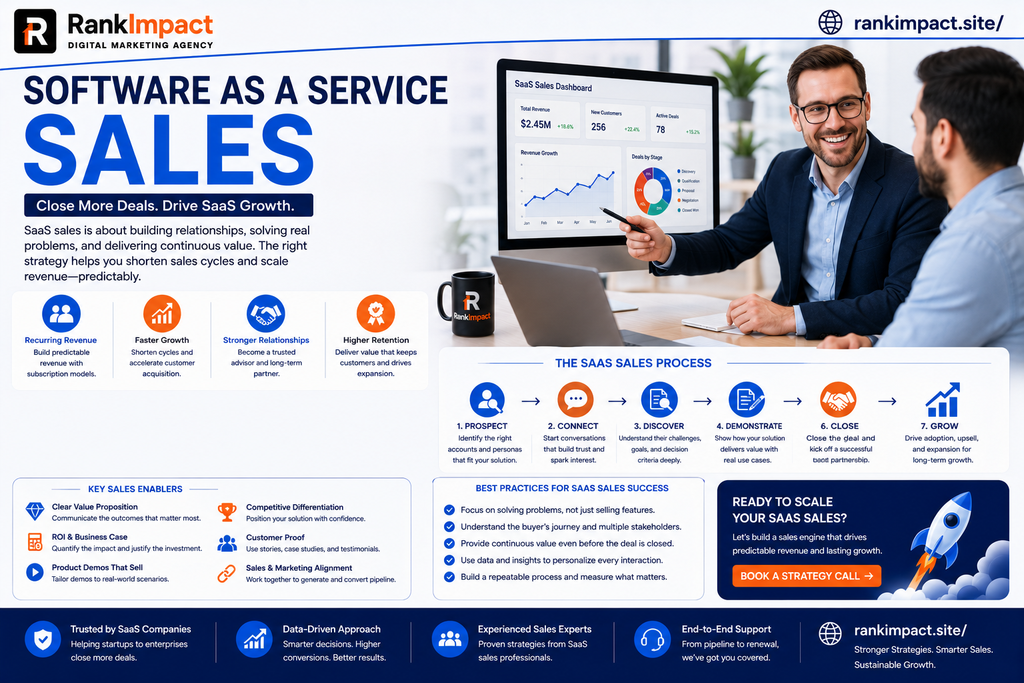
Sales team closing a software as a service sales deal in a modern office.

1 What Software As A Service Sales Really Means

Software as a service sales is the process of guiding a prospective customer from first awareness of a problem to a signed subscription agreement, and then continuing to support that relationship so the customer renews and ideally expands their usage over time. Unlike a traditional one time sale, the transaction itself is only the beginning of the relationship rather than the end of it. A rep who closes a deal but ignores onboarding and early usage is setting up the account for churn within the first renewal cycle, which erases the value of the original sale. This is why software as a service sales teams increasingly measure success not just by closed revenue but by net revenue retention, which tracks how much recurring revenue survives and grows after the initial contract. Selling a subscription also means the buyer is evaluating ongoing value, not a one time feature set, so every conversation during the sales process needs to build confidence that the product will keep solving the problem months and years into the future, not just on day one.

2 Why Software As A Service Sales Differs From Traditional Sales

Traditional sales optimizes for a single transaction, while software as a service sales optimizes for a long term relationship built on renewals and expansion. This changes almost everything about how a deal should be structured. A traditional sales rep can walk away the moment a contract is signed, but a subscription sales rep has a strong incentive to make sure the customer actually adopts the product, because a churned customer in month four erases months of recurring revenue and often costs more to replace than it did to acquire in the first place. Pricing structure also differs significantly, since most software as a service deals involve tiered plans, seat based pricing, or usage based pricing rather than a single flat fee, which means a rep needs to understand the buyer’s growth trajectory to recommend the right plan rather than just the biggest one. Buying committees tend to be larger too, especially for mid market and enterprise deals, often including a economic buyer, a technical evaluator, and an end user champion, each of whom cares about a different aspect of the product. A rep who only pitches to one persona in this committee will consistently lose deals to a competitor who addresses all three.

3 Building A Software As A Service Sales Process That Scales

A scalable software as a service sales process starts with a clearly defined and documented set of stages that every deal moves through, typically something like qualification, discovery, demo, proposal, negotiation, and close. Without documented stages, forecasting becomes guesswork and new reps take far longer to ramp because they have no repeatable playbook to follow. Qualification deserves special attention in a subscription business, since chasing a prospect who is not a strong fit wastes not only the sales cycle but also the future support and success resources required to keep that account from churning after signing. A common qualification framework asks whether the prospect has a genuine pain point your product solves, whether they have budget and authority to buy, and whether the timeline for solving the problem aligns with your sales cycle. Discovery calls should focus on understanding the specific outcome the buyer needs to achieve rather than walking through a generic feature list, because buyers remember how well a rep understood their situation far more than they remember a list of product capabilities. As the process matures, layering in clear exit criteria for each stage, meaning specific actions that must happen before a deal can move forward, keeps the pipeline honest and prevents deals from sitting in a stage indefinitely with no real progress.

4 Key Stages Of The Software As A Service Sales Funnel

The top of a software as a service sales funnel usually starts with marketing qualified leads generated through content, paid channels, or referrals, and the job at this stage in software as a service sales is simply to confirm genuine interest and basic fit before investing sales time. The middle of the funnel is where discovery and evaluation happen, and this is typically the longest stage because the buyer is comparing your solution against alternatives, checking references, and often running a trial or pilot to validate that the product delivers on its promises. The bottom of the funnel involves proposal, pricing negotiation, and internal approval on the buyer’s side, which can move quickly for smaller deals but often stretches for weeks or months in mid market and enterprise accounts due to procurement and legal review. A stage that is frequently underestimated is the post sale onboarding period, which some teams treat as a separate customer success function but which strongly influences whether the deal actually pays off, since a customer who never reaches meaningful product usage is a customer who will not renew regardless of how smoothly the initial sale went. Mapping conversion rates at each of these stages lets a sales leader spot exactly where deals are stalling, whether that is a messaging problem at the top of the funnel or a pricing objection at the bottom.

5 Sales Models Used In Software As A Service Sales

Most software as a service sales organizations operate under one of three broad models or a hybrid of them, and choosing correctly among these software as a service sales models shapes almost every other decision a growing company makes. Sales led growth relies on a traditional rep driven process where an account executive owns the relationship from first conversation through close, which tends to work best for higher priced products with longer evaluation cycles and multiple stakeholders. Product led growth flips this structure by letting users try or use the product with minimal friction, often through a free trial or freemium tier, with sales only entering the picture once usage signals indicate a strong likelihood of conversion or expansion, which works well for lower priced or highly self serve products. A growing number of companies now run a hybrid model where product led growth handles smaller accounts and self serve conversion, while a dedicated sales team focuses on larger accounts that need a more consultative approach and custom contract terms. Choosing the right model, or the right mix, depends heavily on price point, deal complexity, and how much value a prospect can experience on their own before needing human guidance, and getting this choice wrong is one of the most expensive strategic mistakes a growing software company can make.

6 Common Mistakes That Kill Software As A Service Sales Deals

The most common mistake in software as a service sales is pitching product features instead of the outcome the buyer actually cares about, which makes even a strong product sound generic and interchangeable with competitors. Another frequent mistake is neglecting the multi threaded nature of larger deals, where a rep who only builds a relationship with a single champion loses the deal the moment that person changes roles or loses internal influence, which happens more often than most reps expect. Underpricing to win a deal quickly is another costly mistake, since a customer who negotiates an unsustainably low price in year one often churns when the price normalizes at renewal, and that churn frequently costs more than the value of winning the deal in the first place. Poor handoffs between sales and customer success also quietly damage renewal rates, since a customer who was promised something during the sales process that the product cannot actually deliver becomes frustrated and disengaged almost immediately after signing. Finally, many teams rely too heavily on discounting as the default response to price objections instead of addressing the underlying value question, which trains buyers to expect a discount on every renewal and steadily erodes margins across the entire customer base.

7 Tools And Metrics That Support Software As A Service Sales Teams

A modern software as a service sales stack typically includes a customer relationship management platform to track pipeline and deal stages, a sales engagement tool to manage outreach cadences, and a conversation intelligence tool that records and analyzes sales calls to identify what top performers in software as a service sales do differently from the rest of the team. Beyond tools, the metrics that matter most in a subscription business go well beyond traditional close rate and deal size. Net revenue retention shows whether existing customers are expanding, staying flat, or shrinking over time, and it is often considered one of the single most important health indicators for a software as a service business. Customer acquisition cost measured against customer lifetime value tells a leadership team whether the sales motion is actually sustainable, since acquiring customers who churn quickly can look fine on a monthly revenue report while quietly destroying long term profitability. Sales velocity, which combines deal count, average deal size, win rate, and sales cycle length into a single formula, helps a sales leader understand how efficiently the team is converting pipeline into closed revenue and where the biggest opportunity for improvement actually sits.

8 How AI Is Changing Software As A Service Sales

Artificial intelligence has started reshaping software as a service sales at almost every stage of the funnel, and teams that ignore this shift in software as a service sales are already falling behind. Lead scoring models now analyze behavioral signals such as product usage, email engagement, and website activity to flag which accounts are most likely to convert, which lets reps prioritize their time far more effectively than manual scoring ever allowed. Conversation intelligence tools use AI to transcribe and analyze sales calls, surfacing objection patterns and coaching opportunities that would take a sales manager weeks to identify manually across a full team. AI powered forecasting is also becoming more common, pulling from historical deal data and current pipeline activity to produce more accurate revenue predictions than the gut feel estimates many teams still rely on. None of this replaces the human relationship building that closes complex deals, but it does mean that reps who use these tools well are consistently outperforming reps who still run their pipeline entirely from memory and instinct, and that gap is likely to keep widening as these tools continue to mature.

Frequently Asked Questions

What is software as a service sales in simple terms?

Software as a service sales is the process of selling a subscription based software product, which involves not only closing the initial deal but also supporting the customer through onboarding and renewal so the recurring revenue relationship actually lasts.

How is software as a service sales different from traditional sales?

The biggest difference is that software as a service sales optimizes for renewal and expansion revenue over time rather than a single transaction, which changes pricing strategy, deal structure, and how success is measured across the entire customer relationship.

What is the typical sales cycle length for software as a service sales?

Sales cycle length varies widely by price point and buyer complexity, ranging from a few days for low cost self serve products to several months for enterprise deals involving multiple stakeholders and a formal procurement process.

Is product led growth replacing traditional software as a service sales?

Product led growth is not fully replacing sales led approaches, but rather complementing them, with many companies now running a hybrid model where self serve handles smaller accounts and a sales team focuses on larger, more complex deals.

What metrics matter most in software as a service sales?

Net revenue retention, customer acquisition cost compared to lifetime value, and sales velocity tend to matter more in software as a service sales than traditional metrics like raw close rate, since they reflect the long term health of the subscription relationship.

How do you qualify a lead in software as a service sales?

A strong qualification framework checks whether the prospect has a genuine pain point the product solves, whether they hold budget and buying authority, and whether their timeline for solving the problem realistically aligns with your sales cycle.

Why do software as a service sales deals fail after closing?

Deals often fail after closing because of a poor handoff to onboarding, unrealistic promises made during the sales process, or low product usage that prevents the customer from experiencing real value before the first renewal decision.

What tools do software as a service sales teams typically use?

Most teams rely on a customer relationship management platform for pipeline tracking, a sales engagement tool for outreach, and increasingly a conversation intelligence tool to analyze sales calls and coach reps at scale.

How important is multi threading in software as a service sales?

Multi threading is critical for larger deals, since relying on a single champion leaves a deal vulnerable to stalling or collapsing entirely if that person changes roles, loses influence, or leaves the company during the evaluation process.

Can a small software company build an effective sales process without a large team?

Yes. A small team can build an effective process by documenting clear deal stages, qualifying leads rigorously, and focusing sales time only on prospects with strong fit, which often outperforms a larger team working without a defined process.

Conclusion

Software as a service sales is fundamentally different from traditional selling because the transaction is only the starting point of a much longer customer relationship built on renewal and expansion. The companies that consistently win at software as a service sales treat qualification, discovery, and onboarding as equally important parts of the same process rather than separate functions that hand off and forget about each other. Whether you are building your first sales process or refining one that already exists, the fundamentals stay the same, understand the buyer’s real outcome, multi thread every meaningful deal, price for long term sustainability rather than short term wins, and measure success through retention and expansion, not just closed revenue. Build the process this way and software as a service sales stops being a series of one off wins and becomes a genuine growth engine for the business, one that compounds with every renewal your software as a service sales team protects.
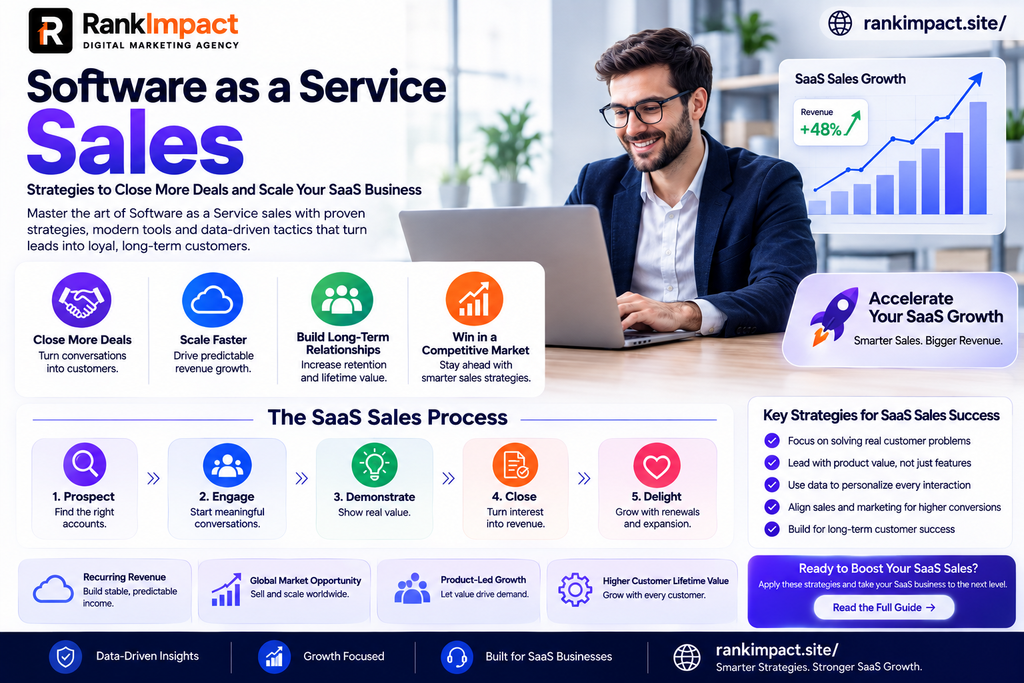
Key Takeaways

Software as a service sales optimizes for renewal and expansion revenue, not just the initial closed deal Qualification and discovery should focus on the buyer’s real outcome rather than a generic feature pitch Sales led growth, product led growth, and hybrid models each fit different price points and deal complexity Multi threading larger deals protects against losing momentum when a single champion changes roles Net revenue retention and sales velocity matter more than raw close rate in a subscription business AI powered lead scoring, conversation intelligence, and forecasting are becoming standard parts of the sales stack
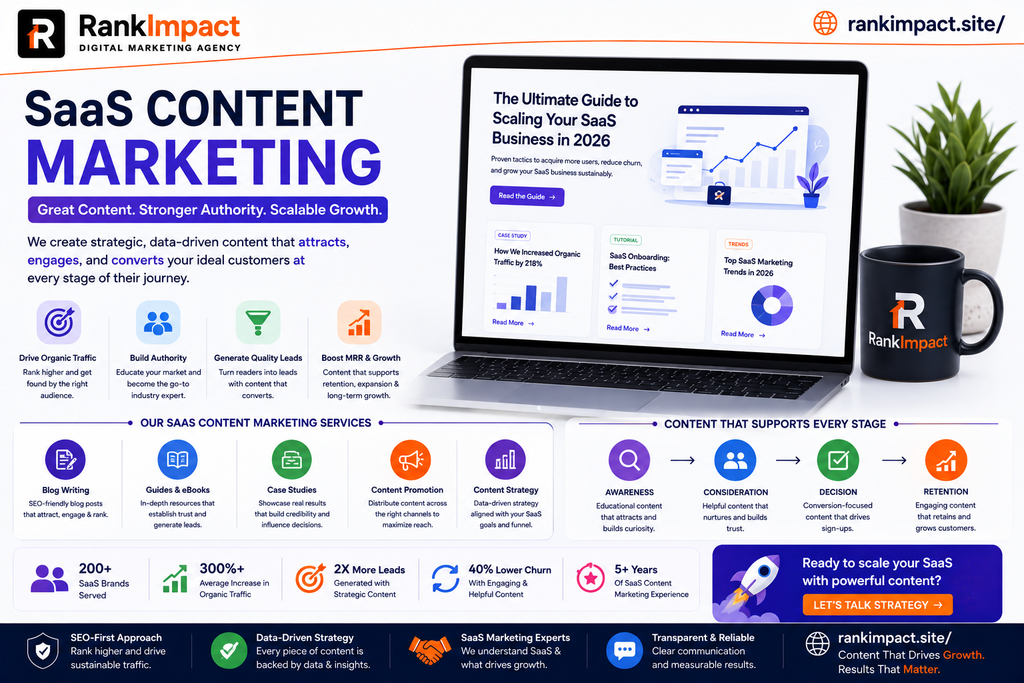
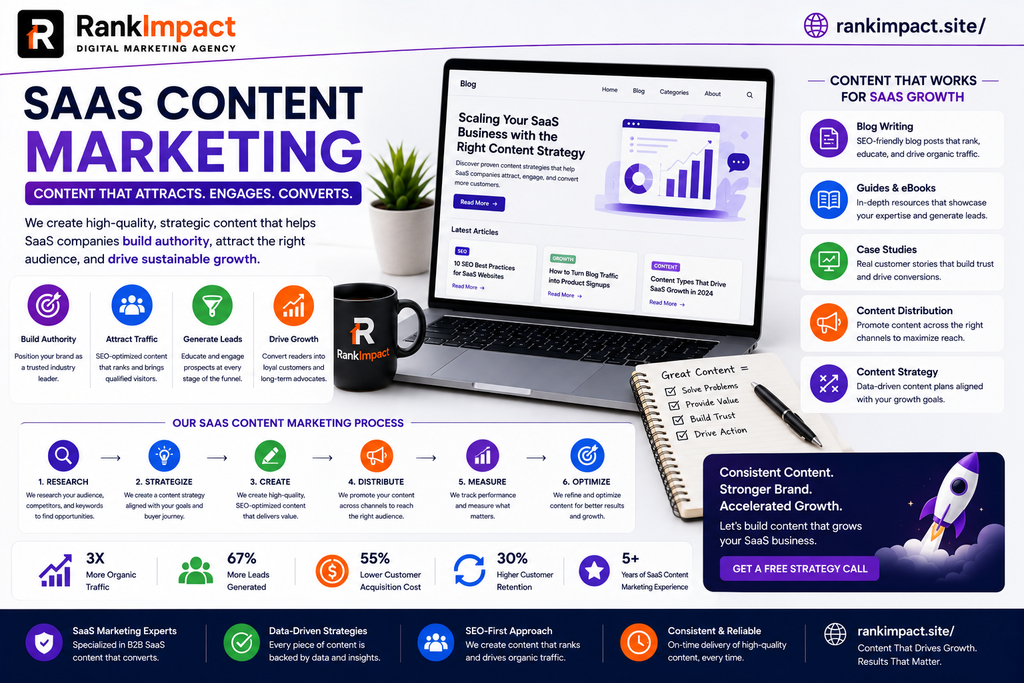
SaaS Content Marketing 11 Strategies That Drive Signups

Learn how SaaS content marketing turns organic traffic into trial signups and revenue, with strategies, formats, and mistakes to avoid in 2026.

SaaS content marketing

Why SaaS Content Marketing Decides Who Wins the Category

Every SaaS category eventually reaches a point where the product features start to look the same across vendors. When that happens, the company that wins is usually the one that has built the most trust with buyers before they ever request a demo. That trust is built almost entirely through content.

SaaS content marketing is the practice of creating and distributing educational, product aware, and decision stage content that moves software buyers from first discovering a problem to signing up for a trial and eventually becoming a paying customer. Unlike traditional content marketing, it has to serve a longer, more research heavy buying journey, support both marketing and product teams, and speak to technical and non technical stakeholders at the same time.

Research from First Page Sage’s 2026 benchmarking study found that cite index=59-3 B2B SaaS SEO produces an average return of 702 percent with a break even period of roughly seven months when measured over a three year window cite. Few other marketing channels for software companies come close to that kind of long term payoff, which is exactly why so many SaaS founders and marketing leaders treat content as a core growth lever rather than a side project.

This guide breaks down what SaaS content marketing actually involves, how it differs from generic B2B content, and the specific strategies, formats, and workflows that experienced SaaS marketers rely on to turn blog traffic into trial signups and expansion revenue.

What Makes SaaS Content Marketing Different From Regular Content Marketing

On the surface, SaaS content marketing looks like any other form of content marketing. There is still keyword research, blog writing, distribution, and measurement. The differences show up in the details, and they matter enormously if you want your content to actually move the needle.

First, SaaS products are usually intangible and often hard to explain in a single sentence, which means content has to do more educational heavy lifting before a prospect understands why the product matters. Second, the buying committee for most B2B software purchases includes several people with different priorities, so a single blog post rarely closes a deal on its own. Third, SaaS is a subscription business, so content does not stop mattering after the sale. Onboarding guides, feature announcements, and best practice articles all influence whether a customer renews or churns.

Finally, SaaS competes in some of the most saturated search results on the internet. Review sites like G2 and Capterra, along with a handful of large incumbent brands, dominate the top rankings for many high intent software queries. Winning visibility requires content that is more specific, more technically credible, and better structured than what a generic content marketing playbook produces.

Understanding Buyer Intent Across the SaaS Funnel

The single biggest mistake in SaaS content marketing is treating every piece of content the same way. Buyers at different stages of the funnel need fundamentally different information, and mapping content to each stage is what separates a strategy that generates leads from one that just generates traffic.

Top of funnel content targets people who are aware of a problem but not yet aware that software can solve it. These readers respond well to broad educational guides, industry trend pieces, and original research. Middle of funnel content targets people actively comparing approaches or evaluating categories of tools, so templates, calculators, and how to guides tend to perform best here. Bottom of funnel content targets people who already know they need a solution and are deciding between specific vendors, which is where comparison pages, alternative pages, and detailed case studies do the heavy lifting.

A useful rule of thumb shared by several experienced SaaS content strategists is that alternative and versus pages, while lower in search volume than broad educational terms, convert at dramatically higher rates because the searcher is closer to a buying decision. Mapping your keyword list to funnel stage before you write a single article prevents the common trap of producing dozens of top of funnel posts that generate traffic but never move anyone toward a purchase.

Building a SaaS Content Marketing Strategy That Aligns With Product Led Growth

Many SaaS companies now rely on product led growth, where the product itself, often through a free trial or freemium tier, does much of the selling. This changes what a content strategy needs to accomplish. It is no longer enough to generate a lead for a sales team to call. Content also needs to drive self serve signups and help users discover value inside the product quickly.

A strong SaaS content marketing strategy for a product led company typically includes use case pages that show specific job to be done scenarios, in app content and empty states that guide new users, and comparison content that helps prospects self select the right plan or feature set without a sales conversation. It also means writing content with clear, low friction calls to action, since a reader who is ready to act should be able to start a trial in one click rather than fill out a lengthy contact form.

The strategy also needs a clear point of view on what the company stands for. Buyers increasingly choose vendors that demonstrate real expertise rather than generic best practices they could find anywhere. Original research, proprietary benchmarks, and opinionated frameworks consistently outperform recycled listicle content because they cannot be easily replicated by competitors or summarized away by an AI answer engine.

Keyword Research and Topical Authority for SaaS Companies

Keyword research for SaaS content marketing works best when it starts from the product rather than from a generic keyword tool. Begin by listing every job your product helps a user accomplish, every problem it solves, and every alternative approach a buyer might currently be using instead of your software. From there, expand into adjacent topics your audience cares about, even if those topics are not directly about your product category.

Topical authority is built by covering a subject area exhaustively rather than publishing isolated posts. A useful structure is the pillar and cluster model, where a broad pillar page targets a competitive head term and a set of supporting articles targets the specific long tail questions related to that topic, all linked back to the pillar. This structure signals to search engines that your site has depth on the subject, and it also gives readers a clear path to explore related content, which improves engagement metrics.

Keyword difficulty matters more for newer SaaS sites than for established ones. A site with limited domain authority should prioritize lower competition, high commercial intent terms first to build early wins, then gradually move into more competitive head terms as authority grows. Chasing the highest volume keyword in a category before your site has earned enough authority is one of the most common ways early stage SaaS content programs waste months of effort.

Content Formats That Work Best for SaaS Companies

Blog posts remain the backbone of most SaaS content marketing programs, but the format mix matters. Comparison and alternative pages convert exceptionally well because they meet buyers at the exact moment they are deciding between vendors. Customer case studies build the kind of social proof that no amount of self authored content can replicate, especially when they include specific, measurable outcomes.

Webinars deserve more attention than many SaaS marketers give them. Industry data shows that cite index 58 4 a majority of marketers report webinars generate higher quality leads than any other content format cite, largely because live formats create a level of engagement and trust that static content cannot match. Templates, calculators, and other interactive tools also perform well because they let prospects experience the value of your thinking, and often your product, before they ever sign up.

Changelogs and product update posts are frequently overlooked, but they matter for retention. Existing customers who understand what is new and why it matters are less likely to churn, and public changelogs also give your sales and customer success teams fresh material to share with prospects and accounts. A well rounded SaaS content marketing plan blends acquisition focused formats with retention focused formats rather than treating content purely as a top of funnel activity.

Structuring a SaaS Content Team and Workflow

Small SaaS companies often start with a single content marketer wearing several hats, while larger organizations build dedicated teams that include a content strategist, writers or freelancers, an SEO specialist, and a designer or video producer. Regardless of team size, the workflow that separates high performing programs from stagnant ones is consistency paired with a documented editorial process.

Every piece of content should move through a clear pipeline that includes topic research and validation, an outline or brief that captures search intent and key points to cover, a draft reviewed by someone with subject matter expertise, and a publishing checklist that covers onpage SEO, internal linking, and calls to action. Subject matter review is especially important in SaaS, where technical inaccuracies or outdated feature claims damage credibility with the exact audience you are trying to win over.

Publishing frequency matters less than most marketers assume, but consistency does not. Research on SaaS blogging performance found that cite index=56 2 roughly 98 percent of top performing SaaS companies maintain an active blog, and those publishing eleven or more posts per month see over three times more traffic than less frequent publishers cite. The takeaway is not that every company needs to publish daily, but that a realistic, sustainable cadence beats sporadic bursts of content followed by long gaps.

SEO Best Practices for SaaS Content Marketing

Technical SEO issues quietly undermine a surprising number of otherwise strong SaaS content programs. Product subdomains that are not properly blocked from crawling can waste crawl budget on thin, session specific pages instead of your marketing content. Duplicate pricing pages, parameter heavy URLs, and slow loading, JavaScript heavy marketing sites all suppress rankings that good content should otherwise earn.

On page optimization for SaaS content should focus on matching search intent precisely, using clear heading structure, and answering the core question a reader is searching for within the first few sentences of the page. This approach also happens to align well with how featured snippets and AI generated answer summaries pull information, since both favor content that states a direct answer early and supports it with detail afterward.

Backlinks remain one of the strongest ranking factors for competitive SaaS keywords. Analysis from uSERP found that <cite index=”65 6″>pages ranking in the top position have nearly four times as many backlinks as lower ranked pages on the same results page</cite>. For SaaS companies, earning links through original research, tool based content, and genuine expert commentary tends to outperform outreach campaigns built around generic guest posts.

Using SaaS Content Marketing to Reduce Churn and Grow Existing Accounts

Most conversations about SaaS content marketing focus entirely on acquisition, but some of the highest-leverage content a SaaS company can produce is aimed at existing customers. Onboarding guides, feature deep dives, and workflow-specific tutorials directly influence whether a new customer reaches the point of realizing value, often called the activation moment, before their trial ends or their first invoice arrives.

For customers already using the product, ongoing educational content helps drive feature adoption, which is one of the strongest predictors of renewal. A customer who only uses a fraction of what your software offers is far more likely to churn than one who has adopted several core workflows. Content that proactively teaches underused features, shares customer success patterns, and explains new releases keeps the product relevant in the customer’s daily work.

This retention focused content also supports expansion revenue. Case studies and use case content that show what is possible at a higher tier or with an add on feature give customer success and sales teams natural material for upsell conversations, without content ever feeling like a hard sell.

Common SaaS Content Marketing Mistakes to Avoid

The most common mistake is writing generic, surface level content that could have been published by any company in any industry. Buyers evaluating software are usually more sophisticated than the average reader, and shallow content erodes trust rather than building it. The second most common mistake is ignoring bottom of funnel content in favor of broad, high volume topics that look impressive in traffic reports but rarely convert.

Many SaaS teams also underestimate how much technical SEO and site structure affect content performance, publishing excellent articles on a site that search engines struggle to crawl efficiently. Others treat content as a one time project rather than a compounding asset, failing to update older posts as the product evolves, which leaves outdated screenshots, pricing, and feature claims live on the site for years.

A final and increasingly important mistake is failing to differentiate content from what a search engine or AI assistant can already summarize. As more informational queries get resolved directly within search results and AI tools, purely explanatory content loses value over time. The content that continues to earn attention going forward is content built on original data, direct product expertise, and a clear point of view that cannot be easily reproduced by a machine summarizing publicly available information.

Measuring the ROI of SaaS Content Marketing

Traffic is the easiest metric to track and the least useful one on its own. A mature SaaS content marketing program measures performance against business outcomes, including trial signups attributed to organic content, content influenced pipeline, and the eventual conversion of content sourced leads into paying customers. Tools like Google Search Console and product analytics platforms can be connected to track a reader’s path from first blog visit to signup.

Assisted conversions matter as much as last click conversions in SaaS, since the buying journey often spans weeks or months and touches multiple pieces of content before a decision is made. Attribution models that only credit the final touchpoint will consistently undervalue top and middle of funnel content, leading teams to defund the very content that built initial awareness and trust.

For retention focused content, the relevant metrics shift to feature adoption rate, time to activation, and support ticket deflection. A knowledge base article that reduces support volume for a common question delivers measurable value even though it will never appear in a traditional marketing attribution report, which is why SaaS content ROI should be evaluated holistically across acquisition, activation, and retention rather than through a single funnel top metric.

Real World SaaS Content Marketing Examples

Several well known SaaS companies illustrate what disciplined content marketing looks like in practice. Ahrefs built its blog around detailed, data backed guides written by practitioners who use the product daily, which reinforces product credibility while ranking for competitive SEO terms. HubSpot has long relied on a massive library of educational content across every stage of the funnel, supported by tools and templates that generate leads independent of the blog itself.

Smaller, more focused companies show that scale is not a prerequisite for strong results. Niche SaaS products have grown organic traffic significantly by publishing narrowly focused, highly specific content that speaks directly to a well defined audience rather than trying to compete for broad, generic terms. The common thread across every successful example is specificity. Companies that describe exactly who a piece of content is for, and exactly what problem it solves, consistently outperform companies producing broader, less targeted material aimed at everyone and no one in particular.

Frequently Asked Questions

What is SaaS content marketing?

SaaS content marketing is the process of creating and distributing content, such as blog posts, comparison pages, case studies, and guides, to attract, convert, and retain customers for a software as a service business. It differs from general content marketing because it must support a longer buying cycle, multiple stakeholders, and both new customer acquisition and existing customer retention.

How is SaaS content marketing different from B2B content marketing in general?

SaaS content marketing shares many principles with broader B2B content marketing but places heavier emphasis on product education, comparison content, and post sale retention material, since SaaS revenue depends on ongoing subscriptions rather than one time purchases.

How long does it take to see results from SaaS content marketing?

Most SaaS companies begin seeing measurable organic traffic and lead generation within three to six months, though competitive terms and newer domains often take longer. Results tend to compound over time as topical authority and backlink profiles grow.

What type of content converts best for SaaS companies?

Bottom of funnel content such as comparison pages, alternative pages, and detailed case studies typically converts at the highest rate, since it targets readers who are actively evaluating vendors and close to a purchase decision.

How often should a SaaS company publish blog content?

Consistency matters more than raw frequency. A sustainable cadence that a team can maintain long term, whether that is weekly or a few times a month, generally outperforms sporadic bursts of publishing followed by long gaps.

Should SaaS companies create content for existing customers, not just prospects?

Yes. Onboarding guides, feature updates, and educational content for current users directly influence activation, feature adoption, and renewal rates, making retention focused content one of the highest leverage areas of a content program.

How does SEO fit into a SaaS content marketing strategy?

SEO and content marketing are deeply intertwined for SaaS companies, since organic search is typically the largest source of long term, low cost traffic. Keyword research, technical site health, and backlink acquisition all directly affect how much value a content program generates.

What are the biggest mistakes SaaS companies make with content marketing?

Common mistakes include publishing generic content that lacks real expertise, over indexing on top of funnel topics while neglecting bottom of funnel conversion content, ignoring technical SEO issues, and treating content as a one time project instead of an asset that requires ongoing updates.

How should a SaaS company measure content marketing ROI?

ROI should be measured across the full customer lifecycle, including organic traffic, trial signups, content influenced pipeline, and retention metrics like feature adoption and support ticket deflection, rather than relying on a single top of funnel metric like page views.

Do small SaaS startups need a large content team to succeed with content marketing?

No. Many successful SaaS content marketing programs start with a single dedicated marketer or a small team, focused on a narrow set of high intent topics, before scaling up as the strategy proves itself and budget allows.

Conclusion

SaaS content marketing is no longer optional for software companies competing in crowded categories. It is the mechanism through which buyers build trust, evaluate alternatives, and ultimately decide who deserves their business, and it continues working long after the sale by driving activation and reducing churn. The companies that treat content as a disciplined, funnel aware program, backed by real subject matter expertise and sound technical execution, consistently outperform those treating it as an occasional blogging exercise. Whether you are a founder writing your first ten articles or a marketing leader scaling a mature program, the fundamentals stay the same: understand exactly who you are writing for, map content to where they are in their decision, and never stop refining what you publish as your product and market evolve.

Conclusion

SaaS content marketing is no longer optional for software companies competing in crowded categories. It is the mechanism through which buyers build trust, evaluate alternatives, and ultimately decide who deserves their business, and it continues working long after the sale by driving activation and reducing churn. The companies that treat content as a disciplined, funnel aware program, backed by real subject matter expertise and sound technical execution, consistently outperform those treating it as an occasional blogging exercise. Whether you are a founder writing your first ten articles or a marketing leader scaling a mature program, the fundamentals stay the same: understand exactly who you are writing for, map content to where they are in their decision, and never stop refining what you publish as your product and market evolve.

Key Takeaways

Effective SaaS content marketing requires mapping content to every stage of the buyer journey rather than producing generic educational posts alone. Bottom of funnel formats like comparison pages and case studies typically deliver the strongest conversion rates. Topical authority, built through a structured pillar and cluster approach, outperforms isolated, disconnected blog posts. Technical SEO health directly affects whether strong content can actually rank. Retention focused content for existing customers is often undervalued despite its direct impact on renewal and expansion revenue. Original research, proprietary data, and genuine product expertise increasingly separate content that earns lasting attention from content that gets summarized away by search engines and AI tools. Finally, ROI should be tracked holistically across acquisition, activation, and retention, not through traffic alone.

Top SaaS Tools for Startups 15 Best Picks for 2026

Discover the top SaaS tools for startups in 2026, covering CRM, finance, marketing, support, and hosting, with real free tier options for every growth stage.

top saas tools for startups

15 Top SaaS Tools for Startups to Scale Faster in 2026

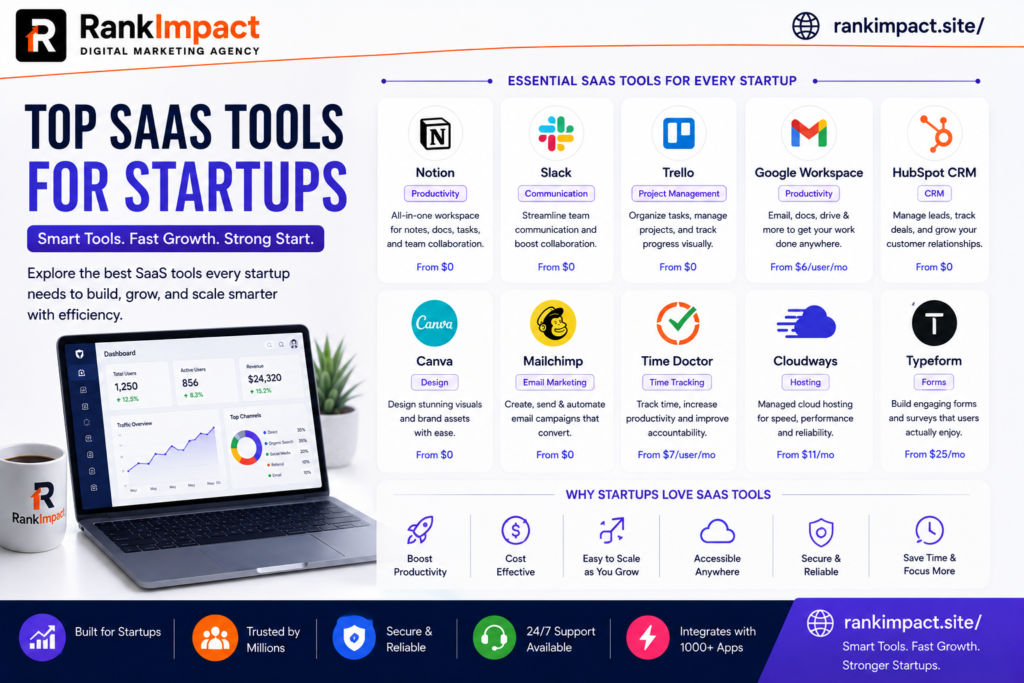
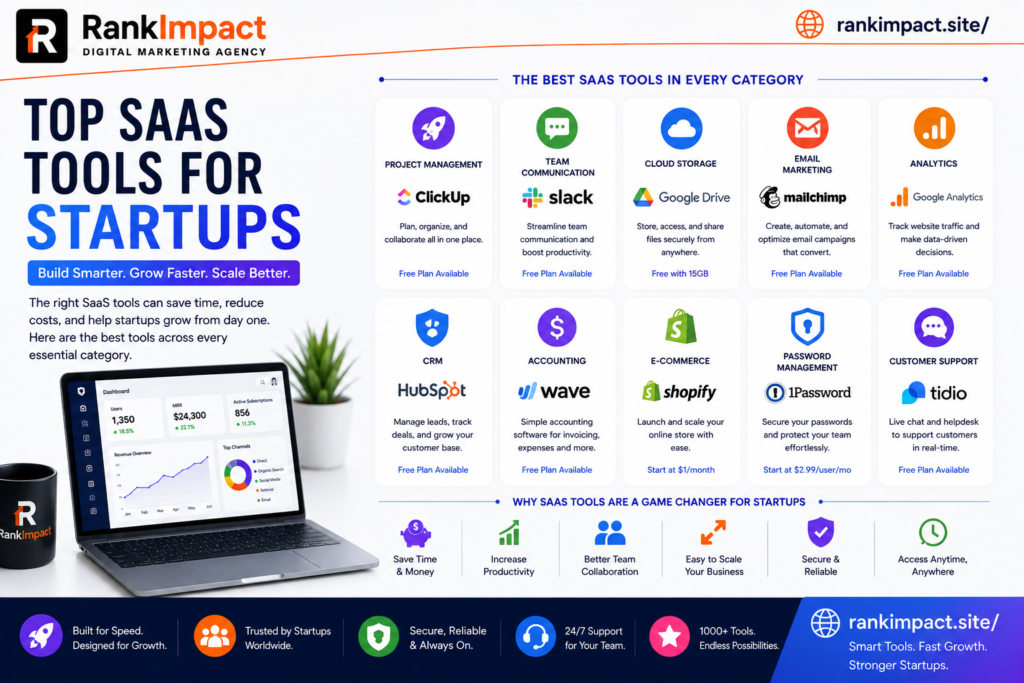
Every early stage founder eventually hits the same wall. The product is live, the first customers are signing up, and suddenly there is no time left to run finance, support, marketing, and operations by hand. This is exactly where the right software stack starts to matter. Choosing the top SaaS tools for startups is not about collecting as many apps as possible. It is about picking a lean set of platforms that remove friction, save hours every week, and grow with the business instead of holding it back.

This guide walks through the categories every startup needs to cover, names specific platforms worth testing in each one, and explains how to evaluate a tool before you commit your card details to another monthly subscription. The goal is not a random directory of software. It is a practical shortlist of the top SaaS tools for startups, built around what actually moves the needle for a small team trying to reach product market fit without burning through runway on tools nobody uses after month two.

Whether you are a solo founder validating an idea or a five person team preparing for your first funding round, the categories below cover the operational backbone almost every SaaS or product led startup eventually needs. Rather than listing every possible option, this article focuses on tools with a track record of actually being adopted by small teams, not just tools that look impressive in a sales demo.

Why the Right SaaS Stack Matters More Than People Think

Founders often underestimate how much a messy tool stack costs them. Spreadsheets scattered across Google Drive, five different chat apps because nobody agreed on one, and a CRM that only half the sales team updates are not just annoying. They slow down decisions, create blind spots around cash flow, and make onboarding a new hire painful because nothing lives in one place.

A well chosen set of SaaS tools for startups solves three problems at once. First, it centralizes information so founders and managers can see what is actually happening in the business without chasing five people for updates. Second, it automates repetitive work like invoicing, lead follow up, and reporting, which frees up hours that a small team simply does not have to spare. Third, it creates a foundation that can scale. A tool that works for three people and breaks at twenty is a tool you will have to migrate away from later, and migrations are expensive in both time and morale.

The best approach is to think in categories rather than individual products. Every startup, regardless of industry, needs to cover communication, customer relationships, finance, marketing, project management, support, analytics, and hosting. Below is a breakdown of proven options in each category, along with what makes them a strong fit for early stage teams specifically, and why they consistently appear on lists of the top SaaS tools for startups across different industries.

Communication and Team Collaboration Tools

Remote and hybrid teams live or die by how well they communicate asynchronously. The right messaging and video tools keep everyone aligned without turning every question into a 30 minute meeting.

Slack remains one of the most widely adopted options for team messaging because it integrates with almost every other tool a startup already uses, from project trackers to customer support software. Its free tier is generous enough for a small team to run entirely on it before upgrading. You can review current plans directly on the Slack pricing page.

Notion has become a favorite for startups that want a single workspace for documentation, wikis, meeting notes, and lightweight project tracking. Because it replaces several standalone tools, it often ends up saving money rather than adding another line item. Details on its startup friendly pricing are available on the Notion for startups page.

Google Workspace is still the default choice for email, shared calendars, and document collaboration for a reason. It is reliable, familiar to almost every new hire, and scales cleanly from a two person team to a two hundred person company without a painful migration.

Customer Relationship Management Platforms

A CRM is often the first serious software purchase a startup makes once sales conversations move past a handful of manual emails. The mistake many founders make is jumping straight to an enterprise grade CRM before they need one.

HubSpot’s free CRM tier is a strong starting point because it covers contact management, deal tracking, and basic email tools without requiring a credit card. As the sales process matures, teams can move into paid tiers without switching platforms. You can explore what is included on the HubSpot CRM overview.

Zoho CRM is another practical option for budget conscious startups, particularly those already using other Zoho products for finance or support. Its lower entry pricing compared to some competitors makes it appealing for teams that need CRM functionality without a large monthly commitment.

Pipedrive is worth considering for startups with a sales led motion, since its pipeline visualization is built specifically around helping small sales teams move deals forward rather than managing large enterprise account hierarchies.

SaaS Content Marketing and Growth Tools

Marketing software is where many startups either overspend on tools they barely touch or underinvest and fall behind competitors who are consistently visible in search and social. A lean content marketing stack should cover email, SEO research, and social scheduling at minimum.

Mailchimp continues to be a dependable entry point for email marketing, offering automation, audience segmentation, and a free plan suitable for early stage lists. Current plan details are on the Mailchimp pricing page.

Semrush and Ahrefs are the two most established platforms for keyword research, competitor analysis, and technical SEO audits. Startups building an organic acquisition channel through blog content, much like a SaaS content marketing strategy built around search intent, typically rely on one of these two tools to identify keyword opportunities and track ranking progress over time.

Buffer offers a straightforward way to schedule and manage social posts across multiple platforms from a single dashboard, which matters when the same one or two people are handling marketing, support, and half of sales.

Finance, Accounting and Budget Control Tools

Financial visibility is non negotiable, even for a two person startup. Founders who put off proper accounting until year two often discover expensive surprises when it comes time to raise funding or file taxes.

QuickBooks Online remains the most widely used accounting platform for small businesses and startups, offering invoicing, expense tracking, and integrations with most banks and payment processors. Its scalability makes it a safe long term choice rather than something you will outgrow quickly.

Wave is a genuinely free alternative for very early stage startups that need basic invoicing and accounting without a monthly fee, making it a sensible starting point before revenue justifies a paid platform.

Stripe handles payment processing for a large share of SaaS and ecommerce startups worldwide, and its documentation and developer tools make it a practical choice even for non technical founders working with a small engineering team. Pricing and product details are available on the Stripe pricing page.

As spending on software grows, startups should also build a habit of auditing which subscriptions are actually being used each quarter, since unused licenses are one of the most common silent budget leaks in a growing SaaS stack.

Project Management and Productivity Tools

Without a shared system for tracking work, tasks live in someone’s head, in Slack threads, or in a notebook that gets lost. A lightweight project management tool prevents dropped balls as the team grows past a handful of people.

Trello’s board based interface is simple enough for non technical teams to adopt in a single afternoon, which makes it a common first project management tool for startups that are not ready for something more complex.

Asana works well for startups managing multiple projects across departments, offering timelines, dependencies, and reporting that Trello does not provide out of the box, while still remaining approachable for smaller teams.

ClickUp positions itself as an all in one workspace covering tasks, docs, and goals, and its generous free tier makes it attractive for cash conscious founders who want more functionality without an immediate spend commitment.

Customer Support and Success Platforms

How a startup handles its first hundred support tickets often determines whether early customers become advocates or churn quietly. Support tooling does not need to be complex, but it does need to be consistent.

Zendesk is a long established option for structured ticketing, live chat, and a searchable help center, making it a solid choice once support volume grows beyond what a shared inbox can handle. You can review its plans on the Zendesk pricing page.

Intercom combines live chat, help center articles, and product tours in one platform, which appeals to SaaS startups that want support and onboarding to feel connected rather than separate systems.

Help Scout is worth considering for startups that want a shared inbox style experience that still feels personal, rather than a ticket number driven workflow that can feel impersonal to early customers.

Analytics and Product Data Tools

Startups that do not measure usage tend to guess at what to build next, which is one of the most expensive mistakes a small team can make. Product analytics turns assumptions into evidence.

Google Analytics remains the default choice for website traffic analysis and is free for the volume most early stage startups generate, covering acquisition channels, behavior flow, and conversion tracking.

Mixpanel and Amplitude both specialize in product analytics, tracking how users actually move through a SaaS product rather than just website traffic. These tools are particularly useful once a startup needs to understand feature adoption and retention cohorts rather than just top of funnel numbers.

Hotjar adds a visual layer to analytics through heatmaps and session recordings, helping product and marketing teams see exactly where users hesitate or drop off on a page.

Hosting, DevOps and Security Tools

Reliable infrastructure is invisible when it works and catastrophic when it does not. Startups need hosting and security tools that scale automatically rather than requiring manual intervention every time traffic spikes.

DigitalOcean and Vercel are both popular among startups for their straightforward pricing and developer friendly deployment workflows, particularly for teams building modern web applications without a dedicated infrastructure team.

Cloudflare provides content delivery, DNS management, and basic security protection that most startups need from day one, and its free tier covers a meaningful amount of what a small site requires before any paid upgrade becomes necessary.

1Password or a similar credentials manager should be considered mandatory rather than optional, since shared logins passed around in chat messages are one of the most common and easily preventable security failures at early stage companies.

Matching SaaS Tools to Your Startup’s Growth Stage

Not every startup needs the same stack on day one, and one of the most common mistakes founders make is adopting tools built for a stage they have not reached yet. Matching software choices to where the company actually stands saves both money and onboarding time.

Thinking about the top SaaS tools for startups through the lens of company stage, rather than category alone, makes the decision process far less overwhelming. At the idea and pre revenue stage, the priority should be free tools that require no long term commitment. A founder validating a concept does not need a paid CRM or a premium analytics suite. Google Workspace, Trello, Wave, and the free tiers of Slack and Mailchimp are usually more than enough to run the business end to end at this stage.

Once a startup has its first paying customers, it typically needs to add proper accounting through QuickBooks or Stripe for payments, a real CRM like HubSpot to track a growing pipeline, and a support tool such as Help Scout to keep response times consistent as inbound volume increases.

As the team grows past ten or fifteen people, the top SaaS tools for startups at this stage usually shift toward platforms with stronger permissions, reporting, and integration depth, such as Asana for cross department project tracking, Zendesk for structured support ticketing, and dedicated product analytics like Mixpanel or Amplitude to guide roadmap decisions with real usage data instead of guesswork.

How to Choose the Right SaaS Tools for Your Startup

With so many options in every category, the decision process matters more than the specific brand name. A few principles consistently separate startups that build an efficient stack from those that end up with tool sprawl.

Start with the problem, not the product. It is tempting to adopt a tool because a competitor uses it or because it trended on a startup newsletter, but the better question is always what specific bottleneck this tool removes right now.

Favor tools with genuine free tiers over free trials when you are pre revenue. A free trial creates artificial urgency to decide before you have real usage data, while a genuine free tier lets you validate fit over weeks or months without financial pressure.

Check integration compatibility before committing. A tool that does not connect to the rest of your stack through native integrations or something like Zapier will eventually create manual work that defeats the purpose of automating in the first place.

Reassess every quarter rather than assuming a tool chosen at launch is still the right fit a year later. Startups change quickly, and a tool that fit a five person team may be the wrong choice once headcount doubles.

Talk to the team actually using the tool before renewing or expanding a subscription. Founders often make software decisions in isolation based on what looks good in a pitch deck or investor update, while the people entering data every day have the clearest view of whether a platform is genuinely saving time or just adding another login to manage. A quick five minute check in before each renewal date can surface friction points long before they show up as a churned customer or a missed deadline.

Test a tool with real data before rolling it out company wide. A trial run with actual customer records, actual invoices, or actual support tickets reveals limitations that a sales demo never will, and it is far cheaper to discover a dealbreaker during a two week pilot than after a year long contract has already been signed.

Common Mistakes Startups Make When Selecting SaaS Tools

Even experienced founders fall into predictable traps when building out their software stack. Recognizing these patterns early can save real money and time.

Buying enterprise tools too early is one of the most frequent mistakes, since features built for companies with hundreds of employees often add complexity a five person startup does not need yet, along with a price tag that does not match current revenue.

Letting different departments choose tools independently, without checking whether something already covers the need, leads to overlapping subscriptions that quietly drain the budget every month without anyone noticing until a financial review flags it.

Ignoring onboarding and training time is another common blind spot. A tool that looks powerful in a demo but takes three weeks for the team to actually adopt is not saving time, it is costing it, at least in the short term.

Skipping the cancellation step when a tool stops being used is a small habit that compounds. Startups that build a quarterly subscription audit into their routine consistently spend less on software than those that only look at their SaaS bill once a year.

Chasing every new tool that appears on a startup newsletter or a Product Hunt launch is another trap worth naming directly. Novelty is not the same as necessity, and the strongest lists of the top SaaS tools for startups tend to favor proven, well supported platforms over the newest entrant promising to disrupt an entire category overnight.

Building a Lean Stack Without Sacrificing Growth

A lean approach to software does not mean avoiding paid tools altogether. It means being deliberate about when a paid upgrade is actually justified by a real bottleneck rather than a nice to have feature. Many of the top SaaS tools for startups mentioned throughout this guide offer a natural upgrade path, which means a founder can start on a free tier, prove the value internally, and only move to a paid plan once the team is genuinely constrained by the free version.

This approach also protects runway during the earliest and most fragile period of a company’s life. Every dollar spent on a tool that sits unused is a dollar that could have extended the runway by another day, and in a startup that difference sometimes matters more than founders realize until they are staring at a shrinking bank balance a year later. Treat every new subscription as a decision that deserves the same scrutiny as a hire, because in a very real sense, a SaaS subscription is buying a small amount of capacity that a human would otherwise have to provide manually.

Frequently Asked Questions

What are the most important SaaS tools for a brand new startup?

At minimum, a new startup should cover communication, a basic CRM, accounting, and a project management tool. These four categories represent the most essential of the top SaaS tools for startups and address the operational basics that almost every early stage company needs regardless of industry.

Are there genuinely free SaaS tools for startups, or are they all trials?

Several tools mentioned in this guide, including Wave for accounting and the free tiers of Slack, Trello, and HubSpot CRM, offer real ongoing free plans rather than limited time trials, making them practical choices for pre revenue startups.

How many SaaS tools should a startup realistically use?

There is no fixed number, but most efficient early stage teams operate with somewhere between eight and fifteen core tools across all departments. Beyond that range, overlapping functionality and unused subscriptions tend to creep in.

What is the best free CRM for an early stage startup?

HubSpot’s free CRM tier is generally considered the strongest free option, since it includes contact management, deal tracking, and basic email tools without a time limit, unlike many trial based alternatives.

Should a startup choose an all in one platform or specialized tools for each function?

It depends on team size. Very small teams often benefit from all in one platforms like ClickUp or Notion that reduce the number of logins, while growing teams with specialized needs tend to get more value from best in class tools per category.

How often should a startup review its SaaS subscriptions?

A quarterly review is generally sufficient for most early stage companies. This cadence catches unused licenses and overlapping tools before they accumulate into a significant unnecessary expense.

What SaaS tools help startups with limited marketing budgets specifically?

Mailchimp’s free email tier, Buffer’s social scheduling, and Google Analytics all offer meaningful functionality at no cost, making them a sensible starting point before investing in paid SEO or advertising platforms.

Is it worth paying for premium SaaS tools before reaching product market fit?

Generally no, with the exception of tools directly tied to revenue generation like payment processing or core infrastructure. Most other categories have capable free or low cost options that are sufficient before product market fit is confirmed.

How do startups avoid overspending on SaaS tools as they scale?

Regular subscription audits, centralizing purchasing decisions rather than letting every department buy independently, and negotiating annual plans once usage is proven are the three most effective ways startups keep SaaS spend under control.

What is the biggest risk of choosing the wrong SaaS tools early on?

The biggest risk is not the monthly cost itself but the migration cost later. Moving customer data, retraining a team, and rebuilding workflows around a new platform is far more expensive in time and disruption than the subscription fee ever was.

Conclusion

There is no single correct answer to which software a startup should run on, and treating this list as a rigid checklist would miss the point. The real value in identifying the top SaaS tools for startups lies in matching each category to an actual operational need rather than chasing trends or copying a competitor’s stack without understanding why it works for them. Start small, favor tools with real free tiers while validating fit, and build the habit of reviewing subscriptions regularly as the team grows. A startup that gets its software stack right early spends less time fighting its own tools and more time building the product and relationships that actually drive growth.

Key Takeaways

Choosing the top SaaS tools for startups comes down to solving real bottlenecks with tools that have genuine free tiers, integrate cleanly with the rest of the stack, and can scale without forcing a painful migration later. Communication, CRM, finance, marketing, project management, support, analytics, and hosting are the eight categories every startup needs to cover, though the specific product within each category should match the team’s size, budget, and technical comfort level rather than simply following what a competitor uses. Reviewing the stack every quarter, favoring free tiers over trials while pre revenue, and checking integration compatibility before committing are the habits that consistently separate lean, efficient startups from those buried in unused subscriptions.

SaaS SEO Services 7 Steps to Choose the Right Partner

Discover 7 key steps to choosing the right SaaS SEO services partner, including what to look for, common mistakes, and pricing tips.

SaaS SEO services

SaaS SEO Services A Complete Guide to Choosing the Right Partner

Choosing between building an internal SEO function and hiring outside help is a decision nearly every growing SaaS company eventually faces, and it rarely has an obvious answer. SaaS SEO services occupy a specific niche within the broader digital marketing industry because ranking a software product involves technical considerations, buyer research patterns, and content depth requirements that differ meaningfully from SEO work in most other industries. A generalist agency comfortable optimizing an ecommerce product page or a local business listing often struggles when asked to build topical authority around a complex software category with a long, research intensive sales cycle.

This guide is written for founders, marketing leaders, and growth teams evaluating whether to bring in SaaS SEO services and, if so, how to actually choose a partner that will deliver genuine results rather than vanity traffic metrics. Readers researching this topic typically fall into a few groups. Some are early stage founders trying to understand what SaaS SEO services actually include before committing budget. Others are marketing leaders who have already tried a generalist agency without success and are trying to understand what a specialized provider does differently. And some are evaluating multiple SaaS SEO services providers and need a framework for comparing them meaningfully. This article addresses all three in depth.

What SaaS SEO Services Actually Include

SaaS SEO services typically cover a combination of strategic, technical, and content focused work specifically tailored to how software buyers research and evaluate products. This usually begins with keyword and topic research grounded in actual buyer intent rather than generic search volume, since a term with high search volume but low genuine buying intent often wastes resources that would be better spent targeting more specific, lower volume terms closer to an actual purchase decision.

Technical SEO work forms another core component, addressing site architecture, page speed, structured data, and crawlability issues that specifically affect how search engines index and understand a SaaS company’s often large and complex website, which frequently includes a marketing site, a documentation section, a blog, and sometimes a separate help center all needing to work together cohesively from a technical indexing standpoint.

Content strategy and production represents the most visible component of most SaaS SEO services, encompassing everything from top of funnel educational content to bottom of funnel comparison and product pages designed to convert readers already deep in an evaluation process. Link building and digital PR often round out a comprehensive service offering, since earning genuine authoritative backlinks remains one of the more difficult but impactful levers within any competitive SEO strategy.

Why SaaS Companies Need a Specialized Approach

Software buyers research differently than consumers or buyers in most other B2B categories, typically consuming a longer sequence of content before ever engaging directly with a sales team, often involving multiple stakeholders within the same purchasing company who each research independently before a group decision is made. SaaS SEO services built around this reality structure content specifically to support this extended, multi stakeholder research process rather than optimizing purely for a single conversion moment.

The competitive landscape within most software categories has also grown considerably more sophisticated, with well funded competitors regularly publishing detailed comparison content, in depth guides, and product led content specifically designed to intercept buyers at every stage of research. Generic SEO tactics that might work adequately in a less competitive industry frequently underperform significantly against this level of sophistication, which is precisely why specialized SaaS SEO services focused specifically on software company growth have become a distinct category within the broader agency landscape.

Search intent within software categories also carries unique complexity, since a single keyword can represent meaningfully different intent depending on subtle phrasing, and providers experienced specifically with SaaS companies tend to recognize these distinctions more reliably than generalist providers accustomed to industries with more straightforward, transactional search behavior.

Core Deliverables to Expect From a Quality Provider

A genuinely comprehensive SaaS SEO services engagement typically begins with a thorough technical and content audit identifying specific gaps and opportunities rather than generic recommendations that could apply to nearly any website. This audit should result in a clear, prioritized roadmap rather than an overwhelming list of every possible improvement without guidance on what actually matters most given the company’s current stage and resources.

Ongoing content production forms the backbone of most engagements, and quality providers typically involve subject matter expertise directly in the process rather than producing generic content written without genuine understanding of the software category or its buyers. This often means structured interviews with a company’s own product and customer success teams to extract genuine expertise that generic freelance writers simply cannot replicate independently.

Regular reporting tied to meaningful business metrics, rather than surface level traffic numbers alone, distinguishes providers genuinely focused on driving pipeline from those primarily focused on demonstrating activity. A provider should be able to clearly connect specific content or technical work to measurable outcomes like organic trial signups or demo requests, even if full attribution remains imperfect given the realistic complexity of a typical SaaS buying journey.

Technical implementation support, not just recommendations, matters considerably as well, since many internal teams lack the bandwidth or specific expertise to implement technical SEO recommendations independently, and a provider willing to work directly within a company’s content management system or alongside its engineering team tends to produce considerably faster and more reliable results than one that simply hands off a list of suggested changes.

How to Evaluate SaaS SEO Services Providers

Reviewing a prospective provider’s own case studies and client results provides useful signal but should be examined critically rather than taken entirely at face value, since traffic growth alone does not necessarily indicate genuine business impact. Asking specifically about how results connected to actual pipeline or revenue for previous SaaS clients reveals considerably more than a chart showing organic traffic climbing over time.

Requesting to speak directly with a current or recent client, ideally one in a similar stage or category to your own company, offers insight that marketing materials alone cannot provide, particularly around how responsive and collaborative the provider actually is once an engagement is underway rather than during the initial sales process when every provider naturally presents its best face.

Evaluating a provider’s own content and organic visibility offers a surprisingly direct signal, since a SaaS SEO services provider that cannot demonstrate strong organic performance for its own website raises legitimate questions about whether they can genuinely deliver that same outcome for a client’s more complex situation.

Understanding exactly who will work on your account day to day, rather than only the senior team members present during the sales process, prevents a common disappointment where impressive initial conversations give way to considerably less experienced staff handling the actual ongoing work once a contract begins.

Common Mistakes Companies Make When Hiring SaaS SEO Services

One of the most frequent mistakes is selecting a provider based primarily on price rather than evaluating genuine fit and experience within the software category specifically, since a lower cost provider lacking real SaaS expertise often ends up costing considerably more in wasted time and missed opportunity than a more expensive specialized provider would have.

Expecting rapid results within the first few months represents another common misstep, since meaningful organic SEO results generally require six to twelve months to materialize even with excellent execution, given how long search engines take to fully recognize and reward genuinely improved topical authority and content depth. Companies that abandon a provider prematurely based on impatience often never see the results that were beginning to build.

Many companies also fail to provide the internal access and collaboration a provider genuinely needs to succeed, treating an external SEO engagement as something that can operate entirely independently without input from product, sales, or customer facing teams who hold genuine expertise the provider needs to produce truly authoritative content rather than surface level material.

Neglecting to align on clear success metrics before an engagement begins creates ongoing friction and unclear expectations later, since a company expecting pipeline impact while a provider is measuring success primarily through traffic growth will inevitably experience a mismatch that becomes apparent only well into the engagement rather than being addressed proactively from the start.

In House SEO Versus Hiring SaaS SEO Services

Deciding between building an internal team and hiring an external provider depends considerably on company stage, budget, and how central organic growth is to the overall growth strategy. Very early stage companies often lack sufficient budget to hire a full internal team while simultaneously lacking sufficient content volume to fully occupy an outside agency’s typical retainer, making a smaller specialized freelancer or boutique provider a more practical starting point than either extreme.

Companies at a more established growth stage frequently find that a hybrid model works best, maintaining a smaller internal team responsible for strategy and internal subject matter coordination while outsourcing specific execution work like technical implementation or content production volume to specialized SaaS SEO services providers who can scale output more flexibly than hiring additional full time staff.

Larger, well resourced companies sometimes eventually build a fully internal team once organic growth has proven itself as a genuinely core growth channel worth dedicated permanent investment, though even at this stage many continue supplementing internal capacity with specialized outside expertise for specific technical audits or competitive analysis work that benefits from an outside perspective.

Pricing Models and Budget Expectations

SaaS SEO services pricing varies considerably depending on scope, provider experience level, and whether an engagement includes content production volume or focuses primarily on strategy and technical work. Monthly retainer models remain the most common structure, typically scaling based on the volume of content produced and the depth of ongoing technical and strategic involvement included within the engagement.

Project based pricing sometimes applies to discrete work like a comprehensive technical audit or a content migration project with a clearly defined scope and endpoint, though most SaaS companies benefit more from an ongoing retainer relationship given how much organic SEO results depend on sustained, consistent effort over an extended period rather than a single discrete project.

Companies should approach unusually low pricing with healthy skepticism, since genuinely effective SaaS SEO services require meaningful time investment from experienced practitioners, and pricing significantly below typical market rates often indicates either less experienced staff, production heavy content mills prioritizing volume over genuine quality, or unsustainable business practices that eventually affect service quality as a provider scales.

Questions to Ask Before Signing a Contract

Asking directly what specific SaaS categories a provider has worked within previously reveals whether their experience genuinely transfers to your own company’s situation, since expertise gained working with consumer subscription apps does not necessarily transfer smoothly to complex B2B software with a considerably longer and more technical buying process.

Understanding exactly how content topics get selected and approved throughout an engagement clarifies how much internal involvement will genuinely be required, preventing a mismatch where a company expects a provider to work entirely independently while the provider actually expects significant ongoing internal collaboration to produce genuinely authoritative content.

Clarifying what happens to content and any accumulated organic assets if the engagement ends helps avoid an unpleasant surprise later, since some providers structure contracts in ways that complicate a company’s ability to continue benefiting from work already completed after a relationship concludes.

Frequently Asked Questions

What do SaaS SEO services typically include?

SaaS SEO services typically include keyword and topic research grounded in buyer intent, technical SEO work, content strategy and production, and link building specifically tailored to how software buyers research and evaluate products.

How much do SaaS SEO services typically cost?

Pricing varies considerably based on scope and provider experience, though most SaaS companies should approach unusually low pricing with skepticism since genuinely effective work requires meaningful time investment from experienced practitioners.

How long does it take to see results from SaaS SEO services?

Meaningful organic results typically take six to twelve months to materialize, even with excellent execution, given how long search engines take to fully recognize genuinely improved topical authority and content depth.

Should an early stage SaaS startup hire SaaS SEO services or build an internal team?

Early stage companies often benefit most from a smaller specialized freelancer or boutique provider, since they typically lack sufficient budget for a full internal team while also lacking enough content volume for a large outside agency retainer.

What makes SaaS SEO services different from general SEO services?

SaaS SEO services address the longer, multi stakeholder buying process, technical complexity, and competitive content sophistication specific to software categories, requiring genuine category expertise that generalist providers often lack.

How can a company evaluate whether a SaaS SEO services provider is genuinely effective?

Companies should review case studies critically, speak directly with current or recent clients, and examine the provider’s own organic visibility as a direct signal of whether they can genuinely deliver similar results.

Do SaaS SEO services include technical implementation or only recommendations?

Quality providers typically offer direct implementation support rather than only recommendations, since many internal teams lack the bandwidth to execute technical SEO changes independently.

What is the biggest mistake companies make when hiring SaaS SEO services?

The biggest mistake is selecting a provider based primarily on price rather than genuine SaaS specific experience, since a cheaper but less specialized provider often costs more in wasted time and missed opportunity.

Can a hybrid model combining internal staff and outside SaaS SEO services work well?

Yes, many established growth stage companies find a hybrid model effective, maintaining internal strategy and subject matter coordination while outsourcing execution and content volume to a specialized provider.

What should be clarified before signing a contract with a SaaS SEO services provider?

Companies should clarify prior category specific experience, how content topics get selected and approved, and what happens to accumulated content and organic assets if the engagement ends.

Conclusion

Choosing among available SaaS SEO services providers requires looking well beyond a polished pitch deck toward genuine category specific experience, transparent reporting tied to real business outcomes, and a collaborative approach that treats a company’s own product and customer expertise as essential to producing content that actually deserves to rank. Companies that invest the time to evaluate providers rigorously, set realistic timeline expectations, and maintain genuine internal collaboration throughout an engagement consistently see stronger, more sustainable results than those that treat outside SEO help as a hands off solution requiring no meaningful internal involvement.

Key Takeaways

SaaS SEO services differ meaningfully from general SEO work due to longer buying cycles, multiple stakeholders, and considerably more sophisticated competitive content within most software categories. A comprehensive engagement should include technical implementation support, not only strategic recommendations left for an internal team to execute independently. Evaluating a provider’s own organic visibility and speaking directly with current clients reveals considerably more than marketing materials or case studies alone. Meaningful results typically require six to twelve months, and companies that abandon a provider prematurely often never see results that were genuinely beginning to build. A hybrid model combining internal strategic ownership with outsourced execution frequently works best for companies at a more established growth stage.

SaaS Development Services Guide and Cost Breakdown 2026

Explore what saas development services actually include, real 2026 pricing by project stage, and how to choose a partner who delivers on time and on budget.

saas development services

SaaS Development Services: What They Include, Costs, and How to Choose the Right Partner

Building a SaaS product is one of the most capital efficient business models available today, but only if the software actually gets built well the first time. Founders who try to save money by cutting corners on development usually end up paying for it twice, once in wasted engineering hours and again in the rebuild that follows. Saas development services exist to close that gap, giving founders and product teams access to the architecture experience, delivery discipline, and specialized skills that a typical in house team may not have yet, especially in the early stages of a company. This guide walks through exactly what these services include, how pricing actually breaks down, what the engagement process looks like from discovery to launch, and how to choose a partner that will still be a good decision eighteen months from now. Whether you are scoping your first MVP or bringing in support for a mature product, understanding what these services really cover will save you both time and money.

What SaaS Development Services Actually Include

The phrase gets used loosely across the industry, so it helps to be specific about what a genuine engagement covers rather than treating it as a vague catch all term for writing code.

Product discovery and technical scoping typically comes first, where a development partner works with you to translate a business idea into a defined feature set, data model, and architecture plan before a single line of production code gets written. Skipping this phase is one of the most common reasons SaaS projects run over budget, since undefined scope tends to expand quietly during the build.

Architecture and infrastructure design covers decisions like multi tenancy strategy, database structure, authentication approach, and hosting environment, all of which are far more expensive to change after launch than to get right during planning. A rushed architecture decision made in week one can quietly cost tens of thousands of dollars in rework a year later.

Core application development is the part most people picture when they think of saas development services, covering the actual frontend and backend build, API design, and integration work needed to bring the product to a usable state.

Billing and subscription logic deserves its own mention because it is genuinely more complex than founders expect, covering trial periods, proration, plan upgrades and downgrades, dunning management for failed payments, and usage based pricing where applicable.

Quality assurance and testing should run in parallel with development rather than as an afterthought squeezed in before launch, covering automated testing, security review, and performance testing under realistic load.

DevOps and deployment pipeline setup ensures the product can actually ship reliably once built, covering continuous integration, staging environments, monitoring, and rollback procedures so a bad deploy does not become a customer facing outage.

Post launch support and iteration rounds out a complete engagement, since a SaaS product is never really finished at launch, and ongoing support often shifts toward bug fixes, performance tuning, and new feature delivery based on real user feedback.

Types of SaaS Development Services Engagement Models

Not every project needs the same relationship structure, and choosing the wrong model is a common source of friction between founders and their development partner.

Fixed price engagements work well for narrowly scoped projects with a clear, stable set of requirements, giving budget certainty in exchange for less flexibility if priorities shift mid project.

Dedicated team models place a group of developers, designers, and a project lead under your direction for an extended period, functioning much like an extension of your own team while giving you more control over day to day priorities than a fixed price contract allows.

Time and materials arrangements bill based on actual hours worked, which suits projects where requirements are expected to evolve as the product takes shape, though it requires more active oversight from the client to keep scope and budget aligned.

Staff augmentation is a lighter touch option where a provider supplies individual specialists, such as a backend engineer or a DevOps specialist, to slot directly into an existing in house team rather than delivering an entire self contained engagement.

How Much SaaS Development Services Cost in 2026

Pricing is the question every founder actually wants answered, and the honest response is that it depends heavily on scope, region, and compliance requirements rather than any single flat number.

A basic validation prototype built purely to test demand generally runs in the low five figures, since the goal is speed and learning rather than production grade polish. A lean minimum viable product with core functionality and clean design typically lands in the range of seventy five thousand to one hundred forty thousand dollars depending on feature complexity and integrations required. A market ready product with a fuller feature set, stronger security, and production grade infrastructure commonly falls between one hundred forty thousand and two hundred eighty thousand dollars. Enterprise grade platforms requiring single sign on, detailed audit trails, and strict compliance certifications can run from two hundred eighty thousand dollars well past half a million depending on scope.

Regional rate differences move the final number more than almost any other single factor. United States based development teams commonly bill in the range of one hundred fifty to three hundred dollars per hour, while experienced teams in regions such as Eastern Europe or South Asia often deliver comparable technical quality in the range of thirty five to ninety nine dollars per hour, which is why so many founders blend a US based product lead with an offshore engineering team to balance cost and communication.

Hidden costs are worth planning for explicitly, since design, quality assurance, DevOps setup, and post launch maintenance together commonly add forty to sixty percent on top of the base development quote, and a project quoted at eighty thousand dollars can realistically land closer to one hundred twenty or one hundred thirty thousand once those line items are included.

The SaaS Development Services Process From Discovery to Launch

Understanding the typical delivery timeline helps set realistic expectations before signing a contract with any provider offering this type of engagement.

Discovery and scoping usually takes two to four weeks and produces a documented feature list, technical architecture plan, and a realistic budget range, giving both sides a shared reference point before real development spending begins.

Design and prototyping follows, translating the scoped requirements into wireframes and eventually high fidelity interface designs that stakeholders can review and approve before expensive engineering time gets committed to building screens that might change.

Iterative development typically runs in two week sprints, with regular demos so the client can see working software incrementally rather than waiting months for a single large reveal that may miss the mark on important details.

Quality assurance runs continuously throughout development rather than as a single phase at the end, though a dedicated hardening period before launch is still common to catch edge cases and performance issues under realistic conditions.

Launch and stabilization covers the actual release along with close monitoring in the days and weeks that follow, since real user behavior almost always surfaces issues that internal testing did not catch.

Ongoing iteration continues after launch for most successful products, with saas development services shifting toward a lighter, ongoing cadence focused on new features, performance improvements, and fixes driven by actual usage data.

Core Technology Choices in SaaS Development

The technical stack a provider recommends should be driven by your specific product needs rather than simply what that team happens to know best, though certain patterns show up consistently across strong SaaS builds.

Cloud infrastructure choices typically center on providers such as AWS, Google Cloud, or Azure, with managed services increasingly preferred over self managed infrastructure for early stage products, since managed options reduce the need for a dedicated infrastructure hire during a stage when engineering focus should stay on the product itself.

Multi tenancy architecture decisions made early in a project determine how efficiently the platform can scale later, and getting this wrong is one of the more expensive mistakes to correct after a product already has paying customers on it.

API design and integration capability matters enormously for SaaS products, since most modern platforms need to connect with payment processors, CRM systems, analytics tools, and increasingly with artificial intelligence services, and a well designed API layer makes each new integration faster than the last.

Security and compliance requirements should be scoped early rather than bolted on near launch, particularly for products serving regulated industries such as healthcare or finance, where standards like HIPAA, GDPR, or PCI DSS shape core architecture decisions rather than being a checklist item handled at the end.

How to Choose the Right SaaS Development Services Partner

Selecting a provider is ultimately a bet on a working relationship that may run for years, not just a one time purchase decision, so the evaluation criteria should reflect that.

Review a provider’s actual portfolio for products similar in complexity to what you are building, rather than being swayed by an impressive logo wall that may not reflect the specific technical challenges your product will face.

Ask directly about their discovery process and how they handle scope changes mid project, since a provider without a clear answer here is likely to produce budget surprises once development is already underway.

Evaluate communication style and time zone overlap honestly, since even the most technically skilled team becomes frustrating to work with if updates are inconsistent or feedback loops take days instead of hours.

Clarify ownership of code and intellectual property in writing before signing anything, ensuring your contract explicitly states that you retain full rights to the codebase, since disputes over ownership become far harder to resolve after a product is already live.

Ask for references and actually call them, focusing your questions on how the provider handled a difficult moment in the project rather than only asking about the parts that went smoothly.

Common Mistakes Companies Make When Hiring a Development Partner

Even strong providers cannot save a project from a handful of avoidable mistakes made on the client side of the relationship.

Choosing a provider based purely on the lowest hourly rate frequently backfires, since the true cost of a project includes rework, delays, and miscommunication, all of which tend to be higher with providers who compete primarily on price rather than process.

Skipping a proper discovery phase to save a few weeks almost always costs far more time later, as undefined requirements surface mid build and force expensive rework that a clear scoping phase would have caught early.

Failing to define success metrics before development begins leaves both sides guessing at what a successful launch actually looks like, making it difficult to evaluate whether the engagement delivered real value.

Underestimating the importance of post launch support leads many founders to treat launch as the finish line, when in reality it is closer to the starting point of a product’s real lifecycle, and budgeting nothing for iteration after launch is a common and costly oversight.

Not involving internal stakeholders early enough in the process creates a disconnect between what gets built and what the business actually needs, since a development team can only build what it clearly understands about your goals.

In House Team Versus Outsourced SaaS Development Services

This comparison comes up constantly for founders deciding how to structure their build, and the right answer depends heavily on stage and available capital rather than a universal best practice.

An in house team offers deeper long term product context and tighter day to day alignment with company strategy, but building that team from scratch is slow and expensive, particularly for early stage companies that need to move quickly without a large payroll commitment.

Outsourced saas development services offer faster access to a full range of specialized skills without the overhead of recruiting, onboarding, and retaining a full internal team, which is especially valuable during the initial build phase when speed to market matters most.

Many growing companies land on a hybrid model, keeping core product and leadership roles in house while relying on outsourced custom development for specialized needs such as DevOps setup, a specific feature build, or scaling support during a period of rapid growth.

The Future of SaaS Development Services

The SaaS development landscape is shifting quickly as artificial intelligence changes both how software gets built and what customers expect from the finished product.

AI assisted development is accelerating build timelines industry wide, with development teams increasingly using AI tools for code generation, testing, and documentation, which is shifting the value of a strong provider away from typing speed and toward architecture judgment and product thinking.

AI features are moving from optional add ons to a baseline customer expectation in many SaaS categories, meaning saas development services increasingly need to scope AI integration from the start of a project rather than treating it as a later phase addition.

No code and low code tooling is expanding what founders can validate before committing to a full custom build, though most products that reach meaningful scale still transition to custom development once they outgrow what no code platforms can support.

Compliance requirements continue to tighten across regulated industries, meaning development partners with genuine experience in frameworks like HIPAA, GDPR, and SOC 2 are becoming more valuable rather than less as the market matures.

Frequently Asked Questions

What exactly do saas development services include?

A complete engagement typically covers discovery and scoping, architecture and infrastructure design, core application development, billing and subscription logic, quality assurance, deployment setup, and post launch support, rather than just writing application code.

How much does SaaS development cost for a small startup ?

A lean MVP with core functionality commonly falls in the range of seventy five thousand to one hundred forty thousand dollars, though a basic validation prototype can cost significantly less if the goal is early demand testing rather than a full production build.

How long does a typical SaaS development engagement take ?

A lean MVP often takes three to six months from discovery through launch, while a fuller market ready product can take six to twelve months depending on feature complexity and integration requirements.

Should a startup hire an in house team or use outsourced saas development services?

Early stage startups often benefit from outsourced services to move quickly without a large payroll commitment, while more mature companies frequently shift toward a hybrid model that keeps core roles in house.

What is the difference between fixed price and dedicated team engagement models?

Fixed price arrangements suit narrowly scoped projects with stable requirements, while dedicated team models offer more flexibility for projects where priorities are expected to evolve throughout development.

Does this type of engagement include ongoing maintenance after launch?

Many providers offer ongoing support as a separate phase after the initial build, covering bug fixes, performance improvements, and new feature development based on real user feedback after launch.

How do I protect my intellectual property when outsourcing development?

Ensure your contract explicitly states that you retain full ownership of the codebase and any related intellectual property, and confirm this in writing before development begins rather than assuming it by default.

What questions should I ask before hiring a SaaS development partner ?

Ask about their discovery process, how they handle scope changes, their communication cadence, who specifically will work on your project, and request references you can actually call and question directly.

Can AI tools replace the need for professional development support ?

AI tools can accelerate parts of the development process, but architecture decisions, security judgment, and product strategy still require experienced human oversight, particularly for products handling sensitive data or complex business logic.

What is the biggest hidden cost in SaaS development projects?

Design, quality assurance, DevOps setup, and post launch maintenance together commonly add forty to sixty percent on top of the initial development quote, which is why the headline number in a proposal rarely reflects the full project cost.

Conclusion

Choosing the right development partner is one of the highest leverage decisions a founder or product team will make, since the quality of that early architecture and delivery discipline shapes how expensive every future change becomes. The founders who get the most value from these engagements are rarely the ones who found the cheapest hourly rate, but the ones who invested in a real discovery phase, chose an engagement model that matched their actual needs, and treated post launch iteration as part of the plan rather than an afterthought. Whether you outsource the entire build or bring in specialized saas development services to support an existing team, the fundamentals stay the same, which are clear scope, honest communication, and a partner who is thinking about your product’s next two years rather than just the next sprint.

Key Takeaways

A complete engagement covers far more than writing code, spanning discovery, architecture, billing logic, quality assurance, deployment, and post launch support as a complete engagement.

Pricing depends heavily on scope and region, with lean MVPs commonly landing between seventy five thousand and one hundred forty thousand dollars and hidden costs often adding forty to sixty percent on top of the base quote.

Choosing between fixed price, dedicated team, time and materials, or staff augmentation should match your project’s actual requirements rather than defaulting to whichever model a provider prefers to sell.

The strongest partner relationships come from a real discovery process, clear intellectual property terms, and honest references, not from selecting the lowest hourly rate on the table.

Artificial intelligence is reshaping how saas development services get delivered, shifting the value of a strong provider toward architecture judgment and product strategy rather than raw coding speed alone.

SaaS B2B Marketing The Complete Growth Framework

Learn how SaaS B2B marketing really works channels, funnel strategy, metrics that matter, and mistakes that quietly stall growth. Read the full guide.

SaaS B2B marketing

What Is SaaS B2B Marketing?

SaaS B2B marketing runs on a completely different set of rules than marketing a physical product or a one time service. When a business buys software, the decision is rarely made by one person in one meeting. It typically involves a champion, budget holder, end-user team, and sometimes IT or procurement before a contract gets signed.

How SaaS B2B Marketing Drives LongTerm Growth

The work doesn’t stop after the contract is signed. Customers need to renew, expand their usage, and eventually become advocates for the product, or the recurring revenue model can suffer. Effective SaaS B2B marketing focuses on channels and tactics that generate qualified pipeline rather than vanity metrics, while aligning marketing with the realities of customer acquisition, retention, expansion, and long term growth.

What Makes SaaS B2B Marketing Different From Traditional B2B Marketing

Traditional B2B marketing often optimizes for a single closed won moment get the lead, get the demo, get the signature. Marketing a subscription product has to optimize for that same moment and then keep optimizing for months or years afterward, because monthly or annual recurring revenue depends on customers staying, upgrading, and expanding their usage over time. This shifts the job description considerably. Instead of just generating leads, teams working in this space are increasingly responsible for product adoption content, customer marketing, and expansion campaigns that sit much closer to the customer success function than a traditional demand generation team ever needed to be.

The buying committee is also larger and more distributed than in most traditional B2B categories. A mid market software deal might involve a department head who feels the pain point daily, a VP who controls budget, an IT security reviewer who needs to approve the vendor, and sometimes a procurement team focused purely on contract terms. Content has to speak to all of these audiences with different messaging, not a single generic value proposition repeated across every touchpoint. This complexity is exactly what separates SaaS B2B marketing from simpler transactional selling, and it’s why frameworks borrowed directly from consumer marketing rarely translate cleanly into this world.

Core Channels That Drive Results

Content Marketing and SEO

Organic search remains one of the highest-leverage channels available because buyers actively research solutions before ever speaking to a salesperson. The most effective content strategies map directly to the buyer journey top of funnel educational content that builds awareness, middle-of-funnel comparison and alternatives pages that capture people actively evaluating options, and bottom of funnel pages like pricing, integrations, and use case pages that support the final decision. Companies that treat content as a series of disconnected blog posts rather than a structured system rarely see it compound into meaningful pipeline over time.

Product-Led Growth and Free Trials

Product led growth has fundamentally reshaped how software companies approach acquisition over the last several years by shifting part of the sales process into the product itself. Instead of gating every interaction behind a sales call, PLG companies let prospects experience real value through a free trial or freemium tier before any conversation with a sales rep happens. This approach works exceptionally well for lower complexity products with fast time-to-value, though it tends to work less well for genuinely complex enterprise software where a guided evaluation and multiple stakeholders are simply unavoidable.

Paid channels search ads, LinkedIn ads, and retargeting still play an important role, particularly for capturing high-intent searchers and re engaging visitors who didn’t convert on their first visit. The mistake many teams make is treating paid acquisition as a standalone growth lever rather than an amplifier for content and product-led motions that are already working organically. Paid spend tends to perform best when it’s pointed at proven, high converting pages rather than propping up weak messaging that hasn’t been validated any other way.

Email and Lifecycle Marketing

Because recurring revenue depends on retention as much as acquisition, lifecycle email deserves far more strategic attention than it typically receives. Onboarding sequences, usage based trigger emails, and renewal or expansion campaigns directly influence churn and net revenue retention two of the most important numbers in any subscription business. A well built lifecycle program can often move the needle on revenue more costeffectively than a comparable investment in new customer acquisition.

Customer Marketing and Advocacy

Case studies, customer testimonials, and communitydriven advocacy carry disproportionate weight in software buying decisions, since prospects trust peer validation far more than vendor claims. Building a structured customer marketing motion actively identifying happy customers, capturing their results, and turning them into referenceable stories is one of the most underinvested channels across this space, despite consistently strong returns.

Building a Funnel That Actually Converts

A funnel built around this kind of buying process needs to account for the fact that conversion isn’t a single event it’s a sequence of smaller commitments that build toward a signed contract and, eventually, a renewed one. Top of funnel content should focus on genuinely useful education rather than thinly veiled product pitches, since buyers can spot a sales pitch dressed up as an article within seconds and will simply leave. Middle of funnel content needs to directly address comparison and evaluation questions, because this is exactly where competitors are fighting hardest for the same searcher’s attention.

Bottom of funnel pages pricing, demo requests, and free trial signups deserve disproportionate optimization effort relative to their traffic volume, because even small improvements in conversion rate on these pages have an outsized impact on pipeline. Many companies invest heavily in top of funnel content while leaving their pricing page cluttered, vague, or missing the specific objections that stop a buyer from signing up. Auditing and improving these lower funnel pages is often the highest ROI project available at any given time, yet it’s frequently overlooked in favor of chasing new content volume.

Common Mistakes in SaaS B2B Marketing

One of the most persistent mistakes is chasing traffic instead of pipeline. A blog post that ranks well and drives thousands of visits but attracts the wrong audience contributes nothing to revenue, yet it’s easy to celebrate because the traffic graph looks impressive. Every piece of content and every campaign should be evaluated against whether it’s reaching people who could realistically become customers, not just people who are curious about the topic.

Another common error is neglecting the post-signup experience. Teams often pour resources into acquisition while treating onboarding, activation, and retention as someone else’s job. In a subscription business, a customer who churns after two months erases most of the value that acquisition work went into creating, which means marketing has a direct stake in making sure new customers actually succeed with the product.

Misaligned messaging across the buying committee is another frequent issue. Content written entirely from the perspective of the end user will fail to address the budget-holder’s concerns about ROI, and content that only speaks to ROI will fail to convince the day to day user that the product is actually pleasant and effective to work with. A well run SaaS B2B marketing strategy deliberately builds messaging tracks for each stakeholder rather than assuming one message fits everyone in the room.

Finally, many teams under invest in customer marketing and case studies relative to how much buying decisions actually depend on peer proof. It’s common to see a marketing team with a robust blog and a strong paid program but only two or three outdated customer stories, even though prospects consistently cite peer validation as one of the strongest factors in their final decision.

A subtler mistake worth naming separately is treating every stage of the funnel with equal urgency. Early stage teams especially tend to spread themselves thin across every possible channel at once, rather than getting one or two motions working well before expanding further. A content engine that’s actually driving qualified pipeline is worth far more than five half built channels that never individually reach critical mass.

Metrics That Actually Matter

Vanity metrics like total website traffic or social media followers rarely correlate with revenue outcomes in a subscription business. The metrics that genuinely matter include marketing qualified leads that convert into sales qualified opportunities, trial to-paid conversion rate, customer acquisition cost relative to lifetime value, and critically how marketing sourced customers perform on retention compared to customers acquired through other channels. A channel that generates cheap signups but poor retention is often more expensive in the long run than a slower, higher quality channel that costs more upfront.

Net revenue retention deserves particular attention because it reflects how well the entire customer lifecycle is being managed, not just the initial sale. Teams that track and influence this number, rather than treating it purely as a customer success metric, tend to build far stronger cases for their budget and their strategic value inside the business. When marketing leadership can point to a direct line between specific campaigns and improved retention, budget conversations become dramatically easier to win.

Attribution is another area worth getting right early, even if it stays imperfect. Multi touch attribution models are notoriously difficult to build accurately, especially in longer sales cycles involving several stakeholders and touchpoints spread across months. Rather than chasing a perfect model, most growing teams get more value from a simpler approach: tracking which content and channels show up most often in the journeys of customers who both closed and retained well, then doubling down on those patterns even without perfect certainty about causation. Directionally correct data used consistently tends to outperform a theoretically perfect model that takes a year to build and constantly needs recalibrating.

How to Structure a Marketing Team for This Kind of Business

Early-stage companies typically need generalists who can move across content, paid, and lifecycle marketing simultaneously, since there isn’t yet enough volume in any single channel to justify a dedicated specialist. As a company grows past product market fit and into a scaling phase, specialization becomes more valuable a dedicated content or SEO lead, a paid acquisition specialist, and a lifecycle or customer marketing owner each start to justify their own headcount because the volume and complexity in each channel increases significantly.

Regardless of team size, close alignment with sales and customer success is non negotiable. Marketing needs direct visibility into which content and campaigns are actually influencing closed deals, and customer success needs to feed real usage and satisfaction data back into marketing’s understanding of what a good fit customer actually looks like. Companies that keep these functions siloed consistently struggle to improve their funnel, because each team is optimizing against an incomplete picture of what’s really happening across the full customer lifecycle.

External expertise can also play a useful role at specific inflection points, even for teams that are otherwise building in-house. Bringing in a specialist for a defined project — auditing a stalled content program, restructuring a pricing page, or setting up lifecycle email infrastructure — can move faster than hiring a full-time employee for a problem that may only need concentrated attention for a few months. The key is treating outside help as a way to accelerate a clear internal strategy, not as a substitute for having one in the first place.

FA1. What is SaaS B2B marketing exactly?

Q: SaaS B2B Marketing

SaaS B2B marketing is the practice of promoting subscription based software to business buyers, with strategies built around a longer, multi stakeholder buying process and a revenue model that depends on ongoing retention and expansion rather than a single transaction.

2. How is SaaS B2B marketing different from B2C SaaS marketing?

It typically involves longer sales cycles, multiple decision makers, and higher price points, which means content and campaigns need to address several distinct audiences rather than a single individual consumer making a fast purchase decision.

3. What channels work best for this type of marketing?

Content marketing and SEO, product led growth motions like free trials, targeted paid acquisition, lifecycle email marketing, and customer advocacy programs consistently produce the strongest results, though the ideal mix depends heavily on deal size and product complexity.

4. How important is SEO in a subscription software strategy?

SEO is one of the highest-leverage long-term channels because it captures buyers who are actively researching solutions, and a well structured content strategy compounds in value over time rather than requiring continuous spend like paid channels.

5. What is product led growth and how does it relate to this discipline?

Product-led growth is a go to market strategy where the product itself, often through a free trial or freemium plan, drives acquisition and conversion, shifting part of the traditional sales process into hands on product usage.

6. How do you measure success in SaaS B2B marketing?

Success is best measured through pipeline driving metrics like marketing qualified to sales qualified conversion rates, trial to paid conversion, customer acquisition cost versus lifetime value, and how marketing sourced customers retain over time, rather than surface level traffic or engagement numbers.

7. Why does customer marketing matter in this strategy?

Case studies, testimonials, and peer validation carry significant weight in software buying decisions because prospects trust the experiences of similar companies far more than direct vendor claims, making customer marketing a high return but often underinvested channel.

8. How big should a marketing team be for a growing SaaS company?

Team size depends on company stage early stage companies usually rely on generalists covering multiple channels, while companies past product market fit benefit from specialized roles in content, paid acquisition, and lifecycle or customer marketing as channel complexity grows.

9. What’s the biggest mistake companies make in SaaS B2B marketing?

The most common mistake is optimizing for traffic and lead volume instead of pipeline and retention, which leads to marketing programs that look successful on paper but fail to contribute meaningfully to actual revenue growth.

10. How does marketing influence retention in a subscription business?

Marketing influences retention through onboarding content, lifecycle email sequences, and ensuring the customers being acquired are genuinely a good fit for the product, since poor fit customers acquired for a quick sale tend to churn faster and damage long term revenue.

Conclusion

SaaS B2B marketing succeeds or fails based on how well a team understands that a subscription business isn’t won at the moment of signature it’s won and re-won continuously through onboarding, retention, and expansion. The companies that consistently outperform their competitors treat content, product led growth, paid acquisition, lifecycle marketing, and customer advocacy as connected parts of a single system rather than isolated tactics, and they measure themselves against pipeline and retention rather than surface-level traffic. Building this kind of marketing function takes time and discipline, but it’s the difference between a growth engine that compounds and one that quietly stalls the moment a single channel underperforms.

Key Takeaways

  • SaaS B2B marketing has to account for a multi stakeholder buying committee and a revenue model built on retention, not just a single closed won moment.
  • Content, product led growth, paid acquisition, lifecycle email, and customer advocacy work best as a connected system rather than isolated tactics.
  • Bottom of funnel pages like pricing and trial signups deserve disproportionate optimization attention relative to their traffic volume.
  • Vanity metrics like traffic and followers should be replaced with pipeline and retention focused metrics.
  • Marketing has a direct stake in onboarding and retention, not just acquisition, in a subscription business.
  • Team structure should evolve from generalists to specialists as the company scales past product market fit.
  • Close alignment between marketing, sales, and customer success is essential for improving the full customer lifecycle.

Get Your FREE SEO Audit

Enter your details below. Our team will review your website and email you a comprehensive SEO and speed report within 24 hours.