+92 318 3068833 Get Free Audit

Best CRM Software Examples for Businesses 2026

Explore the best crm software examples for 2026 including Salesforce HubSpot Zoho and Pipedrive with real business use cases and buying tips.
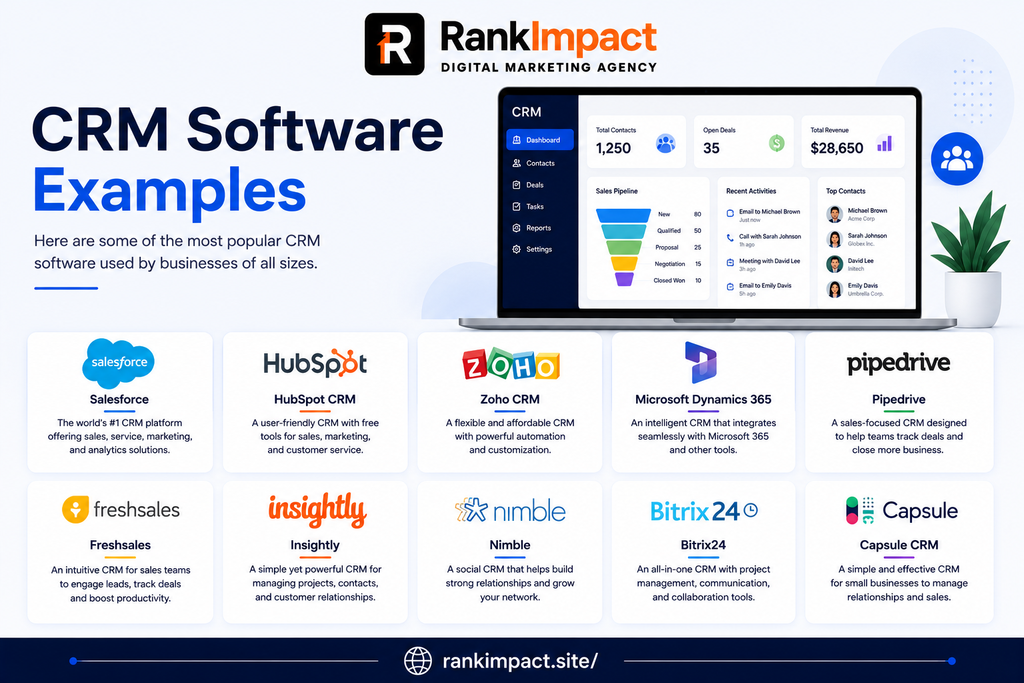
crm software examples comparison guide for businesses.

What CRM Software Actually Does For a Business

Customer relationship management software is the central system where a company stores every interaction it has with a lead or customer. That includes emails, calls, meeting notes, deal stages, support tickets, and purchase history. Instead of scattering this information across spreadsheets, inboxes, and sticky notes, a CRM pulls it into one organized record for every contact. Sales teams use it to track deals as they move through a pipeline. Marketing teams use it to see which campaigns actually turned into paying customers. Support teams use it to understand a customer full history before responding to a ticket. The real value is not the software itself but the visibility it gives every department into the same customer story, which reduces miscommunication and helps teams close deals faster and retain customers longer.

Salesforce Sales Cloud

Salesforce is the name most people think of first when they hear customer relationship management, and for good reason. It is used by companies ranging from small startups to Fortune 500 enterprises because it can be customized to fit almost any sales process imaginable. A mid sized software company might use Salesforce to build a fully automated lead scoring system that routes hot prospects straight to the right sales rep within seconds of a form submission. Larger enterprises often use it to connect dozens of internal tools through its AppExchange marketplace, creating a single hub for sales, service, and marketing data. The tradeoff is that Salesforce has a steeper learning curve and often requires a dedicated administrator or consultant to configure properly, which makes it a better fit for teams with the budget and technical resources to unlock its full potential rather than a solo founder just getting started.

HubSpot CRM

HubSpot built its reputation on offering a genuinely useful free tier, which makes it one of the most common entry points for small businesses trying their first real CRM. A three person marketing agency can start tracking every client email and deal stage without paying a cent, then gradually add HubSpot marketing or service tools as the business grows. What sets HubSpot apart in practice is how tightly its CRM integrates with content marketing, email campaigns, and website tracking, so a sales rep can see exactly which blog post or pricing page a lead visited before their last call. This makes it especially popular among SaaS companies and marketing agencies that live and breathe inbound lead generation. The downside some growing teams run into is that costs can climb quickly once you need the more advanced sales and marketing hubs, so it is worth mapping out expected usage before scaling up.

Zoho CRM

Zoho CRM has become a favorite among cost conscious small and mid sized businesses because it delivers a huge feature set at a fraction of the price of bigger competitors like Salesforce. A regional real estate brokerage might use Zoho to manage hundreds of property leads, automatically assign new inquiries to available agents, and trigger follow up reminders so no lead goes cold. Zoho also plays well with its own suite of business apps, including accounting and email marketing tools, which appeals to companies that want one vendor handling multiple operational needs instead of stitching together five different subscriptions. Some users find the interface less polished than newer competitors, but the depth of customization available at its price point keeps it firmly on the shortlist for budget conscious teams.

Pipedrive

Pipedrive was designed from day one around a simple idea, that salespeople think in visual pipelines, not spreadsheets. A boutique consulting firm running a handful of active deals at any given time can drag and drop opportunities across pipeline stages and instantly see what needs attention today. This visual first approach makes Pipedrive one of the easiest CRMs to onboard a new sales hire on, often within a single afternoon rather than a full week of training. It is particularly popular with small sales teams that want a tool built specifically for closing deals rather than a sprawling platform trying to do everything at once. Where it falls short is in marketing automation and customer service functionality, so companies that need those capabilities usually pair Pipedrive with separate specialized tools.

Microsoft Dynamics 365

Microsoft Dynamics 365 appeals strongly to enterprises already deeply invested in the Microsoft ecosystem, including Outlook, Teams, and Excel. A manufacturing company that runs its entire operation on Microsoft tools can connect Dynamics 365 directly into existing workflows, letting sales reps log calls and update deal records without ever leaving their inbox. Its strength lies in combining CRM functionality with enterprise resource planning features, giving large organizations a single platform that spans sales, finance, and supply chain data. This depth comes with real complexity though, and implementation projects for Dynamics 365 often take months and involve specialized consultants, making it a realistic option mainly for larger organizations with dedicated IT teams rather than small businesses looking for a quick setup.

Freshsales

Freshsales, built by Freshworks, has carved out a niche among businesses that want built in artificial intelligence features without paying for a separate add on. A subscription box company might use Freshsales built in lead scoring to automatically flag which trial users are most likely to convert to paying customers, based on how they interact with the product. The platform also includes built in phone and email tools, so smaller teams do not need to purchase and integrate a separate calling system just to make it functional. Freshsales tends to appeal most to teams that want a modern, clean interface and quick setup, though very large enterprises with complex multi department workflows may eventually outgrow some of its more advanced customization limits compared to platforms like Salesforce.

Monday Sales CRM

Monday Sales CRM grew out of the popular Monday work management platform, which means it brings a highly visual, flexible board style layout to customer relationship management. A creative agency managing both client projects and sales pipelines might appreciate being able to see deals, tasks, and project timelines in the same connected workspace instead of switching between separate tools. Its drag and drop customization lets teams build a CRM structure that matches their exact process rather than forcing them into a rigid predefined pipeline. Because it started as a general project management tool, some sales specific features like advanced forecasting are less mature than dedicated CRM platforms, but for teams that value flexibility and already use Monday for other work, the CRM add on removes friction between departments.

Insightly

Insightly positions itself as a strong middle ground option for small and mid sized businesses that need both CRM and basic project management in a single tool. A design studio that needs to track new client leads and then hand off won deals into an execution phase with tasks and milestones can do both inside Insightly without buying a second piece of software. This makes it especially attractive to service based businesses where the sales process and the delivery process are closely linked. Insightly also offers solid workflow automation for its price tier, letting teams automatically create follow up tasks or send internal notifications when a deal changes stage. Companies with very complex sales cycles involving many stakeholders sometimes find its reporting less robust than enterprise focused platforms.

Copper CRM

Copper was built specifically to integrate deeply with Google Workspace, which makes it a natural choice for businesses that already run their entire operation through Gmail, Google Calendar, and Google Drive. A digital marketing agency living inside Gmail all day can see and update CRM records directly from their inbox without switching tabs, which significantly reduces the friction that normally causes sales teams to neglect data entry. Copper automatically logs emails and meetings against the right contact record, cutting down on manual admin work that eats into selling time. Teams that do not use Google Workspace as their primary suite generally will not see the same seamless experience and might be better served by a more platform agnostic CRM instead.

Keap

Keap, formerly known as Infusionsoft, focuses heavily on combining CRM with marketing automation specifically for small businesses and solo entrepreneurs. A course creator or online coach can use Keap to automatically tag a new lead based on which lead magnet they downloaded, then trigger a personalized nurture email sequence without any manual follow up. This makes Keap particularly popular among small service businesses and online educators who need marketing automation firepower without hiring a dedicated marketing operations person. The tradeoff is that Keap tends to be priced higher than comparable entry level CRMs, positioning it more as an investment for businesses that are ready to lean heavily into automated sales and marketing workflows rather than those just testing the waters.

How to Choose the Right CRM for Your Business

Picking a CRM should start with an honest look at your current sales process rather than a feature checklist. A five person team closing a handful of large deals each month has completely different needs than a hundred person team processing thousands of smaller transactions, so the size and complexity of your pipeline should guide your first filter. Next, consider which tools your team already lives inside every day, because a CRM that integrates naturally with your existing email, calendar, and communication tools will get adopted far more consistently than one that requires constant tab switching. Budget matters too, but it should be evaluated against total cost of ownership rather than just the advertised monthly price, since some platforms charge extra for automation, reporting, or user seats that quickly add up. Finally, always run a real trial with your actual sales data before committing, because a demo environment full of sample records rarely reveals how a tool will feel once your genuine day to day chaos is loaded into it.

Common Mistakes Businesses Make When Choosing CRM Software

One of the most frequent mistakes companies make is choosing a CRM based purely on brand recognition rather than actual fit for their sales process, which often leads to paying for enterprise features that never get used. Another common error is skipping proper data migration planning, resulting in incomplete or duplicate contact records that make the new system feel messy from day one and quietly erode team trust in the data. Many businesses also underestimate the importance of user adoption, rolling out a powerful new CRM without adequate training, which causes sales reps to quietly revert back to spreadsheets or personal notes within a few weeks. Overcomplicating the initial setup is another trap, since teams that try to build every possible automation and custom field before ever using the system in daily practice often delay launch for months and lose momentum. The businesses that get the most value from CRM software typically start simple, get the team using it consistently, and layer in advanced automation gradually once the basics are second nature.

Best Practices for Getting the Most Out of Your CRM

Successful CRM adoption almost always starts with clean, consistent data entry standards agreed upon before the tool ever goes live, so every rep is logging deals and contacts the same way. Building automation around repetitive administrative tasks, like sending follow up reminders or updating deal stages based on specific triggers, frees up sales reps to spend more time actually talking to prospects instead of updating records. Regularly reviewing pipeline reports as a team, rather than only during quarterly reviews, helps surface bottlenecks early and keeps forecasting accurate. It also pays to periodically audit your CRM for unused fields, outdated automations, or duplicate records, since systems that accumulate clutter over time become harder to trust and slower to navigate. Finally, connecting your CRM with your marketing and support tools, even in a basic way, ensures that every department is working from the same source of truth about each customer relationship.

CRM Examples by Business Type

Startups and solo founders generally benefit most from free or low cost entry points like HubSpot CRM or Pipedrive, since these platforms let a small team get organized quickly without a steep learning curve or major financial commitment. Marketing agencies and content driven businesses often lean toward HubSpot or Copper because of how tightly these tools connect with email, content, and Google Workspace workflows they already rely on. Real estate and property based businesses frequently choose Zoho CRM or Freshsales for their strong lead management and follow up automation features suited to high volume inquiry handling. Enterprises with complex, multi department operations typically gravitate toward Salesforce or Microsoft Dynamics 365 because of their extensive customization and integration capabilities across sales, service, and finance. Service based businesses managing both sales and project delivery, such as design studios or consulting firms, often find Insightly or Monday Sales CRM particularly useful since these tools blend pipeline tracking with task and project management in one place.

Frequently Asked Questions

What is an example of CRM software used by small businesses ?

HubSpot CRM and Pipedrive are two of the most common examples used by small businesses because both offer straightforward setup, visual pipelines, and free or low cost starting plans that do not require a dedicated administrator.

What are the 4 types of CRM systems?

The four main types are operational CRM which focuses on automating sales, marketing, and service processes, analytical CRM which focuses on analyzing customer data to improve decisions, collaborative CRM which focuses on sharing customer information across departments, and strategic CRM which focuses on building long term customer relationships and loyalty.

Which CRM software is best for small business?

The best CRM for a small business usually depends on budget and process complexity, but HubSpot CRM, Zoho CRM, and Pipedrive are consistently top choices because they combine affordability with an easy learning curve and strong core sales features.

Is Salesforce a CRM software?

Yes, Salesforce is one of the largest and most widely used CRM platforms in the world, offering deep customization and a broad ecosystem of add on tools that scale from small teams up to large global enterprises.

Can I use Excel as a CRM ?

A spreadsheet can technically track basic contact and deal information for a very small business, but it lacks automation, reminders, integrations, and reporting that a dedicated CRM provides, so most growing teams quickly outgrow spreadsheets once their contact volume increases.

What is the difference between CRM and ERP software?

CRM software focuses specifically on managing customer facing relationships like sales, marketing, and support, while ERP software focuses on internal business operations such as finance, inventory, and supply chain, though some platforms like Microsoft Dynamics 365 combine elements of both.

How much does CRM software typically cost?

CRM pricing varies widely, ranging from free plans for very small teams up to more than one hundred dollars per user per month for advanced enterprise plans, with most small to mid sized businesses landing somewhere in the twenty to eighty dollar per user per month range depending on features needed.

Do freelancers need a CRM?

Freelancers managing more than a handful of active clients often benefit from a lightweight CRM to track proposals, follow ups, and past client history, since relying purely on memory or scattered notes becomes harder to manage as a client base grows.

What features should I look for in CRM software ?

Important features to evaluate include pipeline visualization, email and calendar integration, workflow automation, reporting and forecasting tools, mobile access, and how easily the platform connects with other software your team already uses.

Can CRM software help with customer retention ?

Yes, CRM software helps improve customer retention by giving support and sales teams full visibility into a customer full history, which allows for more personalized follow up, faster issue resolution, and proactive outreach before a customer considers leaving.

Conclusion

Choosing among the many crm software examples available today does not need to feel overwhelming once you understand what each platform actually does well and which type of business it fits best. Salesforce and Microsoft Dynamics 365 shine for larger enterprises with complex needs, HubSpot and Pipedrive remain excellent starting points for small and growing teams, and specialized tools like Copper, Keap, and Insightly serve very specific workflows exceptionally well. The right choice ultimately comes down to matching a platform to your actual sales process, your team size, and the tools you already use every day rather than chasing the most popular name on the market. Take the time to run a genuine trial with your real data, involve the people who will use the system daily in the decision, and start with a simple setup you can build on over time.

Key Takeaways

CRM software centralizes every customer interaction into one organized system that helps sales, marketing, and support teams work from the same information.

Salesforce and Microsoft Dynamics 365 are best suited for large enterprises needing deep customization and cross department functionality.

HubSpot CRM and Pipedrive are strong starting points for small businesses because of their ease of use and affordable entry pricing.

Zoho CRM, Freshsales, and Insightly offer a strong balance of features and cost for growing mid sized businesses.

Choosing the right CRM depends more on matching your actual sales process and existing tools than on picking the most popular brand.

Common mistakes include skipping proper data migration, underestimating user training, and overcomplicating the initial setup before the team even starts using the tool.

Clean data standards, gradual automation, and regular pipeline reviews are what separate businesses that get real value from their CRM from those that abandon it within a year.
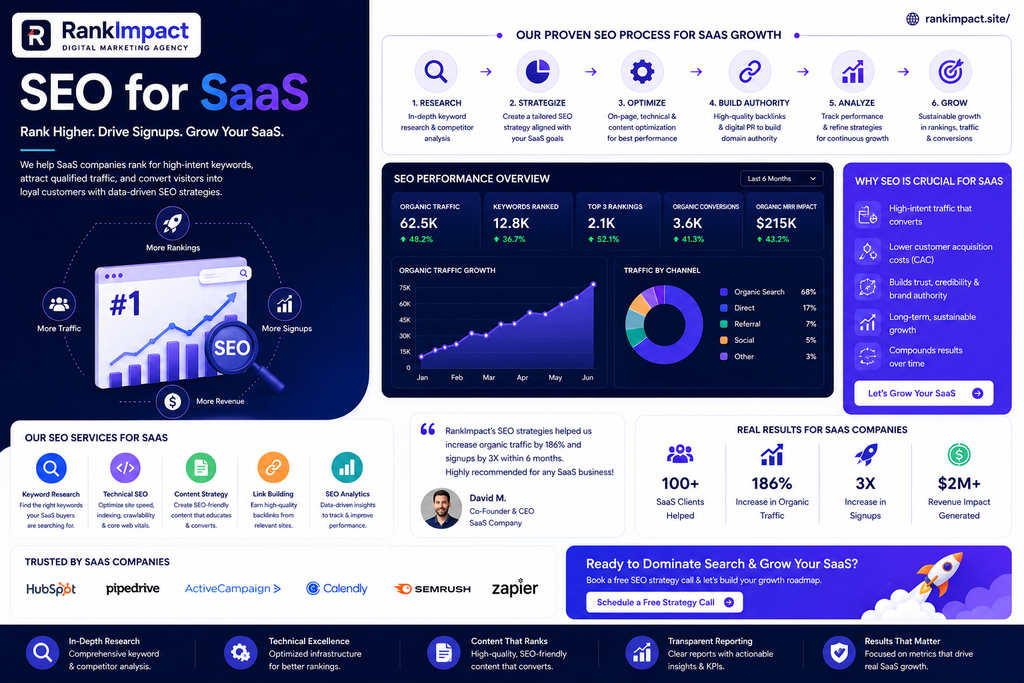
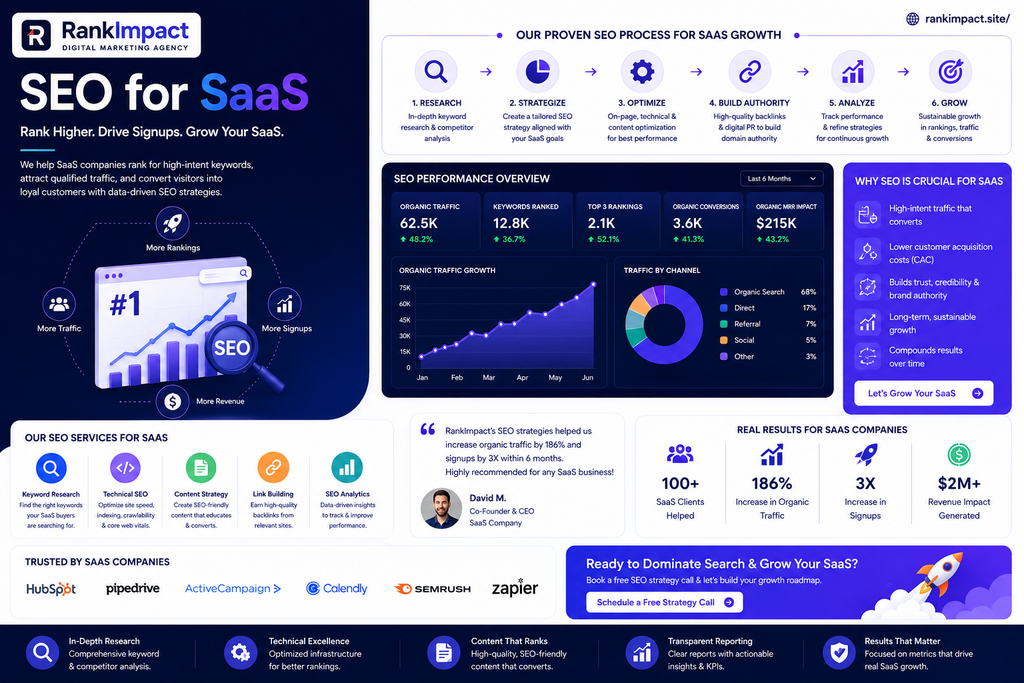
SEO For SaaS 2026 Strategy Guide That Drives Growth

Learn seo for saas in 2026 covering content clusters programmatic seo AI search optimization technical fundamentals and mistakes costing you pipeline.

seo for saas 2026 strategy content clusters and AI search illustration.

SEO For SaaS 2026 Strategy Guide

Every software company eventually reaches the same crossroads paid acquisition costs keep climbing and leadership starts asking whether organic search could actually become a real growth channel rather than an afterthought buried in the marketing budget. Getting seo for saas right in 2026 looks meaningfully different from the tactics that worked even two years ago since buyer research now splits across traditional search and AI powered chat tools while Google itself has cracked down hard on low value scaled content. This guide walks through exactly how to build a genuine organic growth engine covering strategy content architecture technical fundamentals and the specific mistakes quietly capping results for otherwise capable marketing teams.

What SEO For SaaS Actually Means In 2026

SEO for saas is the practice of optimizing a software company’s website and content to rank for the specific queries its target buyers actually search throughout their entire evaluation journey. Unlike traditional SEO for an ecommerce store or local business seo for saas prioritizes monthly recurring revenue and pipeline contribution over raw traffic volume alone since a thousand visitors who will never buy software matters far less than a hundred visitors representing genuine purchase intent. This distinction shapes nearly every strategic decision from keyword selection through content format and even which metrics actually deserve leadership’s attention in a monthly report.

The category has also fundamentally split in a way that did not exist just a couple of years ago. A growing share of business buyers now consult an AI chat tool like ChatGPT Perplexity or Gemini at some point during their research with recent industry data placing that figure around 94 percent of business buying groups meaning a platform invisible to these tools is effectively invisible at the exact moment a deal gets shortlisted. Recent research also shows organic search programs delivering a median three year return on investment around 702 percent for saas companies that build a mature program which explains why so many companies are shifting real budget away from paid channels and toward building genuine organic authority over time.

Building Commercial Clarity Before Any Tactical Work Begins

The single biggest mistake companies make with seo for saas is jumping straight into keyword research and content production before establishing genuine clarity about who they are actually targeting. Effective strategy starts by clearly defining whether your product serves a self service motion small and medium business buyers or complex enterprise deals since this single decision shapes everything downstream including keyword selection content format and even which specific pages deserve priority investment. A self service product benefits enormously from bottom funnel comparison content and quick answer pages while an enterprise focused platform needs deeper content addressing multiple stakeholders across a much longer evaluation cycle.

Understanding the specific switch moments that bring a buyer to market matters just as much as understanding who they are. A prospect searching because their current tool just raised prices behaves very differently from one exploring options simply because their company is scaling and outgrowing a spreadsheet based process. Mapping these distinct triggers to specific content and keyword targets before writing a single article ensures your entire content investment aligns with genuine commercial outcomes rather than chasing broad search volume that never converts into demos or trials regardless of how well the resulting pages actually rank.

Content Clusters The Foundation Of Modern SaaS SEO

Topic clusters remain the structural backbone of any serious seo for saas strategy in 2026 and understanding how to build them correctly separates genuinely effective programs from scattered content calendars producing little real authority. A cluster consists of one comprehensive pillar page targeting a broad core topic surrounded by eight to twelve supporting articles each addressing a specific long tail subtopic or question with every cluster piece linking back to the pillar and the pillar linking out to each cluster in turn. This tightly interlinked structure signals genuine topical depth to search engines while also giving AI answer engines a coherent cross linked set of pages to draw from when summarizing your specific category to a buyer asking a research question.

Most teams following this approach see cluster rankings begin moving within three to four months with measurable pipeline impact typically following six to twelve months later a timeline worth setting clearly with leadership before starting rather than after when patience inevitably runs thin. A practical example for a project management software company might use a pillar page covering project management methodologies broadly supported by cluster pieces covering agile versus waterfall comparisons scrum implementation for remote teams and specific software comparison content all linking back to strengthen the central pillar’s authority. Building three or four of these clusters mapped directly to your core product use cases produces far stronger long term results than forty scattered blog posts covering unrelated tangential topics with no coherent internal linking structure tying them together.

Programmatic SEO Scaling Content Without Scaling Your Team

Programmatic seo has become one of the defining tactics separating fast growing saas companies from those relying purely on manual content production and understanding it correctly matters enormously given how much the rules around this tactic shifted during 2026. This approach generates large numbers of landing pages from a single template populated with structured data your product already possesses such as every integration your platform supports every specific use case it serves or every competitor buyers commonly compare you against. Zapier famously pioneered this exact approach building a dedicated landing page for every possible app combination while companies like HubSpot and Atlassian have applied similar templates to their own specific product ecosystems with considerable success.

The critical caveat every team needs to understand is that Google’s scaled content abuse policy enforced heavily during the March 2026 core update stripped between 50 and 80 percent of traffic from low value programmatic sites built on thin template swaps with no genuine unique value per page. Programmatic seo still works powerfully in 2026 but only when each generated page contains real data or genuine utility a prospect cannot find elsewhere rather than the same three sentences reshuffled across a thousand near identical URLs. Companies implementing this correctly are reporting 300 to 500 percent increases in organic traffic within twelve to eighteen months precisely because they treat each page as a genuine resource built on real structured data rather than a shortcut around actual content investment.

Comparison Content And Capturing High Intent Bottom Funnel Searches

Comparison and alternative focused content deserves particular priority within any seo for saas strategy because it captures searchers at the exact moment they are actively evaluating a purchase rather than simply researching a broad topic. Pages built around alternative to a specific named competitor searches consistently convert at meaningfully higher rates than generic educational content since anyone searching that specific phrase has already identified a problem with their current tool and is actively shopping for a replacement. Building these pages honestly with genuine feature comparisons pricing transparency and clear differentiation rather than thinly veiled marketing copy produces far stronger trust and conversion than an obviously biased comparison that damages credibility the moment a prospect notices the framing.

Best practice for this content type involves acknowledging genuine competitor strengths alongside your own differentiation since prospects researching alternatives are typically sophisticated buyers who can immediately spot dishonest positioning and will trust your entire site less once they catch even one exaggerated claim. Including specific pricing information migration guidance and honest use case fit guidance helps these pages serve genuine research needs which both improves conversion and increases the odds these pages get cited when a buyer asks an AI tool for a direct comparison between your product and a named competitor.

Technical SEO Foundations Every SaaS Site Needs

Strong content ultimately underperforms without a solid technical foundation supporting it and seo for saas carries several technical considerations specific to how software platforms are typically built. Core web vitals performance deserves particular attention since AI driven search crawlers increasingly factor genuine page speed and interactivity metrics into how they evaluate and summarize content meaning a slow loading site can undermine even genuinely excellent content regardless of how well researched it actually is. Many saas platforms run on complex single page application frameworks that require specific server side rendering configuration to ensure search engines and AI crawlers can actually access and index content properly rather than encountering a blank page where meaningful text should be.

Structured data markup deserves careful implementation across product pages pricing pages and content since properly formatted schema helps both traditional search engines and AI systems understand exactly what your page offers reducing ambiguity that could otherwise cause a crawler to misrepresent your product when summarizing it for a buyer. Site architecture matters just as much with a clear logical hierarchy connecting your homepage core product pages and content clusters through consistent internal linking that helps both search engines and human visitors understand how everything on your site relates to your core offering rather than presenting a disorganized collection of disconnected pages competing against each other for the same keywords.

Optimizing For AI Search Alongside Traditional Rankings

The single biggest shift reshaping seo for saas in 2026 involves treating traditional search engine optimization and generative engine optimization as one connected system rather than two separate disciplines competing for budget and attention. When a buyer asks an AI system a research question that system typically expands the original prompt into multiple related sub questions a process now commonly called query fan out meaning your content cluster needs to address every facet a buyer might explore rather than simply targeting one narrow keyword variation. Recent data shows AI overviews appearing above traditional search results now produce an average 61 percent click through decline on the queries where they appear making direct AI citation increasingly as valuable as a traditional top ranking position itself.

Structuring content with the most important direct answer appearing early in each section rather than buried under a lengthy introduction improves your odds of being cited inside an AI generated summary while also improving traditional featured snippet performance since both systems reward the same underlying clarity and directness. Building genuinely comprehensive cluster coverage around a core topic rather than a single isolated page increases the odds an AI system finds your content specifically relevant across multiple related sub questions a prospect might ask during their research rather than just one narrow phrasing that happens to match your target keyword exactly.

Common Mistakes Killing SaaS SEO Results

Watching underperforming seo for saas programs reveals the same avoidable mistakes appearing repeatedly across otherwise capable marketing teams. Publishing scattered standalone blog posts with no coherent cluster structure or internal linking strategy wastes enormous content investment since search engines struggle to identify genuine topical authority from disconnected pages covering unrelated tangential subjects. Chasing broad high volume keywords with no genuine commercial intent behind them produces impressive traffic charts that leadership eventually questions once nobody can connect that traffic to actual pipeline or closed revenue.

Treating programmatic seo as a shortcut around genuine content investment by publishing thin templated pages with no real unique value per page now carries serious risk given how aggressively Google’s 2026 scaled content policies penalize exactly this pattern. Measuring success through vanity metrics like raw traffic or keyword rankings rather than pipeline contribution and closed revenue creates a dangerous disconnect where marketing looks successful on paper while leadership quietly loses confidence in the entire program. Finally many teams ignore AI search visibility entirely treating it as a future consideration rather than a current priority which means they remain completely invisible during a growing share of buyer research happening right now through tools their own prospects are actively using.

Off page authority signals remain a meaningful ranking factor within seo for saas even as content and technical fundamentals get most of the attention in current industry discussion. Earning genuine editorial links from relevant industry publications and respected review sites continues carrying more weight than volume based link building tactics that produce low quality placements search engines increasingly discount or actively penalize. Building relationships with journalists and industry analysts covering your specific category through genuine expertise sharing and original research tends to produce far stronger long term link acquisition than direct outreach purely asking for a placement in exchange for nothing of genuine value to the publication.

Treating link building as an always on program woven into your broader content and public relations strategy rather than a separate isolated initiative produces considerably more consistent results over time. Original research and proprietary data specific to your industry or product category represents one of the most reliable ways to earn genuine editorial links since publications and other content creators consistently prefer citing primary data over simply linking to another company’s marketing page. Working with a specialized saas digital marketing agency that maintains genuine relationships across your specific industry can meaningfully accelerate this authority building process compared to building those relationships entirely from scratch with no existing network to draw from.

Measuring What Actually Matters In A SaaS SEO Program

Building a genuinely useful measurement framework for seo for saas requires moving well past surface level traffic numbers toward metrics that actually connect to business outcomes leadership cares about. Tracking pipeline contribution and closed revenue attributed to organic search alongside more traditional metrics like keyword rankings and organic sessions ensures your reporting tells the full story rather than celebrating vanity numbers that never translate into actual customers. Monitoring conversion rate at each stage from organic visitor through trial signup and eventually closed deal reveals exactly where your funnel is genuinely working and where it needs real attention rather than relying on a single blended conversion number that can mask a serious problem concentrated at just one specific stage.

Increasingly tracking AI citation frequency across major chat tools deserves a place in this measurement framework alongside traditional analytics since a growing share of your addressable buyer research happens through these systems whether or not your current reporting currently captures it. Reviewing this full picture quarterly alongside sales leadership rather than only within marketing keeps the entire organization aligned around the same understanding of what is genuinely working and ensures continued investment in organic search remains justified through real business outcomes rather than optimistic assumptions about future potential that never quite materializes into measurable results.

Frequently Asked Questions

What makes seo for saas different from regular seo?

SEO for saas prioritizes monthly recurring revenue and qualified pipeline over raw traffic volume and specifically accounts for longer buying cycles multiple stakeholders and increasingly the need to be cited accurately inside AI powered research tools rather than traditional search results alone.

How long does it take to see results from a saas seo strategy?

Most content clusters begin showing ranking movement within three to four months with measurable pipeline impact typically following six to twelve months later making patience and realistic timeline setting essential before starting any serious program.

Is programmatic seo still safe to use in 2026 ?

Yes but only when every generated page contains genuine unique data or utility since Google’s scaled content abuse policy enforced during the March 2026 core update stripped significant traffic from sites built on thin templated pages with no real value.

What is a content cluster and why does it matter for saas seo?

A content cluster combines one comprehensive pillar page with eight to twelve supporting articles addressing specific subtopics all interlinked together which signals genuine topical authority to search engines and gives AI tools a coherent set of pages to reference.

How important is AI search optimization for saas companies today?

Extremely important since roughly 94 percent of business buying groups now consult an AI chat tool during their research process meaning a platform poorly structured for these systems risks being effectively invisible during a significant share of active evaluation.

What return on investment can a saas company expect from organic search ?

Industry research shows a median three year return on investment around 702 percent for saas companies running a mature organic search program though results depend heavily on execution quality and consistency over time.

Should comparison content mention competitors by name?

Yes honest comparison content addressing named competitors directly tends to convert well since it captures buyers already actively shopping for alternatives though acknowledging genuine competitor strengths alongside your own differentiation builds far more trust than dishonest framing.

What technical factors matter most for saas seo in 2026?

Core web vitals performance proper server side rendering for complex application frameworks and clean structured data markup all matter significantly since AI driven crawlers increasingly factor these signals into how they evaluate and summarize your content.

How should a saas company measure seo success ?

Pipeline contribution and closed revenue attributed to organic search should take priority over vanity metrics like raw traffic alone with AI citation frequency increasingly deserving a place in this measurement framework alongside traditional analytics.

How can a growing saas company execute a seo strategy without a large internal team ?

Many companies partner with an experienced saas digital marketing agency to combine specialized strategic guidance with consistent execution across content technical work and link building without needing to build a large internal team from scratch.

Conclusion

Getting seo for saas right in 2026 requires treating organic search as a genuine long term growth engine built on commercial clarity coherent content clusters and technical fundamentals rather than a collection of disconnected tactics chasing whatever trend happens to be trending this quarter. Understanding your specific buyer and their switch moments before writing a single article building content that serves both traditional search engines and increasingly AI powered research tools and measuring success through pipeline rather than vanity metrics together separate programs that genuinely move the business from those that produce impressive charts nobody can connect to actual revenue. Start with clarity about who you serve build your content architecture deliberately rather than reactively and stay disciplined about measuring what actually matters and your organic search program can become one of the most durable cost effective growth channels available to your company for years to come.

Key Takeaways

  • SEO for saas prioritizes monthly recurring revenue and qualified pipeline over raw traffic volume which shapes every strategic decision from keyword selection through measurement
  • Establishing commercial clarity about your specific buyer and their switch moments before any tactical work begins prevents wasted content investment chasing irrelevant search volume
  • Content clusters combining one pillar page with eight to twelve supporting articles remain the structural foundation of effective modern saas seo programs
  • Programmatic seo still works powerfully in 2026 but only when every page delivers genuine unique value given how heavily Google now penalizes thin templated content
  • Comparison and alternative focused content captures high intent buyers actively shopping for a replacement and consistently converts better than generic educational content
  • Roughly 94 percent of business buying groups now consult an AI chat tool during research making generative engine optimization essential rather than optional
  • Technical fundamentals including core web vitals and proper structured data markup matter more than ever as AI crawlers increasingly factor these signals into their evaluation
  • Partnering with a specialized saas digital marketing agency can help growing companies execute a mature seo program without needing to build a large internal team from scratch.

SaaS SEO Consultant Guide 2026 Cost And Hiring Tips

Find the right saas seo consultant in 2026 with real hourly and retainer pricing key skills to look for red flags and when to hire versus build in house.

saas seo consultant hiring guide cost and skills illustration 2026.

SaaS SEO Consultant Guide 2026 Cost And Hiring Tips

Organic search remains one of the few marketing channels that keeps compounding in value long after the initial investment which is exactly why so many growing software companies eventually search for a saas seo consultant rather than trying to figure everything out internally. But hiring the right person for this role is trickier than it looks since the title gets used loosely across a market filled with generalists junior freelancers and genuinely specialized operators who understand the specific mechanics of subscription software growth. This guide breaks down exactly what a saas seo consultant does realistic 2026 pricing across every engagement model how to tell a strong candidate from a weak one and the mistakes that waste budget before a single ranking ever improves.

What A SaaS SEO Consultant Actually Does

A saas seo consultant is fundamentally different from a general SEO freelancer because the work centers on problems unique to subscription software businesses rather than generic search optimization. This typically means auditing a site for technical issues specific to product led growth platforms diagnosing why a previously ranking page has started losing traffic mapping keyword strategy to the actual buyer funnel stages a saas customer moves through and increasingly advising on how a company shows up inside AI powered search tools rather than traditional search results alone. The role sits closer to strategic diagnosis than pure execution which is an important distinction to understand before you start comparing candidates or quotes.

This distinction matters enormously when deciding who to hire. A consultant is typically one experienced person selling strategy diagnosis and a clear roadmap while an agency is a full team selling ongoing execution across content technical work link acquisition and AI visibility tracking simultaneously. If your team already has writers and a developer and what you are genuinely missing is direction a consultant often makes more sense than a full agency retainer. Bounded problems such as diagnosing a sudden traffic drop planning a site migration or building an initial twelve month roadmap are consultant shaped projects regardless of your company’s current revenue stage.

How Much Does A SaaS SEO Consultant Cost In 2026

Pricing varies considerably depending on the specific engagement model and the consultant’s experience level so understanding the full range helps you budget realistically rather than anchoring on a single number you saw somewhere online. Hourly consulting rates in 2026 typically run between 100 and 300 dollars per hour with the broader market average sitting closer to 171 dollars according to recent industry survey data covering hundreds of SEO providers. Monthly retainers for an individual saas seo consultant commonly range from 1500 to 10000 dollars with many experienced specialists focused specifically on software companies pricing their ongoing work between 3500 and 10000 dollars per month depending on scope and how hands on the engagement actually is.

Project based work follows a different structure entirely since a comprehensive technical SEO audit for a saas platform typically runs 5000 to 10000 dollars while a full content strategy including keyword research mapped to your specific funnel stages commonly falls between 8000 and 20000 dollars. Site migrations carry the highest project pricing often ranging from 15000 to 30000 dollars given how much revenue risk a poorly executed migration can create almost overnight. One useful comparison point when evaluating whether a consultant or a full agency makes more financial sense is that a senior in house SEO manager in the United States now earns roughly 118 thousand dollars annually in base salary alone which climbs to somewhere between 120 thousand and 180 thousand dollars once benefits and tools are included making a consultant relationship considerably more affordable for companies not yet ready to build an internal team.

Consultant Versus Agency Versus In House Which Is Right For You

Choosing between these three paths depends heavily on your current revenue stage and exactly what kind of gap you are trying to fill rather than any universal best answer. Hiring a saas seo consultant tends to make the most sense for companies below roughly 1 million dollars in annual recurring revenue that already have some internal content and development capacity but lack a clear strategic roadmap or senior judgment guiding day to day execution decisions. Consultants also make sense at any revenue stage for genuinely bounded problems like a technical migration a sudden traffic drop investigation or an initial audit meant to inform a broader hiring decision down the line.

A full agency retainer tends to make more sense once a company reaches somewhere between 2 million and 5 million dollars in annual recurring revenue and needs several specialized capabilities running simultaneously including technical SEO content production link acquisition and increasingly generative engine optimization tracking all at once. Recent industry analysis shows a full service retainer priced between 8000 and 15000 dollars monthly delivers roughly equivalent output to a 96 thousand to 180 thousand dollar annual in house investment while getting a program operational within weeks rather than the six to twelve months a full hiring cycle typically requires. Building a fully in house team generally only becomes the stronger financial choice once a company reaches 50 million dollars or more in annual recurring revenue or has a specific strategic reason to fully own the function such as a regulated industry or a content program deeply tied to proprietary product data.

Key Skills And Qualifications To Look For

Evaluating a potential saas seo consultant requires looking past a polished pitch deck toward specific evidence of genuine capability across several distinct areas. Strong tool proficiency with platforms like Semrush or Ahrefs alongside Google Analytics and Google Search Console remains table stakes since a consultant who cannot demonstrate fluent navigation of these platforms during a conversation will struggle to deliver the data driven recommendations your business actually needs. Deep technical SEO knowledge covering site architecture crawlability page speed and structured data matters particularly for saas platforms that often run on complex frameworks with unique indexing challenges compared to a simple content website.

Keyword research skill focused specifically on mapping terms to buyer funnel stages rather than chasing broad search volume alone separates consultants who genuinely understand saas buyer psychology from those applying a generic playbook borrowed from unrelated industries. Analytical thinking and comfort interpreting ranking fluctuations against algorithm updates matters enormously given how frequently search behavior continues shifting. Increasingly candidates should also demonstrate adaptability toward AI search changes since a growing share of buyer research now happens through generative engines rather than traditional search alone meaning a consultant with no clear point of view on generative engine optimization is already behind where the market has moved. Finally clear communication with non technical stakeholders matters just as much as technical skill itself since a brilliant strategy nobody on your team can actually understand or execute produces very little real value.

Red Flags To Watch For When Hiring

Certain warning signs appear consistently across saas seo consultant engagements that ultimately disappoint despite an impressive initial sales conversation. Vague guaranteed ranking promises should immediately raise concern since no honest consultant can guarantee a specific ranking position given how many variables sit outside anyone’s direct control including competitor behavior and ongoing algorithm changes. A consultant who cannot point to specific measurable case studies connecting past SEO work directly to pipeline or revenue rather than vanity traffic metrics alone is likely optimizing for the wrong outcomes entirely regardless of how confidently they present.

Watch closely for consultants who seem unable to discuss AI search visibility with any real depth since companies now report their brand being absent from AI generated answers roughly half the time their buyers are actively researching a purchase decision which means this genuinely is not an optional area of expertise anymore. Pricing that sits dramatically below typical market rates deserves scrutiny too since extremely low rates often signal junior talent learning on your budget or a consultant spread across far too many clients to deliver genuine focused attention. Finally be wary of anyone unwilling to provide a direct reference call with a past client since a consultant confident in their own track record should have no hesitation connecting you with someone who can speak honestly about the actual working relationship.

How Generative Engine Optimization Changes The Consultant Role

The rise of AI powered search tools has genuinely reshaped what a strong saas seo consultant needs to understand beyond traditional Google ranking factors alone. Generative engine optimization sometimes called answer engine optimization focuses specifically on whether AI tools like ChatGPT Perplexity and Gemini actually cite your company when a buyer asks a relevant research question rather than purely tracking where your pages rank inside a traditional search results page. Standalone GEO retainers now run anywhere from 1000 to 25000 dollars monthly depending on scope with one time AI search audits commonly priced between 1500 and 5000 dollars for companies wanting an initial diagnostic before committing to ongoing work.

For most growing saas companies this capability belongs inside a broader SEO retainer rather than existing as a completely separate line item since the underlying content strategy driving strong traditional rankings and strong AI citation performance overlaps considerably more than it differs. A genuinely qualified saas seo consultant in 2026 should be able to explain concretely how they track AI citation performance over time and what specific structural changes to your existing content improve your odds of being referenced inside an AI generated answer rather than treating this simply as a buzzword added to their service list without any real methodology behind it.

Common Mistakes Companies Make Hiring SEO Help

Watching disappointing SEO engagements unfold reveals the same avoidable mistakes appearing repeatedly across companies of every size. Choosing based purely on the lowest quoted price without evaluating actual relevant saas experience consistently produces generic advice that fails to account for the specific dynamics of subscription software buyer behavior and product led growth funnels. Expecting meaningful ranking improvements within thirty or sixty days sets unrealistic expectations that damage the relationship even when the underlying strategy is genuinely sound since organic search improvements typically take three to six months to show measurable movement.

Treating an initial audit or roadmap as a one time deliverable rather than an ongoing living strategy that needs regular revisiting as algorithms and AI search behavior continue shifting wastes the value of that initial investment within just a few months. Failing to give a consultant genuine access to analytics data content management systems and internal stakeholders slows progress considerably and often produces recommendations built on incomplete information. One particularly costly pattern involves companies hiring based purely on a consultant’s personal brand or social media presence without verifying whether their documented case studies actually connect to real pipeline and revenue rather than traffic numbers that look impressive but never translated into paying customers.

How To Evaluate And Onboard A New Consultant Successfully

Setting a new saas seo consultant relationship up for genuine success requires more deliberate structure than simply signing a contract and waiting for results. Start by clearly defining what success actually looks like for your specific engagement whether that means organic pipeline contribution AI citation coverage or a completed technical migration rather than leaving the definition of success vague and open to interpretation later. Providing full access to your analytics platforms content management system and at least one internal stakeholder who can answer product and customer questions quickly during the first thirty days dramatically accelerates how fast a new consultant can produce genuinely useful recommendations.

Establishing a regular reporting cadence covering both traditional ranking metrics and increasingly AI search visibility tracking keeps both sides accountable to measurable progress rather than vague reassurances that things are moving in the right direction. Many growing companies find that pairing a specialized saas seo consultant with broader support from a dedicated saas digital marketing agency creates a more complete growth system since the consultant provides focused SEO strategy while the agency handles broader execution across paid channels content distribution and demand generation that SEO alone cannot fully cover.

Frequently Asked Questions

What is the difference between a saas seo consultant and a saas seo agency ?

A consultant is typically one experienced person selling strategy diagnosis and a clear roadmap while an agency is a full team handling ongoing execution across content technical work link building and AI visibility tracking simultaneously.

How much does a saas seo consultant charge per hour?

Hourly rates in 2026 commonly range from 100 to 300 dollars with the broader market average sitting around 171 dollars though rates above 300 dollars per hour place a consultant in the top tier of the market.

When should a saas company hire a consultant instead of an agency?

Companies below roughly 1 million dollars in annual recurring revenue with existing writers and developers but no clear strategic direction along with any company facing a bounded problem like a migration or traffic drop tend to benefit most from a consultant relationship.

How long does it take to see results from SEO work ?

Most organic search improvements take three to six months to show measurable movement in rankings and traffic which means expecting significant results within thirty or sixty days sets an unrealistic timeline for any genuine strategy.

What tools should a qualified saas seo consultant know ?

Strong candidates should demonstrate fluent proficiency with Semrush or Ahrefs alongside Google Analytics and Google Search Console since these platforms provide the underlying data any credible SEO strategy actually depends on.

Is generative engine optimization part of a modern saas seo consultant role ?

Yes an increasing share of buyer research happens through AI powered chat tools rather than traditional search alone which means a genuinely qualified consultant in 2026 needs a clear methodology for tracking and improving AI citation performance.

What are red flags when evaluating a saas seo consultant ?

Guaranteed ranking promises an inability to connect past work to real pipeline or revenue extremely low pricing compared to market rates and reluctance to provide a direct reference call all signal a candidate worth avoiding.

Should a small SaaS startup hire an in house SEO manager or a consultant ?

Most early stage companies benefit more from a consultant relationship since a senior in house hire costs roughly 120 thousand to 180 thousand dollars annually once benefits are included compared to a considerably more affordable consultant retainer.

Does site migration require a specialized saas seo consultant?

Yes site migrations carry significant revenue risk if executed poorly and typically require specialized expertise with project pricing commonly running between 15000 and 30000 dollars given the technical complexity involved.

Can a saas seo consultant work alongside a broader marketing team ?

Yes many growing companies successfully pair a specialized saas seo consultant with a dedicated saas digital marketing agency handling broader execution creating a complete system that covers both focused SEO strategy and wider demand generation.

Conclusion

Hiring the right saas seo consultant in 2026 comes down to matching the engagement model to your actual revenue stage and specific gap rather than defaulting to whichever option seems most impressive or familiar. Understanding realistic pricing across hourly project and retainer models protects you from both dramatically overpaying and from anchoring on suspiciously cheap rates that typically signal inexperience. Prioritize candidates who can speak concretely about connecting past work to genuine pipeline results who demonstrate real fluency with both traditional SEO and the emerging demands of generative engine optimization and who communicate clearly enough that your entire team can actually act on their recommendations. Get this hiring decision right and organic search becomes one of the most durable and cost effective growth channels available to your business rather than another disappointing line item on your marketing budget.

Key Takeaways

  • A saas seo consultant sells strategic diagnosis and a clear roadmap while a full agency sells ongoing execution across multiple specialized capabilities at once
  • 2026 hourly rates commonly range from 100 to 300 dollars with monthly retainers typically falling between 1500 and 10000 dollars depending on scope and experience
  • Consultants tend to fit best below 1 million dollars in annual recurring revenue or for any bounded problem like a migration or traffic drop regardless of company size
  • Strong candidates demonstrate genuine tool proficiency technical SEO depth and a clear methodology for tracking AI search visibility rather than traditional rankings alone
  • Guaranteed ranking promises vague case studies and reluctance to provide client references are consistent red flags worth taking seriously
  • Generative engine optimization has become a core expectation for any consultant claiming genuine expertise in 2026 rather than an optional add on service
  • Organic search improvements typically take three to six months to show measurable results which should shape realistic expectations from the start
  • Pairing a focused saas seo consultant with a broader saas digital marketing agency often creates the most complete growth system for scaling companies.

Pixieset Company Overview B2B SaaS 7 Facts For 2026

Read this pixieset company overview b2b saas guide covering products pricing revenue and 7 facts every buyer should know before choosing the platform in 2026.

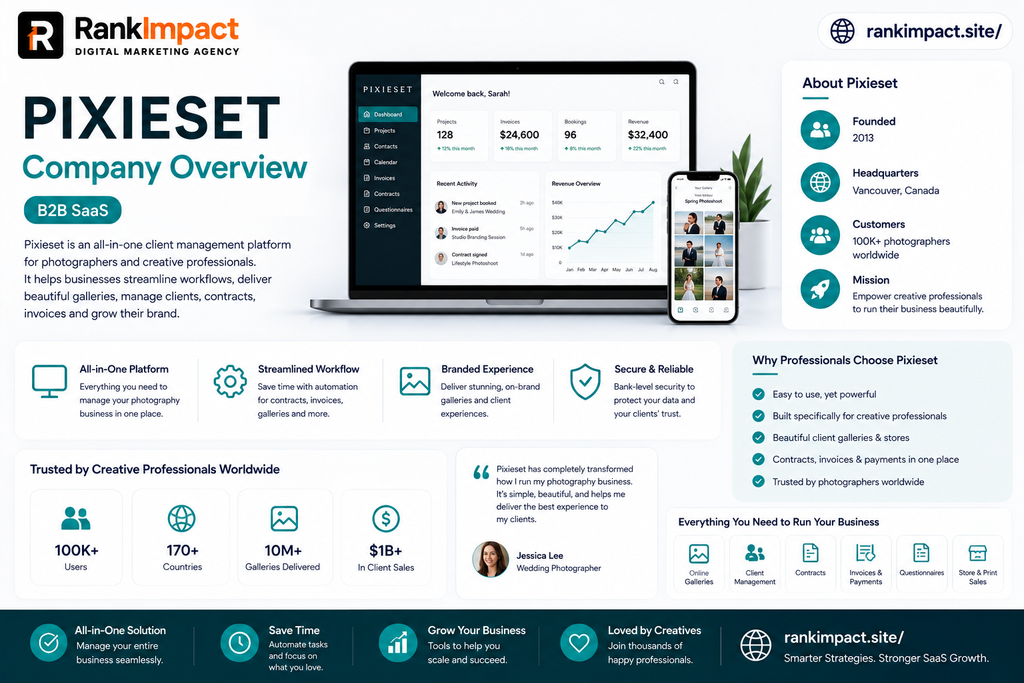
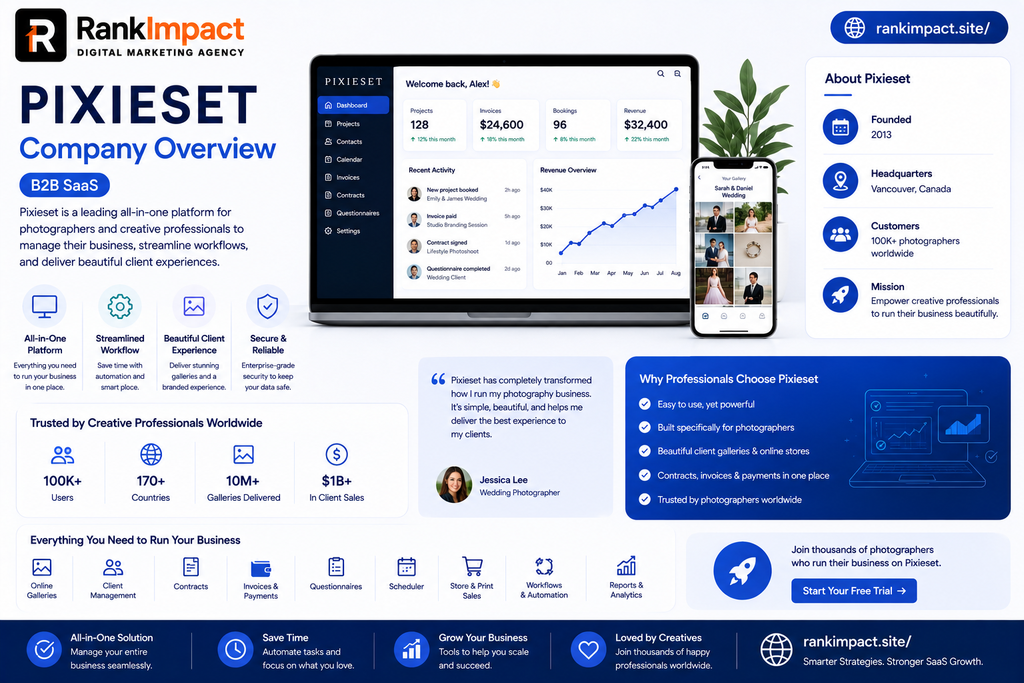
pixieset company overview b2b saas platform for photographers.

What Is Pixieset A Quick Company Snapshot

Pixieset is a Vancouver based software company that built an all in one platform for photographers and creative professionals. The core idea behind the business is simple photographers needed one connected system to deliver photo galleries build a website sell prints and prints products run online stores and manage client bookings instead of stitching together five separate tools. Since launching the company has grown into a platform used by hundreds of thousands of photographers and creative business owners around the world which places it firmly in the vertical SaaS category rather than a generic horizontal tool built for every industry. This distinction matters a lot for anyone doing competitive research because vertical SaaS companies like Pixieset tend to win by depth of workflow features rather than breadth of audience.

The Origin Story Behind Pixieset Founding and Growth

Pixieset was founded in 2013 in Vancouver Canada by Phoebe Jiang and Simon Wong who set out to solve a very specific pain point in the photography industry the clunky and unprofessional way photographers were delivering finished images to their clients. Early on the founders focused on a client gallery product that let photographers upload polished password protected galleries their clients could browse download from and order prints through. That single feature became the foundation for a much larger platform. Over the following decade the company expanded into website building online stores a studio management system and payment tools turning a single utility product into a full business operating system for creatives. The company has been recognized as a leading Vancouver based software solutions provider for photographers and creative professionals and its growth story is frequently cited as an example of a bootstrapped creative tool maturing into an investor backed SaaS company.

Core Products Inside the Pixieset Platform

A useful way to understand Pixieset as a business is to look at the product suite as four connected pillars rather than one single app.

The first pillar is Client Galleries which remains the flagship product and allows photographers to deliver high resolution images through a branded gallery experience complete with proofing tools favoriting and direct print ordering. The second pillar is Websites a drag and drop website builder aimed specifically at photographers who need a portfolio that converts visitors into paying clients without hiring a developer. The third pillar is the Online Store which turns finished photos into sellable products including prints albums and digital downloads with built in fulfillment. The fourth pillar is Studio Manager which functions as the operational backbone covering client bookings contracts invoicing and payments in one dashboard. Together these four pillars mean a photographer can technically run their entire client facing business inside a single login which is exactly the kind of workflow lock in that makes vertical SaaS companies sticky and valuable.

How Pixieset Fits Into the B2B SaaS Landscape

At first glance Pixieset might look like a consumer facing photography app but the underlying business model is textbook B2B SaaS. The buyer is not a casual hobbyist it is a small business owner a working photographer or a creative studio using the software to run recurring revenue generating operations. Pixieset sells subscription access charges based on usage tiers and builds features around retention and upsell paths which are the same growth mechanics used by mainstream B2B SaaS companies in project management CRM and marketing tooling. Understanding Pixieset through this lens is useful for SaaS marketers and founders because the company demonstrates how a vertical focused tool can achieve strong retention by owning an entire workflow for a specific professional audience rather than trying to be a general purpose product for everyone.

Pixieset Pricing Plans and Business Model

Pixieset generally follows a freemium to paid subscription structure a common and proven B2B SaaS pattern. New users can start on a limited free tier to test core features such as client galleries before upgrading to paid plans that unlock storage limits custom branding advanced store features and studio management tools. This approach lowers the barrier to entry for solo photographers while creating a natural upgrade path as their business grows and their storage or feature needs increase. The layered pricing model also allows Pixieset to serve two very different customer types inside one product line the beginner photographer running a side business and the established studio managing dozens of active clients a strategy many successful SaaS companies use to expand average revenue per customer over time.

Key Company Metrics Revenue Team Size and Funding

For anyone researching Pixieset as a company rather than just a product the underlying numbers tell an important trust building story. Pixieset reached approximately 19 million dollars in revenue in 2025 with a team of around 173 people reflecting steady and disciplined growth rather than the boom and bust pattern seen at many venture backed startups. On the funding side Pixieset received a growth investment from Susquehanna Growth Equity an entrepreneur focused growth equity firm that exclusively invests in software and information services companies giving the company institutional backing and governance structure. Pixieset has also been involved in acquisition activity including a deal involving Polarr completed in May 2025 which points to a company actively expanding its product capabilities through strategic purchases rather than organic development alone. These are exactly the kinds of signals a cautious B2B buyer or partner should look for before trusting a vendor with client data and recurring payments.

Top Pixieset Competitors and How It Stands Apart

No pixieset company overview b2b saas discussion is complete without placing the company against its competitive set. Pixieset competes with platforms including PhotoShelter SmugMug and Vermilion along with a wider field of more than a hundred active competitors in the photography software space according to industry tracking data. What tends to separate Pixieset from single purpose competitors is the breadth of its connected suite. A tool that only offers galleries forces photographers to bolt on a separate website builder and a separate invoicing system while Pixieset consolidates those functions under one account and one login. For a buyer comparing options the real question is rarely which tool has the prettiest gallery design it is which platform reduces the number of separate subscriptions and logins a small creative business needs to juggle every single month.

Who Should Use Pixieset Ideal Customer Profile

Not every business needs the full Pixieset suite and understanding the ideal customer profile helps clarify whether the platform is the right fit before you invest time migrating existing systems. The strongest fit tends to be a solo photographer or a small studio with two to five team members who handles the entire client journey from booking through final image delivery and product sales. Wedding photographers portrait studios family photographers and small commercial photography businesses tend to see the fastest return because their workflow naturally moves through gallery delivery print sales and repeat bookings which lines up directly with what the platform was built to handle. On the other end of the spectrum a large enterprise studio with dozens of photographers and complex custom integration needs may eventually outgrow certain modules and look toward more customizable enterprise software though many larger studios still use Pixieset for the client facing gallery and delivery layer even after adopting separate internal tools for accounting or large scale team management.

Company Culture and the Team Behind Pixieset

A company overview is incomplete without looking at how the business actually operates internally because culture often predicts product quality and customer support consistency over the long run. Pixieset has built a reputation around a design focused engineering culture with an emphasis on clean interfaces thoughtful product decisions and a support team that understands the day to day reality of running a photography business rather than treating customers as generic software users. The company has also been recognized among the best workplaces in its home region which signals a stable internal culture that tends to translate into lower staff turnover and more consistent product development over time. For a B2B buyer this kind of operational stability is a meaningful signal because a platform with high internal turnover often struggles to maintain support quality and product roadmap consistency which are two of the biggest long term risks when adopting any SaaS vendor for a growing business.

Best Practices for Using Pixieset as a Growing Creative Business

Businesses that get the most value out of Pixieset tend to follow a few consistent habits. They set up their online store and pricing structure before their first client delivery rather than after so every gallery automatically becomes a sales opportunity. They invest time customizing gallery branding and website templates early because a polished first impression directly affects client trust and referral rates. They also treat the Studio Manager tools as a core part of daily operations rather than an afterthought since centralizing contracts bookings and payments inside one system reduces administrative overhead significantly. Finally the most successful users regularly review their storage and plan tier as their business grows to avoid last minute upgrade friction during a busy shooting season.

Common Mistakes Businesses Make When Evaluating Pixieset

The most common mistake is comparing Pixieset purely on price without factoring in the time saved by having galleries websites stores and client management in a single connected platform. A cheaper standalone tool often ends up costing more once you add the price of a separate website builder and a separate invoicing app. Another common mistake is signing up for a plan without mapping actual storage needs first which leads to unexpected upgrade costs mid year. Some businesses also underuse the platform by only adopting the gallery feature and ignoring the website and store tools that could be generating additional print and product revenue from the same client base. Avoiding these mistakes usually comes down to treating the evaluation process seriously and mapping the full workflow rather than judging the platform on a single feature in isolation.

Frequently Asked Questions

What is Pixieset used for?

Pixieset is used by photographers and creative professionals to deliver client photo galleries build portfolio websites sell prints and products through an online store and manage bookings contracts and payments through a studio management dashboard.

When was Pixieset founded?

Pixieset was founded in 2013 in Vancouver Canada by co founders Phoebe Jiang and Simon Wong who built the platform to simplify how photographers deliver finished work to clients.

Is Pixieset a B2B SaaS company?

Yes Pixieset operates as a vertical B2B SaaS company selling subscription software to small business owners specifically photographers and creative studios that need recurring workflow and client management tools which is why a pixieset company overview b2b saas analysis fits the platform naturally.

Where is Pixieset headquartered?

Pixieset is headquartered in Vancouver British Columbia Canada where its core leadership and product teams are based.

Does Pixieset have a free plan ?

Pixieset offers a free tier for new users to test core gallery features before upgrading to a paid plan with expanded storage branding and studio management tools.

Who are Pixieset main competitors?

Pixieset’s main competitors include platforms such as PhotoShelter SmugMug and other photography focused software providers along with dozens of smaller niche tools in the client gallery and studio management space.

How many people use Pixieset?

Pixieset serves hundreds of thousands of photographers and creative business owners globally making it one of the larger platforms in its specific software category.

Has Pixieset raised outside funding ?

Yes Pixieset received a growth investment from Susquehanna Growth Equity a firm that invests exclusively in software and information services companies giving the business institutional financial backing.

What makes Pixieset different from a simple gallery tool?

Pixieset combines client galleries a website builder an online store and a studio management system into one connected platform reducing the number of separate tools a creative business needs to operate.

Is Pixieset a good long term choice for a growing studio?

For studios that want to consolidate client delivery sales and operations into one login Pixieset is generally a strong long term choice because its pricing tiers and feature set are built to scale alongside a growing client base.

Conclusion

Pixieset has grown from a single client gallery tool built in 2013 into a genuine B2B SaaS company serving hundreds of thousands of photographers and creative businesses with institutional backing and steady revenue growth behind it. Understanding this pixieset company overview b2b saas picture matters whether you are choosing software for your own creative business studying the company as a competitor or researching it as a case study in vertical SaaS growth. The platform succeeds because it solves a full workflow rather than a single feature and that same lesson applies to almost any SaaS business trying to build long term retention in a crowded market.

Key Takeaways

Pixieset was founded in 2013 in Vancouver Canada by Phoebe Jiang and Simon Wong

The platform combines client galleries a website builder an online store and studio management into one connected system

Pixieset operates as a vertical B2B SaaS company using a freemium to paid subscription model

The company reported around 19 million dollars in revenue in 2025 with roughly 173 team members

Pixieset received institutional growth funding from Susquehanna Growth Equity and has made strategic acquisitions to expand its product suite

Main competitors include PhotoShelter SmugMug and other photography focused software platforms

The biggest evaluation mistake buyers make is comparing price alone instead of the full connected workflow value.

SaaS Development Company Guide 2026 Hiring Tips

Learn how to choose the right saas development company covering real costs the hiring process red flags and questions to ask before you sign a contract.

saas development company hiring guide and cost breakdown illustration.

SaaS Development Company Guide To Hiring The Right Partner

Building a software product that customers pay for month after month is one of the most rewarding ventures a founder can pursue but it is also one of the easiest places to lose time and money on the wrong partner. Choosing a saas development company is not just a technical decision it is a business decision that shapes how fast you launch how much you spend on maintenance and whether your platform can actually scale once real customers start signing up. This guide walks through everything you genuinely need to know before signing a contract including what these companies actually do how pricing works the red flags that predict a failed project and the exact questions that separate a great partner from an expensive mistake.

What A SaaS Development Company Actually Does

A saas development company specializes in building cloud hosted software that customers access through a browser or app rather than installing locally on their own machine. Unlike a general web development shop these teams understand the specific architecture patterns that make a subscription product work including multi tenant databases usage based billing systems automated onboarding flows and the security controls enterprise buyers expect before they will sign a contract. The work typically spans the full lifecycle from early product discovery and technical architecture through development quality assurance deployment and ongoing post launch support.

Global demand for this expertise keeps growing because software adoption itself keeps accelerating across every industry. Recent industry research shows worldwide IT spending is projected to exceed 6 trillion dollars in 2026 with software spending among the fastest growing categories inside that total as businesses continue shifting away from on premise systems toward cloud delivered platforms. The average company now runs well over 100 separate SaaS applications across its operations which means the market a new SaaS product enters is already crowded making the quality of your development partner one of the biggest factors separating a product that gains traction from one that quietly fails.

Core Services Offered By SaaS Development Companies

Not every saas development company offers the same scope of work so understanding the typical service breakdown helps you evaluate whether a potential partner actually covers what your project needs. Product discovery and technical consulting usually comes first where an experienced team helps translate a business idea into a concrete technical specification including database design API architecture and a realistic timeline. Custom application development follows covering both frontend interface work and backend infrastructure including the subscription billing logic that makes a SaaS business model function at all.

Cloud infrastructure setup is another core offering since nearly every modern SaaS platform runs on a provider such as AWS Azure or Google Cloud and needs proper configuration for auto scaling load balancing and disaster recovery from day one. Quality assurance and security testing deserves particular attention given that a striking share of SaaS businesses report experiencing a security incident within a twelve month period making rigorous testing a non negotiable part of any serious engagement. Finally ongoing maintenance and support keeps a platform running smoothly after launch covering bug fixes performance monitoring feature updates and the quarterly security patching that compliance frameworks increasingly require.

How Much Does A SaaS Development Company Cost

Cost is usually the first question founders ask and unfortunately also the hardest to answer with a single number because pricing depends heavily on project complexity team location and engagement model. A simple minimum viable product built by an experienced team commonly starts somewhere in the 40 thousand to 60 thousand dollar range while a more feature rich platform with complex integrations enterprise security requirements and multiple user roles can easily run into the low hundreds of thousands of dollars before launch.

Beyond the initial build ongoing maintenance is a cost many founders underestimate during budgeting. Industry benchmarks now place annual maintenance at roughly 15 to 20 percent of the original development cost covering everything from routine bug fixes to mandatory security updates. Cloud hosting itself typically runs between 200 and 2000 dollars per month depending on user volume with additional charges for any third party API usage particularly if your product integrates AI features that carry their own per use costs. When comparing quotes from different companies always ask exactly what is included in a given number since one firm’s estimate for an MVP might include a full design phase and three months of post launch support while another firm’s identical sounding number covers development hours alone.

How To Choose The Right SaaS Development Company

Selecting the right partner comes down to evaluating a handful of factors that consistently separate successful engagements from painful ones. Industry specific experience matters more than most founders initially expect since a company that has already built products for your specific vertical understands the compliance requirements user expectations and common technical pitfalls unique to that space rather than learning them at your expense. Reviewing a company’s actual portfolio and speaking directly with past clients about communication responsiveness and how the team handled scope changes reveals far more than a polished sales pitch ever will.

Technical proficiency deserves close scrutiny particularly around cloud native architecture experience with the specific technology stack your product needs and a demonstrated approach to security given how much sensitive customer data flows through a typical SaaS platform. Equally important is evaluating how a company approaches post launch support since a platform that works perfectly on launch day but has no clear maintenance plan behind it is a liability waiting to surface. Finally pay attention to communication style during the sales process itself since a team that asks sharp clarifying questions about your business model before quoting a price is signaling the same diligence they will bring to the actual project.

SaaS Development Process Explained Step By Step

Understanding the typical development process helps you set realistic expectations and spot warning signs early if a potential partner skips important steps. The process almost always begins with discovery and requirements gathering where the development team works with you to define user personas core features and technical constraints before a single line of code gets written. This is followed by architecture and design where the team maps out database structure API endpoints and user interface wireframes creating a blueprint the entire project can be measured against.

Development typically happens in iterative sprints usually spanning two weeks each with working software demonstrated at the end of every cycle rather than disappearing for months only to reveal a finished product at the very end. Quality assurance runs continuously alongside development rather than as a single phase at the end covering functional testing security testing and performance testing under realistic user load. Deployment introduces the product to a production environment often starting with a limited beta group before a full public launch and the process concludes with a defined handover period where the development team documents the codebase and trains your internal team or transitions into an ongoing support agreement.

Common Mistakes Businesses Make Hiring A SaaS Development Company

Watching failed SaaS projects unfold reveals the same handful of mistakes appearing again and again regardless of industry or company size. Choosing a development partner based purely on the lowest quoted price consistently backfires since inexperienced or under resourced teams tend to cut corners on security testing and architecture decisions that only become expensive problems after real customers depend on the platform. Failing to define clear requirements before development begins is nearly as damaging leading to constant scope creep timeline slippage and a final product that drifts away from the original business goal.

Treating the launch date as the finish line rather than the starting point of an ongoing relationship causes many founders to underbudget for maintenance leaving them scrambling when the inevitable bug or security patch appears. Skipping reference checks with a company’s past clients means missing red flags around missed deadlines or poor communication that would have been obvious with a fifteen minute phone call. One particularly costly pattern involves founders trying to save money by using purely automated AI code generation for a complex backend without any senior human architect reviewing the output leading to systems that work fine for the first few hundred users before collapsing under real load because nobody on the team can actually explain how the underlying code works.

Questions To Ask Before Signing A Contract

Asking the right questions before signing gives you far more leverage than trying to fix problems after a contract is already in place. Ask directly how the company structures pricing and what specifically triggers an additional charge beyond the initial quote since vague answers here often predict budget surprises later. Ask to see two or three examples of similar projects the team has completed along with a direct introduction to a past client rather than a curated testimonial alone.

Ask what security certifications or compliance frameworks the team has experience implementing particularly if your product will handle sensitive customer data or operate in a regulated industry such as healthcare or finance. Ask exactly what happens after launch including response time commitments for critical bugs and whether ongoing support is included in the original engagement or billed separately once the initial build concludes. Finally ask who specifically will be working on your project day to day since some companies present senior talent during the sales process only to staff the actual work with far less experienced team members once the contract is signed.

Why Development Alone Is Not Enough To Succeed

A common blind spot among founders is assuming that once a saas development company delivers a working product the hardest part is finished. In reality a technically excellent platform with no customers is simply an expensive piece of software sitting unused. Growth requires the same level of intentional strategy on the marketing and demand generation side that you applied to the technical build itself which is why many growing companies pair their development partner with a dedicated saas digital marketing agency to make sure qualified leads are flowing in by the time the product is ready for real customers.

Coordinating these two workstreams early rather than treating marketing as an afterthought once development wraps up consistently produces better outcomes. A development team focused purely on shipping features has no visibility into which messaging resonates with buyers or which onboarding friction points are actually costing you trial conversions information your marketing partner gathers constantly through customer research and campaign data. Bringing both teams into the same conversation during the discovery phase rather than sequencing them one after another can meaningfully shorten the time between launch and your first genuinely repeatable revenue.

Frequently Asked Questions

What does a saas development company typically charge for a minimum viable product ?

Most experienced teams charge somewhere between 40 thousand and 60 thousand dollars for a genuine minimum viable product though the exact figure depends heavily on feature complexity integrations and the specific technology stack chosen for the build.

How long does it take to build a SaaS product from scratch?

A focused minimum viable product typically takes twelve to sixteen weeks to reach launch while a more feature complete platform with complex integrations can take six months or longer depending on scope and team size.

Should I hire a freelancer or a full saas development company?

Freelancers can work well for very small well defined projects but a full company typically offers more reliable project management broader technical coverage and continuity if an individual team member becomes unavailable mid project.

What programming languages do most SaaS development companies use ?

Common technology choices include JavaScript and TypeScript for frontend and backend development Python for data heavy applications and cloud platforms such as AWS Azure or Google Cloud for infrastructure though the right stack depends entirely on your specific product requirements.

How do I know if a saas development company is trustworthy ?

Look for a verifiable portfolio of completed projects direct references from past clients transparent pricing structures and clear communication during the sales process itself since how a company behaves before signing a contract usually predicts how they behave afterward.

Is it cheaper to build a SaaS product overseas ?

Offshore and nearshore teams often offer lower hourly rates than local agencies though total cost depends heavily on communication overhead time zone alignment and the additional oversight often needed to maintain the same quality standard.

What ongoing costs should I expect after my SaaS product launches?

Expect annual maintenance costs of roughly 15 to 20 percent of your original development budget along with monthly cloud hosting fees that scale with your user base and any third party API costs tied to specific features.

Do SaaS development companies help with product strategy or only coding ?

Many established companies offer product discovery and strategic consulting alongside pure development work though the depth of this service varies significantly so confirm what is included before assuming strategic guidance is part of the engagement.

What security measures should a SaaS development company implement by default?

Expect encrypted data storage secure authentication protocols regular vulnerability testing and clear compliance planning for frameworks relevant to your industry such as SOC 2 or HIPAA depending on the type of data your product handles.

Can a saas development company help after the product has already launched?

Yes most reputable companies offer ongoing maintenance and feature development contracts after launch and switching to a new partner for this ongoing work is common when the original build was completed by a different team.

Conclusion

Choosing the right saas development company is one of the highest stakes decisions a founder makes because the wrong choice does not just cost money upfront it compounds into maintenance headaches security risk and a product that struggles to scale exactly when customer demand finally arrives. Focus your evaluation on relevant industry experience genuine technical depth transparent pricing and a clear plan for what happens after launch rather than choosing based on the lowest quote alone. Ask pointed questions before signing anything reference check past clients directly and remember that a technically strong build still needs a coordinated go to market plan to turn into a genuinely successful business. Get these fundamentals right and your development partnership becomes a foundation for sustainable growth rather than a recurring source of costly surprises.

Key Takeaways

  • A saas development company specializes in cloud native architecture subscription billing and the security practices a subscription software product specifically requires
  • Minimum viable product costs commonly start between 40 thousand and 60 thousand dollars while full featured platforms can run into the low hundreds of thousands
  • Annual maintenance typically runs 15 to 20 percent of the original development cost and should be budgeted from day one rather than treated as a surprise
  • The strongest partners demonstrate relevant industry experience a verifiable portfolio and a clear post launch support plan rather than competing purely on price
  • A predictable sprint based development process with continuous testing produces far more reliable outcomes than a long single phase build with no visibility until the end
  • Choosing the cheapest bid or skipping reference checks with past clients are among the most common and costly mistakes founders make
  • Asking direct questions about pricing structure team staffing and security practices before signing protects you from expensive surprises later
  • Pairing your development partner with a dedicated saas digital marketing agency helps ensure demand generation is ready the moment your product reaches launch.

B2B SaaS Marketing News 2026 Trends You Must Know

Get the latest b2b saas marketing news for 2026 covering LinkedIn reach AI agents rising CAC and the strategies smart software teams are using now.

b2b saas marketing news 2026 trends and statistics illustration for software growth teams

B2B SaaS Marketing News 2026 Trends That Matter

Every week brings a fresh wave of b2b saas marketing news and most of it gets forgotten within days. A platform tweaks its algorithm. A research firm publishes a new benchmark. A well known founder posts a thread that changes how a hundred teams plan their next quarter. If you run growth demand generation or content for a software company the real challenge is not finding news it is knowing which stories actually deserve a change in strategy and which ones are just noise. This guide breaks down the biggest b2b saas marketing news stories shaping 2026 explains what they mean in practical terms and gives you a repeatable system for separating signal from distraction going forward.

Why B2B SaaS Marketing News Matters More Than Ever

Software marketing used to move slowly. A channel would work for two or three years before it needed a serious overhaul. That pace is gone. Customer acquisition costs across b2b saas have climbed sharply since 2023 with multiple industry studies placing the increase somewhere between 40 and 60 percent depending on category and competitiveness. At the same time buyer behavior has shifted just as fast. Search traffic to vendor websites has become unpredictable organic reach on social platforms has fallen and a growing share of research now happens inside AI chat tools rather than a traditional search bar.

This is exactly why staying on top of b2b saas marketing news is no longer optional. Teams that treat news as background noise end up reacting six months late after a channel has already stopped working for everyone else. Teams that treat it as a strategic input can shift budget and messaging while a trend is still an advantage rather than a requirement. The goal of this article is to help you build that second habit turning industry news into a genuine edge instead of a distraction from real work.

The Biggest B2B SaaS Marketing News Story Right Now LinkedIn Reach Collapse

If there is one story dominating b2b saas marketing news in 2026 it is the collapse of organic reach for company pages on LinkedIn. Multiple independent research sources now report a 60 to 66 percent drop in company page reach between 2024 and 2026 with some analyses showing organic company content making up as little as 2 percent of what users actually see in their feed. Meanwhile personal profiles are thriving posts from an individual employee routinely earn around eight times the engagement of the exact same content published from a brand account.

For b2b saas companies this is not a minor algorithm update it is a structural shift in how buyers discover and evaluate software. Research behavior has moved away from vendor pages and onto the feeds of founders product leaders and individual contributors who share honest opinions rather than polished announcements. The practical takeaway is straightforward. Your company page should still exist and still post consistently but it can no longer be your primary distribution engine. Founders and senior team members need to become the face of your content strategy sharing lessons data and opinions in their own voice rather than reposting brand graphics. Companies that made this shift early are already seeing the reward in pipeline while competitors still pouring budget into company page content wonder why engagement keeps sliding.

AI Agents Are Now Running Entire Marketing Workflows

A second major theme running through b2b saas marketing news this year is the move from AI as a writing assistant to AI as an operator. Two years ago most teams used AI tools to draft a blog post or suggest a subject line. In 2026 the most advanced marketing teams deploy AI agents that manage entire workflows end to end including onboarding email sequences lifecycle campaigns lead scoring and even real time ad optimization across paid channels.

This shift matters because it changes what a lean marketing team can realistically accomplish. A five person team with the right agentic workflows can now run campaigns that previously required fifteen people. It also raises the bar for quality. When every competitor has access to the same AI tools the differentiator stops being speed and becomes judgment original research and a genuine point of view. Practical example a mid sized project management SaaS company automated its lead scoring and nurture sequencing with an AI agent freeing up two full time marketers to focus entirely on original research and customer interviews. Within one quarter their demo to close rate improved because the content speaking to prospects was grounded in real customer language rather than generic templates. The lesson is simple automate the repetitive layer of your workflow so your human team can spend its time on the parts that actually require expertise.

Customer Acquisition Cost Keeps Climbing Across B2B SaaS

No roundup of b2b saas marketing news would be complete without addressing cost. Research this year shows customer acquisition cost increases ranging from roughly 60 percent over five years in competitive categories to as much as 222 percent over eight years for some segments. Paid social costs continue rising with LinkedIn ad prices up around 24 percent year over year and Google Ads costs up close to 19 percent over the same period.

The rising cost of paid acquisition is forcing a real strategic reset. Growth at all costs is no longer a viable playbook when every additional dollar of spend produces a smaller return than the year before. The companies growing fastest today are not the ones spending the most they are the ones building reusable systems retention programs and owned distribution channels that do not depend on an ad auction. Three practical moves worth prioritizing right now are investing in retention and expansion revenue from existing customers building a genuine content and community presence that compounds over time and treating every piece of paid spend as an experiment with a clear kill criteria rather than a permanent line item.

Generative Engine Optimization Is Reshaping B2B SaaS Marketing News

Perhaps the fastest moving thread in b2b saas marketing news this year is the rise of generative engine optimization often shortened to GEO. As more buyers turn to AI chat tools for early stage research the question shifts from how do we rank on Google to how do we get cited by ChatGPT Perplexity and Gemini when a buyer asks for a recommendation. Industry data shows a striking number of B2B decision makers now say they rely on AI chatbots at some stage of their research journey yet fewer than half of software companies currently track citation performance inside these tools as a real marketing metric.

Winning inside AI search requires a different kind of content than winning inside traditional search. These systems favor content that is direct well structured and easy to extract rather than content padded with SEO jargon. Clear definitions original data comparison tables and specific numbers all tend to perform better than long narrative introductions. Practical tip restructure your core pages so the most important answer appears in the first two or three sentences of each section rather than being buried under a long preamble. This single change improves both traditional SEO performance and your odds of being cited inside an AI generated answer.

Product Led Growth And Sales Led Growth Are Merging

Another consistent theme across recent b2b saas marketing news coverage is the blending of product led growth and traditional sales led motions. For years these were treated as opposing philosophies you either let the product sell itself through a free trial or you built an outbound sales team to chase enterprise deals. In 2026 the most successful companies are running both simultaneously using product usage data to identify accounts showing buying signals and then routing those accounts to a human seller at exactly the right moment.

This hybrid motion depends heavily on marketing and product teams sharing data in real time. When a free trial user hits a usage milestone that historically correlates with conversion that signal needs to reach a sales rep within hours not weeks. Companies getting this right are seeing meaningfully shorter sales cycles because the human conversation only starts once genuine intent has already been demonstrated through product behavior rather than a cold outbound email. If your organization still treats product analytics and sales enablement as separate departments closing that gap should be one of your top priorities this year.

Organic Search And Content Marketing Are Making A Quiet Comeback

While paid channels get more expensive and less predictable organic search is experiencing a genuine resurgence inside b2b saas marketing news coverage. Recent research found organic channels running roughly 40 percent cheaper than paid acquisition in b2b saas while converting more than double as well leading to strong long term returns for companies willing to invest patiently. Owned channels including organic search and content have climbed from around 22 percent of median pipeline in 2023 to roughly 27 percent today with top performing companies attributing over 40 percent of qualified pipeline to these channels combined.

The reason is intuitive even with traffic volumes down across the industry the people who do arrive through organic search and content tend to be higher intent because they found you through genuine research rather than an ad impression. For a growing saas company this means content strategy deserves a bigger seat at the leadership table not a smaller one. A genuinely useful resource like a detailed guide to choosing a saas digital marketing agency can quietly generate qualified pipeline for years after publication something no single paid campaign can replicate.

Seven Common Mistakes B2B SaaS Marketers Make Reacting To News

Even experienced teams stumble when trying to respond to fast moving b2b saas marketing news. Recognizing these patterns helps you avoid repeating them.

  1. Chasing every new platform feature instead of evaluating whether it fits your specific audience and buying cycle
  2. Abandoning a channel entirely after one disappointing month rather than testing a genuinely new approach within it
  3. Copying a competitor tactic without understanding the underlying data that made it work for their audience
  4. Treating AI generated content as a finished product instead of a first draft that still needs expert review
  5. Ignoring retention and expansion metrics while chasing new logo growth that costs far more to acquire
  6. Failing to track how buyers actually discover your product across AI search social and traditional channels
  7. Waiting for a quarterly planning cycle to react to a shift that is already reshaping buyer behavior today

Avoiding these seven traps alone will put your team ahead of a large share of competitors who are still making at least one of them right now.

Best Practices For Staying Ahead Of B2B SaaS Marketing News

Turning industry news into a genuine advantage requires a system rather than occasional attention. Start by assigning one person on your team ownership of tracking industry shifts even if that is a small part of a broader role. Build a simple weekly review where new data points get logged and discussed rather than scattered across individual inboxes. Prioritize primary research and benchmark reports from credible industry sources over secondary commentary since original data ages much better than opinion pieces.

When a genuinely significant shift appears run a small controlled test before committing meaningful budget. If personal profile content is outperforming your company page do not abandon your company page overnight instead run both for a defined period and measure the difference directly with your own data. Document what you learn in a shared playbook so institutional knowledge does not disappear when someone leaves the team. Companies that build this muscle consistently outperform those relying on a single person’s memory of what worked last year.

How To Build A Newsjacking Strategy For B2B SaaS Marketing

Newsjacking meaning creating timely content around a breaking industry story can be one of the highest leverage tactics inside b2b saas marketing news strategy when done well and one of the most embarrassing when done poorly. The goal is to add a genuine point of view to a story your audience is already discussing rather than simply repeating the headline.

A workable process looks like this. First set up alerts for the handful of publications and analysts that genuinely move your specific market rather than trying to monitor everything. Second when a relevant story breaks ask whether your company has real data or a real customer story that adds something new to the conversation. Third publish quickly through the channel where your audience already spends time whether that is a LinkedIn post from a founder or a short expert commentary piece on your blog. Speed matters here a thoughtful response within 48 hours of a major story will earn far more attention than a polished piece published two weeks later once the conversation has moved on. Fourth always tie the commentary back to something concrete you have built or learned rather than pure opinion since credibility compounds much faster than hot takes.

Tools And Resources To Track B2B SaaS Marketing News Every Week

Consistently tracking b2b saas marketing news becomes far easier with the right lightweight system in place. A simple RSS reader or newsletter aggregator covering five to eight trusted industry sources beats scrolling social media hoping to stumble onto something useful. Pair that with a shared internal document where your team logs anything that might affect strategy alongside a one line note on why it matters.

It also helps to follow a small number of specific benchmark reports published annually or quarterly by research firms and marketing platforms since these tend to carry more statistical weight than individual opinion posts. Set a recurring 30 minute team meeting every two weeks specifically to discuss what has changed in the market rather than folding this conversation into an already packed status meeting. Teams that protect this dedicated time consistently spot shifts earlier than teams that treat industry awareness as something to squeeze in whenever there happens to be spare time.

Frequently Asked Questions

What is the most important b2b saas marketing news story in 2026?

The most significant story is the collapse of organic reach for LinkedIn company pages alongside the sharp rise in engagement for personal profiles which is reshaping how software companies distribute content and build trust with buyers.

How often should a saas marketing team review industry news ?

A dedicated review every two weeks strikes a good balance between staying current and avoiding constant distraction from execution. Daily monitoring often leads to reactive decisions based on incomplete information.

Is AI replacing human marketers in b2b saas companies?

No current evidence shows AI replacing marketing roles entirely rather it is replacing repetitive execution tasks while increasing demand for strategic judgment original research and genuine subject matter expertise.

Why has customer acquisition cost risen so much in b2b saas?

Rising competition inflation in paid advertising auctions and more channels competing for the same buyer attention have combined to push acquisition costs up sharply across nearly every b2b saas category since 2023.

What is generative engine optimization and why does it matter ?

Generative engine optimization is the practice of structuring content so AI tools like ChatGPT and Perplexity are more likely to cite your brand when answering a buyer question making it an increasingly important companion to traditional search engine optimization.

Should a small saas company still invest in a company LinkedIn page ?

Yes but it should not be the primary channel. Personal profiles belonging to founders and team members should carry the bulk of organic distribution while the company page serves as a secondary amplification and credibility touchpoint.

How can a saas company measure whether a marketing trend is worth adopting?

Run a small controlled test with a clear success metric and a defined timeframe before shifting significant budget. Comparing real performance data against your current approach is far more reliable than adopting a trend purely because competitors are discussing it.

What role does content marketing play in reducing acquisition costs ?

Content marketing and organic search consistently run cheaper than paid acquisition while converting at a higher rate over time making them one of the most reliable long term levers for lowering blended customer acquisition cost.

Is product led growth replacing sales led growth in b2b saas?

Not entirely the two motions are increasingly merging with product usage data used to identify high intent accounts that are then handed to a human sales team at the right moment rather than one approach fully replacing the other.

Where can a saas company get help building a modern marketing strategy ?

Many growing companies partner with an experienced saas digital marketing agency to combine specialized industry knowledge with the execution capacity needed to act on these trends quickly.

Conclusion

B2B saas marketing news moves faster today than at any point in the past decade and the gap between companies that adapt early and those that react late continues to widen. The stories covered here from the collapse of LinkedIn organic reach to the rise of AI agents and generative engine optimization all point toward the same underlying truth marketing has shifted from a game of raw spend toward a game of genuine systems judgment and authentic distribution. Building a simple repeatable habit of tracking testing and documenting what actually works for your specific audience will matter far more over the next few years than chasing every individual headline. Start small assign ownership review consistently and let real data rather than industry noise guide where your team invests its time and budget next.

b2b saas marketing news 2026 trends and statistics illustration for software growth teams.

Key Takeaways

  • LinkedIn company page organic reach has dropped roughly 60 to 66 percent since 2024 while personal profile content earns around eight times more engagement
  • AI agents are now managing full marketing workflows from onboarding to lead scoring freeing human teams to focus on strategy and original research
  • Customer acquisition cost has risen sharply across b2b saas making retention and owned channels more valuable than ever
  • Generative engine optimization is becoming as important as traditional SEO as more buyers research software through AI chat tools
  • Organic search and content marketing convert better and cost less than paid acquisition over the long term
  • Product led growth and sales led growth are merging with usage data guiding when a human seller should step in
  • A simple biweekly review system beats reactive daily scrolling for staying genuinely ahead of industry shifts
  • Partnering with a specialized saas digital marketing agency can help smaller teams execute on these trends without overextending internal resources.

Company Name SaaS Pricing Model 7 Tips for 2026

Learn how to build a smart company name saas pricing model with proven strategies tips and mistakes to avoid so your SaaS pricing drives real growth.

company name saas pricing model

Understanding What Makes a Strong SaaS Pricing Model

A strong saas pricing model starts with a clear picture of the value your product delivers, not with what a competitor charges. Before choosing numbers or tiers, successful companies map out the specific outcomes customers get from using the product, whether that is time saved, revenue generated, or risk reduced. This value mapping becomes the backbone of every pricing decision that follows.

Pricing also needs to align with how customers naturally think about the product. A project management tool might price per user because teams grow one person at a time. A data platform might price by volume because usage scales with the size of the business. When the pricing metric matches the way value is delivered, customers find the model intuitive rather than confusing, and that clarity reduces friction during the buying process.

Finally, a strong pricing model has room to grow with the customer. Rigid pricing forces customers to either overpay for capacity they do not need or hit a wall and churn when they outgrow a plan. The best models create a natural upgrade path so revenue expands as the customer gets more value, which keeps both sides of the relationship aligned over time.

The Core Types of SaaS Pricing Models Explained

Most successful software businesses build their pricing around one of a handful of proven structures, often blending two or three together.

Flat rate pricing offers a single price for full access to the product. It works well for simple tools with one core use case, since customers know exactly what they are paying without needing to calculate usage. The downside is that flat rate pricing does not scale revenue as customer usage grows, which can leave money on the table with larger accounts.

Tiered pricing groups features and limits into packages such as starter, growth, and enterprise. This is the most widely used company name saas pricing model because it lets a single product serve very different customer segments, from solo users to large organizations, while giving the business multiple price points to capture different budgets.

Usage based pricing charges customers according to how much they consume, whether that is API calls, storage, or transactions processed. This model aligns cost directly with value delivered and feels fair to customers, but it can make revenue harder to forecast month to month.

Per user pricing charges based on the number of seats or active users. It is straightforward to understand and scales naturally as a team grows, though it can discourage adoption across large teams if the cost per seat feels high.

Freemium pricing offers a free tier with limited features alongside paid upgrades. It is a powerful acquisition tool for products with strong network effects or viral growth potential, but it requires careful design so the free tier drives adoption without cannibalizing paid conversions.

How to Choose the Right Pricing Model for Your Business

Selecting the right company name saas pricing model requires an honest assessment of three things: your ideal customer profile, your cost structure, and your growth stage.

Start by studying how your best customers already talk about value. If sales conversations keep coming back to time saved per employee, per user pricing likely makes sense. If customers talk about volume, transactions, or scale, usage based pricing is probably a better fit. Listening closely to these conversations often reveals the pricing metric before any formal analysis begins.

Next, look at your cost structure. A product with high infrastructure costs per customer, such as one involving heavy data processing, needs a pricing model that scales with usage so margins stay healthy as adoption grows. A product with low marginal cost per user, such as a simple workflow tool, has more freedom to experiment with flat or tiered pricing without risking profitability.

Finally, consider your growth stage. Early stage companies often benefit from simpler pricing with fewer tiers, since the goal is validating product market fit and gathering feedback quickly. As the company matures and customer segments become clearer, pricing can become more sophisticated with additional tiers, add ons, and enterprise options tailored to larger accounts.

Value Based Pricing Versus Cost Based Pricing in SaaS

One of the most important distinctions in building a company name saas pricing model is choosing between value based and cost based approaches.

Cost based pricing starts with the cost of delivering the product and adds a margin on top. It feels safe because it guarantees profitability on paper, but it often leaves significant revenue on the table for products that deliver outsized value relative to their cost to run. It also ties price increases to internal cost changes rather than to the value customers actually receive.

Value based pricing instead starts with the outcome the customer achieves and prices a fraction of that value. A tool that saves a sales team ten hours a week is priced based on what that time is worth to the business, not on the server costs behind the software. This approach typically leads to higher margins and stronger willingness to pay, but it requires deep customer research to quantify value accurately.

Most mature SaaS companies eventually shift toward value based pricing as they gather enough customer data to understand the true return on investment their product delivers, using that insight to justify premium tiers and enterprise pricing with confidence.

Common Mistakes Companies Make When Building a Pricing Model

Even experienced teams fall into predictable traps when designing their company name saas pricing model.

The first mistake is underpricing out of fear of losing customers. Many founders set prices too low early on and then struggle to raise them later without backlash from existing customers. It is almost always easier to launch with a defensible price and offer early adopter discounts than to attempt a painful price increase down the road.

The second mistake is copying a competitor’s pricing structure without understanding the reasoning behind it. Two companies with different cost structures, target markets, and value propositions rarely benefit from identical pricing. Blind copying often results in a model that fits someone else’s business better than your own.

The third mistake is offering too many tiers or add ons, which overwhelms buyers with decision fatigue. Research consistently shows that too many choices reduce conversion rates rather than increase them. A cleaner three tier structure with clear differentiation almost always outperforms a confusing menu of five or six plans.

The fourth mistake is neglecting to revisit pricing as the product evolves. Pricing models that made sense at launch often become outdated as new features are added and the product delivers more value. Companies that treat pricing as a one time decision instead of an ongoing process leave significant revenue growth unrealized.

Best Practices for Testing and Optimizing Pricing

Building a strong pricing model is not a single event, it is an ongoing process of testing and refinement.

Run structured pricing interviews with both current customers and prospects who did not convert. Ask directly what price would feel too expensive, what price would feel like a steal, and what price feels fair. This qualitative research, often called the Van Westendorp method, gives a realistic price range grounded in real customer perception rather than guesswork.

Test new pricing with new customers before rolling changes out to your entire existing base. This limits risk and lets you gather real conversion data on a new company name saas pricing model without disrupting revenue from customers already locked into your product.

Track metrics beyond just monthly revenue when evaluating a pricing change. Watch trial to paid conversion rate, average revenue per account, upgrade rate between tiers, and churn by plan level. A pricing change might increase revenue per customer while quietly reducing new signups, and only a full metrics view reveals that tradeoff.

Communicate any pricing change clearly and with advance notice, especially to existing customers. Transparency about why a change is happening, paired with grandfathering options for loyal customers, preserves trust even when prices increase.

Real World Examples of Successful SaaS Pricing Strategies

Looking at how established companies structure pricing offers useful patterns for building your own model.

Project management tools often use per user tiered pricing, charging more per seat as feature depth increases across starter, business, and enterprise plans. This works because team size is a natural proxy for the value the tool delivers across an organization.

Cloud infrastructure providers frequently use pure usage based pricing, charging by compute time, storage, or data transfer. This mirrors how customers experience cost internally and scales fairly from a small startup to a massive enterprise workload.

Email marketing platforms commonly combine freemium access with tiered pricing based on subscriber count, letting small businesses start free and naturally graduate into paid tiers as their audience grows. This model turns product usage itself into the sales funnel.

Customer support software often blends per agent pricing with feature based tiers, recognizing that both team size and functionality needs grow together as a support organization scales. Studying patterns like these across your own industry, rather than a single competitor, reveals which pricing structures are proven to work at scale.

How Pricing Psychology Influences SaaS Buying Decisions

Numbers on a pricing page are never evaluated in isolation, they are judged relative to other options and to the perceived risk of the decision.

Anchoring plays a major role in how buyers perceive value. Placing a premium tier at the top of a pricing table, even if few customers choose it, makes the middle tier look more reasonable by comparison. This is why most tiered pricing pages are designed with a recommended middle plan that captures the majority of conversions.

Decoy pricing, where one tier is deliberately less attractive than another to steer buyers toward a specific plan, is widely used across the software industry. A poorly value engineered basic tier next to a strong middle tier nudges undecided buyers toward the option the business actually wants them to choose.

Loss aversion also shapes upgrade behavior. Framing an upgrade around what a customer will lose by staying on a lower tier, such as missing automation features that save hours each week, is often more persuasive than simply listing what the higher tier adds. Buyers weigh potential losses more heavily than equivalent gains, and pricing pages that understand this convert better.

Pricing strategy continues to evolve as customer expectations and technology shift.

Outcome based pricing is gaining traction, particularly among AI powered tools, where customers pay based on results delivered rather than seats or usage volume. This shifts risk toward the vendor but can command premium pricing when outcomes are clearly measurable.

Hybrid models that combine a base subscription with usage based add ons are becoming more common, giving companies predictable baseline revenue while still capturing upside from high usage accounts. This blended approach addresses the forecasting weakness of pure usage based pricing while retaining its fairness.

Personalized pricing driven by account level data is also emerging, where enterprise buyers see tailored quotes based on predicted usage and value rather than fixed public tiers. As pricing tools become more sophisticated, expect more companies to move away from rigid public pricing pages toward dynamic, data informed quoting for larger accounts.

Frequently Asked Questions

What is a saas pricing model?

A saas pricing model is the structure a software company uses to charge customers for access to its product, typically based on factors such as number of users, usage volume, feature tiers, or a flat recurring fee. The right company name saas pricing model depends on how the product delivers value and who the target customer is.

Which pricing model is best for a new SaaS company?

Early stage companies generally benefit from a simple tiered model with two or three plans, since this keeps the buying decision easy while still allowing some segmentation between smaller and larger customers.

How often should a company update its pricing model?

Most established SaaS companies review pricing at least once a year and make more significant changes every two to three years as the product and market evolve, rather than leaving pricing untouched indefinitely.

Is usage based pricing better than flat rate pricing?

Neither model is universally better, it depends on the product. Usage based pricing suits products where cost and value scale directly with consumption, while flat rate pricing suits simple tools with a single core use case and predictable delivery cost.

How do you decide how many pricing tiers to offer?

Three tiers is the most common and effective structure for most SaaS products, since it balances customer choice with simplicity and avoids the decision fatigue that comes with too many options.

What is the difference between value based and cost based pricing?

Cost based pricing sets price by adding a margin on top of delivery cost, while value based pricing sets price as a portion of the outcome or value the customer receives, which usually results in stronger margins and clearer differentiation.

Should a SaaS company offer a free trial or a freemium plan?

Free trials work well for products with a clear onboarding flow and fast time to value, while freemium works best for products with strong network effects where free users increase the value of the product for paid users.

How do you test a new pricing model without losing customers?

Introduce new pricing to new customers first, grandfather existing customers on their current plan for a defined period, and communicate any future changes with clear advance notice to preserve trust.

What metrics should you track when changing pricing?

Track trial to paid conversion rate, average revenue per account, upgrade rate between tiers, and churn broken down by plan, since revenue alone can hide important tradeoffs happening beneath the surface.

Can pricing alone increase SaaS revenue without new features?

Yes, pricing optimization is one of the highest leverage levers in a SaaS business, since even small improvements in how value is packaged and priced often produce a larger revenue impact than adding new features.

Conclusion

Building the right company name saas pricing model is not about picking a number that feels safe, it is about understanding the value your product delivers and translating that value into a structure customers find fair and easy to understand. From choosing between tiered, usage based, or hybrid approaches to avoiding common mistakes like underpricing and tier overload, every decision along the way shapes how your business grows. Treat pricing as a living part of your product strategy rather than a one time setup task, and revisit it regularly as your product and customer base evolve. Companies that approach pricing with this level of intention consistently outperform those that set it once and forget it.

Key Takeaways

A strong company name saas pricing model is built around customer value, not internal cost or competitor mimicry. Tiered pricing remains the most widely used structure because it balances simplicity with the ability to serve different customer segments. Usage based and hybrid models are growing in popularity as products scale with customer consumption. Common mistakes include underpricing early, copying competitors blindly, offering too many tiers, and neglecting to revisit pricing as the product matures. Regular testing through customer interviews and phased rollouts, paired with clear communication, is the most reliable way to optimize pricing over time.

SaaS Data Security Platform 7 Things to Check in 2026

What a SaaS data security platform actually does, how it works, and what to check before buying one. A practical, no hype guide.

SaaS data security platform connecting multiple cloud apps to a central protected data hub.

SaaS data security platform

Most companies did not choose to scatter their sensitive data across forty different apps. It happened gradually, one signed-up tool at a time, until nobody in the security team could say with confidence where customer records, financial data, or internal documents actually lived. A SaaS data security platform exists to answer that exact question and act on it. This article explains what these platforms actually do, how they work under the hood, where they genuinely help, where they fall short, and what to check before you commit budget to one.

What a SaaS Data Security Platform Actually Is

A SaaS data security platform is a tool that discovers, classifies, and protects sensitive data across the SaaS applications a company uses, then monitors who can access that data and flags risky configurations or behavior. Instead of securing one application at a time, it connects to many SaaS tools through their APIs and gives a security team a shared view across all of them.

This is different from securing the SaaS application itself. A SaaS data security platform is not trying to patch a vendor’s software or run their infrastructure; it is watching the data that flows through the apps a company already trusts, and the permissions attached to that data.

It also sits next to, not instead of, more familiar categories:

  • CASB (Cloud Access Security Broker): focuses more on controlling access and traffic to cloud apps, often at the network layer.
  • SSPM (SaaS Security Posture Management): focuses on misconfigurations and settings inside SaaS apps themselves.
  • DLP (Data Loss Prevention): focuses on stopping sensitive data from leaving in the first place, often at the endpoint or network level.

Many current platforms blend elements of all three, which is part of why the category can be confusing to shop for.

Why This Matters More Than It Used To

A decade ago, most business data lived behind a company firewall, on servers IT controlled directly. Today, a mid sized company might run its CRM, payroll, support desk, file storage, and internal wiki on five separate SaaS vendors, each with its own admin panel, its own sharing settings, and its own third-party integrations connected through OAuth.

Every one of those connections is a door. An employee can misconfigure a shared folder without realizing it is publicly link-accessible. A former employee’s account can retain access after offboarding if it was not removed everywhere. A third-party integration approved two years ago can quietly retain broad read access to a company’s entire customer database.

None of this requires a sophisticated attacker. Misconfiguration and overly broad permissions are consistently among the most common causes of SaaS related data exposure, which is why visibility, not just prevention, is the starting point for most of these platforms.

The scale of the problem compounds quietly. Each new SaaS subscription adds its own login, its own admin console, and often its own set of default sharing settings that lean toward convenience rather than caution. Multiply that across dozens of tools and several years of gradual adoption, and even a security conscious company can end up with a sprawling, undocumented web of access it never deliberately chose to create. This is less about any single mistake and more about the natural drift that happens when nobody is assigned to watch the whole picture.

Core Components of a SaaS Data Security Platform

A working platform in this category is usually built around four connected functions rather than one single feature.

1. Discovery

The platform connects to sanctioned SaaS applications through APIs and, in more mature tools, also detects shadow SaaS, meaning apps employees signed up for on their own that IT never approved. Without discovery, everything else in the platform is working on an incomplete map.

2. Data classification

Once connected, the platform scans for sensitive data: customer PII, payment details, health information, credentials, source code, or internal financial data, depending on what the business defines as sensitive. Classification quality varies significantly between vendors, and this is one of the areas most worth testing with real data before buying.

3. Access and permission mapping

The platform maps who, and what, can reach classified data: employees, external collaborators, and connected third-party apps. This is where over-permissioned accounts, stale shares, and risky OAuth integrations usually surface.

4. Monitoring and response

The platform watches for risky changes over time, such as a sensitive file suddenly becoming externally shared, a dormant account being reactivated, or an integration requesting broader scopes than before, and either alerts a security team or, in some tools, automatically remediates the issue.

How Implementation Actually Works

Rolling one of these platforms out is rarely a single afternoon of setup, even though vendors often present it that way.

  1. Connect priority applications first. Start with the apps holding the most sensitive data, not every app the company uses. Trying to onboard everything at once usually produces alert fatigue before the team has trusted the tool.
  2. Let discovery and classification run before acting. Early results are often noisy. A first scan commonly surfaces old, forgotten shares and unused integrations that are not urgent, alongside genuinely risky ones. Sorting the two takes a review pass, not automation alone.
  3. Set alert thresholds deliberately. A tool that alerts on everything trains the team to ignore it. Start narrower, focusing on externally shared sensitive data and admin-level access changes, and widen scope once the signal-to-noise ratio is trusted.
  4. Assign clear ownership. Someone specific needs to own triage of what the platform surfaces, or findings pile up unreviewed, which defeats the purpose of buying the tool.
  5. Review integrations quarterly, not once. New OAuth connections get approved constantly as teams adopt new tools; a one-time cleanup does not stay accurate.

Example: What This Looks Like in Practice

The following is an illustrative example, not a real case study.

Imagine a 60 person company using a CRM, an HR platform, and a cloud storage tool. After connecting a SaaS data security platform, the first scan might reveal a shared folder in the storage tool that contains customer contracts and has been set to anyone with the link for over a year, plus a marketing automation integration that was granted read access to the full CRM contact list but has not been used in eight months. Neither issue involves an attacker. Both are the kind of quiet, accumulated risk this category of tool is built to surface, and both are fixable in minutes once someone actually sees them.

Best Practices When Using One of These Platforms

  • Treat the platform’s findings as a starting point for a process, not a one-time cleanup project.
  • Combine it with basic access hygiene: least-privilege permissions, regular offboarding audits, and periodic reviews of third-party app access.
  • Prioritize fixes by the sensitivity of the exposed data first, not by alert volume.
  • Involve the teams who actually use each SaaS app in remediation decisions; security teams often lack context on why a share exists.
  • Revisit classification rules periodically as the business starts using new categories of sensitive data.

Common Mistakes to Avoid

  • Buying based on the connector list alone. A platform that “supports” hundreds of apps but classifies data poorly in the ones you actually use will not help much.
  • Skipping a real-data pilot. Classification accuracy is hard to judge from a demo with sample data; test it against your own environment before committing.
  • Treating the tool as a replacement for access policy. A platform can show you that ten people have unnecessary admin rights; it cannot decide your access policy for you.
  • Ignoring shadow SaaS. A platform that only monitors already-approved apps misses a large share of real-world exposure.
  • Under-resourcing the review process. Discovery without a person acting on the findings produces a dashboard nobody looks at.

Measuring Whether It’s Working

There is no single universal metric here, but a few practical indicators are worth tracking over time: the number of sensitive files with unnecessary external sharing, the number of dormant accounts still holding active access, the average time between a risky finding and its remediation, and the number of third-party integrations with access broader than they need. A platform is earning its cost when these numbers trend down consistently, not just at initial rollout.

Limitations Worth Knowing Before You Buy

No SaaS data security platform prevents a breach on its own. It reduces the odds and shortens the time to notice a problem, but it depends entirely on someone acting on what it finds. Classification is also not perfect; even strong tools produce some false positives and miss some genuinely sensitive data, especially in unstructured formats like chat threads or free-text fields. And coverage is limited to the apps you connect; an unconnected or unapproved app remains a blind spot regardless of how good the platform is elsewhere. None of this makes the category unhelpful; it means it works best as one layer in a broader security approach, not a replacement for one.

Advanced Considerations for Larger or Regulated Companies

Companies in regulated industries such as healthcare, finance, or anywhere handling government contracts usually need a platform that supports the specific classification categories their regulations require (such as PHI or cardholder data) and produces audit-ready reporting, not just internal dashboards. Larger organizations with hundreds of SaaS apps should also weigh how well a platform handles automated remediation versus alert-only workflows, since manual triage does not scale past a certain volume of connected apps. Privacy and data residency requirements vary by jurisdiction and by industry, so any compliance claim a vendor makes should be verified directly against your specific regulatory obligations rather than taken at face value.

It is also worth considering how a platform handles multi-entity or multi-region setups, since a company operating across several countries may need data classified and reported differently depending on where it physically resides or which customers it belongs to. Vendors targeting enterprise buyers usually address this directly in their documentation; if a vendor cannot clearly explain how their tool handles this, that is a reasonable reason for caution rather than an oversight to work around later.

FAQ

1. What is a SaaS data security platform in simple terms?

It is a tool that connects to the SaaS applications a company uses, finds sensitive data inside them, and monitors who can access that data so risky exposure gets caught and fixed.

2. Is a SaaS data security platform the same as a CASB?

Not exactly. A CASB traditionally focuses on controlling access and traffic to cloud apps, while a SaaS data security platform focuses more on the data inside those apps and how it is exposed. Many current products combine both approaches.

3. Do small businesses actually need one?

It depends on how much sensitive data sits in SaaS apps and how many of them are in use. A five-person company using two apps has a very different risk profile than a fifty-person company using twenty.

4. Can this replace a firewall or antivirus software?

No. It addresses a different layer of risk, data exposure inside SaaS apps, and is meant to work alongside, not instead of, other security tools.

5. How long does implementation usually take?

Initial connection to priority apps can happen quickly, but getting classification tuned and alert thresholds set to a trustworthy level usually takes several weeks of active review.

6. What is “shadow SaaS” and why does it matter here?

Shadow SaaS refers to applications employees sign up for without IT approval. It matters because a platform that only watches sanctioned apps misses a meaningful share of where company data actually ends up.

7. Does this stop a data breach automatically?

Not on its own. It surfaces risky exposure and, in some tools, automates certain fixes, but it depends on a team acting on what it finds.

8. How is pricing usually structured?

Pricing commonly scales with the number of connected applications, users, or amount of data scanned, though exact models vary by vendor and should be confirmed directly, since pricing changes over time.

9. What should be tested before buying?

Classification accuracy against your own real data, the quality of alerting versus alert fatigue, and how well it detects apps you have not manually listed.

10. Does using one make a company automatically compliant with data protection regulations?

No. It can support compliance efforts by improving visibility and control, but compliance depends on your specific regulatory obligations, which vary by jurisdiction and should be confirmed with a qualified professional.

Key Takeaways

  • A SaaS data security platform discovers, classifies, and monitors sensitive data across the SaaS apps a company uses, rather than securing one app at a time.
  • Its four core functions are discovery, classification, access mapping, and ongoing monitoring.
  • Misconfiguration and over-permissioned access, not sophisticated attacks, are the most common source of the exposure these platforms catch.
  • It works best alongside good access hygiene and a clear owner for triage, not as a standalone fix.
  • Classification accuracy and shadow SaaS detection are worth testing with real data before buying.
  • No platform in this category prevents a breach on its own or guarantees regulatory compliance.

Conclusion

A SaaS data security platform will not make every security decision for a company, and no honest vendor should claim otherwise. What it does well is give a security team something they usually do not have without one: a real, current view of where sensitive data sits across a sprawling set of SaaS apps, and who can actually reach it. That visibility, paired with a team that acts on it consistently, is what turns the tool from a dashboard into an actual reduction in risk.

7 SaaS Subscription Management Best Practices for 2026

Learn 7 proven saas subscription management practices to cut involuntary churn, automate billing, and scale recurring revenue in 2026.

saas subscription management dashboard showing plan tiers and billing status.

What Is SaaS Subscription Management

SaaS subscription management refers to the ongoing administration of a customer’s subscription lifecycle, from the first sign up through renewals, upgrades, downgrades, pauses, and eventual cancellation. It sits at the intersection of billing software, the product itself, and customer facing communication.

A subscription management system typically needs to answer a few core questions for every customer at any moment. What plan are they on. Have they paid. When do they renew. What access should the product grant them right now. If any one of those answers is wrong or delayed, the customer experience and the company’s revenue reporting both suffer.

This is different from a one time transaction. A single purchase ends the moment payment clears. A subscription is a continuing relationship, and subscription management is the operational layer that keeps that relationship accurate over months or years, across plan changes, price updates, currency differences, and payment method failures.

Why Subscription Management Matters More as You Scale

At ten customers, a founder can track subscriptions in a spreadsheet without much trouble. At a few hundred customers across multiple plans, currencies, and billing cycles, that same spreadsheet becomes a liability. Manual tracking cannot keep pace with proration, mid cycle upgrades, tax rules that vary by region, or the sheer number of payment retries needed to recover failed charges.

There is also a direct revenue impact. Industry research on failed payments consistently shows that a meaningful share of subscription churn is involuntary, meaning the customer did not choose to leave, their card simply failed and nobody recovered the payment in time. A structured subscription management process directly reduces this category of loss, which is often the easiest churn to fix because the customer never intended to cancel in the first place.

Scaling also introduces reporting requirements that ad hoc processes cannot support. Once a company answers to investors, a board, or auditors, recurring revenue needs to be reported consistently and, in many cases, in line with formal accounting standards such as ASC 606, which governs how and when subscription revenue is recognized rather than simply when cash is collected.

The Core Components of a Subscription Management System

Before getting into best practices, it helps to know what a complete saas subscription management setup actually includes.

Billing and invoicing handles the recurring charge itself, including proration when a customer changes plans mid cycle.

Payment processing connects to a payment gateway to collect and retry charges, and needs to handle multiple payment methods and currencies for companies selling internationally.

Plan and entitlement management controls what a customer can actually access in the product based on their current subscription tier.

Dunning management is the structured process of retrying failed payments and communicating with the customer before a service is suspended.

Customer communication covers renewal reminders, receipt emails, upgrade confirmations, and cancellation flows.

Reporting and analytics track recurring revenue, churn, expansion revenue, and other metrics leadership uses to run the business.

A gap in any one of these areas creates friction somewhere else in the system, which is why the practices below treat subscription management as one connected workflow rather than a set of disconnected tools.

Centralize Your Subscription and Billing Data

The single most common mistake in saas subscription management is letting subscription data live in more than one place. When billing status lives in a payment processor, plan entitlements live in the product database, and customer notes live in a support tool, nobody has a complete picture of any single account.

Centralizing this data does not necessarily mean building a custom internal tool. Most subscription billing platforms are designed to be the single source of truth for plan, billing status, and payment history, with the product application reading from that system rather than maintaining its own separate record.

As an illustrative example, imagine a support agent needs to confirm whether a customer’s recent downgrade has actually taken effect. If billing status and product entitlements are centralized, the agent sees one accurate record. If they are not, the agent may need to check three different systems and still get a stale answer, which is a common source of customer frustration during plan changes.

Automate Recurring Billing and Invoicing

Manual invoicing does not scale past a small handful of accounts. Automated recurring billing removes the need for anyone to remember to charge a customer, generate an invoice, or apply proration when someone changes plans partway through a billing cycle.

Automation matters most at the edges of normal billing, such as mid cycle upgrades, annual to monthly conversions, and tax calculation for customers in different regions. These edge cases are exactly where manual processes break down and errors creep into financial reporting.

Automated billing also directly supports accurate revenue recognition. Because subscription revenue under standards like ASC 606 is typically recognized ratably over the service period rather than all at once when payment is collected, a billing system that tracks service periods correctly makes it far easier for finance to close the books accurately each month.

Build a Structured Dunning and Failed Payment Recovery Process

Dunning is the process of retrying a failed payment and communicating with the customer until the issue is resolved or the subscription is cancelled. This single practice often has the largest measurable impact on retained revenue of anything on this list, because failed payments are common and largely fixable.

A reasonable dunning sequence typically includes an automatic retry of the failed charge on a schedule, an email notifying the customer that their payment did not go through, a clear and low friction way for the customer to update their payment method, and a final notice before access is suspended or the subscription is cancelled.

The tone of dunning emails matters as much as the technical retry logic. A message that reads as a threat tends to trigger a cancellation. A message that reads as a helpful reminder, with a one click link to update a card, tends to recover the payment without damaging the relationship.

Support Flexible Plan Changes, Upgrades, Downgrades, and Cancellations

Customers expect to move between plans without contacting support. If upgrading requires an email to your sales team, some percentage of customers who would have upgraded simply will not bother, and that is expansion revenue quietly lost.

Downgrades and cancellations deserve just as much attention as upgrades, even though they feel less pleasant to build for. A downgrade flow that clearly explains what the customer will lose, and a cancellation flow that asks a short, genuine reason rather than throwing up obstacles, both produce better long term outcomes than flows designed purely to prevent the action.

Proration deserves specific mention here because it is where a surprising number of subscription management systems get the customer experience wrong. When a customer upgrades mid cycle, they generally expect to be charged only for the remaining time at the new rate, not the full new price on top of what they already paid. Getting this calculation visibly correct at checkout builds trust at exactly the moment a customer is deciding whether to spend more with you.

Track the Metrics That Actually Predict Churn and Growth

Subscription management generates a large amount of data, and the practices above only pay off if that data gets turned into metrics the team actually uses. A handful of numbers matter more than the rest.

Monthly recurring revenue and annual recurring revenue show the current run rate of the business. Customer churn rate and revenue churn rate show how much business is being lost, and these two numbers can tell very different stories if you have a small number of large accounts. Net revenue retention shows whether expansion from existing customers is outpacing churn, which is often the clearest single signal of a healthy subscription business. Failed payment recovery rate shows how well your dunning process is actually working, not just whether one exists.

None of these numbers are meaningful in isolation. A rising churn rate paired with rising net revenue retention can still describe a healthy business if expansion from remaining customers is strong enough, so these metrics need to be read together rather than one at a time.

Keep Payment Data and Compliance Requirements in Check

Subscription businesses handle sensitive payment information continuously, not just at the moment of a single purchase, which raises the stakes on payment security. Most subscription management platforms handle card storage and processing through a payment gateway rather than having the SaaS company store card numbers directly, and that is generally the safer default for a smaller team.

Any business that stores, processes, or transmits payment card data needs to be aware of the Payment Card Industry Data Security Standard, commonly known as PCI DSS, which sets baseline security requirements for handling cardholder data. This is an industry standard rather than a government law, but card networks and payment processors enforce it, and non compliance can carry real financial and operational consequences.

This is marketing and operational guidance, not legal advice, and privacy or payment regulations vary by jurisdiction and change over time. Any business handling recurring payments should verify current compliance requirements with a qualified advisor rather than relying solely on general content like this article.

Choose Subscription Management Software That Fits Your Stage

There is no single best subscription management platform, only a best fit for a company’s current stage, billing complexity, and technical resources. A ten person startup with simple monthly and annual plans has very different needs than a company selling usage based pricing across multiple currencies and sales channels.

When evaluating options, weigh a few practical factors honestly. How much engineering time will integration and ongoing maintenance actually require. Does the platform support your current pricing model, including any usage based or seat based components, without heavy custom development. How strong is the built in dunning and failed payment recovery functionality, since this directly affects retained revenue. Can the platform grow with you, or will you need to migrate again in two years.

It is worth being honest about trade offs here. Simpler tools are easier to set up but can become limiting as pricing models get more complex. More powerful platforms handle complexity well but often come with a steeper learning curve and higher cost, so the right choice depends on being realistic about where the business actually is today, not where it hopes to be in three years.

Common Mistakes to Avoid in SaaS Subscription Management

A few mistakes show up repeatedly across growing subscription businesses. Treating billing as a one time setup task rather than an ongoing process is one of the most common, since pricing models, tax rules, and payment methods all change over time. Ignoring failed payments until churn numbers look bad is another, when a proactive dunning process would have caught much of that loss earlier. Building custom billing logic in house without a clear reason is a third, since this work is rarely a company’s actual competitive advantage and tends to accumulate maintenance debt. Finally, treating subscription metrics as a monthly reporting exercise rather than an operating tool means real problems get noticed weeks after they start rather than days.

How to Measure Success After Implementing Subscription Management

Once these practices are in place, a few signals indicate they are actually working. Involuntary churn from failed payments should trend down measurably within one or two billing cycles after a proper dunning process goes live. Time spent on manual billing tasks by finance or operations staff should drop noticeably. Customer support tickets related to billing confusion, incorrect charges, or plan change problems should decrease. Recurring revenue reporting should become fast enough to check weekly rather than something that only gets assembled once a month under time pressure.

If none of these improve within a reasonable window after implementing changes, it is worth revisiting whether the underlying data is actually centralized, since most subscription management problems trace back to fragmented or inconsistent data rather than the specific tool in use.

Frequently Asked Questions

What is saas subscription management in simple terms?

Saas subscription management is the ongoing process of handling a customer’s billing, plan access, and payment status for a software product sold on a recurring basis, covering everything from the first charge through renewals and eventual cancellation.

Is subscription management the same as billing software?

Billing is one part of subscription management. Full subscription management also includes plan entitlements, dunning, customer communication, and revenue reporting, not just the act of charging a card.

What causes most subscription churn?

Churn typically splits into voluntary churn, where a customer actively decides to cancel, and involuntary churn, where a payment fails and the subscription lapses without the customer intending to leave. Involuntary churn is often the easier of the two to reduce through better dunning.

How often should a saas company review its subscription metrics?

Core metrics like monthly recurring revenue, churn rate, and failed payment recovery rate are worth reviewing weekly once a company has meaningful subscriber volume, with a deeper monthly review for trends and board reporting.

Do small SaaS companies need dedicated subscription management software?

Not always at the very earliest stage, but most companies outgrow spreadsheet based billing well before they expect to, usually once plan variety, proration, or international payments enter the picture.

What is dunning in subscription management?

Dunning is the structured process of retrying a failed payment and notifying the customer, typically through a scheduled sequence of retries and emails, before access is suspended or the subscription is cancelled.

How does proration work when a customer upgrades mid cycle?

Proration calculates a partial charge or credit based on the time remaining in the current billing cycle, so a customer upgrading partway through a month is generally charged only for the remaining days at the new plan rate rather than the full new price.

What is the difference between customer churn and revenue churn?

Customer churn counts the number of customers who cancel. Revenue churn measures the dollar value lost, which can tell a very different story if the customers who leave are mostly on lower priced plans.

Does subscription management affect how revenue is reported financially?

Yes. Under accounting standards such as ASC 606, subscription revenue is generally recognized over the service period rather than all at once when cash is collected, and accurate subscription management data makes this reporting far more reliable.

What is net revenue retention and why does it matter?

Net revenue retention measures how much recurring revenue a company keeps and grows from its existing customer base over a period, accounting for upgrades, downgrades, and cancellations. A rate above 100 percent means expansion revenue is outpacing losses from downgrades and churn.

Key Takeaways

  • Saas subscription management covers the full customer billing lifecycle, not just the act of charging a card, and gaps in any one part of the system tend to create problems elsewhere.
  • Centralizing subscription and billing data in one source of truth is the single change that makes the rest of these practices easier to implement.
  • A structured dunning process is usually the highest leverage improvement available, since involuntary churn from failed payments is common and largely recoverable.
  • Flexible, low friction plan changes protect both expansion revenue and customer trust, while poorly handled downgrades and cancellations quietly damage both.
  • The right subscription management software depends on a company’s current billing complexity and stage, not on which platform has the longest feature list.
  • Payment security and revenue recognition are not optional extras. They are core requirements once a subscription business handles real customer payments at any meaningful volume.

Conclusion

Saas subscription management is easy to overlook while a company is small and painfully obvious the moment it is not built to scale. The good news is that the fixes are well understood. Centralize billing data, automate the recurring charge itself, take dunning seriously, make plan changes genuinely easy, and choose tools that match your actual stage rather than an aspirational one.

None of this guarantees a specific growth rate or outcome, and nothing in this article should be read as a promise about search rankings, revenue targets, or how quickly results appear. What a solid subscription management foundation does provide is fewer silent losses, cleaner financial reporting, and a lot less manual work for the team running the business day to day.

8 Reasons You Need A SaaS Digital Marketing Agency

Learn what a saas digital marketing agency does when to hire one how to choose the right partner and common mistakes to avoid before signing a contract.

Saas digital marketing agency team reviewing campaign performance data.

What A SaaS Digital Marketing Agency Actually Does

A saas digital marketing agency is a specialized marketing partner that focuses primarily on helping subscription based software companies grow their pipeline, brand visibility, and revenue through digital channels. Unlike a general digital marketing agency that might handle everything from restaurant social media to retail advertising, this type of partner understands the specific dynamics of a subscription business, including longer sales cycles, multiple decision makers, and the importance of metrics like customer acquisition cost and lifetime value rather than simple one time conversion tracking. Services typically include search engine optimization, content marketing, paid advertising across platforms like Google and LinkedIn, marketing automation setup, and increasingly demand generation programs designed to fill a sales pipeline with qualified opportunities rather than just generic website traffic. Because the buyer journey for software often stretches across weeks or months and involves several stakeholders, a strong saas digital marketing agency also understands how to build content and campaigns that speak differently to a technical evaluator than to an economic buyer signing off on the budget.

Why Software Companies Choose A Specialized Digital Marketing Partner

Generalist digital agencies often struggle with the unique rhythm of a subscription business, since their playbooks were built around industries with shorter sales cycles or simpler buyer journeys. A saas digital marketing agency brings pattern recognition from working across many software companies facing similar challenges, which means they often spot growth opportunities and warning signs faster than an internal team encountering these dynamics for the first time. Specialized partners also tend to understand which metrics actually matter for a subscription business, focusing on pipeline generated, sales qualified leads, and eventual closed revenue rather than vanity metrics like raw traffic or social media followers that do not necessarily translate into paying customers. For smaller software companies without the budget to hire a full internal marketing team covering SEO, paid ads, content, and automation separately, working with a specialized digital marketing agency often provides access to that full range of expertise at a fraction of the cost of hiring each function internally. This combination of relevant experience and cost efficiency is exactly why so many growing software companies eventually decide that outside digital marketing expertise is worth the investment.

Core Services Offered By A SaaS Digital Marketing Agency

Search engine optimization remains a foundational service, helping a software company rank for the terms their ideal customers actually search when evaluating solutions, which requires understanding both technical SEO and the specific keyword patterns common in software buying research. Content marketing goes hand in hand with SEO, producing educational articles, comparison pages, and case studies that build trust with a buyer during a typically long evaluation period rather than pushing for an immediate sale. Paid advertising, particularly on platforms like Google, LinkedIn, and increasingly programmatic display networks, helps generate immediate pipeline while organic efforts like SEO and content build momentum over a longer timeframe. Marketing automation and lifecycle email campaigns nurture leads who are not yet ready to buy, keeping a company top of mind through relevant messaging until a prospect reaches a stage where sales outreach makes sense. Some agencies also offer conversion rate optimization, website design, and even light sales enablement support, recognizing that digital marketing and sales increasingly need to work as a connected system rather than separate functions handing leads off with little coordination. A strong saas digital marketing agency treats this connectivity as a core part of the service rather than an afterthought.

Signs Your Company Might Need A SaaS Digital Marketing Agency

A clear signal is a growth plateau, where your company has been generating a similar volume of pipeline for several consecutive quarters despite continued effort from your internal team, suggesting a need for fresh strategy or additional execution capacity. Another sign is an internal team spread too thin across too many digital channels, attempting SEO, paid ads, content, and automation simultaneously without enough time to execute any single channel well, which often results in mediocre performance everywhere rather than strong results anywhere. Companies preparing for a funding round or aggressive growth target sometimes bring in a specialized partner specifically to accelerate pipeline generation ahead of a critical business milestone that internal capacity alone cannot support fast enough. A lack of specialized expertise is another common trigger, particularly when a company needs technical SEO knowledge, complex marketing automation setup, or paid advertising experience that nobody on the current team has developed. Finally, companies entering a new market segment or launching a new product line sometimes hire a saas digital marketing agency specifically for that initiative, since a specialized partner can bring relevant experience faster than building that expertise internally from scratch.

How To Evaluate And Choose The Right Agency

Start by reviewing case studies and asking for specific results the agency has achieved for companies similar in size and business model to yours, since generic testimonials without measurable outcomes tell you very little about what to actually expect. Ask detailed questions about how the agency reports on performance, since a partner that only shares vanity metrics like impressions or website visits without connecting that activity to pipeline and revenue is not operating with the right priorities for a subscription business. Understand the team structure you will actually work with, since some agencies pitch senior strategists during the sales process but hand day to day execution to significantly more junior staff once the contract is signed, which can meaningfully affect quality. Pricing models vary considerably, from flat monthly retainers to performance based arrangements, and it is worth understanding exactly what is included at each pricing tier before committing, since scope creep and unclear deliverables are common sources of frustration in agency relationships. Finally, trust your instincts about communication style and cultural fit, since a technically excellent saas digital marketing agency that is difficult to communicate with or slow to respond will still create significant friction over a long term engagement.

Common Mistakes Companies Make When Hiring An Agency

The most common mistake is choosing a saas digital marketing agency based purely on price without carefully evaluating actual expertise and fit, which often results in a partner who technically executes the requested tasks but does not understand the strategic nuance needed for a subscription business to actually grow. Another frequent mistake is failing to define clear goals and success metrics before the engagement begins, leaving both the company and the agency without a shared understanding of what a successful partnership actually looks like after several months of work. Many companies also underestimate the importance of internal alignment, bringing on an outside partner without ensuring sales, product, and leadership teams are aligned on messaging and priorities, which creates friction and inconsistent execution regardless of how skilled the agency itself is. Expecting immediate results is another common frustration, since organic channels like SEO and content marketing typically take several months to show meaningful impact, and companies that judge an agency relationship too quickly based on paid channel results alone often miss the compounding value building in the background. Finally, some companies treat the relationship as fully hands off, providing minimal input or feedback, when in reality the strongest partnerships with a saas digital marketing agency involve active collaboration and regular communication from both sides throughout the engagement.

Questions To Ask Before Signing A Contract

Ask specifically what channels and services are included in the proposed scope, since a proposal that sounds comprehensive on a sales call can sometimes turn out to be narrower once the actual statement of work is reviewed in detail. Clarify how often you will receive reporting and what specific metrics that reporting will include, ensuring pipeline and revenue impact are tracked alongside more general activity metrics rather than instead of them. Ask about contract length and cancellation terms, since a partner confident in their ability to deliver results should be comfortable offering reasonable flexibility rather than locking a client into a long term commitment with difficult exit terms. Request references from current or recent clients, ideally in a similar industry or company size, and actually speak with those references rather than relying solely on written testimonials the agency selected themselves. Finally, ask how the saas digital marketing agency handles a situation where results are not meeting expectations, since understanding their process for course correction reveals a great deal about whether they will be a genuine partner during challenging periods rather than someone who disappears when things get difficult.

The Future Of SaaS Digital Marketing Agency Partnerships

Artificial intelligence is reshaping how a saas digital marketing agency approaches research, content production, and campaign optimization, with many agencies now using AI tools to accelerate keyword research, draft initial content, and analyze campaign performance faster than manual processes ever allowed. Buyers researching software increasingly rely on AI powered search summaries and chatbots before ever visiting a company’s website, which means agencies are adapting content strategy to earn visibility within these AI generated answers rather than optimizing purely for traditional search rankings. Account based marketing continues to gain traction as a specialized service, since targeting specific high value accounts with tailored campaigns often produces stronger results for enterprise focused software companies than broad, general audience marketing efforts. Integration between digital marketing and revenue operations is also becoming a more standard expectation, with agencies increasingly expected to work closely within a client’s existing customer relationship management and marketing automation systems rather than operating as a disconnected outside function. Companies evaluating a partner today should look for agencies actively investing in these emerging capabilities, since one still relying entirely on outdated playbooks will struggle to keep pace with how quickly software buyer behavior continues to evolve.

Frequently Asked Questions

What does a saas digital marketing agency actually do?

A saas digital marketing agency helps subscription based software companies grow through services like search engine optimization, content marketing, paid advertising, and marketing automation, with a specific focus on subscription business metrics and longer sales cycles.

How much does it cost to hire a saas digital marketing agency?

Costs vary significantly based on scope and company size, with smaller retainers covering a single channel like SEO or content, while comprehensive engagements spanning multiple services typically involve a considerably higher monthly investment.

How is a saas digital marketing agency different from a general digital agency?

The key difference is specialized understanding of subscription business dynamics, including longer sales cycles, multiple decision makers, and metrics like customer acquisition cost and lifetime value that differ from typical retail or consumer marketing approaches.

How long does it take to see results from a saas digital marketing agency?

Paid advertising can generate leads relatively quickly, often within the first few weeks, while organic channels like SEO and content marketing typically take three to six months to show meaningful impact on pipeline and revenue.

What questions should I ask before hiring a saas digital marketing agency?

Ask what is included in the proposed scope, how often you will receive reporting tied to pipeline and revenue rather than just activity metrics, and what the contract and cancellation terms actually look like.

Should a small startup hire a saas digital marketing agency or build an internal team first?

This depends on budget and growth stage, but many early stage companies find that a saas digital marketing agency provides broader expertise at lower cost than hiring multiple internal specialists before the company has proven sustainable growth.

What is the biggest mistake companies make when hiring a saas digital marketing agency?

The biggest mistake is choosing based purely on price without evaluating actual expertise and strategic fit, which often results in technically adequate execution that lacks the nuance needed for a subscription business to genuinely grow.

Can a saas digital marketing agency help with both marketing and sales alignment?

Yes, many agencies now offer light sales enablement support and work closely with a client’s sales team to ensure messaging and lead qualification criteria stay consistent across both functions.

How do I measure the success of a saas digital marketing agency partnership?

Success should be measured primarily through pipeline generated and closed revenue attributed to marketing efforts, alongside supporting metrics like qualified lead volume and channel specific performance rather than raw traffic alone.

Is it common to switch saas digital marketing agency partners?

Yes, switching is fairly common when goals, communication, or results do not align well after a reasonable evaluation period, which is why understanding contract flexibility and cancellation terms matters before signing any agreement.

Conclusion

A saas digital marketing agency can be a genuine growth accelerator for a software company, but only when the partnership is built on clear goals, honest evaluation criteria, and consistent communication from both sides. The companies that get the most value from this type of partnership treat it as a genuine collaboration rather than a fully outsourced function they can ignore, staying involved in strategy while trusting the agency’s specialized expertise on execution. Whether you are evaluating your first outside partner or reconsidering an existing relationship that is not delivering results, focus on proven experience with companies like yours, transparent reporting tied to pipeline and revenue, and a communication style that fits how your team actually works. Approached this way, a saas digital marketing agency becomes a genuine extension of your team rather than just another vendor relationship to manage.

Key Takeaways

A saas digital marketing agency specializes in the unique dynamics of subscription businesses, including longer sales cycles and multiple decision makers Core services typically include SEO, content marketing, paid advertising, and marketing automation Growth plateaus, limited internal capacity, and upcoming funding milestones are common reasons companies seek specialized help Evaluating a partner requires reviewing real case studies, understanding team structure, and clarifying reporting practices upfront The most common hiring mistake is choosing based on price alone without assessing genuine expertise and strategic fit AI adoption and account based marketing are increasingly shaping how leading agencies operate in 2026.

Get Your FREE SEO Audit

Enter your details below. Our team will review your website and email you a comprehensive SEO and speed report within 24 hours.